A snowy morning frames a view of Lopez Sound and Lopez Island as seen from the southwest corner of Center Island.
I’VE OFTEN REMINDED OTHER ISLAND FOLK that February can throw just about anything our way, and after a springlike month that had us all scoffing at Punxsutawney Phil’s Groundhog Day prediction of more winter ahead, Center Islanders woke up this morning.
To snow on the ground.
It was one of those surprise snowfalls that began well after dark last night. And unlike rain, heralded by its rooftop patter, snow parachutes to the ground unannounced. So one had to be really paying attention to avoid a gee-whillikers moment when first looking out this morning.
OK, it was just an inch. Nothing to flap about, but a late-February surprise nonetheless. I worried about the narcissus that is starting to bloom in the side yard.
The nice thing was that by dawn the sky had cleared to that watery, light blue you get only in winter, as if someone put a capful too much bleach in with the baby boy’s blanket. As the sun came up while I sipped my first coffee, from the Nuthatch’s front window I saw an accenting blush of pink like watercolor paint brushed boldly across the treeline of Lopez Island. Below my front deck, the salal thicket sparkled.
Galley Cat is no fan of snow, though she didn’t let the cold, white stuff stop her from a paw-mincing climb up the rocky knoll with me to inspect the Back 40. Frosty toes sent her scooting back inside as soon as the cabin door was open, however.
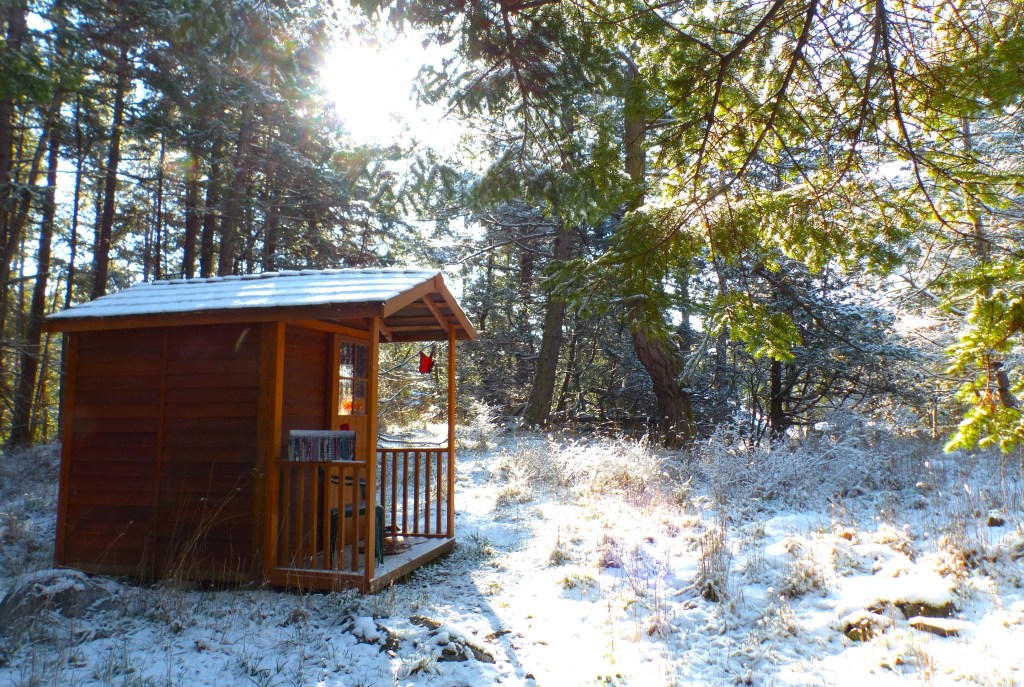
My writing hut, Wee Nooke, is a cozy retreat among the snow.
It was a good week here, with a four-day visit by daughter Lillian, who brought her cat, Tiberius, along for the first time. Galley growled at the feline interloper, and Tibbers spent a lot of time hiding under a bed in the loft. But by visit’s end there was a tolerant sheathing of claws. If only the Russians could follow their example.
Tomorrow, Galley and I head across the water to visit Friday Harbor friends for another session of planning our upcoming Alaska voyage, and to meet another crew member. Take heart. More sunshine is in the forecast, and March is coming soon.
The doughnut-shaped part that needed replacing sits atop my tool box in the cargo area of my golf cart, Mr. Toad. As always with a DIY repair, kitty supervision was key.
FEW THINGS ARE MORE SATISFYING than repairing something yourself, especially when you live on a remote island with no Mr. Fix-It shops just down the road.
It’s especially satisfying when you’re fixing something about which you know very little, such as my golf cart, Mr. Toad. And the fix works.
I’ve never been a golfer. Until a couple years ago, when Barbara needed more help getting around, I never had reason to own a golf cart, though the electric-powered flivvers are the preferred method of personal locomotion on Center Island, where covenants prohibit personal vehicles powered by internal combustion.
I still prefer to walk (the only way you get to see the Golden-Crowned Kinglets mobbing trees along the airfield), or ride my bike, which I do for exercise when the weather is nice. But my golf cart, which dates to the Clinton Administration and is named for the speed-happy amphibian of “Wind in the Willows,” comes in handy when it’s time to lug trash to the dock or transport groceries back to the cabin.
After buying Mr. Toad in summer 2020, my first big fix came last fall, replacing the bank of six 6-volt deep-cycle batteries, which cost almost as much as I paid for the whole darn buggy. But the new batteries gave me the needed oomph to get up hills again.
Then all was fine until recently, when a new problem became apparent. Instead of accelerating slowly and smoothly, Mr. Toad began hopping in short bursts. No matter how carefully I trod the accelerator, either it wanted to sit still or go full-tilt, which seemed perfectly fitting for its fictional namesake who was imprisoned for his reckless driving. But it didn’t make for a relaxing ride to the clubhouse.
I can occasionally be clever with tools (see “A tool chest full of memories on Father’s Day,” June 2019). After taking a community college class in marine-diesel repair years ago, I never had to pay for someone else to repair my sailboat engine. But I knew bupkis about what made golf carts go, other than the batteries.
Here’s where the internet earned its keep, which is a big admission coming from me, Mr. Luddite 2022. I asked Google, “Why is my golf cart going herky jerky?” Within minutes I was watching a YouTube video in which a well-fed, jovial little man in Texas told me all about my E-Z-GO golf cart’s inductive throttle sensor and showed me how to change it.
From online research, I found other possible fixes, including a part that cost $400. But the inductive throttle sensor could be had for $23.99 on Amazon. I always like to start with the cheapest likely fix and go from there. I hit the order button. The part would arrive in six days.
The Chinese-made part was sold by a company that inexplicably calls itself 10LOL. That’s the numeral “10,” followed by the letters “LOL.” I wonder where some of these Chinese companies get their names, and who is advising them. Don’t they know that in the U.S.A., “LOL” stands for “laughing out loud”? Maybe the Omaha-based marketing consultant who helped them pick that name is laughing all the way to the bank.
The new part looked just like the old one: a doughnut-shaped piece of hardened black plastic, about two inches high, topping a small platform with a couple of electrical hookups. It didn’t look like anything that should make a difference to how my golf cart accelerated, but it did the trick for that well-tummied Texan. I said a Hail Gary (most fix-it guys on YouTube are named Gary) and proceeded.
Happily, the part came with detailed, illustrated instructions that showed every step needed to make the replacement in my model of golf cart. Even though it involved time-consuming removal of a lot of bolts to access the part, which hid in a little box beneath the floor mat, I was done in an hour.
I took Mr. Toad for a test drive. The acceleration is once again as smooth as a frog pond on a sultry August afternoon.
Boaters wave as they churn past my lunch spot on the cliffs at Lopez Island’s Shark Reef Sanctuary on Saturday.
A BIG PART OF MY ISLAND ADVENTURE and this ride you’ve all been on with me is how I’m adjusting to being here without my beloved wife of 41 years, whose corporeal life ended in the front room of Nuthatch cabin in the wee hours of last April Fool’s Day.
I’ve tried not to dwell on my grief too frequently in these lines, but it’s like the 800-pound mortician in the room.
I’m not a fan of solitary living, but I’ve come to realize that the quiet months I’ve had here, with few physical or emotional demands other than playing with my silly cat, have helped me start to come to terms with my wife’s death. It’s not a matter of healing from the devastation of Barbara’s loss. I’ll always feel that. But along with generous support from friends and loved ones, this quiet and lovely little island has allowed me to renew my energy to cope.
This past Thursday, February 10, was Barbara’s birthday. It was a rough week for daughter Lillian and me. Others who’ve lost life partners had warned me early on of the brutal challenge of “firsts” — first Thanksgiving without her, first Christmas without her, and so on. So, as we did with those holidays, Lil and I planned a special observance that would temper the sadness. Last Sunday, a few days in advance of her actual birthdate, we spent a day together that Barbara would have loved, experiencing some of the best of Seattle.
My daughter and I met at the new Northgate station and took light rail downtown. We grabbed coffees and enjoyed a long amble along the waterfront to the Seattle Art Museum’s sculpture park. After retracing our steps and exploring shops along the way, we lunched at Ivar’s Fish Bar. Barbara, whom I believe now has influence on these things, gave us a pristine, springlike day, so we sat at an outdoor table in the sun, watched ferries come and go, and fed french fries to the gulls. (It’s a longtime Seattle tradition, sanctioned by Ivar Haglund himself. No gulls were grievously harmed in the writing of this blog.)
After lunch, we ventured up the hill to the main galleries of Seattle Art Museum and toured a special exhibition of work by Imogen Cunningham, one of Barbara’s favorite photographers. Afterward, we snacked on luscious cannoli at DeLaurenti’s in the Pike Place Market.
It was a good day in honor of Barbara. However, come Thursday, as I was back on Center Island, her actual birthday weighed on me. Along with the approaching one-year anniversary of losing her good company, these particular firsts are forcing me to put aside denial. With melancholy reluctance, I’m fully recognizing this loss is forever.
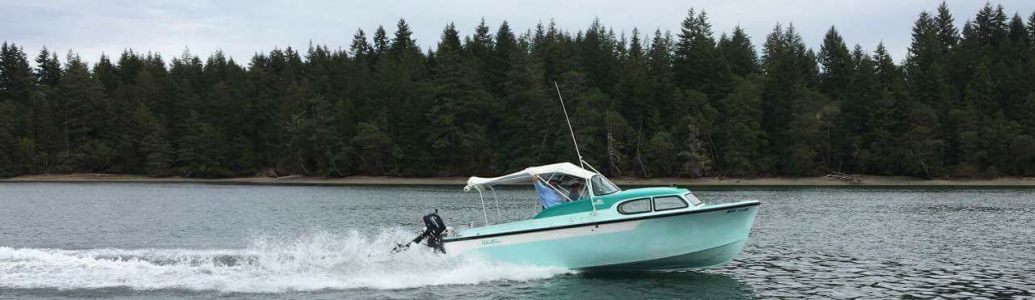
Friday, I finally got my boat, WeLike, back in the water after it had sat on its trailer since November, waiting out thrashing winter winds. Yesterday, with more sunshine to brighten my outlook, I motored over to Lopez Island. As a reward for starting on the first crank, Ranger Rick, my loyal Ford pickup, got a wipedown to remove accumulated bird droppings, and we toured the island. I sipped a strong brew and read my newest Dana Stabenow book on the deck at Isabel’s Espresso. Got a few groceries from the market. Then steered toward the trailhead at Shark Reef Sanctuary, the best place I know for restoring peace to the soul.
A sailboat ghosts past the Cattle Point Lighthouse on the southern tip of San Juan Island, as seen from Shark Reef Sanctuary.
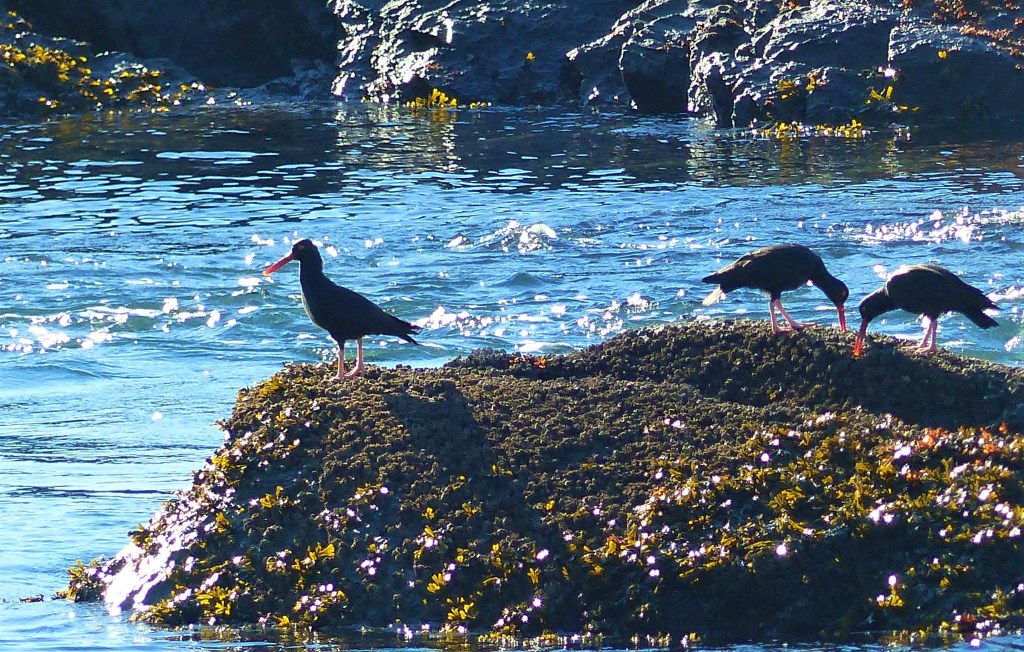
I had the mossy cliffs edging San Juan Channel all to myself, looking down at the rocky, kelp-pantalooned islets just offshore where sea lions and shorebirds abound. I munched a sack lunch and scanned the panorama, from sun-dappled swirling currents below Cattle Point Lighthouse, across the way on San Juan Island, to the snow-blanketed Olympic Range to the south, beyond the sprawling Strait of Juan de Fuca. I listened to an alto chorus of Black Oystercatchers gossip and squabble on the rocks. I waved to a passing powerboat, churning slowly against the tidal change. I let the peace seep in.
Black Oystercatchers love the kelp-carpeted rocks at Shark Reef.
Most days I smile, some days I weep. But I’m not despairing. Barbara wouldn’t want that. As long as I need to, I’ll take one day at a time. And this salty, soothing, serene place helps me recharge.
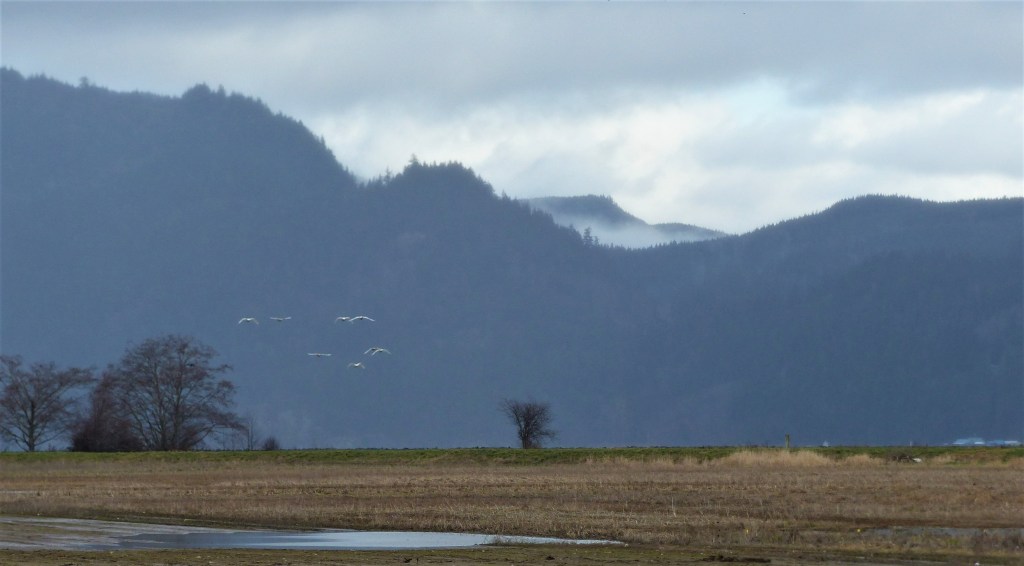
Swans flap over the Samish Flats in the northern Skagit Valley as mists shroud the Chuckanut Mountains and Cascade foothills.
‘WOO HOO!’CAME THE ASTONISHED CRY from everyone in our band of birders as a low-flying flock of Dunlin flash-mobbed us earlier this week on Fir Island.
“Flash mob” is a perfect metaphor for a flock of these medium-sized, long-beaked shorebirds that typically fly at high-speed in cigar-shaped formations. Mystically coordinating pell-mell flight in perfect unison, as they change direction their white breasts can glint as brightly as a lighthouse beam shining across the surrounding marshes and saltwater flats. Thus the “flash.”
In this case, scores of Dunlin strafed our winter-swaddled group of 10, zooming just a few feet above our beanies.
“I’ve never had that happen before!” exulted Woody Wheeler, Seattle-area birder extraordinaire, who was acting as our informal guide for the day. He was among a group I accompanied on a day of winter birding around the Skagit Valley. Some were new friends, others old pals I’d not seen in a few years.
Our day alternated between moody mists shrouding the Cascade foothills, blueberry sky and bright sun, drenching showers and pelting hail. We saw dozens of Bald Eagles, thousands of Snow Geese, entire orchestras of Trumpeter Swans. It was February birding in the magic Skagit.
Snow Geese, unworried the day after hunting season ended, carpet the Samish Flats.
Woody is a natural guide, offering nuggets of knowledge to chew on, even in the face of frigid winds. Starting our day on the Samish Flats, as we looked out at a fallow field where 50 or so Trumpeters waddled he offered this food for thought.
“We are looking at what was equal to the entire American population of Trumpeters in the mid-1930s,” he told us. “That’s right, the population had dwindled that much. Who knows why?”
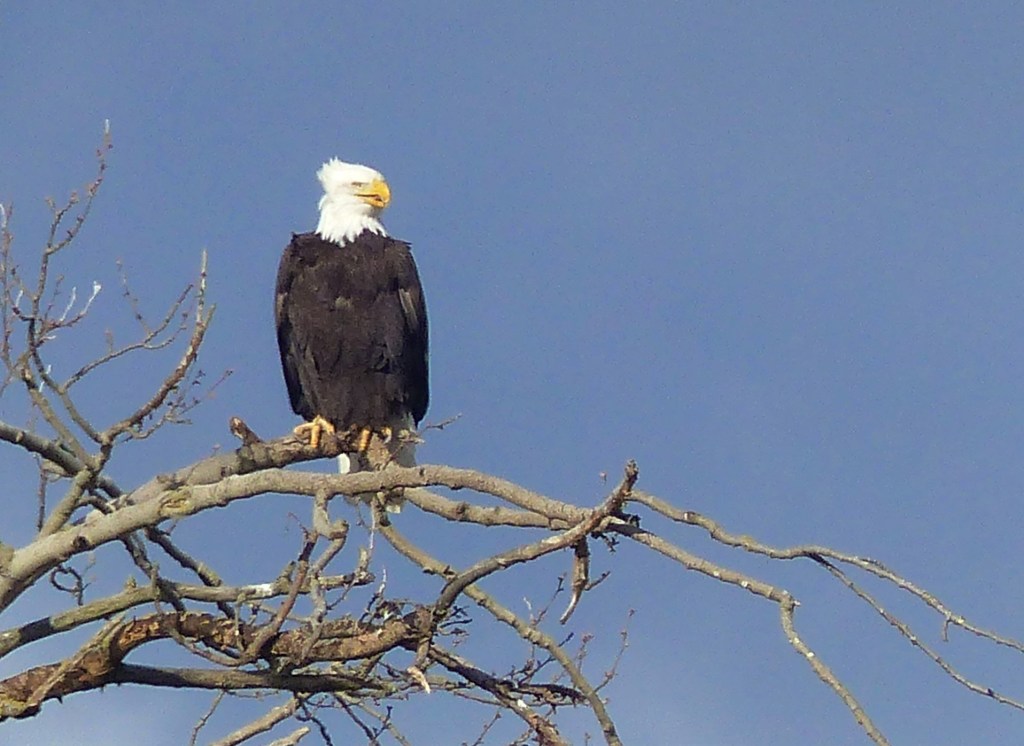
From the Skagit Valley’s “Eagle Tree,” a Bald Eagle seems to smile for the camera.
Lead shot, from shotguns, several of us guessed. (Nope, that’s a more modern problem.) Oh, I know, feathers for women’s hats in the 1920s, someone else suggested. (Good guess, but wrong.)
In fact, the overhunting of swans had started in the 18th century, when swan quills were prized as writing implements. “In fact, our Declaration of Independence was probably written with a swan quill,” Woody suggested.*
The Skagit is a winter birder’s paradise. Our spotting started with a Merlin on a treetop as we met up outside Breadfarm bakery in Edison. On the Samish Flats, we saw a dozen eagles and a giant nest in what’s locally known as the Eagle Tree, and a Rough-Legged Hawk.
To quickly identify a “Roughie,” as they’re commonly known, Woody advised to look for the head that is like “a Styrofoam ball with a beak.”
“That light-colored head is a giveaway,” he noted. “Like Marilyn Monroe,” someone else chirped.
Woody smiled. “And to continue the Marilyn theme, look for the mascara!” A dark eye-ring finishes in a swooping arc toward the back of the bird’s head.
Christi Norman, left, and Hilary Hilscher, next to her, created the Great Washington State Birding Trail for Audubon Washington. They still enjoy visiting sites they mapped 20 years ago.
A few moments later, another Roughie hovered in place above a stand of cattails. “Look, he’s kiting, he’s kiting!” Woody called. With short, quick wing flaps, it hung in the air as if gravity had been turned off, peering down for possible prey.
Cries of excitement rippled through our little crowd every time our car caravan pulled off the side of the road or into another Fish and Wildlife site.
“There’s a harrier!” Woody called, as a big hawk with an owl-like face soared above us. “A marsh hawk!” exclaimed my friend Hilary Hilscher, using the bird’s common name. Hilary was one of two former Audubon Washington employees who together drove all over the state to formulate the Great Washington State Birding Trail, created 20 years ago as a guide to the state’s best birding sites. Her cohort, Christi Norman, was also along with us this day.
At the West 90 site managed by Fish and Wildlife, we saw a field white with thousands of snow geese, filling the chill air with a cacophony of honks and hoots. “They weren’t hanging out here a few days ago, there were hunters,” Woody told us. Our day out was the first day after waterfowl-hunting season ended. “They know!”
During a lunch stop in a picnic shelter at Bay View State Park, Woody’s binoculars spotted goldeneyes, buffleheads and black brant swimming on Padilla Bay. Our final stop of the day, at the Hayton Reserve on Fir Island, in the Skagit River estuary, we saw some male Green-Winged Teal, North America’s smallest dabbling duck, their natty cinnamon-colored heads accented with a swoop of iridescent green around the eye. Also Wigeons, Northern Pintails, and all those Dunlin. And where marshlands are so rich in prey, there are raptors. In treetops and atop stumps, we saw roosting Bald Eagles, a Peregrine Falcon, another harrier and a Red-Tailed Hawk.
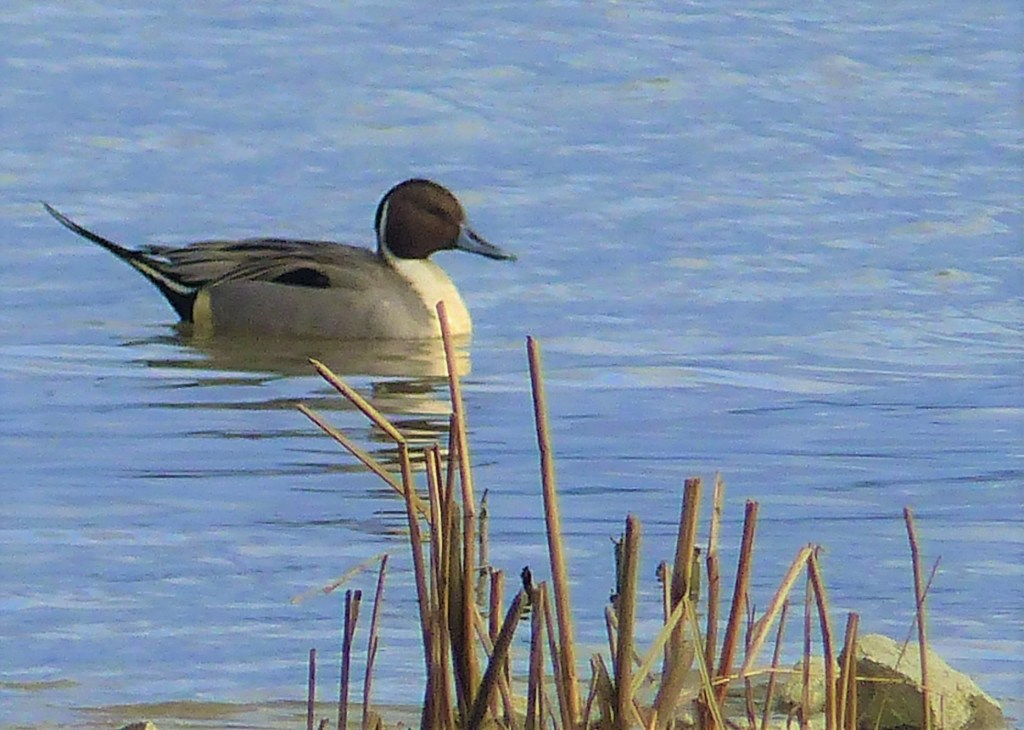
A Northern Pintail swims the marshy waters at Skagit Wildlife Area’s Hayton Reserve on Fir Island.
“In fact, there’s three eagles in a row — an eagle candleabra!” one wag noted.
In the meantime, angry gray clouds had blotted out the blue sky and billowed up against the nearby foothills. As hail started to pelt us, we swooped back to our cars. With the precision of a flock of Dunlin, you might say.
*See Woody Wheeler’s “Conservation Catalyst” blog for more stories of recovered bird species you might see in the Skagit Valley.








 Cantwell's Reef