Into the social whirl (with a tale of ‘Nudes and Prudes’)

Blooming daffodils paint the valley floor east of Best Road in the Skagit Valley. The golden blooms are peaking this week.

FROM LONELY CATERPILLAR TO SOCIAL BUTTERFLY, that’s me this month.

With just me and the cat and not a lot of neighbors around, I’m sharply aware of the necessity of scheduling off-island time in the off-season. Dear Barbara was happy to be a hermit. I’m more of a social animal. On a small island nobody’s heard of, it’s a challenge.

Due to a variety of circumstances, some recent plans got postponed (Galley Cat had a bad cold, then my daughter had a bad cold, etc.) Now, several social occasions and road trips have become stacked on top of one another. Not complaining, but I’m flapping as fast as I can.

Dave and Jill Kern on the dock at Joemma Beach State Park, on South Puget Sound’s Key Peninsula.

It started with me and Galley road tripping through daffodil fields of the Skagit Valley last Thursday on our way to the Kitsap Peninsula. We spent three days there at the end of last week with Dave and Jill Kern, old friends from my days at The Columbian newspaper in Vancouver, Wash. From their home near Port Orchard, my hosts and I had a fun road trip exploring the nearby Key Peninsula, a remote backwater that is home to communities such as Home (yes, that’s the town name), a tiny burg on a shallow bay of South Puget Sound.

Today, Home is a quiet assemblage of pleasant waterfront domiciles, but it was founded in 1895 as a utopian community for free-thinkers, anarchists, nudists and adherents of free love. The community’s founders chose the remote location, hidden from the rest of the world, for a reason. But after a self-proclaimed anarchist assassinated President William McKinley in 1901, the Home anarchists drew the ire of self-styled patriots in nearby Tacoma who almost descended on the community with pitchforks and torches. (Home was spared only because a steamboat operator refused to transport the vigilantes). As years went by, fractures grew within the community, with Home residents staking out various moral grounds, leading to factions being labeled “Nudes and Prudes.” (Read the Wikipedia entry, it’s a hoot.)

Dave and Jill had no idea of the colorful history just down the road from them. I had fun sharing the story that I had learned from an earlier sailing adventure in the area.

Galley and I returned to the Nuthatch on Saturday evening, and I was up and about early the next morning to hop aboard WeLike for a trip to Lopez Island. I was invited to brunch with friends Lynn Thompson and David Foutch at their holiday home overlooking Outer Bay on the southern tip of Lopez. Besides gorging with my friends on tasty pastries and muffins from Holly B’s Bakery and Barn Owl Bakery, along with fruit salad, flagons of good coffee, and Lynn’s tasty quiche with goat cheese, I got to meet new friends Ande and Scott Finley, Lopezians who are active with Transition Lopez Island, a coalition of locals working toward a regenerative, resilient future. The conversation was lively. They told me about vacationing in their electric car. I told them about my Center Island neighbor who is building an electric-powered, carbon-fiber hydrofoil catamaran.

Lopez friends and Eddy the Springer Spaniel pause at Lopez Island’s Iceberg Point monument commemorating the Treaty of 1908, which finalized the boundary between the United States and Canada.

On a hike around nearby Iceberg Point we saw wood ducks, harbor seals and the season’s first wildflowers.

This coming Saturday Galley and I hit the road again for three nights in Vancouver/Portland to visit more friends and have a reunion with my brother Tom, whose 10-week cabin-sitting experience for me last summer helped convince him to return from Arizona to the Northwest. I’m having breakfast with him in his new Portland digs on Sunday. Dinner with friends that night. A day of walks and exploring with another friend on Monday.

Whew. This butterfly’s wings are getting a workout. After a quiet winter in my island cocoon, it’s a good thing.

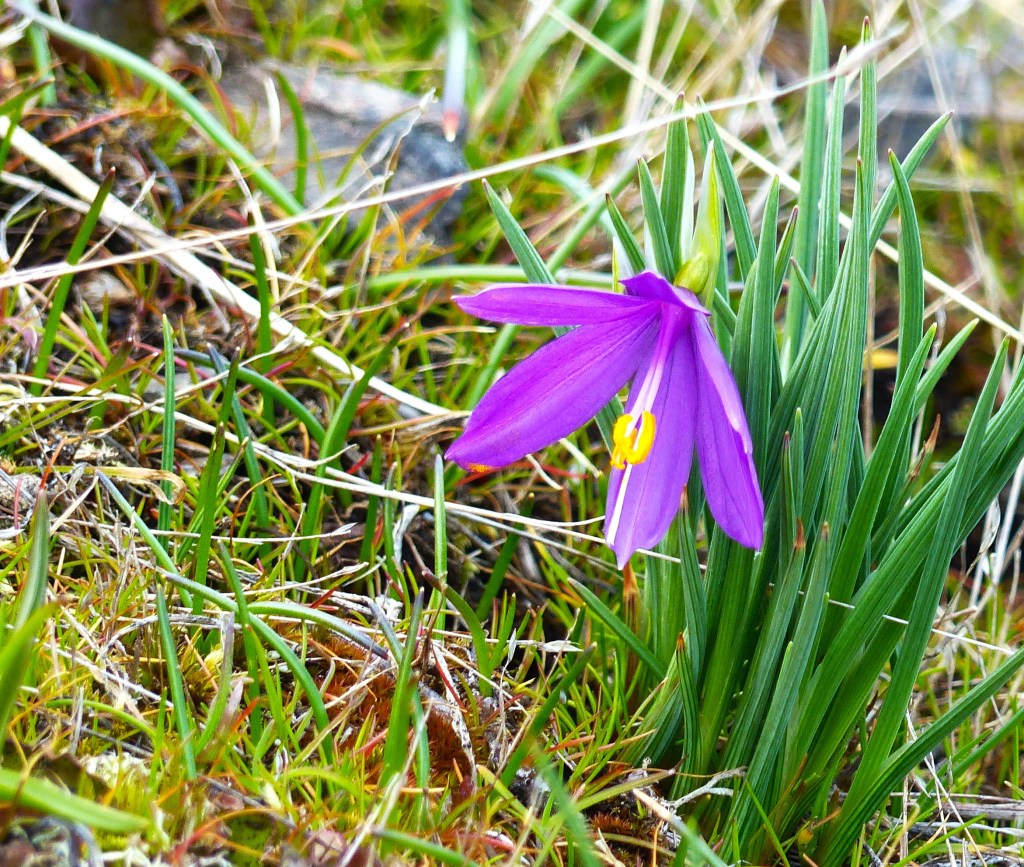
A satin flower, Olysynium douglasii, was among the first blooming wildflowers on Iceberg Point on Sunday.

Glorying in a few days of spring

Sailboats sit at moorings on Fisherman’s Bay, just off Lopez Village, as seen from my lunch spot.

THE OFFICIAL, FARMER’S ALMANAC-SANCTIONED spring equinox might not be until 2:24 p.m. PDT Monday. But spring arrived today in the San Juan Islands.

Hallelujah.

The sky was clear, the seas were calm, the thermometer pushed 60 degrees, and Center Island’s docks were nearly full. All over my island people were outside hammering, hoeing, washing down and tidying up — doing all the celebratory puttering that comes with the end of a long winter.

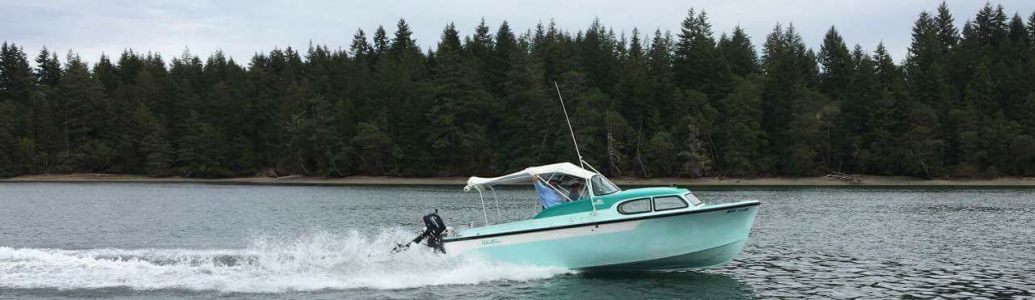
I celebrated a few days early by relaunching my 1957 runabout, WeLike, on Thursday. It had sat forlornly on a trailer since November. Doing my part as a spring-inspired islander, I checked over the boat’s electrical system, added fresh fuel, drained the water strainer, ran the bilge pump and gave the boat a good scrub.

Then I buzzed over to Lopez Island yesterday for a blissful day of normal stuff you do when it’s not winter.

At Isabel’s Espresso, I sat outside on the deck and read a book while I sipped a good coffee. I stopped in at the supermarket for fresh produce. I took a sack lunch and strolled out to a favorite bench at Fisherman Bay Spit, where rogue daffodils were starting to bloom in the pasture of a long-deserted farmstead. I ducked into the public library and checked out a real book. What a delight! One gets overly reliant on Kindle when you live on a remote island.

Galley Cat, too, is reveling in the warmer days, gamboling up and down the rocky knoll. Returning inside today after an hour out inspecting the grounds, she smelled all sun-washed and fresh, like linen sheets that had dried on a clothesline.

It’s supposed to rain on Monday, the Weather Service says. But for a few days, we got a jump on the season of renewal, in all its glory. Hallelujah.

Practicing catch-and-release with my cabin’s chimney. (Sheesh)

A Dark-eyed Junco like this explored my chimney and woodstove this morning.

ALL’S WELL THAT ENDS WELL, Will S. wrote, and as I breathed a sigh of relief this morning I decided he was right.

But this is definitely the year I replace my chimney.

Being Daylight Savings Sunday, I was lolling in bed reading John Grisham and finishing my coffee and avocado toast at what some might call a late-ish hour of the morning. But I had that “spring ahead,” lose-an-hour-of-sleep excuse for lolling.

That’s when I heard the skittering.

For a moment I tried to convince myself it was a Nuthatch — the bird for which my cabin is named — outside messing about in my metal roof’s gutter, as they often do. Getting a sip of water, perhaps; the drainage isn’t all that great.

But then I heard it again: a sound like fingernails lightly brushing metal, and it wasn’t coming from outside. I recognized that sound.

Damn.

I had another bird down my chimney.

Loyal Reefers might recall a couple Novembers ago when this happened before. That time, I got paranoid about what was in my chimney, imagining anything from a hapless bird to a squirrel or raccoon (or, as several merciless readers suggested, a skunk).

At that time, try as I might I couldn’t figure out how to open up the chimney and release the creature, which had fallen into the lowest reaches of the woodstove’s metal flue, the eight feet or so that connect the stove with the cabin ceiling. The chimney has a conical cap up top and I expect it was screened when it was new, but the screen has probably disintegrated with rust and heat over the years. Rising high above my rooftop, it’s not easily inspected.

Unable to catch-and-release that first time round, I went with Undesirable Choice No. 2: Refrain from building a fire and let nature, uh, take its course. It was several days before the skittering stopped.

Eventually I discovered a way to remove the fire bricks at the top of the woodstove and was able to remove the poor dead sparrow.

As I lolled in the loft this morning, I resigned myself to another unpleasant days-long “death watch.”

But then I realized: Now I know how to open up the stove from inside. I could try to get the bird out. If I could free it from the chimney, maybe I could capture it in a large trash bag and set it free outside, hopeful that it wouldn’t be caked with soot and creosote. I had to try.

Meanwhile, Galley Cat, who usually snoozes the morning away on her heated cat bed downstairs, had come up to the loft to see me. Vocal and wide-eyed, she was clearly trying to tell me something.

Descending the stairs and crossing the living room, I saw what she was trying to communicate: “Pops!” (she calls me “Pops”)… “Pops, there’s a birdie in the woodstove, you can see it in there!”

Sure enough, this bird was no longer caught in the chimney, it had squeezed its way down past the firebricks and made it into the stove’s main chamber. There it was, clearly visible, fluttering behind the glass: a very unhappy Dark-eyed Junco. For goodness’ sake.

OK, Rescue One, suit up and respond to an avian distress call at 1366 Chinook Way.

Adrenaline flowing, I grabbed a trash bag from the pantry. Plopped the feline in the bathroom, behind a closed door. (She was certain she could help. I demurred.) I hoped to bag the victim as I cracked open the stove door, but in case it got past me I opened wide the glass slider and a side door.

Happily, the Junco wasn’t caked with creosote. It remained perfectly mobile, which it proved the moment the door was cracked. Despite my best efforts with the trash bag, I had a Junco flying around my living room.

Unfortunately, it didn’t find the open doors. It bumped against one of the big front windows, then flew through the kitchen and thumped against a window by the sink, where it decided to stay and flutter about.

Now, I have to say this for that bird. Whether or not it knew I was trying to help, it did me one huge favor. Anybody who has heard the sad tale of the duck that got into our sailboat’s V-berth, which ended with a very long afternoon at the laundromat getting our bedding de-ducked, will know these things can end badly. I’ll just say it bluntly: No matter how frightened it may have been, the Junco did not shit inside my house. Thank you. Were the roles reversed and a giant songbird was chasing me with a trash bag the size of Mount Constitution, I can’t promise I’d have been so reserved.

Anyway, I sidled over to the kitchen with my trash bag opened wide. The bird tried to take cover in a potted plant sitting behind the sink, but I swooped and scooped.

As first, I didn’t think I’d caught it. Songbirds don’t weigh much, and under the feathers there’s not a lot of bulk. I very lightly gripped the bag closed while I searched around the plant and among the dishbrushes. My home invader wasn’t there. So I carefully peeked into the plastic bag cradled in my fist and saw a pair of fragile bird feet sticking out. It wasn’t struggling, perhaps just resigned to its fate.

Keeping my grip loose, I quickly strode out onto the deck, put the bag down and opened it wide. The Junco flew away, and I don’t think it stopped until it hit Lopez Island.

All’s well that ends well. But, sheesh, it’s time to get a chimney with a screen.

Fleeing my rock for the City of Subdued Excitement

Sailboats scoot across Bellingham Bay.

SOMETIMES A MAN JUST HAS TO GET OFF HIS ROCK.

When I flee the seemingly endless winter on Center Island and seek a place with more live humans, I guess you might call me an “off-my-rocker.” Kind of goes along with living in a cabin called the Nuthatch.

Anyway — forging prosaically on — when I need to get away and have just a day, I like to go to Bellingham.

This week I decided a necessary grocery-shopping trip would be a good opportunity for a northward pilgrimage to the City of Subdued Excitement, as Bellinghamsters like to call their town.

OK, I mean, right there — not only does the place have a great self-deprecatory, tongue-in-cheek slogan, but residents go by a name that conjures a vision of a town full of anthropomorphized rodents driving around in little cars. I appreciate a community with a sense of humor.

They also have almost as many craft breweries and brew pubs as Bend, Ore., which everyone knows adds significantly to the quality of life.

When my family returned from a 1990s sailing trip to Mexico after two years of being off the grid careerwise, Barbara and I realized we could start afresh wherever we chose. We hoped to make a go of it in Bellingham, a congenial college town on a beautiful bay, a half-day’s sail from the San Juans and practically in the shadow of Mount Baker and its razzle-dazzle ski area.

Unfortunately, it didn’t work out. Newspapering was my life, and I did get hired and worked for one day at the local daily, the Bellingham Herald. But I was young, a bit cantankerous, and just returning from the freedom of the wild seas. That first day on the job, after I’d expressed enough disagreements with the corporate policies of the Herald’s parent company, Gannett, one of America’s worst newspaper chains, the newspaper’s H.R. director and I mutually agreed that it just wasn’t a match made in heaven. So my family sailed south into Puget Sound and I ended up at The Seattle Times. A happy ending, as it turned out.

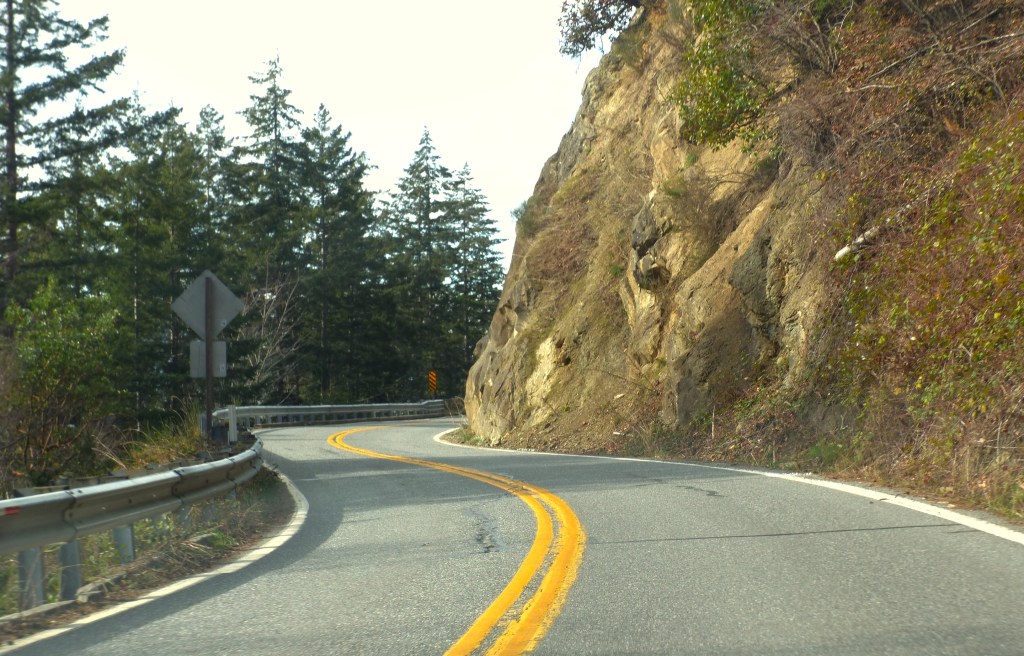
From a viewpoint along Chuckanut Drive, the road to Bellingham offers panoramas of islands and saltwater in a varied palette of blues.
Chuckanut Drive curves

But I’ve always enjoyed visiting Bellingham, about which I wrote numerous travel stories for the Times. These days I like going even if only for a quick trip to the sole Trader Joe’s in Northwest Washington. From the water-taxi dock in Anacortes, it’s an easy hour’s drive.

I got a pleasant sunny day for this trip, and I found time to get off Interstate 5 and chug northward on scenic and serpentine Chuckanut Drive, the original northbound road that skirts the base of the Chuckanut Mountains, a foothill spur that geologists say is the only place the Cascade range meets the sea. It adds only about 15 minutes to the trip, but it’s a superb quarter hour. Starting from the Samish Flats, where I saw a fluttering flurry of snow geese, my red Civic snaked along boulder-strewn cliffs, passed chattering waterfalls and skirted moody panoramas of islands and saltwater.

An overwater boardwalk is part of the waterfront trail crossing Bellingham’s Boulevard Park.

Reaching town, I navigated the old-town Fairhaven district and pulled off at Boulevard Park. A narrow strip of land between the bay and the main north-south railroad tracks, the park offers shoreside benches, picnic tables, a kids’ playground and a waterfront path and overwater boardwalk that stretches miles into downtown. It’s my chosen stop when I pack a lunch. On breezy days, I’ve watched kiteboarders fly high out in the bay. The park even has a good, locally run coffee shop. Very civilized.

After lunch, my day was devoted to grocery shopping. But if you’re there with more time, Bellingham has a bunch of fine museums, dedicated to history, art, and even electricity (the eyepopping Spark Museum); a distinctively spired performing arts center (the 96-year-old Mount Baker Theatre); a variety of pleasant walking trails (such as a waterfront amble on Lake Whatcom), and the aforementioned breweries.

The excitement, though tastefully subdued, is earned.

Source: Google Maps