Into the social whirl (with a tale of ‘Nudes and Prudes’)

Blooming daffodils paint the valley floor east of Best Road in the Skagit Valley. The golden blooms are peaking this week.

FROM LONELY CATERPILLAR TO SOCIAL BUTTERFLY, that’s me this month.

With just me and the cat and not a lot of neighbors around, I’m sharply aware of the necessity of scheduling off-island time in the off-season. Dear Barbara was happy to be a hermit. I’m more of a social animal. On a small island nobody’s heard of, it’s a challenge.

Due to a variety of circumstances, some recent plans got postponed (Galley Cat had a bad cold, then my daughter had a bad cold, etc.) Now, several social occasions and road trips have become stacked on top of one another. Not complaining, but I’m flapping as fast as I can.

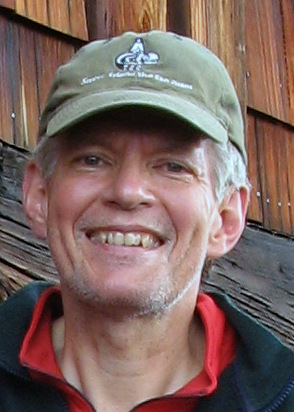
Dave and Jill Kern on the dock at Joemma Beach State Park, on South Puget Sound’s Key Peninsula.

It started with me and Galley road tripping through daffodil fields of the Skagit Valley last Thursday on our way to the Kitsap Peninsula. We spent three days there at the end of last week with Dave and Jill Kern, old friends from my days at The Columbian newspaper in Vancouver, Wash. From their home near Port Orchard, my hosts and I had a fun road trip exploring the nearby Key Peninsula, a remote backwater that is home to communities such as Home (yes, that’s the town name), a tiny burg on a shallow bay of South Puget Sound.

Today, Home is a quiet assemblage of pleasant waterfront domiciles, but it was founded in 1895 as a utopian community for free-thinkers, anarchists, nudists and adherents of free love. The community’s founders chose the remote location, hidden from the rest of the world, for a reason. But after a self-proclaimed anarchist assassinated President William McKinley in 1901, the Home anarchists drew the ire of self-styled patriots in nearby Tacoma who almost descended on the community with pitchforks and torches. (Home was spared only because a steamboat operator refused to transport the vigilantes). As years went by, fractures grew within the community, with Home residents staking out various moral grounds, leading to factions being labeled “Nudes and Prudes.” (Read the Wikipedia entry, it’s a hoot.)

Dave and Jill had no idea of the colorful history just down the road from them. I had fun sharing the story that I had learned from an earlier sailing adventure in the area.

Galley and I returned to the Nuthatch on Saturday evening, and I was up and about early the next morning to hop aboard WeLike for a trip to Lopez Island. I was invited to brunch with friends Lynn Thompson and David Foutch at their holiday home overlooking Outer Bay on the southern tip of Lopez. Besides gorging with my friends on tasty pastries and muffins from Holly B’s Bakery and Barn Owl Bakery, along with fruit salad, flagons of good coffee, and Lynn’s tasty quiche with goat cheese, I got to meet new friends Ande and Scott Finley, Lopezians who are active with Transition Lopez Island, a coalition of locals working toward a regenerative, resilient future. The conversation was lively. They told me about vacationing in their electric car. I told them about my Center Island neighbor who is building an electric-powered, carbon-fiber hydrofoil catamaran.

Lopez friends and Eddy the Springer Spaniel pause at Lopez Island’s Iceberg Point monument commemorating the Treaty of 1908, which finalized the boundary between the United States and Canada.

On a hike around nearby Iceberg Point we saw wood ducks, harbor seals and the season’s first wildflowers.

This coming Saturday Galley and I hit the road again for three nights in Vancouver/Portland to visit more friends and have a reunion with my brother Tom, whose 10-week cabin-sitting experience for me last summer helped convince him to return from Arizona to the Northwest. I’m having breakfast with him in his new Portland digs on Sunday. Dinner with friends that night. A day of walks and exploring with another friend on Monday.

Whew. This butterfly’s wings are getting a workout. After a quiet winter in my island cocoon, it’s a good thing.

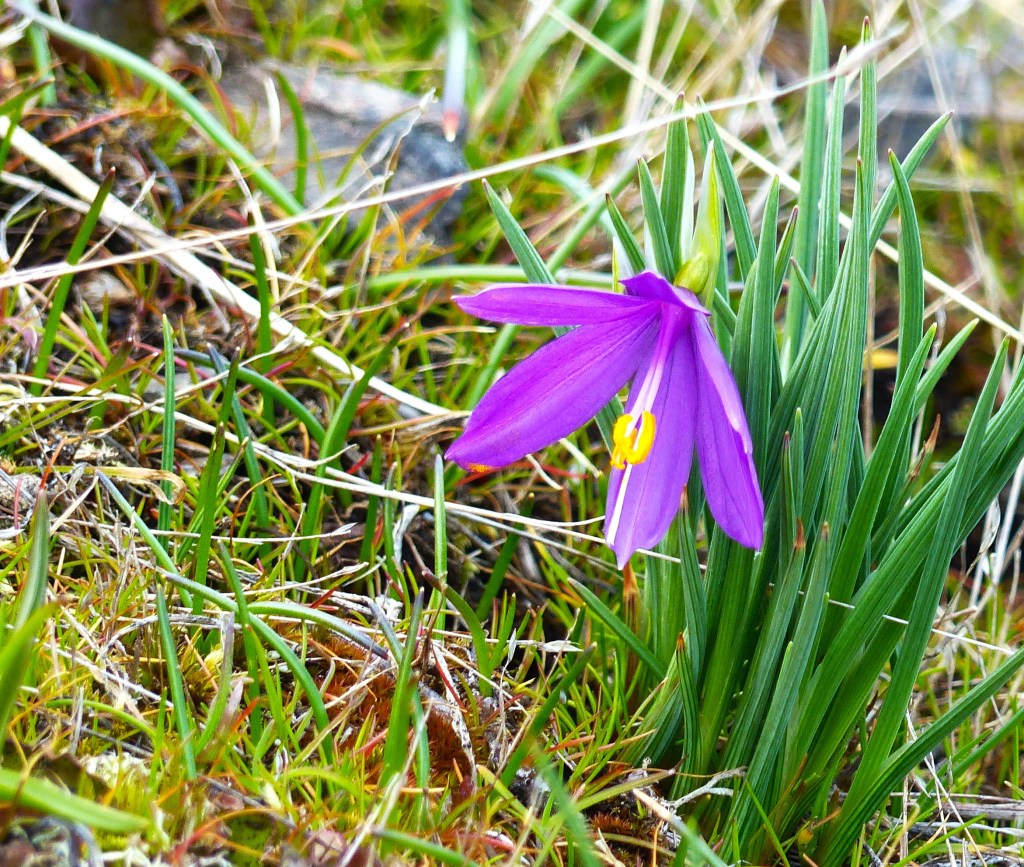
A satin flower, Olysynium douglasii, was among the first blooming wildflowers on Iceberg Point on Sunday.

Febrrrr-uary ends frostily

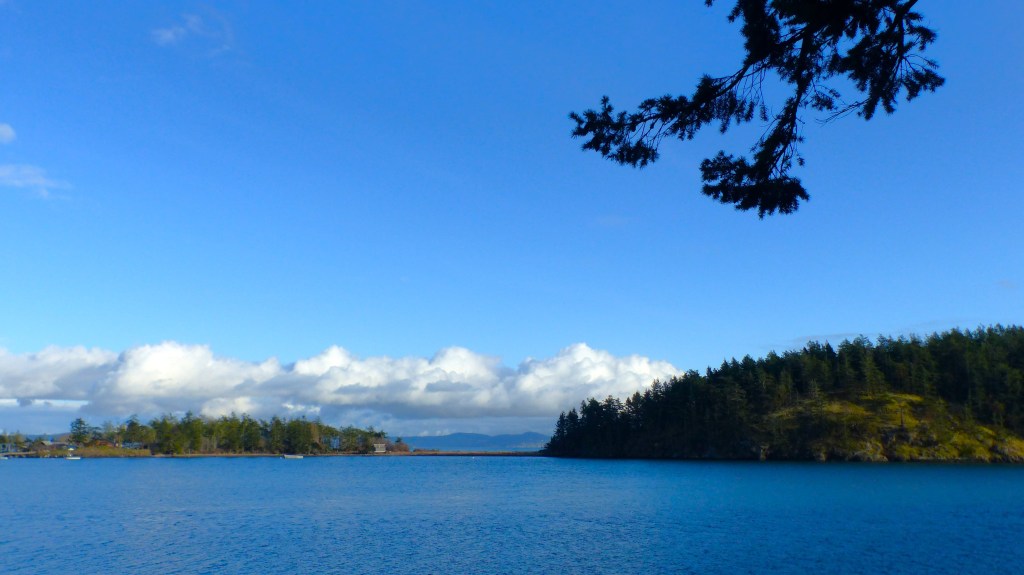
Cottony clouds crowd the Cascades on a recent sunny but cold day. Looking east from Center Island across Decatur Island to Rosario Strait.

DECEMBER TOOK A JAB AT IT, but February has again tussled its way to the title as the San Juan Islands’ winter month with the most unpredictable and weirdest weather.

We’ve had hail (pelting down like a million icy little meteorites on my deck, more than once). We’ve had frigid Fraser Valley gales (combined with big tidal swings that make crossing Rosario Strait to Anacortes a rocking, sloshing, life-challenging adventure, more than once). We’ve had blowing snow, we’ve had frosty nights. And, yes, we’ve also had pristine sunny days, such as today, most of which have never warmed above freezing. And, oh my, the starry nights.

Galley has donned a cunning Argyle sweater against the February cold.

“I’m done with the cold,” the Mad Birder grumped on a recent visit. He moved here from California, which by rights might make him bitter about our February freezes, but today Los Angeles has blizzard warnings, so go figure.

Extreme cold tends to keep us otherwise hardy islanders indoors by blazing fires much of the time. By now, with the month of March parading our direction as if to a John Philip Sousa composition, our feet are decidedly itchy.

I have done a few things other than binge-watch all four seasons of “New Amsterdam” in recent weeks. On a day when the earth wasn’t frozen I finally dug a hole in which to plant the five-foot Charlie Brown fir tree that had been living in a root-bound pot on my deck for many months. Daughter Lillian brought the tree up a couple years ago. It was Nuthatch cabin’s Christmas tree in 2021. When much smaller, it had served as her Christmas tree on the sailboat in 2020, after being dug up on Auntie Sarah’s Camano Island property. So it’s a well-traveled little tree, finally properly planted and surrounded by deer fencing next to the porch of Wee Nooke, my Center Island writing hut.

Wee Nooke’s newly planted tree.

Wee Nooke needed a new tree. We originally erected the 36-square-foot cedar shed in the shade of a sizable shore pine that leaned artfully over its roof until the pine blew down a few winters ago. Had the tree fallen about 10 inches to the left my Nooke would have been transformed from man cave to matchsticks. If the Charlie Brown tree ever gets big and old enough to blow down, I am confident I won’t be around to be squished. Always look on the bright side of life, I say.

I bottled a gallon of beer this week, brewed on the Nuthatch’s stovetop a couple weeks ago with the help of Lillian and partner Chris when they were up for a quick visit. The beer fermented in a jug next to a miniature electric radiator beneath an upturned plastic storage tote behind my bed. I got to drift off to sleep to the comforting “boop-boop” of the jug’s venting gases that told me the yeast was happily working its magic.

Made with a popular strain of pungent, citrus-scented hops called Cashmere, this brew is dubbed Cashmere Blonde. Lillian educated me that cashmere wool comes from Cashmere goats, so I found an image of a wildly-horned, blonde Cashmere goat to go on the bottle label. The ale will be properly bottle-aged in time for me to quaff with Lil and Chris on their next visit, possibly while we brew another batch, in mid-March.

Meanwhile, if robins are harbingers of spring (a highly dubious assumption, I see them here in December) (but I digress)… If robins are harbingers of spring, we should be headed for warmer days. Yesterday I saw about a hundred of the red-breasted harbingers pecking for worms on the grassy field that is Center Island International. So I guess “seeing red” isn’t always a bad thing.

Until spring has sprung, Galley Cat and I send warm thoughts your way.

The latest label from Nuthatch Brewing.

Back on the rock: Paella with pals, and a bittersweet memorial

A bubbling vat of paella on a neighbor’s deck was the lure last week to a Center Island block party, easing my transition back to landlubberly existence.

BACK TO THE REEF, and the rock also known as Center Island.

I needed a writing hiatus for a few weeks after returning from the Alaska adventure. It’s been a period of readjustment to the landlubberly life, and to daily existence shared primarily with Galley Cat, with whom I’ve enjoyed a joyful reunion with many shared runs up and down our rocky knoll.

It took a week or so until I was waking in the morning without the inclination to jump out of my bunk, get coffee water heating on the Force 10 stove and climb down in the hold to complete the morning engine checks so we could weigh anchor.

My past three weeks of land-based confinement has hardly been solitary, though. After a couple of days reuniting with my brother Tom, who was my cabin watcher/cat sitter for 10 weeks, I was invited to lunch on Lopez Island with old friend and Seattle Times colleague Lynn Thompson and her family.

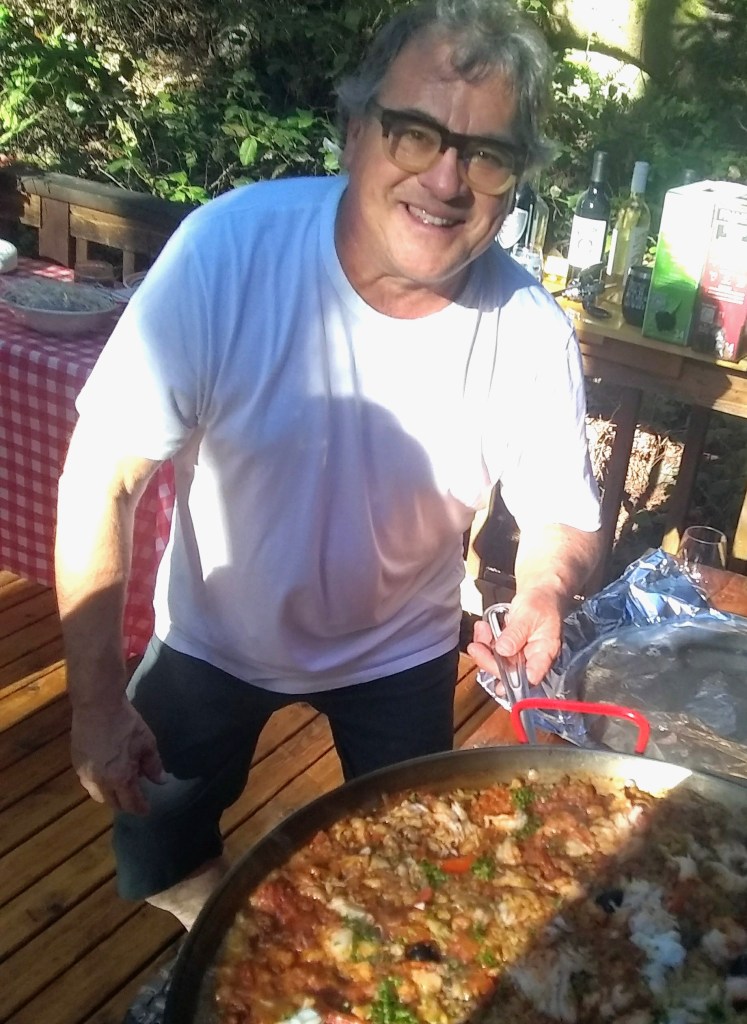
Shortly afterward, The Mad Birder and his wife, Carol, invited me next door with three other neighbors to share a bounty of Dungeness crab, freshly hauled from Lopez Sound. That led to another party two days later after neighbor Steve, a restaurant chef from Nevada, took the crab shells back to his holiday cabin to create a stock from which he whipped up a splendid vat of paella, colorfully aswim with fresh San Juan Channel shrimp, Read’s Bay crab and Center Island Farm vegetables. I was among the dozen or so neighbors who got to partake of that locavore lovefest on a sunset-view deck thanks to Steve and his wife, Dawn, the organizing force behind their family-owned eatery.

Neighbor Steve, the paella king of Center Island.

As cabin-owners come and go on our rock, you never know who will be your next neighbor. Right now, we’re enjoying an amiable mix of compatible friends along our dead-end spur of Chinook Way, the grandiose name of the gravel cow-path winding through our thickets of salal and Nootka rose. Three of us are sailboat owners (four, when you count the neighboring farm). Among others is a family with three energetic boys, ages 5, 7 and 9, who added an element of fun to the block party. The kids’ mom told me they are fans of a YouTube channel called “Outdoor Boys,” and the youngest had recently learned of the edibility of seaweed. So as we prepared to sit down to paella on Steve and Dawn’s deck, this adventurous 5-year-old, expertly wielding a pair of chopsticks, doggedly ate his way through a bowl of some sort of kelp. I like that spirit.

Over good food and drink, we all pondered our island existence. Because our cabins face west overlooking Lopez Sound, with the frequent reward of a sinking sun setting the saltwater sparkling brighter than a Tiffany’s display case, we decided our neighborhood’s new nickname should be “Sunset Strip.” There was serious talk of carving a sign.

A couple days later longtime friends Ken and Kate from Portland joined me for three nights at the Nuthatch, giving me a chance to barbecue, one of the things that makes life worth living (in case you didn’t know). Hickory-smoked vegan burgers with Lebanese spice one night. The next: thick-cut pork chops with a crust of fresh island rosemary, minced garlic and romano cheese, grilled with apple-wood smoke.

All that camaraderie and good food was lovely. But stress and emotion wasn’t absent from my return to the island. On my calendar, these days led up to last Sunday, August 21, when we committed my dear Barbara’s cremated remains to the Salish Sea. It wasn’t an easy day to plan for.

Sucia Island, a 90-minute boat ride to the north, was the location. For some 20 years, my family and I would spend a couple weeks of every August poking around the San Juans in our cozy old Westsail 32 sailboat, Sogni d’Oro. On those sojourns, Sucia Island State Park, near the Canadian border, became perhaps our favorite place in the world. In our wills, Barbara and I both requested that our remains be cast on waters around Sucia.

For a day trip with a dozen family members and friends, I chartered the Paraclete, the water taxi that I routinely use for passage to and from Anacortes. It was a day of good karma; just before arriving at Sucia, we encountered a pod of orca. For my sister-in-law Jane, who spent much of her childhood around the San Juans, this was the first time she finally saw an orca in the wild.

The picnic crowd near Barbara’s bench on Sucia Island. From here you can see far into Canada.

The Sucia visit included a one-mile hike to a new memorial bench honoring Barbara. The bench installation took more than a year to bring to fruition. The effort’s success can largely be credited to the persistent persuasive powers of my friend Daniel Farber, a retired official with Washington State Parks, along with dozens of friends and family who donated to a GoFundMe campaign. The bench’s bronze plaque reads: “For Barbara, who loved this island, from Brian, who always sat beside her.” I’m sorry it doesn’t acknowledge the many others who played a role in the bench’s creation. Barbara and I chose the wording some time ago, paraphrasing a line from a favorite old movie, to be adapted for whomever went first.

The bronze plaque on Barbara’s bench.

Barbara loved to picnic, so we all brought sack lunches and sat on the bench or on the rocky hillside sloping down to the water. Barbara’s sister Julie made a couple loaves worth of sandwiches; ham-and-pickle and chicken salad, according to family tradition. Her brother Mark brought a toothsome potato salad. For the first time in my life, I made deviled eggs, another family favorite.

After lunch, we reboarded the boat and motored a short ways offshore while snacking on chocolate-coated cream puffs, one of Barbara’s favorite desserts, baked by daughter Lillian. We toasted the memory of a dear wife, mother and sister as we scattered her ashes into the sea along with armloads of summer flowers, many provided by our friend Monique from Center Island Farm.

Daughter Lillian tries out the park bench honoring her mum.

It was a bittersweet but wonderful day. A regrettable follow-up: At least three people who made the trip came down with COVID within days. Sigh. Their symptoms are mild, thanks to vaccinations. I’m feeling fine, so far. One way or another, it seems likely that we’ll all catch this stupid bug eventually.

The Mad Birder summed up the day.

“Regardless of the consequences, Sunday was beautiful, and … the bench is soooooo perfect.”

Lillian and I have resolved to revisit that bench every summer. Barbara will be sitting beside us in spirit, I’m certain.

Big island or small, diverse skills make life in paradise possible

Daughter Lillian and her butterflies add to the colorful scene at Akaka Falls on the island of Hawaii.

This post is also available on audio. Listen to my Cantwell’s Reef podcast.

TO MY SMALL ISLAND NOBODY’S HEARD OF, I’ve just returned from nine days on a big island that everybody knows about: the island of Hawaii, home to Kona coffee, sweet papaya, Kealakekua Bay snorkeling, and one of the more active volcanic zones on Earth.

I’ve been to the island before, at least half a dozen times. I try not to consistently label it as “The Big Island,” in deference to locals who disdain that tourism-coined term for their proud and history-steeped island that gave its name to the whole archipelago, its ancient kingdom and, subsequently, the state. (I did enjoy a good snicker, however, at a T-shirt emblazoned with the silhouettes of all the Hawaiian islands and, next to this one, the slogan, “Mine is bigger than yours.”)

Daughter Lillian and I had originally booked this visit for last August as a sort of memorial to my late wife, Barbara, who dearly loved Hawaii. But then COVID’s Delta variant raged. We heeded Hawaii’s governor when he implored tourists to stay home.

Faced with a use-’em-or-lose-’em situation with the air tickets, we committed to late April for a visit that included four nights with my niece, Frances Hartley, and her family. They moved from Tacoma to the charming windward-side community of Honoka’a on Hawaii Island in July 2020, at COVID’s height. A brave couple in their 30s, they bought a home online, sight unseen.

In the subsequent two years, Fran and her husband, Arwain, and their two young children have carved a comfortable niche in the community. Another child is due in August.

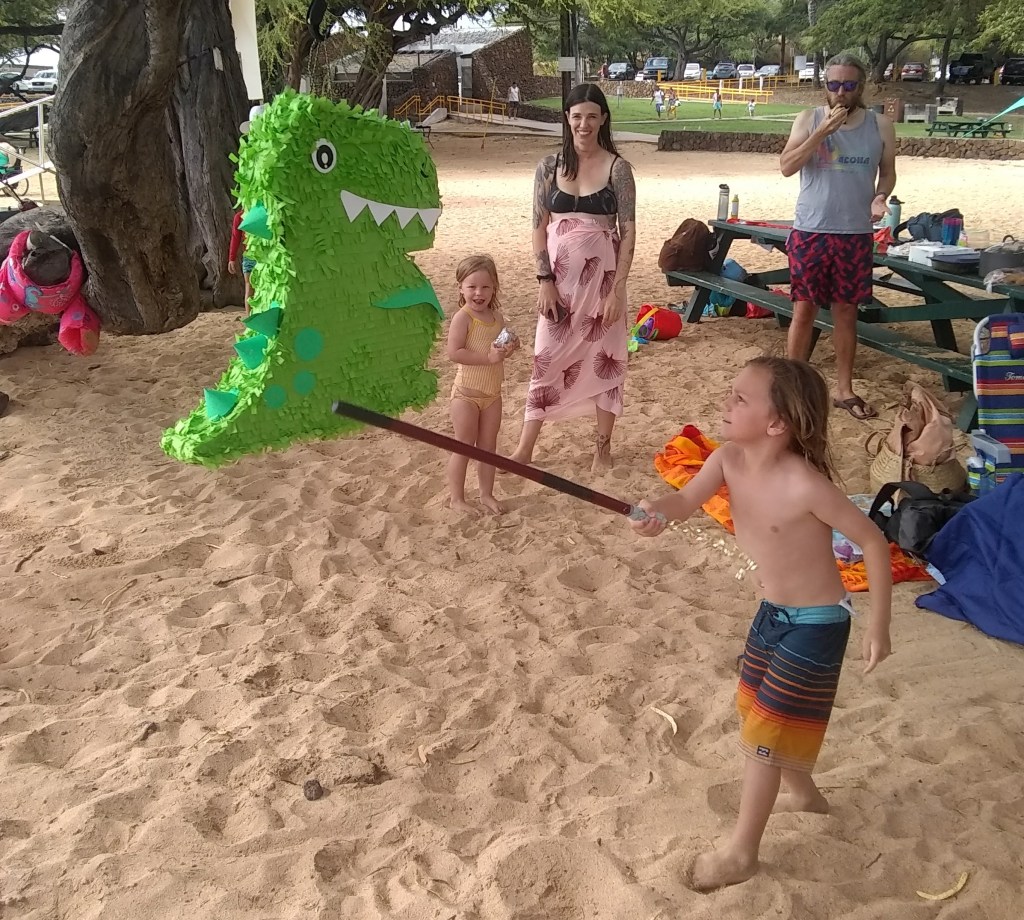
Our first day we spent with their family and friends at a sunny beach park celebrating their son Bodhi’s 6th birthday.

My niece Frances Hartley, center background, with daughter True, 3, watches as Fran’s son, Bodhi, celebrates his 6th birthday with a whack at a piñata handmade by a friend for his beach party.

I enjoyed those days getting to really know my niece and her husband. There are interesting parallels to living on islands, whether on a 172-acre dot in the San Juans or a 4,000-square-mile volcanic wonder in the Pacific. On my island, with no stores, no trash disposal and lots of firewood to cut, you must be a person of many skills. Arwain and Fran’s new life is similar. With its remote location and limited resources, Hawaii is an expensive place to live. Good-paying jobs are sparse. Happily, they are well-suited to it, with multiple talents. Fran is a trained lactation specialist who helps new mothers feed their babies in the healthiest way. Arwain is a man of many skills: university-trained computer-design engineer, day trader, home builder, bartender and more.

A showy heliconia bloom hung next to the shower stall in a lava-rock grotto outside my niece’s Hawaii home.

In addition to their comfortable old Hawaiian-style home high on a hillside overlooking the ocean, they’ve acquired two parcels of property with the intent of organic farming. After wading with machetes into one acreage to hack down invasive sugar cane and other “weeds,” they discovered scores of coffee trees, obviously planted years ago. Through such serendipity, they plan to become coffee farmers, among other hats they’ll wear. They invited Lillian, recently trained as a barista, to come back and help sell their wares at farmers markets when the time is right.

I volunteered to pick the coffee beans by hand. Me and Juan Valdez.

Their coffee wouldn’t be Kona, but Hamakua Coast-grown. There’s always room for a new coffee region among aficionados of America’s favorite breakfast bean, right?

If coffee farming doesn’t work out, Fran and Arwain can grow vegetables for the island’s many restaurants. If that doesn’t swim, they’ve several other potential income streams to tap. It’s the island ideal. Want to live in paradise? Diversify.

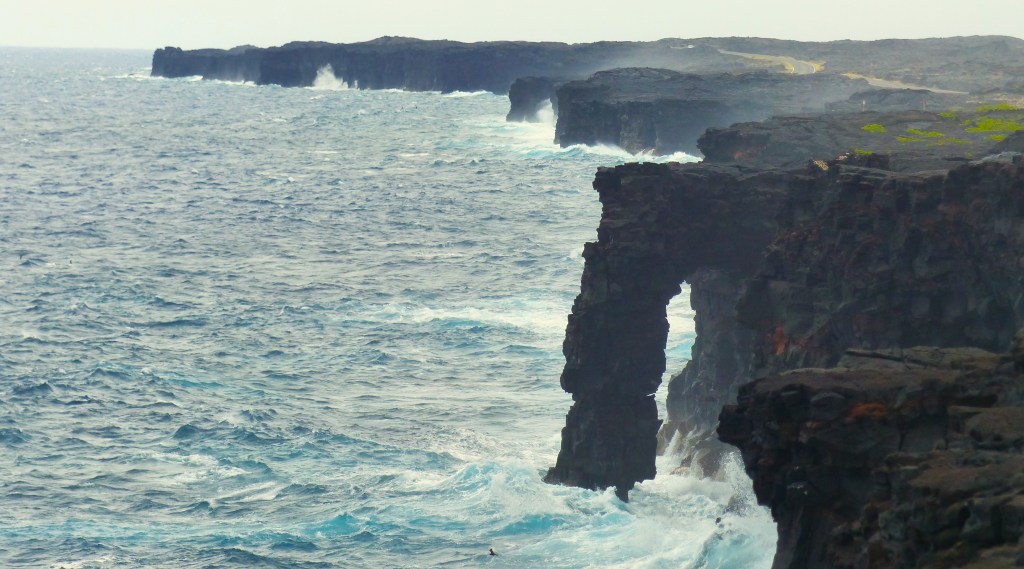
In Hawaii Volcanoes National Park, we drove to the end of Chain of Craters Road to see Hōlei Sea Arch.

Once we left Honoka’a, Lillian and I enjoyed circling the island, gaping at waterfalls, exploring a spooky lava tube, and poking along winding roads where dangling jungle vines tickled our foreheads as we drove in our rented convertible. On a bittersweet kayak paddle on Hilo Bay, we released a sealed bottle full of memories of Barbara, written by friends and family. On a catamaran tour to Kealakekua Bay, we snorkeled among teeming schools of tropical fish. I’ve never seen so many yellow tangs, like a lemony legion of finned ballerinas pirouetting on the tidal surge.

Back on Center Island, Galley Cat and a carpet of sea blush flowers welcome me home.

I love to visit such places. Yet I’m always happy to come home to Center Island. While I was away, the wildflowers bloomed. My rocky knoll is awash with a pleasing pink wave of sea blush. Buttercups and the first spiky flowers of blue camas add to the splendid scene.

And in three weeks I’m on a 37-foot boat headed to Alaska. It’s my season for the 49th and 50th states. Better catch my breath — and pack some warmer clothing.