Happy solstice! Let there be light.

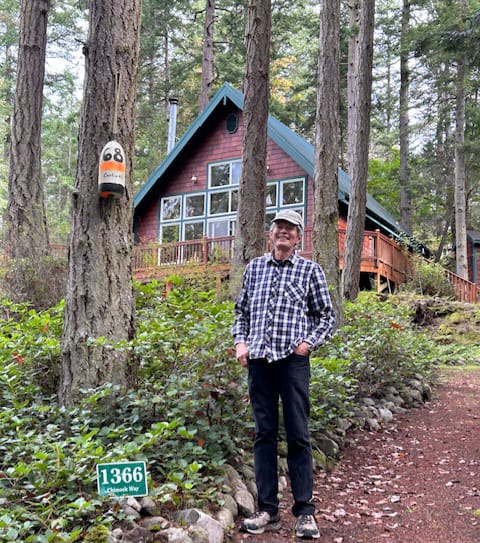
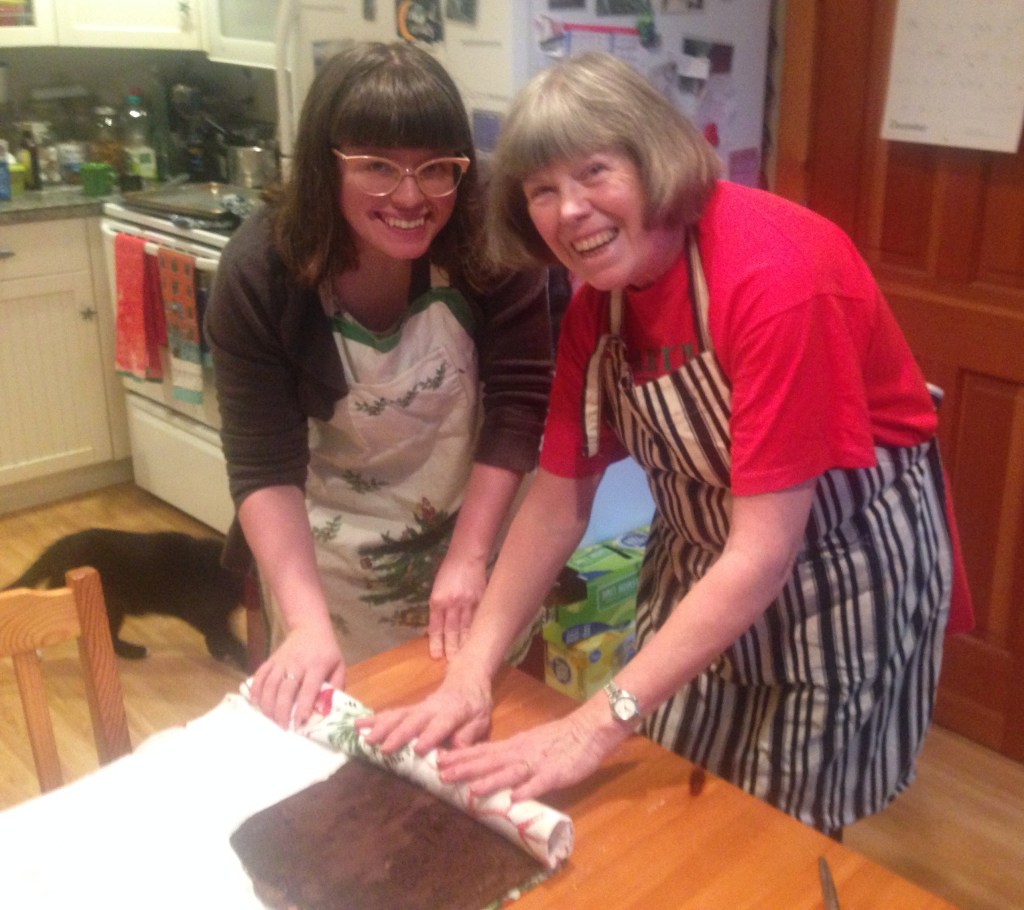
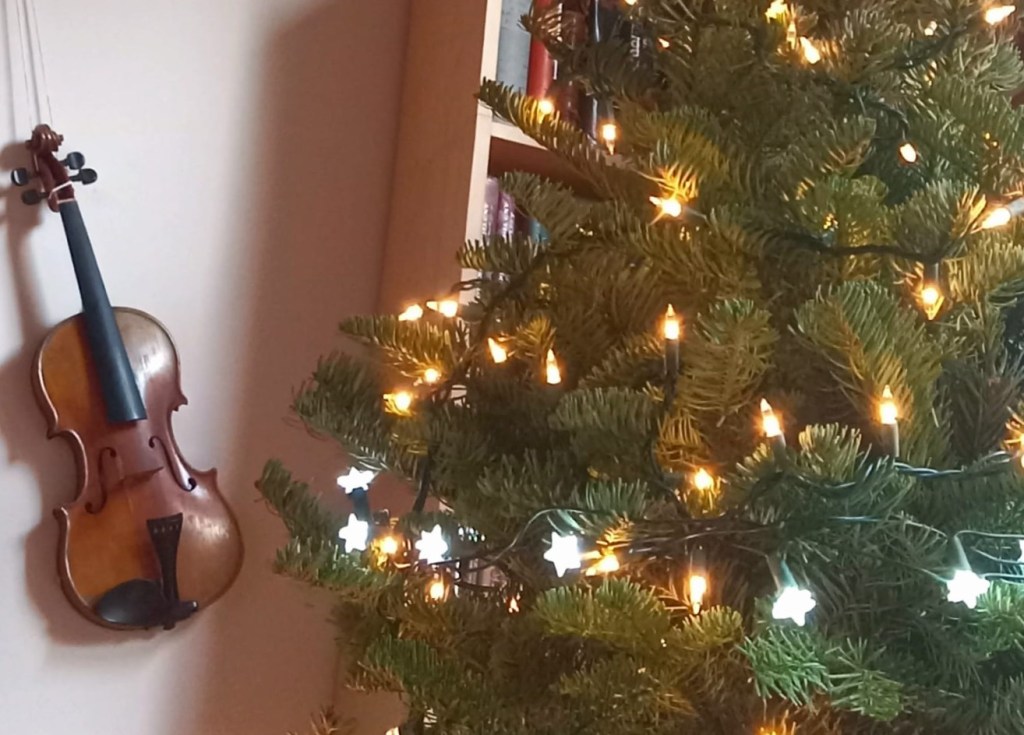
My grandfather’s fiddle, which entertained my mother’s family on long winter nights on the South Dakota prairie, hangs behind my Christmas tree at Nuthatch Cabin. We’ll add ornaments to the tree when daughter Lillian arrives Christmas Eve.

IT’S ALL ABOUT LIGHT this week, starting with today, December 21. Happy winter solstice, the shortest day of the year, and Happy almost-final-day of Hanukkah! Both have to do with winter light and what it means to us all.

With just me and Galley Cat in our cabin on this remote little island in the San Juans, life changes significantly when sunrise doesn’t come until almost 8 in the morning and the sky is inky black before 5.

Keeping the woodshed full is a challenge on short December days.

In mid-summer, 5 o’clock is happy hour on my sun-flooded deck. At this time of year when 5 comes around it means I’d better have made my daily trek to the mail shack already or else have my headlamp charged up.

With barely eight hours of daylight, for me it means less time for outdoor chores, and getting up earlier so I have time to split firewood; pick up fallen branches from the latest storm; go for a walk with Galley Cat.

For the resident feline, it means staying inside after 3 p.m. when dusk starts to descend. Having heard frequent owl hoots in recent months and coming eye-to-eye one late afternoon with a Great Horned Owl peering down from my roof, I keep Galley indoors in peak hunting hours. She’s just small enough that big raptors are a worry.

This December, all over Washington State, the dark days have been even tougher in the face of fierce winds, drenching rains and floods. Mild temperatures in our mountains meant rain fell rather than snow, fueling rampaging rivers. On top of all that, nationwide political chaos continued to test our good nature.

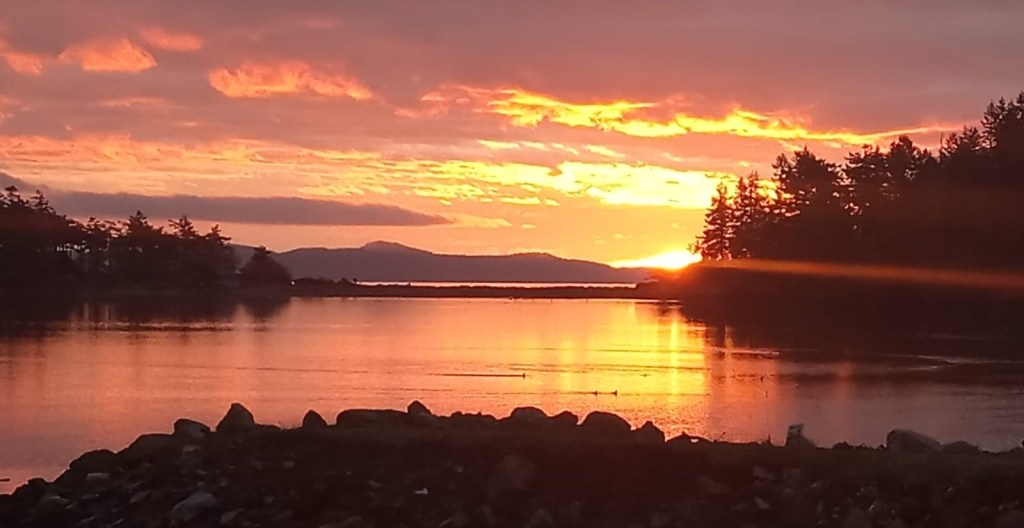
Sunrise from Center Island on December 13: a break from the chaotic weather.

More about our winter daylight: My brother in Santa Fe was surprised when I texted him a photo of a spectacular sunrise I witnessed from our Center Island dock as I awaited a water taxi pickup last weekend during a welcome respite from the storms. He was mystified that the photo was taken at 7:58 a.m., which to him seemed quite late for sunrise. The simple explanation: Center Island is at 48.49 degrees north latitude, while Santa Fe, 1,177 miles to south, is at 35.69 degrees. The hours of daylight have to do with the tilt of the earth in its revolutions around the sun this time of year. In winter the Northern Hemisphere tilts away from the sun, so the sun follows a lower, shorter arc across the sky at northern latitudes and sets much earlier than at lower latitudes.

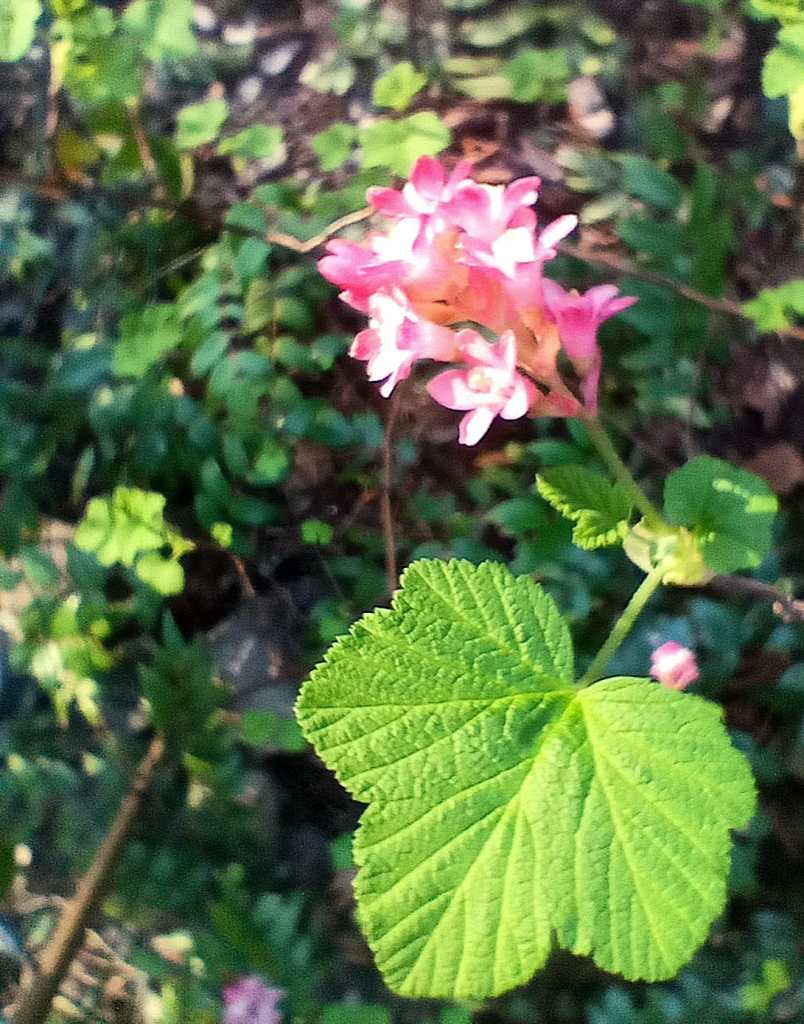
Mild December temperatures mean I still have fuchsias blooming on my deck.

A quick look at the numbers: On today’s winter solstice, Center Island is milking what it can from the sun with 8 hours and 20 minutes of daylight. Santa Fe is enjoying 9 hours and 40 minutes.

Before we Center Islanders cry in our cocoa, we should consider the plight of neighbors to the north. If I lived in Anchorage (61.2 degrees north), I’d get out in daylight for just 5 hours and 28 minutes today. The watery winter sun didn’t peek over the horizon there until 10:14 this morning. That’s just SAD (which happens to be the apt acronym for Seasonal Affective Disorder).

All this came to mind as I put up a 7-foot Noble fir and festooned it with lights in Nuthatch Cabin this week. Whether or not you celebrate the birth of Christ, decking an evergreen with lights is simple self-defense against the dark of December, my brother and I agreed.

How’d that custom start? A quick Google search says:

Christmas trees originated from ancient pagan winter-solstice celebrations using evergreens to symbolize life, evolving into a German Protestant tradition in the 16th century in which trees were decorated with apples and candles, famously popularized globally by Queen Victoria and Prince Albert in the 1840s, spreading from German immigrants to America and beyond as a beloved Christmas symbol. 

Meanwhile, let’s not forget Hanukkah, the Festival of Lights. When a small group of devout Jews defeated an army of oppressors in the 2nd century BCE, a day’s worth of lighting oil miraculously lasted eight days for the victors. With the lighting of candles for eight nights, the modern holiday celebrates spiritual triumph, the victory of light over darkness, and the endurance of faith.

Tomorrow our days start getting longer. What a relief. In these trying times, we could all use another victory of light over darkness.

Happy holidays from the Nuthatch.

Getting to know you, all the San Juan Islands and your people

Cypress Island as seen from our Mount Pickett hike on Thanksgiving morning.

I’M LOVING THESE ISLANDS ever more as I get to know each from the land side rather than just from the water. And as I get to know more of the people.

For decades, my family and I toured on our sailboat every summer throughout the San Juans. We had a rule that every year we must discover at least one new scenic anchorage or hidden cove.

We saw a lot of the islands. But we didn’t meet a lot of the locals that way.

Two things have changed: (1) I live here full-time now and naturally have more chances to hop a ferry with my pickup or bicycle to visit other islands , and (2) My new gig as a tour leader with Road Scholar has rapidly introduced me to more people and places all over the archipelago. For example, while I’d visited the Sunnyfield Farm goat farm on Lopez Island several times before, this past summer I accompanied a Road Scholar group there for a guided tour by Andre, the farm owner and head cheesemaker, whom I’d previously only said hello to in passing. When I took a friend there later in the summer, Andre remembered me. Likewise, I’m now on a first-name basis with Kevin Loftus, the San Juan Historical Museum’s jovial director, a fount of knowledge about these islands. And so on.

I’ve also made a bunch of new local friends who work as guides for Road Scholar.

Orcas Island’s Odd Fellows Hall dates to 1891.

This Thanksgiving reinforced my feelings for other islands, each with their own character, when I spent the holiday with my friend Tom on Orcas Island.

At his suggestion, we joined the free community potluck at the 134-year-old Odd Fellows Hall overlooking the water in Eastsound. Organized by the Odd Fellows and with donated turkey and trimmings, it was open to all islanders as well as visitors, and they got a capacity crowd. I’d guess 200 people shared in the camaraderie and good food. Supplementing the usual fare, everybody brought their favorite holiday dish, from quinoa with salmon to old-fashioned mac ‘n cheese. Pumpkin pies, apple pies and flans! We shared a table with a local mom, Allison, her two teenage sons, and a friendly couple visiting from Tacoma. One of the best-organized volunteer events I’ve ever attended, it further warmed me to Orcas Island and its residents.

Before the feast, Tom and I started our visit with a luxuriant soak in the communal waterfront hot tubs at venerable Doe Bay Resort, about a mile from the cabin he shares with an orange cat named Boxer. We shared the tubs with a local man’s birthday party! We also stopped for coffee at the beautifully renovated Olga Store and toured the Orcas Island Artworks cooperative, housed in a historical strawberry-packing plant at the Olga crossroads. The island nurtures artists working in every medium.

My friend’s Orcas Island cabin, which he has dubbed Belly Acres.

On drizzly Thanksgiving morning, we set out on foot to explore the side of 1,750-foot Mount Pickett in a far-flung corner of Moran State Park. Our trail meandered past more than one monumental old-growth Douglas fir. Not another human to be seen.

Friday afternoon I boarded a homeward-bound water taxi from Obstruction Pass Public Dock for a 20-minute ride back to Center Island.

You may have read previously of my plans to exit these islands. Now, feeling more and more like an at-home San Juanderer, I’m in no hurry to go.

After Christmas with my daughter and her partner on Center Island, I have plans to spend New Years with friends in Friday Harbor, tentatively to include the annual New Year’s Morning bike ride, another fun community event organized by friendly islanders.

Happy holidays, friends near and far.

Run for the border cures November’s island fever

The crowded modern skyline of Vancouver, British Columbia, looms over False Creek on the edge of downtown.

TO FULLY APPRECIATE LIVING ON AN ISLAND, sometimes you just have to get the heck off the rock.

Especially when November rains are turning your world as soggy as an overdunked Oreo and the ferry’s distant foghorn keeps blowing well into the murky afternoon.

Our Vancouver digs. Tom Willard photo.

For a change of scene and a welcome escape from dastardly American politics, my Orcas Island friend Tom and I fled to Canada on Thursday.

Our timing wasn’t perfect. Metro Vancouver was officially under a Heavy Rain Warning. As we navigated Whatcom County on the way north, streaming rivers of rainwater functionally obliterated any view through the Civic’s side windows. The frantic “high” setting on my wipers got its once-a-decade full aerobic workout.

At the Canadian customs station, a bemused border agent looking out on the unwelcoming weather quizzed us, “Why are you coming now?”

Well. Maybe he doesn’t know about island fever. Or that my buddy Tom, originally from Minnesota and an old goalie himself, was starved to see a hockey game. The Canucks were on the road, but we had Friday-night tickets to see the champion women’s team of the University of British Columbia Thunderbirds face off against the pony-tailed team from Edmonton’s MacEwan University, the Griffins (terrors of the prairie).

A flower in lights, part of Vancouver’s annual Lumière Festival, which brightens November.
Tom Willard photo.

Downtown on Richards Street, we checked into the delightful little four-story Kingston Hotel, owned and operated by the same family for more than 100 years.

Vancouver is a city of splendid ethnic diversity, a characteristic Canada seems to happily embrace. The city’s downtown, packed with high-rise apartments, is also crowded with clubs, theaters, independent coffeehouses and thriving little restaurants representing every continent. We set out on foot at dusk to a little hole-in-the-wall Lebanese cafe we found online, Manoush’eh, on Davie Street, about a 12-minute walk from our hotel. With a gas-fired oven up front, it was cozy and the food was delicious. (I had a hot-from-that-oven flatbread wrap with labneh, fresh tomatoes and olives; Tom had sbanekh, a folded lemony flatbread filled with spinach, onion and sumac. Yum.)

For a cool Thursday night, downtown streets were surprisingly packed with people. After dinner we strolled along Davie Street, where serendipity brought us to an outdoor show of art installations based on colorful lighted shapes and images. It was one of seven locations around the city for an annual November festival called Lumière. A happy crowd wandered among artworks that cheered up the chilly night. On our walk home, we happened upon another Lumière installation on Robson Street.

Engine 374 linked Canada’s Atlantic to the Pacific in 1887.

The next day, rain-free, we happily walked the city, starting with a tasty breakfast on a heated patio on the shores of pretty False Creek. Ambling back to our hotel, we stumbled on the Roundhouse Community Arts & Recreation Centre, home to the impeccably restored Engine 374, a musclebound steam locomotive that pulled Canada’s first transcontinental passenger train into the city in 1887. Entry to the iron horse’s pavilion is free of charge, and kids of all ages (us included) were free to climb into the engineer’s cab, work the controls and imagine guiding the steaming behemoth across the continent.

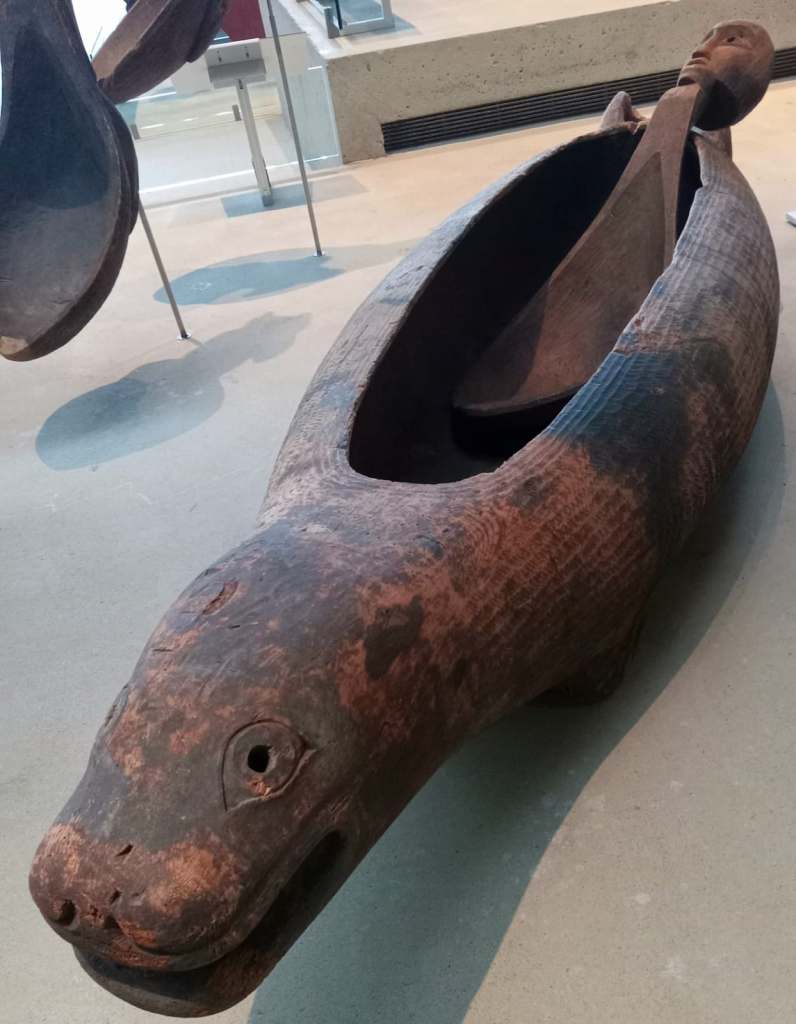
A carved, hollowed-out harbor seal was used as a serving tureen at a First Nations potlatch.

Afternoon took us to the University of British Columbia’s famed Museum of Anthropology, home to a fabulous collection of First Nations art and artifacts, including the Great Hall’s stunning collection of large poles, house posts and carved figures, primarily from the mid-19th century. Among my favorites was a large, hollowed-out wooden harbor seal that first struck us as an innovative canoe with a large paddle. No, a docent informed us: This was an enormous serving tureen for a potlatch celebration. These folks took feasting seriously.

Our dinner was at an Irish pub, the Wolf & Hound in the Kitsilano district, before we headed back to the university for hockey. The powerhouse Thunderbird women pummeled the Griffins, 5-1. Tom tutored me in the wiles of the game as we ranged from one seating zone to another — behind the goalie, next to the home-team box, etc. The live pep band tootling on trumpets happily reminded me of my middle-school days.

The women of U.B.C.’s Thunderbirds rally to celebrate their Friday victory on the ice.

Saturday took us back to the San Juans, where Tom and I each live on forested islands with our respective ginger cats. Vancouver was an invigorating change. And going away always makes coming home all the sweeter.

Haunting memories can be sweet

Daughter Lillian peeks from the gable of the award-winning haunted house as partner
Lux waves in ghostly fashion and your loyal correspondent poses as a nerdly ghost hunter. Sue Burton photo.

I’M HAPPILY BACK on my little island after enjoying a mainland highlight of my year: the family Halloween party.

After relishing the southbound drive across the autumnal Skagit Valley, enjoying views of crimson-leaved blueberry bushes and the season’s first snow geese, I piggybacked two nights at daughter Lillian’s new digs in Seattle’s Roosevelt district with an overnight at the delightful Magnolia Bluff brick bungalow that is home to former Seattle Times travel-writing colleague Carol Pucci and her husband, Tom Auciello. Collectively, they are popularly known as the Pucciellos.

Skagit Valley blueberry bushes wear their fall crimson as October clouds hug the Cascade foothills.

The Halloween party was last Saturday at the home of my sister-in-law Margaret and her husband, Tom, in Shoreline. It’s been an annual event for almost 50 years, almost half of which have been at Margaret’s home. There’s a trophy awarded for best costume.

Lillian brainstormed our costume effort this year. Lil went as a haunted house. Lil’s partner Lux was a scary ghost (Charlie Brown bedsheet with holes, but with an added “bloodstain”). And I was Todd, chief investigator for Acme Paranormal Investigations LLC.

Lillian’s haunted house was a three-dimensional work of art, created in the media of delivery-box cardboard and tempera paint. It featured boarded-up windows (one of them with simulated broken glass) and a hovering ghost that lit up when she flipped a switch.

I wore plaid suspenders with matching bowtie and carried various ghost-detecting tools, including a hand-operated eggbeater with glittery ribbons that swirled with the beater blades. (The effect often causes nervous ghosts to appear when they don’t otherwise intend to; this is a well-known technique. Honest.)

We won the trophy. Or, more accurately, Lillian won the trophy for their creativity and willingness to wear the costume even as they ate dinner, laboriously transporting forkfuls of enchilada to their mouth despite the constrictions of the gable that wrapped their head.

Competition was stiff, including the two “forensics investigators” who left numbered evidence markers all over the house; the sister-in-law, her daughter and partner who all came dressed as the dad of the family, who has come to the party for years without wearing a costume; our hosts’ grandson who piloted a child-size submersible research vessel created on a 3-D printer by his Boeing-mechanic father; and many more.

Seen from Magnolia Bluff: A sailboat exits Elliott Bay as distinctive clouds frame Puget Sound.

Monday night I accompanied my Magnolia friends Carol and Tom, along with another former Seattle Times colleague, Holly, on a memorable walk along the edge of Magnolia Bluff. A purse-seining fishing vessel circled in the water below us and a sailboat scudded out of Elliott Bay as dramatic autumn clouds ranging from cottony white to gunmetal gray framed the panorama of Puget Sound. We dined at a cozy Thai restaurant in Magnolia Village before returning to my friends’ home to lounge in front of the blazing fireplace and debate the state of the world.

Tuesday I shopped for a month’s worth of groceries, packed them in bulging plastic totes and caught a 3 p.m. water taxi back to my hermitage.

Whew. Winter’s on its way. The pantry is full. Time to catch my breath. Happy Halloween, friends.

The social whirlwinds of October

On the airfield: Neil Johannsen and Hilary Hilscher, of Bainbridge Island, visit a small island nobody’s heard of. Hilary holds an apple from one of Center Island’s old fruit trees.

I’VE RARELY HAD such a sociable October on my little rock in the San Juans. It’s been a happy whirlwind of visitors.

My buddy Tom from Orcas Island came over on the state ferry for a couple of days the first week of the month. A few days later longtime friend Patti, of another sailing family, visited from Walla Walla and stayed three nights. And I bid farewell yesterday to Hilary and Neil, birder friends from Bainbridge Island. Galley Cat and I feel like quite the social butterflies.

It’s been a good month for stocking up on visitors. Just as I’ve been busily cutting and splitting firewood in preparation for winter, I’m stockpiling social occasions that will by necessity dwindle as winter squalls set in for the long haul till March.

Your loyal correspondent on the beach at Fisherman Bay Spit, Lopez Island. Tom Willard photo.

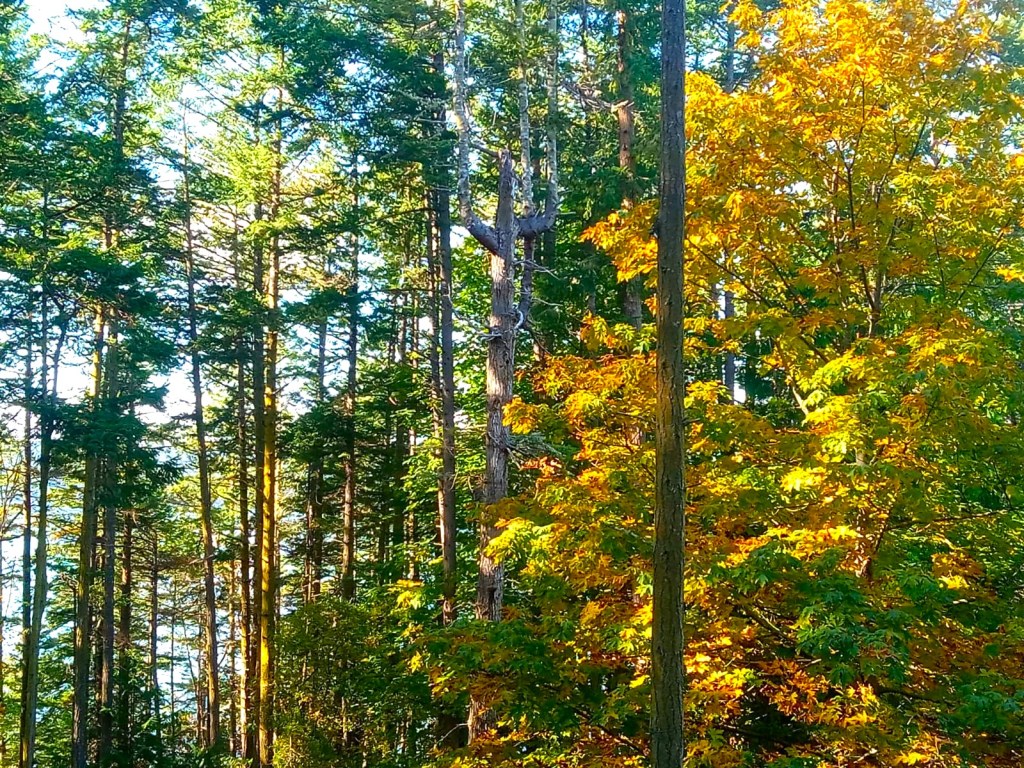
The October weather has been a mixed bag, but every visitor got at least one dreamy day. Tom and I ate a sack lunch on the sunny beach at Fisherman Bay Spit on Lopez. I hiked with Patti through a canyon of salal to the rocky shoreline at Shark Reef County Park on a pristine autumn day. While Hilary and Neil experienced buffeting winds and horizontal rain, observed mostly from in front of my woodstove’s blazing fire, blue skies opened up the next day in time for an enjoyable walk circling Center Island. Our big-leaf maples are turning honey gold, an eye-candy complement to the darkly brooding evergreens.

October’s golden maples are a pleasing contrast to my island’s evergreens.

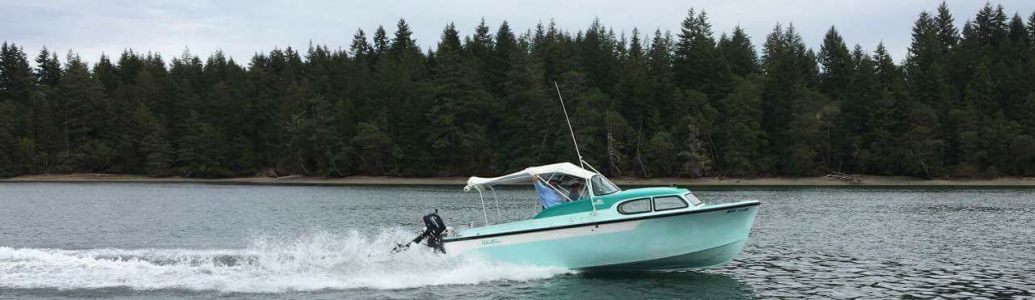
But the visitor season is drawing to a close. In anticipation of Sunday’s storm I hauled WeLike, my aqua-glorious 1957 cuddy-cabin cruiser, out of the water and tarped her on her trailer — probably until January tempests pass.

For the long, quiet months ahead, I’ve filed away some good memories: Teaching a new board game to Patti. (She won. Twice!) Watching a whimsical Jim Jarmusch film with Tom. (His favorite director, my newly acquired taste.) Smacking lips over my second helping of Hilary’s tasty enchilada casserole. (Gotta love visitors who bring dinner!) Witnessing confirmed feline-friend Neil’s jovial adoration of Galley Cat. (Even though she hissed at him in a moment of forgotten manners.)

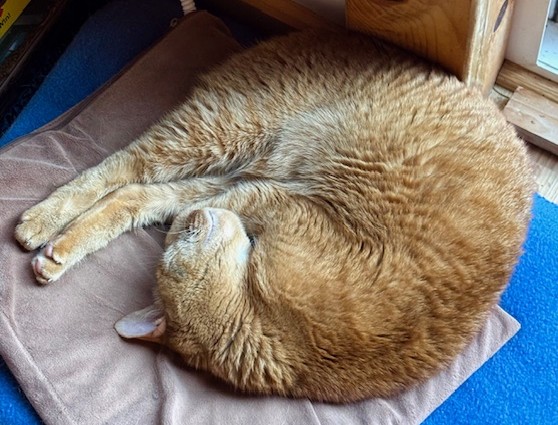
Galley Cat on her pet heating pad. Few cats sleep so soundly. Neil Johannsen photo.

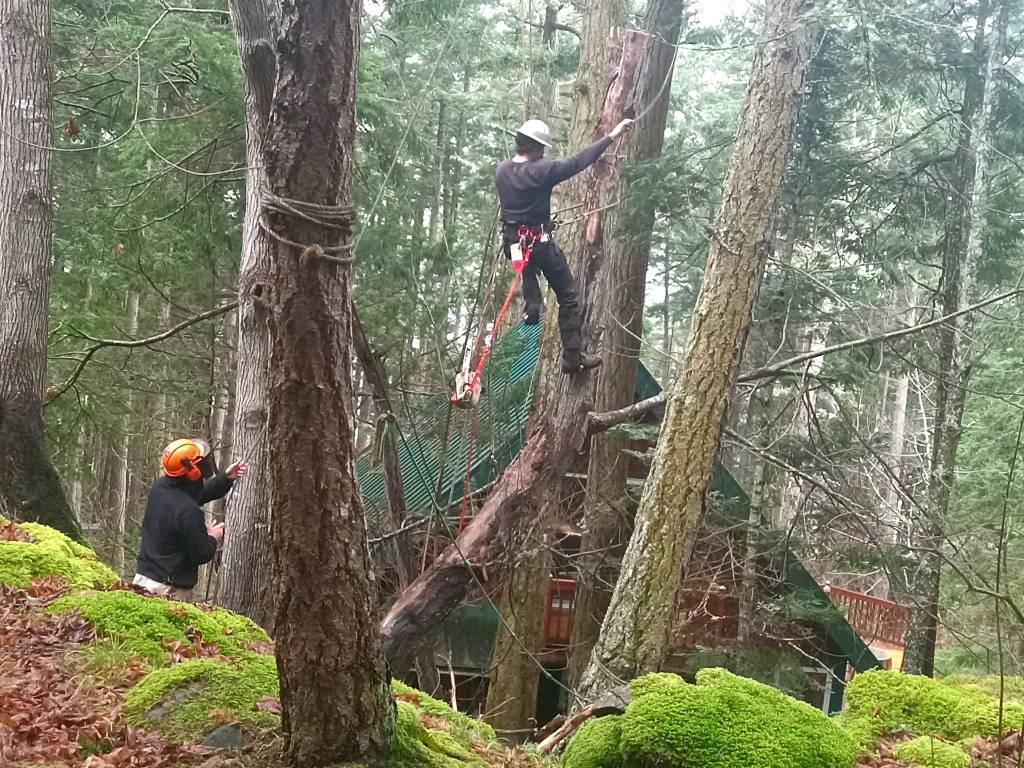
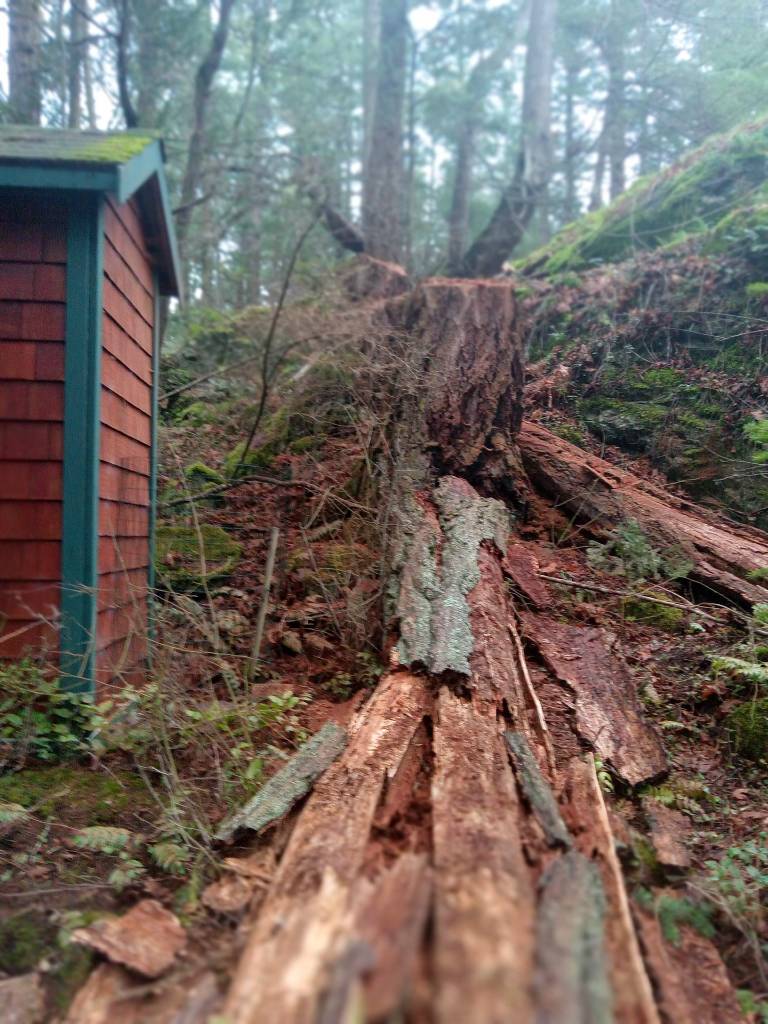
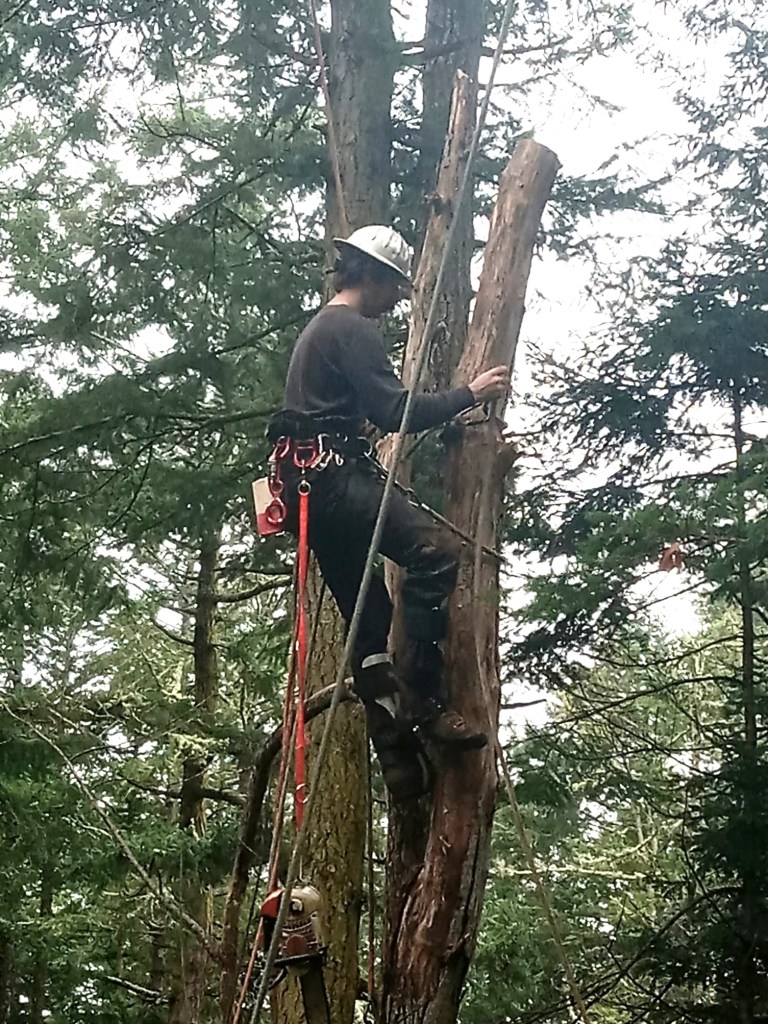
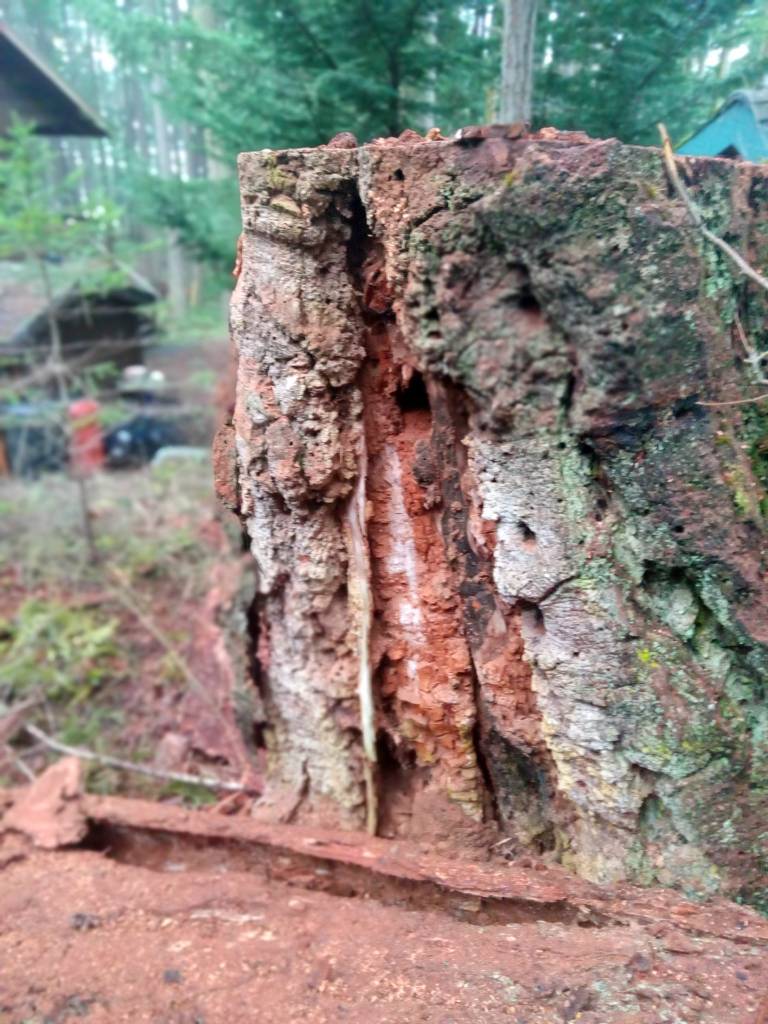
As with these memories, I’ve also stocked up on winter firewood. Our community association recently hired a woodcutter to take down dead or dying trees along our island roads. He cut 60 trees in one day. The supply of firewood has never been so profuse. Thanks to my handy new Husqvarna, my wood rack overflows with new rounds of Doug fir awaiting room in the woodshed.

Unfortunately, the tree cutting has also resulted in an Everest-like mound of trimmed branches awaiting burning at the end of our grass airfield. When the island caretakers torch that sucker it will likely be seen from outer space. Another unfortunate side-effect: Last week a San Juan Airlines single-prop plane delivering UPS packages to our island landed amidst a tailwind capable of lifting a Kansas farmhouse to Oz. Unable to stop at the field’s far end, the plane nosed into the brush pile, just enough to require a complete replacement of propeller and engine. (Anytime a plane’s prop hits something, the engine must be rebuilt or replaced for fear that delicate inner workings might have been thrown off-kilter.) For four days a repair crew brought replacement parts by air and sea. I lent a hand on our dock the day a boat arrived with one of the biggest, oddest-shaped cardboard boxes I’d ever seen. On it, large letters declared: “Contents: airplane propeller.”

So, rarely a dull moment on my remote little island of which few have heard. Not this October.

Paddling with friends and bringing back the seastars

Maple leaves are dropping as autumn arrives on the rocky knoll behind Nuthatch cabin on Center Island.

HAPPY AUTUMN AND JOYOUS BIRTHDAYWEEN, dear Reefers.

I’ve just returned from guiding my final Road Scholar outing of the season, a week of kayaking on perfect, sunny September days over calm, often-mirrorlike waters of the beautiful San Juans.

Not long after I returned to the Nuthatch last evening, rain poured down all night, happily reviving all the thirsty ferns and mosses, but I was barely done with breakfast when the sun broke through again this morning. Now I sit in Wee Nooke, my recently restained and spiffed-up cedar writing hut, basking in the warming sun shining in my windows as I munch a tasty sack lunch, feed kitty treats to the frequently visiting Galley Cat, and tap happily at my keyboard. Honestly, it’s kind of like Cantwell’s Camelot.

As for that greeting up top: The official time of the autumn equinox is 11:19 a.m. Pacific Daylight Time on Monday, September 22. Still some hours away, but what’s a few more fallen leaves among friends?

Birthdayween, you ask? That’s an invention of the delightful daughter, Lillian. Their birthday is next Saturday, September 27. Combining their birth month with their favorite holiday, Halloween, they long ago pronounced the entire months of September and October as the festive season of Birthdayween. It might explain why Halloween candy displays appear in stores in August; one must be ready to celebrate. Keep an eye peeled for Birthdayween greeting cards. I’m sure Hallmark will pick up on it soon.

Once again, Road Scholar has proven a good fit for me. More socialization is one of the aching needs of an old widower living with his cat on a remote island nobody’s heard of, and a week of intense togetherness with interesting (and interested) people from across the continent is like balm for my soul. Happily, these are typically well-educated folks not far from my age who are highly curious to learn about this beautiful archipelago where I live, and love to hear me tell about life on my little rock. I’m a storyteller in search of an audience. It’s a good symbiosis.

Gilda and Dom from California lead the way as Road Scholar paddlers depart Roche Harbor.

Every trip, I make new friends. This time it was Sue from a little island off the coast of Maine (a lot in common there); Nona, from Evanston, Illinois, where I went to grad school, who finished reading “Murdermobile” on her Kindle before our trip’s end; brave first-time paddler Lyn, from Wenatchee; Cheryl, a retired art teacher from Philly, and too many others to name here. All good folks. All new friends.

Together, we circumnavigated Burrows Island, near Anacortes; twice paddled out of Roche Harbor, including a peek at English Camp on Garrison Bay, and said hello to a crowd of basking harbor seals on rocks near Turn Island.

Sunflower seastars fill a tank at the University of Washington’s Friday Harbor Labs. Lyn Plunkett photo.

Among our land-based field trips was a fascinating tour of the University of Washington’s Friday Harbor Labs, where researchers just announced a breakthrough in finding the key to the wasting disease that wiped out most of the West Coast’s seastar population. The cause: a bacterium similar to that which causes cholera, we learned from Jason Hodin, a senior research scientist at the labs. Understanding the cause opens the door to new strategies for prevention and management of the disease.

The loss of seastars has involved far more than the aesthetic loss of the orange and purple stars that my family enjoyed spying in marina shallows when we lived on our sailboat on Puget Sound, I learned. Seastars feed on sea urchins, which feed on kelp. With the loss of seastars, unchecked urchins have decimated West Coast kelp forests, which provide crucial habitat for countless marine species. Hodin calls kelp forests “the rain forests of the ocean.” Their loss has been an ecological disaster. Thanks in part to work going on in the San Juan Islands, maybe there’s a chance to reverse that.

Meanwhile, friends, enjoy this colorful new season, and kick up your heels for Birthdayween. I know I’m going to party.

A seal of approval at Barbara’s bench

“Our” seal watched fearlessly as Lillian and I ventured near on the rocks below Barbara’s memorial bench.

BARBARA JUST MIGHT BE A SELKIE NOW, it seems.

If you’re not an avid fan of the delightful 1994 John Sayles movie, “The Secret of Roan Inish” (in which a selkie is part of the secret), you might need this Wikipedia definition: “Selkies are mythological creatures that can shapeshift between seal and human forms by removing or putting on their seal skin. They feature prominently in the oral traditions and mythology of various cultures, especially those of Celtic and Norse origin.” “Roan Inish” is a real island on the Ulster coast of Ireland.

Daughter Lillian and I just returned from our annual overnight pilgrimage to remote Sucia Island, a marine state park that’s home to the park bench memorializing Barbara, my wife and Lil’s mother, who died of breast cancer in 2021. Three years ago, we cast her ashes in waters near this island.

Barbara aboard WeLike shortly after we retired to Center Island.

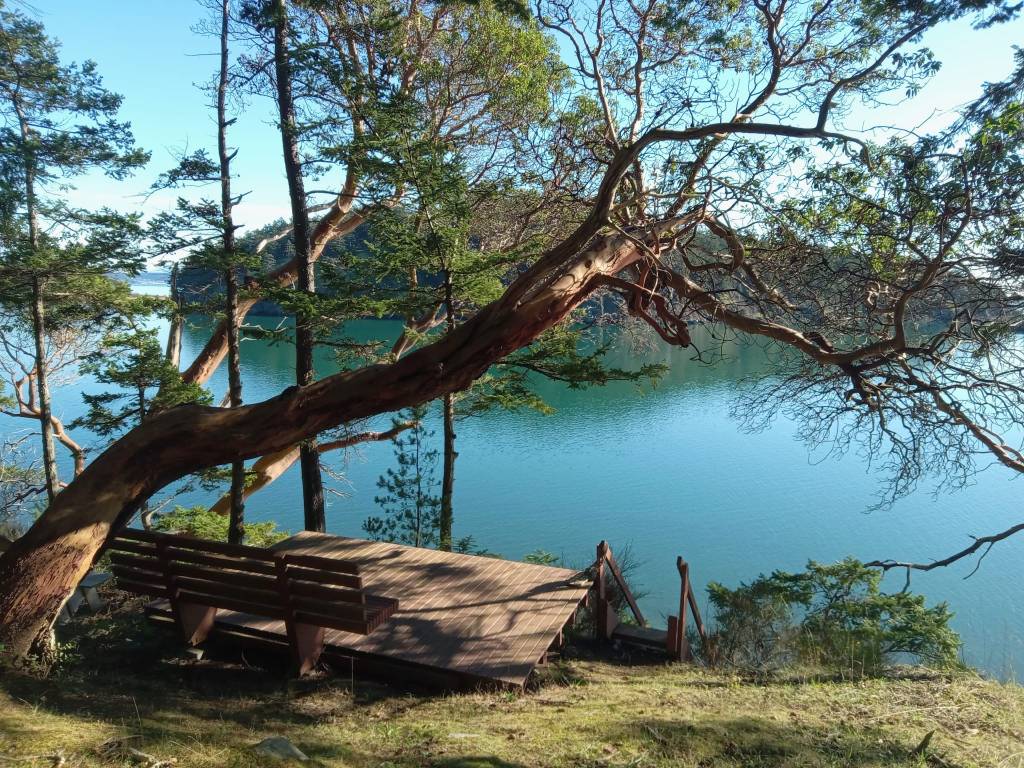
The bench, a GoFundMe project funded by generous donations by many of you Reef readers, sits in one of the most beautiful spots in the San Juan Islands, with a stunning waterfront panorama that takes in Orcas, Waldron and Patos islands in the San Juans, along with Boundary Pass (the Canadian border) and a handful of Canada’s Gulf Islands. Eagles soar, kayakers skim the waves, sailboats ride the breeze on wide, wild waters, and seals bob in the sea.

As always, getting there was an ambitious 90-minute saltwater voyage aboard WeLike, my restored 1957 Skagit Express Cruiser, the 20-footer built in nearby La Conner, Skagit County. WeLike’s cuddy cabin includes a cozy V-berth just big enough for a father and daughter in a couple of sleeping bags.

After departing Center Island in a warm summer-morning rain, Lillian and I docked at Sucia’s Fossil Bay on a pleasant, partly sunny afternoon scattered with puffball clouds. We immediately gathered a sack lunch and set out on a mile-long hike through tall cedars and swordfern grottos to the southerly point at the entrance to Shallow Bay.

There we found the bench in excellent shape. We always bring a scrub brush, spray cleaner and paper towels for an annual cleaning, but the cedar-colored planks of durable recycled plastic needed only a quick wipe. The bronze plaque — which I personally affixed three years ago with wood screws and plenty of epoxy — remained, unmarred: “For Barbara, who loved this island, from Brian, who always sat beside her.”

Lillian offers a toast to her mother as we lunch at the memorial bench on Sucia Island. Boats ride moorings on Shallow Bay behind her.

As we munched our lunch, Lillian and I saw a harbor seal bobbing in the water and looking up at us from just beneath our shoreline perch. The emerald-green water was so clear here we could see the seal’s entire body beneath the surface. Remarkably, the seal stayed there, riding the incoming swell, as we finished our lunch and began to read aloud from one of Barbara’s favorite authors. We continued where we left off in last year’s novel, “The Last Camel Died at Noon,” an Amelia Peabody mystery by Elizabeth Peters.

Your faithful scribe among Sucia tidepools.

As Amelia, husband Emerson and son Ramses traveled down the Nile on a mysterious quest, we watched the seal clamber out of the water and on to a rock so near that we easily looked each other in the eye. Kayakers paddled near, motorboats buzzed by, and our friend the seal stayed put. When Lillian and I walked down to a small rocky point beneath the bench’s promontory, the seal followed us with her eyes but never fled back into the water.

Barbara?

Back at the dock, we chatted with other boaters. One friendly fellow on a C Dory heard our story and asked, “Oh, are you talking about Barbara’s bench? I was there yesterday! Wait, what’s your name?” “I’m Brian,” I told him. Another dock neighbor made plans to visit Barbara’s bench the next morning.

It’s sweet to know that other visitors are enjoying that resting spot with the million-dollar view. It was what dear Barbara wanted.

I hope they saw the seal.

Glassy waters reflect a pleasant morning at Sucia Island’s Fossil Bay. My family and I brought our sailboat to Sucia every summer for decades. Three years ago we cast Barbara’s ashes on nearby waters.

Rainy day brings green (moss), clean (air) and relief from a health scare

The thick moss that upholsters the rocky knoll behind Nuthatch Cabin gets lusher with a summer rain.

FEW THINGS COULD HAVE BEEN MORE WELCOME this morning than to awaken to the patter of raindrops on my Center Island roof.

My rooftop is metal. When I’m abed in my loft, my head is inches from the sharply sloping knotty-pine ceiling and not much farther from the roof outside. Raindrops are like a percussive lullaby, and morning raindrops mean I have the day off from outdoor projects.

It was a celebratory lie-in for me, reading a good book, sipping good coffee and munching toast. The celebration was two-fold: (1) We really needed the rain on my parched and crispy island, and (2) I don’t have thyroid cancer.

I had returned from Seattle yesterday afternoon, following a Monday fine-needle biopsy of a suspicious lump on my thyroid gland.

The thyroid “nodule” (as the docs called it; a less-alarming word than “lump”?) was among discoveries when I did hospital time last December with multiple scans of my innards. After recovering from the ulcer that prompted emergency surgery on Christmas Day, I had a late-January visit with a Swedish Cancer Institute hematologist to find out if the lesions seen on my spleen were something to worry about (apparently not, he decided).

By comparison, the thyroid nodule sounded minor, and frankly I was fed up with being poked and prodded, so I conveniently forgot about it. But my primary-care physician didn’t, and a few weeks ago he prodded me (there’s that word again) to get another ultrasound look at the thing.

The nodule hadn’t disappeared on its own, and on a standard scale used to judge such things, mine was of a size to prompt a FNA, I learned in a MyChart report.

Had to Google that, of course. “FNA” stands for fine-needle aspiration (poking, what did I expect?). It’s a type of biopsy.

“Biopsy.” There’s an ugly word I hadn’t personally experienced before. It meant I had to be tested for cancer.

To ratchet up my apprehension, my primary-care guy phoned me in person less than an hour after the ultrasound finding posted. He’d never done that before. It was no emergency, but he wanted me to schedule the biopsy soon.

So there I was Monday afternoon at the high-rise Optum clinic at 7th and Madison, just off Interstate 5 in Seattle, getting a needle poked into my neck five times while the radiologist attempted to get enough “stuff” (the actual term the doc used) for a reliable analysis. Ick.

It wasn’t pleasant, and I hope not to repeat it. But he gave me a local anesthetic of lidocaine, the same numbing agent most dentists use these days. So all I felt was some unpleasant prodding. Not much poking. In fact, it was a lot like a dentist visit, blessedly without the noise of the high-speed drill and the occasional whiff of smoke from the grinding of tooth enamel.

Absent any actual cutting, the only bandage I wore home was a standard Band-Aid.

I slept on the couch in daughter Lillian’s Roosevelt-district apartment that night. She and a friend had generously taken me out for dinner and a movie to distract from the worry. The doc had said results could take a week.

The dusty blue fruit of Oregon Grape is among this summer’s bumper crops on Center Island.

Tuesday, I did mainland grocery shopping before returning on a 3 p.m. water taxi to my island. The day was muggy and the air unpleasantly smoky from wildfires in the region. As I awakened from a pre-dinner nap, I heard the first of patters on my roof. Stepping to the door, I relished the smell of the freshly rain-washed air, like the aroma of clean sheets on a clothesline. It was a brief reprise of spring rains that nurtured a healthy crop of berries and seedlings in recent months.

I checked my email and with a mild jolt saw that I had a test result waiting on MyChart. I gulped and steeled myself for the news.

It took a moment for me to wade through medical terminology until the word “benign” jumped out at me.

What a relief. For this resident of a remote little island, a cancer finding could have changed my future. Or the rest of my summer, for sure.

Instead, I’m enjoying this showery Wednesday. Breathing deep. Taking a break from outdoor projects. Writing in my hut on the rocky knoll. My happy place.

As my siblings and I often say, getting old ain’t for sissies. For now, though, I feel good, full of energy — and relieved. Stay healthy, friends.

Ding, dong, the deck is done!

IT WAS DOWN TO THE FRIGGIN’ WIRE, but at 5:32 p.m. on July 31, 2025, I jubilantly fulfilled my pledge to be done by the end of this month with replanking the sizable deck that wraps around Nuthatch Cabin. It was a project begun several years ago.

Whew!

The final stretch, just completed. The lighter planks at the far end will match the rest after a second coat of stain.

I’d have finished last Sunday if I’d not discovered serious dry rot in one of the very last supporting beams I exposed when prying up old planks. Once I’d scraped out the rotten wood I could almost stick my fist into the hole.

I solved that with a can of Bondo, the gooey, hard-curing polyester putty from 3M that car restorers love. It has brought new life to many a rusted out fender on a ’53 Studebaker. I happened to have an unopened can I’d bought years ago for another project but never used. It was still in good shape (no rust on the can!) and did a dandy job repairing the rotting beam.

While that repair cured good and hard, I took a couple of days off the deck repairs for an overnight campout aboard WeLike with my friend Tom from Orcas Island. We lucked into dock space at Prevost Harbor and had fun exploring Stuart island.

Tuesday sunset at Prevost Harbor in the San Juans.

Back at the project today, I finished the last 10 square feet of deck replanking. All that remains is trim work on the railings and a second coat of wood treatment on the final new planks. But it’s done enough to celebrate.

Over the month of toil, I’ve memorized the words to every song on Jimmy Buffett’s “Beaches” album, gotten a tan George Hamilton might have envied, battled sciatica (all that bending) and carpal tunnel issues (all that prying and hammering), and done my best to keep Galley Cat from leaving paw prints in the fresh stain.

Cheers, friends! Tomorrow is August. Right now, I’m pouring a glass of wine and putting my feet up.

It’s July! All hands on deck!

Hemlock (the darker wood) started my deck project, with golden cedar now the lumber of choice on this completed first phase of my deck renovation. But it’s not all done yet…

A QUICK JULY HELLO from Center Island, where summer means outdoor projects.

Months ago I committed to setting aside this summer to finally complete the replanking of my 25-year-old, rapidly rotting cedar deck, which had never been treated with any preservative. I started the project a few summers ago in bits and snatches.

The lumber must all be brought over from Sunset Builder’s Supply on Lopez Island. That endeavor is limited by how many 8- and 9-foot planks I can fit into the back of my old Ford pickup, Ranger Rick, and into the cabin of my 20-foot cruiser, WeLike.

The thickness of my wallet has played a role as well. Cedar decking currently sells for $1.06 per foot on Lopez. That’s about 7 cents more than it goes for in mainland Mount Vernon, but a relative bargain compared to the $1.50+ I was paying on Lopez at the height of supply-challenged COVID.

So it’s been a piecemeal effort, involving many hours of yanking nails, prying up old planks, sawing new planks, staining them with a cedar-tone preservative, and drilling and screwing them into place. I’ve even been adding waterproofing caulk atop underpinning supports to lengthen their lifespan.

So, expensive, slow and methodical.

Despite the tortoise pace, over the course of several summers I’ve managed to renew the largest deck area, the 15-foot-by-19-foot surface where I have Adirondack chairs and an umbrella table for entertaining when neighbors drop by for a cold beer or a barbecue.

But plenty remains. Five-foot-deep sections of deck span the front of Nuthatch Cabin and wrap around to the front steps. Here, while I’ve concentrated efforts elsewhere, planks have been gradually collecting moss and lichen and slowly rotting away to the point that arriving guests might just fall through next time they visit. Not quite the welcome I’m looking for.

So, at the end of June I got out the measuring tape. I determined that I needed 651 board feet of lumber to complete the project.

New cedar planks are gradually replacing old across the front of Nuthatch Cabin.

Without delay, I hopped aboard WeLike and spent day after day ferrying cedar from Lopez Island. Other than one quick mid-month trip to Seattle for a doctor appointment and a bit of socializing with friends, I’ve set aside the entire month of July to finish the rebuild. (Today is a rare day of rain, so I get a day to write.)

Just checked my bank statement. I’ve already spent $617 on lumber for this final phase of the rebuild. Not to mention the cost of caulk, stain, deck screws and new Velcro-fastened kneeling pads. The old ones, purchased at the rebuild’s outset, were now held together by duct tape and about as effective as strapping old kitchen sponges onto my 69-year-old knees.

With the mostly sunny days we’ve had, the work has been pretty much nonstop. The days can be hard but the progress is satisfying. In college I read Robert Pirsig’s “Zen and the Art of Motorcycle Maintenance.” This is like that, but for homeowners. When I groaned a bit about aching joints, my friend Daniel comforted (?) me with a reminder. “The deck lasted 25 years. You’ll never have to replace it again!”

Unless I live to be 94. Not going to think about that.

Keep in mind that I live on a remote island with no trash-removal service. So once the deck is all done, I need to dispose of a large pile of old rotten wood. Can you guess where I’ve been storing it in the meantime? Under the deck!

I’m not going to dwell on that right now, either.