THAT WAS MY THOUGHT this afternoon as I sat down with my cup of Trader Joe’s Harvest Blend tea, my favorite autumn sip.
Cinnamon!
Yes, I was smelling it again. Oh, thank the olfactory gods. My sniffer was back on the job.
My favorite autumn tea is heavy on the cinnamon, along with ginger, apple, orange peel and other aromatic sensations — which I missed for a few days.
Just wanted to let loyal Reefers know: I will be smelling again for Christmas. (Yeah, yeah, let it go; you know what I mean.)
In the midst of my bout with COVID, I had lost my sense of smell (which accounts for something like 80 percent of your sense of taste). I had read that people who had lost their senses of smell and taste to COVID have regained the senses in a few days, or a few weeks, or a few months — or not at all. I chose not to ponder the latter. A life without the smell of fresh-ground coffee? Rain-washed forest? Roasting chicken? Bleak. For the near time, I was bemoaning the prospect of an aroma-free Yuletide.
My sincere sympathies go out to the multitudes who have suffered longtime disabilities from COVID, not to mention the countless families who have lost loved ones. I don’t make light of the incomprehensible tragedy.
But I do whisper a thank you into the stratosphere. In the coming month, I will count my blessings every time I smell a Christmas cookie pulled fresh from the oven. I am lucky and I know it.
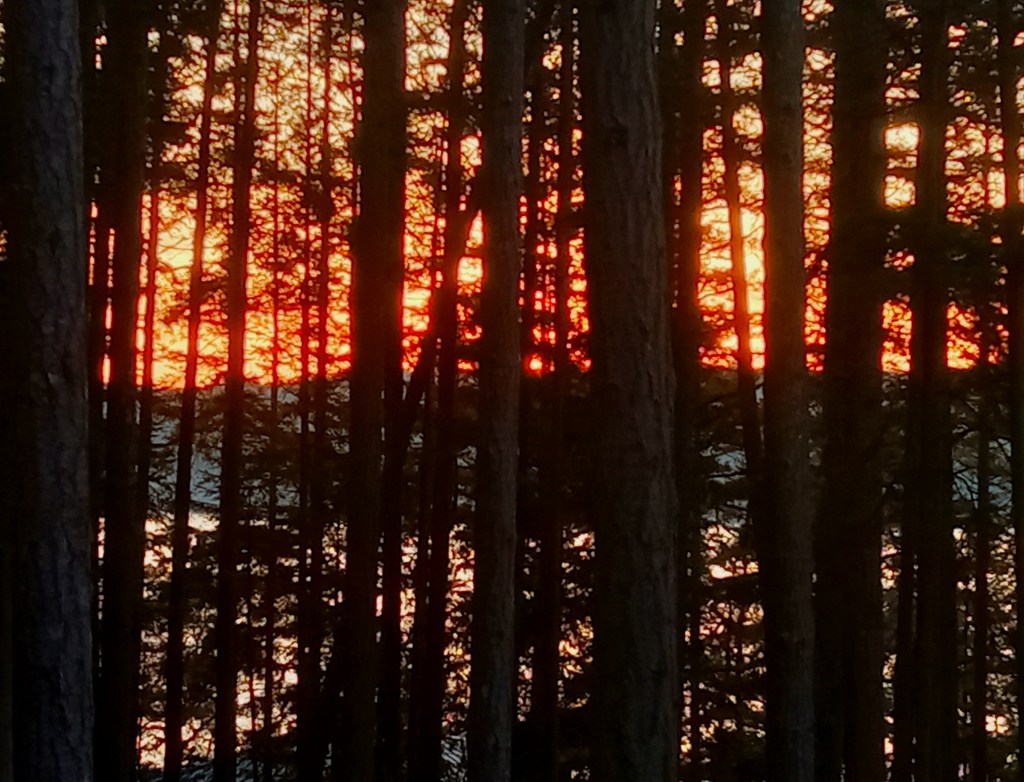
We had some beautiful weather and superb sunsets on Center Island for Thanksgiving. Unfortunately I was a little distracted.
THANKSGIVING CAME EARLY FOR ME this year. It was a good thing, as it turned out.
Two weeks ago, my island neighbor The Mad Birder and his lovely wife, Carol, extended a kind invitation for a turkey dinner. The invite included my brother Doug, who was visiting from New Mexico.
M.B. and Carol had bought a turkey breast to take with them on a Thanksgiving Week camper-van tour of Vancouver Island. They realized belatedly that they couldn’t cross the Canadian border with poultry. So they popped the turkey in the oven and said “Come on over.” There were peas. There was gravy. It was delicious.
My actual Thanksgiving Day could be the subject of a new movie titled “HOME ALONE: Brian Catches the Crud.”
A little context: What worried me most about my travels to Greece and Turkey last month was that, like virtually everyone I know who’s come back from vacationing in Europe in the past two years, I would likely get off the plane in Seattle with COVID.
Living alone on a remote island has helped me avoid catching the lousy illness that has plagued the world the past four years. That was important to me, since my diabetes and my 67 years put me at higher risk. I’ve had more booster shots than I can count. After carefully masking up on the long plane rides and in crowded museums across Greece, I was proud of myself for making it back to Center Island with no cough, no congestion, no sore throat. My senses of smell and taste were intact and ready for another round of ouzo, perhaps with a pumpkin-latte chaser.
It took me barely four weeks of being back home in Western Washington to finally come down with COVID. Damn.
Not really sure where I picked it up, though I traveled last weekend from Anacortes to a funeral in Vancouver, Washington, with stops around Lynnwood, Thurston County, Centralia and several points in between. Masked sometimes, but not always.
Last Monday, my throat was sore. A friend down south had told me she’d tested positive the previous day. I did the home test, swabbing a half-mile up my nostrils, adding droplets to the little device, and waiting 15 minutes for the answer.
I’d done this at least a dozen times before. Negative, always. This time two lines appeared, not just one. It was the “positive” reading.
Not one to accept fate without a fight, I rummaged through my bathroom drawers and came up with another home test, from a different manufacturer. Swabbed, dropped, waited. Swore.
I had The Crud.
First thing, I messaged daughter Lillian to cancel plans for her and partner Chris to spend Thanksgiving with me at the Nuthatch. That was my biggest disappointment. Galley Cat and I hunkered down for the duration. I’d just brought home lots of groceries. Considering I’d had the latest COVID booster shortly before leaving on my October trip, I assumed my illness would be mild.
Yes and no.
By Tuesday, the sore throat was gone, but head-cold symptoms set in, with mild headache. I made sure to drink plenty of fluids. Discovered that my home thermometer was inoperable. By nightfall, however, I was sure I had a fever. My forehead felt warm while the rest of me was shivering. I donned extra layers and climbed into bed.
Beyond just jettisoning those extra fluids, my kidneys seemed to go on overdrive all night long. I was up every hour on the hour to empty my bladder. When finally I fell deeply asleep before dawn, my body fought the fever until it broke and I awakened awash in my own sweat. I had to change the bedding.
Wednesday morning, the headache had eased but the sore throat returned with a vengeance. By dinnertime I could barely swallow. Both ears ached. I couldn’t speak. That night, I barely slept, groaning and wincing with every sip of water that I swallowed. Did I have strep throat on top of COVID? I resolved to get to an E.R. on the mainland the next day.
But, oh, yes, I live on a remote island. I’m reliant on a water taxi. I texted an inquiry. Yes, they could get me to Anacortes. But it was Thanksgiving and they were knocking off early; no boats in the afternoon. I’d be marooned on the mainland.
I chose to gut it out till Friday.
I don’t remember much about Thanksgiving Day. I napped a lot. Sipped ice water to soothe the flaming throat. Made a fishburger for dinner, with every swallow a pain. Watched “Miracle on 34th Street.” Wished for a miracle on Center Island. It was about that time, as I gulped down a little carton of my favorite piña colada yogurt, that I realized that the lively pineapple and coconut flavors I love were…missing in action. The yogurt was white. It was creamy. It was flavorless. I had lost my senses of smell and taste. Aaargh. Another stupid COVID curse coming true.
Friday, securely masked and as isolated on the boat as I could get, I made my way to an Anacortes walk-in clinic. After checking in I had to wait outside in my car because, oh yeah, I had COVID.
Because of my painful throat, I didn’t think I’d be able to speak clearly, so I had typed up and printed a report of my symptoms and concerns. But by the time I saw a doctor, I could talk almost normally. She examined my ears and throat, saw no bacterial infection, and talked me out of a request for Paxlovid, the antiviral med given to many COVID victims.
“The thing is, you’re getting better!” the doc told me with a relieved sense of seeing something she hadn’t seen often enough.
She was right. It’s Sunday. I’m home now, almost through with the sore throat, the congestion. The Snot Factory is shutting down.
All is on the mend, and reports say most people get their senses back.
If not, and I go through Christmas without smelling a fairy-lighted fir, without sniffing a gingerbread man, without the aroma of chestnuts or an open fire — well, that would really stink.
But at least I lived to tell about it. Damned COVID.
My writing hut looks out on a rocky knoll agleam with golden maples.
NOVEMBER CAN BE LONELY on my island in the San Juans.
It’s rarely quieter. I’ve gone days without seeing another human being. Galley Cat and I have kept each other company as the rains have made it a time for quiet indoor days of writing, reading and a good quotient of pleasant napping. For me, a new friendship is blossoming as we correspond by email. So not so lonely.
Perceptions sharpen among the peace and quiet. Stepping up the back path on a walk with Galley this morning, I noticed with a start, as if a breeze had snatched my hat: The maples have changed.
Just yesterday I noticed that maples around my place were still mostly green with leaf, unusual this far into the season.
But overnight that changed, adding splashes of soul-gladdening color among the evergreens. It’s a short period every autumn, but memorable for how the maples enliven the landscape with this painterly contrast of gold peeking from the green.
My heart swelled at the sight, and I ran for my camera.
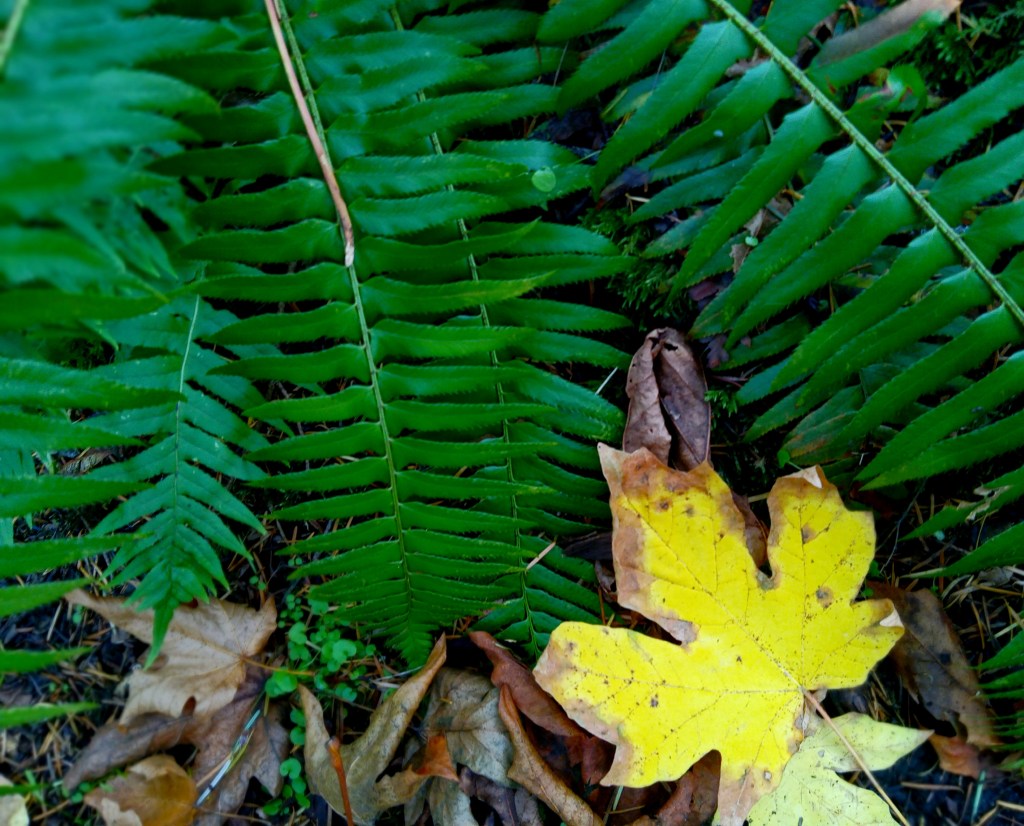
Like a dash of sriracha in a stir-fry, a fallen maple leaf nestles among a swordfern on my hillside.
Another happy note: The Mad Birder and his lovely wife, Carol the Wonderful Watercolorist, have arrived next door for a few days’ visit, and I’m invited to dinner. I baked cookies to take for dessert. Maybe Carol will daub a painting of the maples while she’s here. Perhaps an overflight of southward honking geese will catch M.B.’s ear.
As November arrived, the island was cold and wet. Tonight it’s feeling warmer. I’m enjoying a visit with friends, and a gift from Mother Nature.
Your correspondent, left, as Captain Ahab, with daughter Lillian Cantwell, a baker by profession (and perhaps a future master of puppetry?), as the White Whale of “Moby Dick.”
LOYAL REEFERS KNOW that Halloween has long been a highlight of the year in my late wife’s family, which for more than 40 years now has been my family, too.
You long-timers make a cup of coffee or work a crossword for a moment while I fill in the newcomers.
Some 40 years ago, my sister-in-law Kathleen and brother-in-law Roly started the tradition of an annual Halloween party for friends and family, including a costume contest. Early on, Kathleen visited Goodwill and found an old bowling trophy that had been awarded to a woman named Mildred. Kathleen removed the chrome-plated bowler and, with a bit of glue and gumption, substituted a wax figure of a witch on a broomstick, like what you might find at a crafts store. Thus was born The Mildred Award for Best Costume, and the competition began. For decades, the Mildred has passed from winner to winner.
Maybe 20 years ago, sister- and brother-in-law Margaret and Tom took over hosting, at their comfortable Shoreline home. Elaborate ghoulish decorations are involved, plus a poignant Day of the Dead altar dedicated to missed loved ones (such as my Barbara and Kathleen’s Roly). This year, the party was this past Saturday.
For years, Barbara and I strove to come up with “theme costumes” featuring the two of us, often with a spooky literary theme. Some old favorites: Edgar Allan Poe and the Raven, and Ichabod Crane and the Headless Horseman. Lots of papier-mâché and chicken wire were key components of the bird and the horse. Many other party-goers have shown equal enterprise. One year, Margaret’s daughter Sarah spent the party scooting around in a creditable replica of a Mars exploratory rover.
This year, daughter Lillian and I decided on another literary theme: the white whale and the crazily obsessed Captain Ahab from “Moby Dick.” There are plenty of spooky aspects to the story.
Lillian, whose partner, Chris, would be traveling with a band tour for a few weeks, had some time on her hands and volunteered to tackle the whale.
She outdid herself. Chicken wire, papier-mâché, clay teeth, poster paint and all.
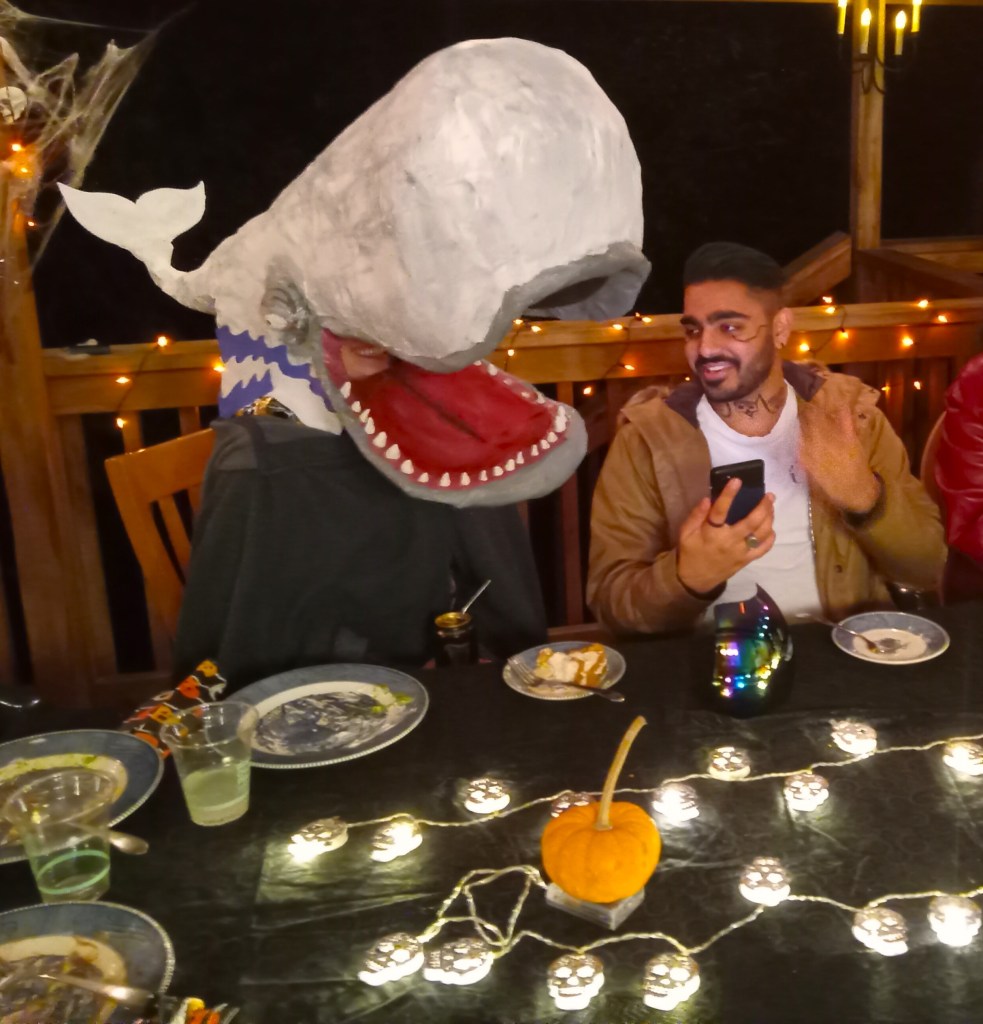
Moby chats with Mustafa, another party-goer, at the Halloween shindig in Shoreline. Lillian somehow managed to sip a beer from a straw.
I arrived at the party before Lillian. Clad in my foul-weather jacket, faded old captain’s hat and peg leg, with a pipe, a spyglass and other accoutrements, I gruffly quizzed other party-goers whether they’d seen the dad-blasted white whale. I had fun with it. (“I got this deckhand whose name, I’m pretty sure, is Harry, but he keeps telling people to call him ‘Ishmael,’ for some danged reason. And you know my first-mate, Starbuck? That feller can’t even make a decent cup o’ coffee.”)
But it was Lillian’s arrival, not my corny conversation, that wowed the crowd. The big, white sperm whale strapped on to her shoulders, with her face peering out over the large pink tongue inside its gaping mouth full of sharp white teeth. She’d fashioned a base of curling ocean waves and wore a gray cloak to match the color of the sea on a stormy day.
There were other great costumes, as always: An immaculately suited NASA astronaut accompanied by a ray-gun toting Martian girlfriend. A “Barbie” clad in lush pink robes à la ancient Rome (worn by sister-in-law Sarah, the Latin teacher). Docter Quinn, Medicine Woman (aka Julia Burns, R.N.), came toting a blow-up horse. My nephew who is a hard-working writer came as author Dean Koontz, a 78-year-old suspense novelist with a Justin Bieber haircut, as seen on the back of one of his novels.
But Moby Dick made a whale of an impression. We humbly took home the Mildred.
I’m back on my little island. With dinner, I plan my annual screening of “Arsenic and Old Lace.” If Galley Cat and I get any trick-or-treaters, we’ll report back. We might invite them in for a party. Happy Halloween!
Silhouette shots are the way to go when a swimsuit model is 67 years old. Your correspondent gets moist in the Med — in October.
I SWAM IN THE LUSCIOUSLY REFRESHING MEDITERRANEAN just a week ago. It was warm and sunny in the Peloponnese region of Greece.
And when I returned to Center Island on Sunday, the weather forecast for the week included the “S” word. I’m not talking about sunshine.
Yes, they were threatening me with snow by midweek. Just a few flakes mixed with rain, probably. But still. It’s not yet Halloween.
To rescue the moment, I built a roaring fire in my woodstove. That would show the Weather Gods, such as they are around here.
In Greece, they really had Weather Gods. Zeus threw lightning bolts.
My head is still there, though my body shivers as a cold rain falls here in the San Juan Islands. Such is the magic of modern travel. Last Thursday, I was on another island — the sunny isle of Rhodes, the largest of Greece’s Dodecanese Islands. Instead of edging the Salish Sea and looking across at Lopez Island, I was in the Aegean Sea, looking 11 miles across to Türkiye, as it now spells itself.
After an idyllic five days on the other side of Greece with my friends Jackie and Joel in the Mani district of the Peloponnese — Jackie is now known to me as “Mani Mama” — I caught a plane out of Athens for the hour flight to Rhodes.
Just getting to the airport was an adventure. Rather than make the three-hour return to the capital on the comfortable intercity bus, which would deposit me at a bus station many miles from the airport, with Jackie’s determined assistance I got a ride with a local guy who regularly made a few extra bucks by ferrying folks to Athens in his Ford minivan.
My Rhodes lodging’s door, left, and the narrow alley I had to navigate in the dark, at right. The steps led to a rooftop terrace with a view of the walled city.
He charged almost four times the bus fare, but he got me directly to the airport for my evening flight, saving me considerable trouble at the Athens end.
The thing was, the driver (I’ll call him Spiro, not his real name) didn’t let on that he would have a fully crammed van, with five passengers going to several different destinations. Or that he would rocket at 80 mph once we hit the tollway. Or that, as we arrived at the airport, he would cagily ask for payment before we got to the departures curb, so police wouldn’t see. (I suspected Spiro wasn’t a licensed taxi driver.) It felt like we were refugees fleeing Syria.
Rhodes was a challenge and a delight. Having booked an Airbnb inside the medieval walled city where narrow cobbled passages limit traffic to pedestrians and motorbikes, I doubled my challenge by arriving after dark. Finding my lodgings was like navigating a corn maze by moonlight. But bless the resourcefulness of my Greek hosts, who emailed photos of the appropriate entry gate, a tiny door to a souvenir shop across from my domicile’s side alley, and another photo of my arched brown door with two gray steps. I was glad I’d brought my mountaineering headlamp.
Selfie at a gate to Old Town Rhodes.
My hosts also suggested a place for dinner: Kostas’ Taverna (which is like saying “Joe’s Diner” in the U.S.A.). It was a five-minute walk through dim stone passages with only the feral cats to keep me company, but when I got there it was brightly lit and comfortably full of happy diners. A stooped little man with an obsequious grin — Kostas himself? — brought me a generous glass of good Greek wine, followed by platters of roasted eggplant with feta, onion and parsley, and a splendid salad generously garnished with manouri cheese and aglow with crimson tomatoes. It was my favorite meal outside the Mani.
The Palace of the Grand Master of the Knights of Rhodes, dating to the 7th century, dominates the Old Town’s skyline.
My next day was filled with wandering the Old Town and marveling at its varied history. Walled or not, the place had a virtual revolving door for invaders, with occupations by European Catholic knights, Ottoman conquerors, Persians and Saracens. A highlight was the Palace of the Grand Master of the Knights of Rhodes, which could easily have starred in a Monty Python movie with a taunting Frenchman atop a turret.
Elaborate mosaic floors fill the Rhodes palace. My favorite featured Medusa. Just don’t step on the snakes.
Back to Athens for a quick overnight in a Muppet-sized rental flat mid-city, then up hours before dawn to catch a train back to the airport. Thus began one of my longest and most challenging travel days ever.
On the trip out of Seattle on Turkish Airlines 12 days earlier, I mysteriously lucked into having a row of three seats to myself in the Economy section of a nicely appointed, otherwise full 787. For the 10-hour overnight nonstop to Istanbul, I was blessedly able to stretch across the seat and get some real sleep.
The flight home, almost 12 hours of bucking headwinds, was karmic payback. (Sometimes life really is fair, I guess.)
Instead of three seats for Brian, I shared my row with a little man who was almost as wide as he was tall, sitting in the middle seat and taking up a quarter of my space as well, with his wife huddled in the window seat. Added to the long hours of being squeezed warmly against him, every time we encountered turbulence (worst I’ve ever experienced, and frequent) I watched his wife go into a ritual of moaning, chanting and raising her arms to heaven, all in Russian except for the word “Jesus” frequently intermingled, loud enough for all the plane to hear. (It really did not help the stress level.) At one point I put on my headphones and tried to find soothing music on the sound system, only to get stuck on some very unsoothing jazz with the volume at full blast, and for the life of me I couldn’t find the volume control. Unintentionally, but only partly to my chagrin, she heard it and stopped her chest-beating. Of course, that was only supplanted by the shrieking of an emotionally overtaxed toddler two rows away whose lung capacity and endurance will someday make her a champion pearl diver.
By the time I was staggering through Passport Control at Sea-Tac, I’d been on the go for 22 hours since Athens, with only about an hour of dozing on the plane.
Oh, well. What doesn’t kill us makes us stronger, is my take on it. But I don’t know that I will tackle long-distance travel on my own-some again anytime soon.
The flip side of ranting about my seatmates: Once I came round to chatting them up like human beings (yes, they spoke English, while I could say only “Da!” and “Nyet!” in their language), I found them to be kind and interesting folks. Born in Kazakhstan during the Soviet era, he was retired from a 30-year career as an airline pilot for Aeroflot. His wife had “won a lottery” to get a green card and they now lived in Tacoma, with family in Snohomish. On parting he gave me a heartwarming handshake and sincere wishes for my good health (after likely noticing that I kept getting served “diabetic meals”). Another example of how travel brings people together in good ways if they open their hearts.
I recovered with a couple nights of intense sleep at sister-in-law Julie’s north of Seattle. On the drive home Sunday, at a Skagit Valley farmstand I bought a cinnamon-orange pumpkin for my step. This week I’m busy planning a Halloween costume for the annual family party.
Glad I went. Glad to be home. That’s how journeys should go, don’t you think?
Editor’s note: I later learned that “Spiro” was, in fact, licensed to transport passengers, and that he asked for payment before reaching the curb in response to new rules designed to expedite traffic at the air terminal.
Cats are everywhere in Greece, including the cobbled passageways of Old Town Rhodes. These naughty twins almost came home in my knapsack.
Your correspondent again feigns consciousness as the rising sun peeks through the Parthenon’s columns during a dawn tour of the Acropolis. Go early to see this monument to antiquity in golden light with smaller crowds.
MY GRECIAN DAYS ARE PASSING LIKE A SCIROCCO from the North African deserts.
Happily, those dust storms aren’t happening during my visit to the cradle of civilization. I’ve had day after day of warm and sunny October skies.
I’ve kept moving and kept busy, from a pre-dawn wander through the rabbit-warren streets of Athens to find the meeting point for my fabulous sunrise tour of the Acropolis; to my challenging cross-country bus ride to Kalamata (the language isn’t easy for me); to calming and restorative days in the scenic little villages of the Peloponnese where my hosts of the last few days, American expats Jackie and Joel Smith, have made their full-time home for six years. (Kirkland, Washington, was their last port of call.)
Jackie, a longtime friend and a colleague in the newspaper business, from Yakima to Seattle, has agreed that our lives, mine on isolated Center Island, and theirs in a fairly remote corner of what’s known as The Continent, bear similarities. We both have little challenges in shopping and dealing with the modern “supply chain,” in staying in touch with family and old friends, in making home repairs when needed, and so on.
But we both have the tradeoff of living in our own little slices of paradise, and nurturing friendships made there.
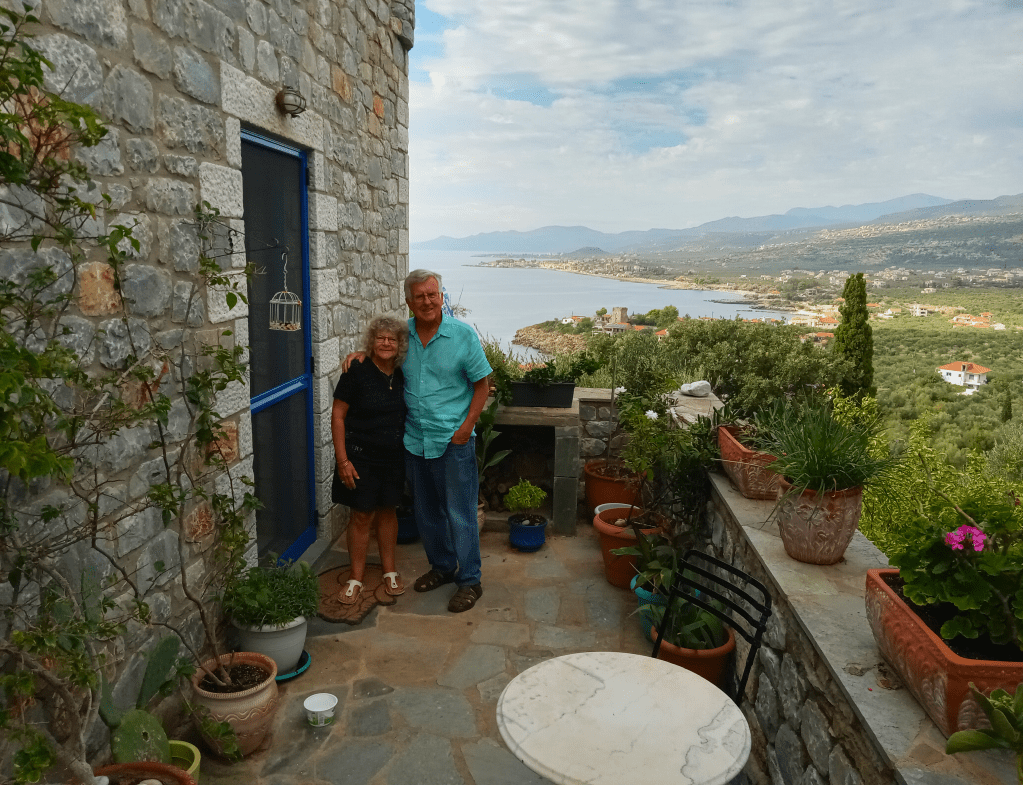
Jackie and Joel Smith and the view from their front door. Nearest village: Agios Dimitrios, an hour’s drive south of Kalamata.
Since arriving at their charming Stone House on the Hill, looking downhill to the blue Mediterranean and across to high, rolling hills, I’ve enjoyed a rich sampling of the spectacular scenery, the warm village social life, the great food, more of the great food, and, oh, have I mentioned the great food?
My first day, we ended with a sunset dinner on their village waterfront, dining on Fava beans, spinach with black-eyed peas, fried zucchini balls and fresh calamari that was delicately imbued with the best flavors of the sea. Went to sleep with windows open, listening to the distant howling of jackals on the hillside. (There are jackals!)
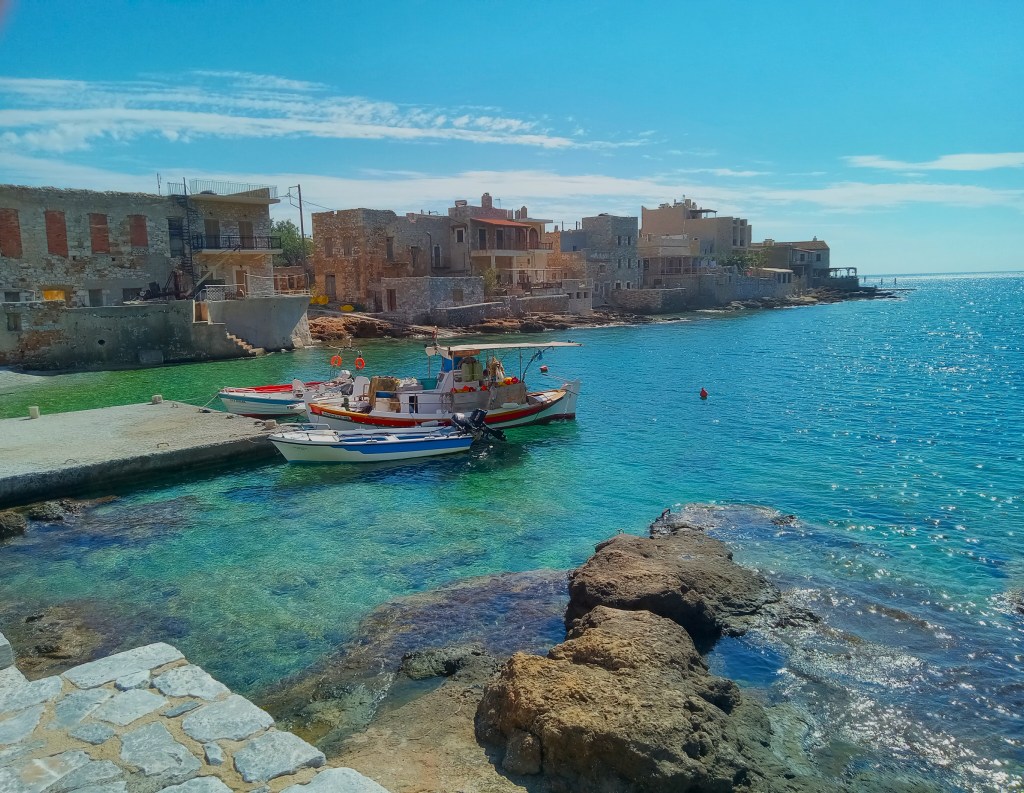
On a driving tour, we lunched in Gerolimenas, with this view, including a traditional-style, double-ender Greek fishing boat. Sad trivia: The European Union is paying fishermen to destroy such vessels, to help preserve the fishery.
Since then, we’ve taken day trips on winding, narrow roads to see more of their beautiful Mani district, poking our noses into little roadside Byzantine-style chapels. I’ve taken a brisk morning hike with one of their American expat neighbors, a new friend named Chuck. Gone swimming with Chuck and his sweetheart, a firecracker of an Englishwoman named Boris (that’s her last name, and preferred moniker; first name: Caroline). And we’ve dined at different little waterfront cafes night after night, sometimes joined by passing friends, always doted on by familiar restaurateurs whom Jackie and Joel greet with a jovial “Kalispéra!” (“Good evening!”).
My new hiking friend, Chuck Bartlett, on an old donkey path we followed. This was the former “highway” between villages of the Peloponnese. Olive groves are seen below.
Jackie and Joel have carved out a comfortable and engaging expat life here, and I’ve felt privileged to share a few days of it. (Follow Jackie’s blog about their life and travels.)
On tomorrow to the isle of Rhodes for this wandering one’s last taste of Greek civilization (for this trip, anyway). On my own again, trying to remember how travel works (you get rusty!); savoring the good things, and trying to let headaches pass like a breeze off the sea.
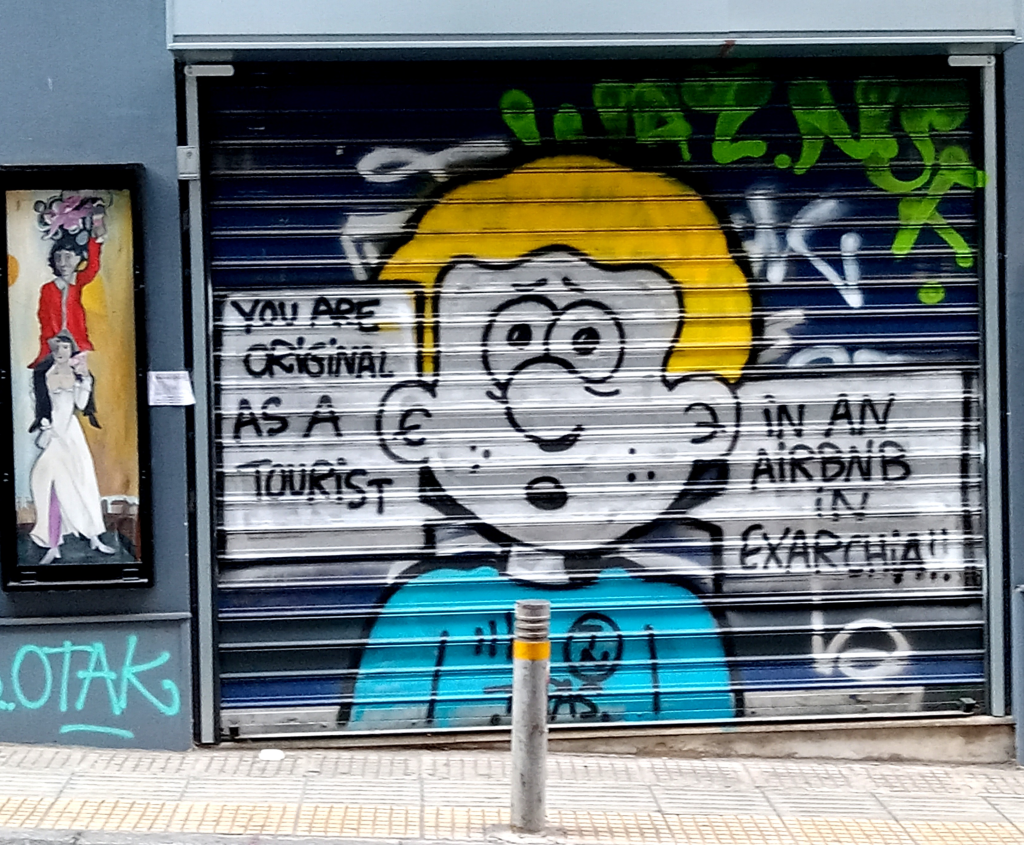
Taggers spare no surface in Athens’ gritty Exarchia district, where a wag with his spray paint declared that “You are original as a tourist in an Airbnb in Exarchia!!” But besides hosting the National Archaeological Museum, the district abounds with second-hand bookstores, comic-book shops and cafes with character.
ATHENS IS ALL ABOUT ANTIQUITIES, and most tourists flock to the Acropolis Museum. It’s a good museum, full of artifacts from the city’s most famous archaeological site.
But Greece’s lesser known, less-crowded, somewhat off-the-beaten-track National Archaeological Museum lured me to the gritty and counterculturist Exarchia district, thanks to a tip from my brother, Doug, along with the author of a Moon guidebook I’ve been using.
I could write a lot about what I saw in my two hours at the museum, and it might sound quite academic and informative — and set you snoring.
Instead, I’ve put together this lively video snippet. I find that a travel outing is often a montage of memories, of quick impressions. Sort of like this:
Istanbul’s glitzy new airport is truly a crossroads of the world, and a monument to capitalism. In the background is the colorful video wall of the airport’s duty-free Louis Vuitton store.
SOMETIMES YOU HAVE TO GET OFF YOUR ROCK. Really off.
I’m sure not in Kansas, or Center Island, or anywhere near it, anymore. And if I were wearing ruby slippers, I expect I’d get blisters from all the walking I’m doing.
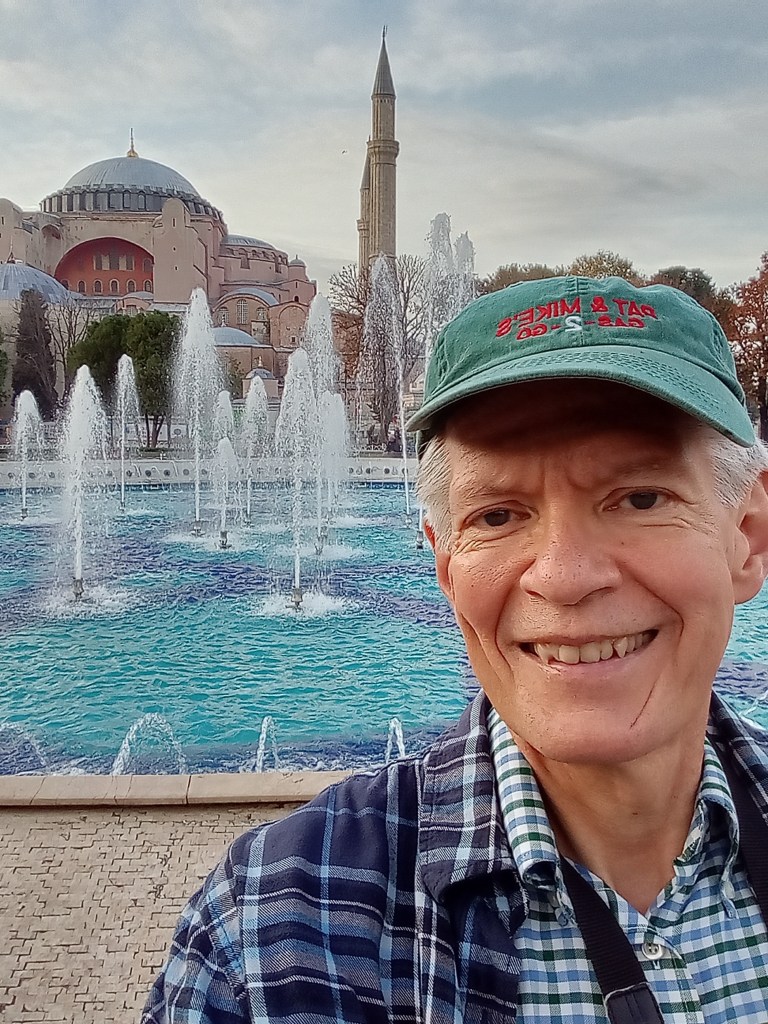
Your jet-lagged correspondent feigning consciousness on a morning walk at the famed Hagia Sophia in old Istanbul.
For a few days, your Cantwell’s Reef scribe is veering away from the San Juans. I’m on my first big overseas adventure since COVID, and since losing Barbara. It’s a very different world.
I’m awakening this morning for the first time in Greece, and tapping out a few lines before I set off on a day of wandering Athens.
I flew out of Sea-Tac on Sunday on a beautifully appointed Turkish Airlines 787 — they call it the Dreamliner for good reason — and had a quick one-night layover in Istanbul.
Long a crossroads for the world, Istanbul now has Europe’s busiest airport, newly opened in 2019.
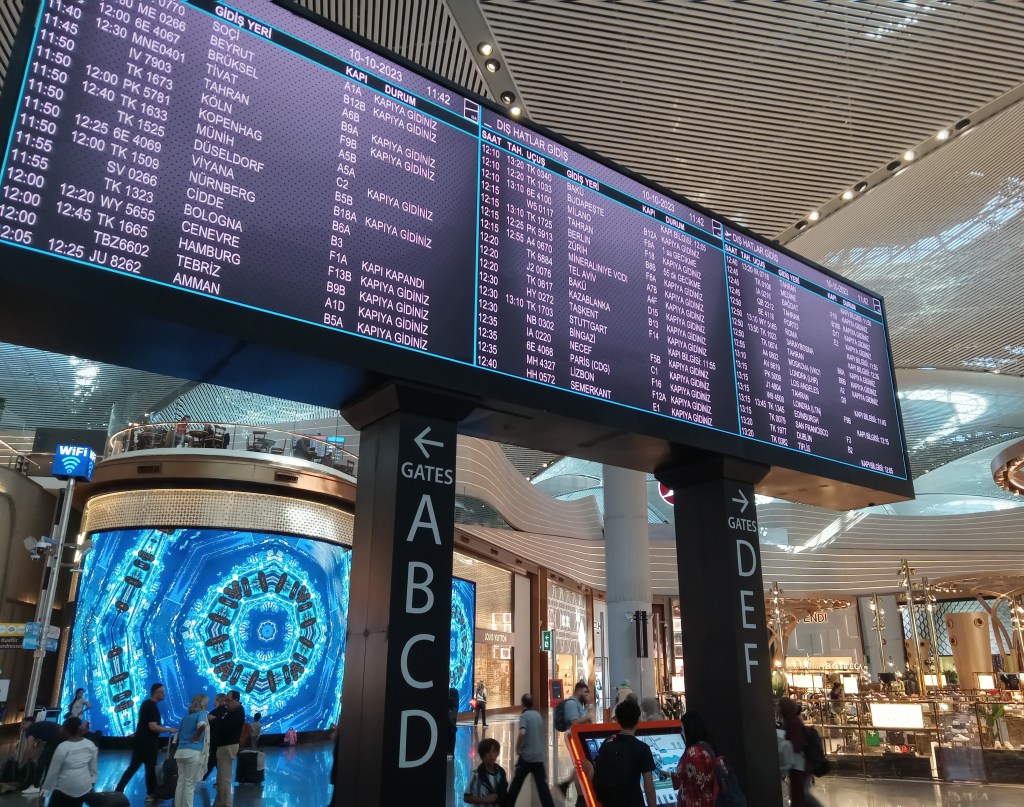
It is a sprawling, huge facility, a monument to capitalism, with shopping glitz to rival New York’s Times Square. It is the hub for the ambitious, world-circling Turkish Airlines. On my departure day yesterday, they were barely managing the chaos and crowds. Finding gates for departing flights was a slow and apparently challenging task, despite the overwhelming size of the facility. Many flights were delayed, including my Athens flight, which left more than an hour late.
My mantra for this trip is to take things in stride.
Istanbul Airport’s gate board, with alphabets of every ilk.
Jet-lag has been a challenge. On my arrival in Athens late yesterday afternoon, I kept falling asleep on my feet in the crowded train from the airport. I am awake and typing this at 6 a.m. the next morning because my circadian rhythms are still off by several beats, like the orchestra’s percussionist who keeps missing his cue with the cymbals.
With all those modern-day challenges, today I dive into antiquity, with a visit to Greece’s National Archaeological Museum. I’m saving the Acropolis for tomorrow, when I’ve gathered my wits (one can only hope).
Now, time for a hot shower and to venture out to find a good Greek coffee shop in the bohemian Exarchia district surrounding the museum. Wish me luck, I’m going in.
As with many boat owners, we don’t have a lot of good photos of our boat under sail. (It’s hard to take a good selfie when you’re on a sailboat.) Here’s a grainy old photo of Sogni d’Oro from years ago, taken by a sailing friend as we plied the Columbia River at Longview, Wash. The boat’s name is the Italian version of “Sweet Dreams.”
FOR THE FIRST TIME in 34 years, the largest sailboat I own is less than 10 feet long.
Last week, I ventured to Seattle to meet with my new friend Lux Sloane Kirkham, and we drove to the credit union to meet with a notary and sign a bill of sale, which I mailed off to the Coast Guard’s National Vessel Documentation Center in Falling Waters, West Virginia.
With that, Sogni d’Oro, the dear old Westsail 32 that was home to all or some of my family for 30 of those aforementioned years, the boat that took us cruising the San Juan Islands every summer for decades, and on one of our lives’ great adventures, to Mexico’s Baja peninsula and the Sea of Cortez, has someone new to love her.
Just as we did, Lux has the ambitions, the dreams and the gumption to give Sogni d’Oro new adventures. For that, daughter Lillian and I feel content.
It was to that boat’s Columbia River moorage that Lil came home from the Portland hospital of her birth in 1991. On the bowsprit, a pink flamingo — not a stork — held the “It’s a girl!” sign above a swaddled bundle in its beak.
It was from that boat’s helm that I first navigated the Columbia River bar, the famed “Graveyard of the Pacific,” which we crossed back over in inky night after a day of traversing fearsome 20-foot-swells that our stout boat criss-crossed like a skilled skier.
It was on that boat’s radio that I called a Mayday distress call in the face of a piracy threat from an unrelentingly aggressive, silent, mystery vessel on another inky night, 20 miles off Ensenada. As soon as I called the Mayday, the other boat turned away. (Nobody ever responded on the radio.)
It was from that boat that my family and I watched a gray whale teaching her calf to breach, again and again and again, just off our beam in the Sea of Cortez. It was from that boat that we thrilled at the sight of hundreds of dolphins leaping all around us another day. And it was from that boat that, with a sense of awe and a trifle bit of anxiety, we identified two cetaceans spouting just off our stern as blue whales, the largest animals on earth.
After the recent final days of clearing our many possessions, logbooks and charts off Sogni d’Oro, I brought home a box full of memories. Sifting through, I discovered a log entry from our first San Juan Islands voyage in the boat that was new to us just two weeks earlier. Reflecting our greenhorn abilities and newbies’ knowledge, and featuring a longtime friend and my late wife and parents, it makes for a nice bit of symmetry on this occasion:
Log of the Sogni d’Oro
August 2, 1989
This was the first day Barbara and I sailed our boat alone, without [our sailing friend] Ken or my parents aboard. It was a momentous day, dawning with gusty breezes coming from the Strait of Juan de Fuca, to the southwest.
Our moorage at lovely little Turn Island State Park was the perfect choice — a 15-minute motor from Friday Harbor, where we had left my mom and dad after a perfect afternoon of sailing up to Yellow Island to see the old driftwood house where the island’s former owner, a San Juans hermit of wide renown, lived until 1960. The island now belongs to the Nature Conservancy.
We set out at about 10 a.m. Barbara was a little anxious about the winds and our first “solo,” so she didn’t eat much of the tasty fresh strawberries, yogurt and granola we had with coffee for breakfast.
Putting up sail off little Brown Island went smoothly. Barbara has become an old pro at it, helping and working with Ken Brinkley, so she needed my help only to get the mainsail to the top of the mast. I lashed the tiller with bungee cords, a moderately satisfactory solution, though a little wobbly.
Wind settled down to about 5 knots. Fighting the ebb tide in San Juan Channel (our customary habit by now), we sat and looked real pretty but didn’t go very far. Looked at Friday Harbor for an hour or so as Barbara handled the tiller. She asked for some sailing tips, so we played “20 Questions” about points of sail, boating right-of-way, etc. A good way to learn. Watched the little interisland ferry, the Hiyu (seems like a folksy, appropriate name for this little open-air bathtub) chug up the channel ahead of us. Comfortingly, it didn’t do much better.
Finally, as we came up even with Wasp Channel, the current seemed to change in our favor and the wind freshened, putting us on a broad reach for several miles, when the boat didn’t alternately decide (skipper be damned) to go wing on wing. Winds fluky, but we were moving comfortably.
Still not fast enough for the skipper. So I finally convinced Barbara (who has suffered foresail anxiety ever since a Barlow winch disintegrated in her hands as we raised the genoa at the wrong time in Saratoga Passage) to let me hoist the dinner-napkin-sized tri-sail. Not much extra horsepower, but it made us look good, as a cutter rig should.
Back to present day: The remaining sailboat in the Cantwell fleet is the little Black Pearl, a plywood sailing dinghy that Lillian and I built under the tutelage of a Center for Wooden Boats instructor at a long-ago Lake Union Wooden Boat Festival. The Pearl is docked most of the year, snugly wrapped in a tarp, beneath the front porch of Nuthatch Cabin.
Another bit of symmetry: While we got much better over the years at reading and predicting San Juan currents in the big sailboat (and had a powerful diesel to crank up if all else failed), a sail outing these days in the little gaff-rigged Black Pearl is totally at the mercy of currents. As much as any point of sail, she’s perfectly happy going backwards, occasionally in circles.
Maple leaves are falling on my knoll. Along with raindrops. Not much autumn color happening.
IT WAS A DRY SUMMER on Center Island, other than the bizarre 48-hour thunderstorm with hourly downpours that we experienced a month or so ago.
But since yesterday, the first full day of autumn, we’ve aptly experienced the weather phenomenon for which the Pacific Northwet should be deservedly famous: drizzle.
In fact, I glanced at the weather forecast yesterday morning — rain for the next week — and dashed outside in robe and slippers, before my first cup of coffee even, to put away the deck furniture for the season. Not that Galley Cat and I ever leave things to the last minute at Nuthatch cabin.
Many non-webfooted outsiders think Seattle is the wettest city in the United States, with constant downpours, but with only about 37 inches of rain in the average year (drizzle, drizzle, drizzle), it’s not even in the top 10. The wettest American city of more than a million people? A place most people go when they want get a tan: Miami, Florida, averaging 64.7 inches of annual liquid sunshine. (Rounding out that top 10 list, based on NOAA records: New Orleans, Birmingham, Houston, Memphis, Orlando, Nashville, Atlanta, New York and Tampa.)
Center Island, in the Olympic rainshadow, gets only about 13 inches a year. Drizzle, drizzle, drizzle, drizzle, drizzle.
It’s cozy inside looking out. I might build a fire in the woodstove. Maybe make a cuppa tea. Happy Sunday, all. Batten down.












 Cantwell's Reef