
Sometimes you have to work for a merry Christmas. Let me tell you.

This was the view from the Nuthatch cabin’s front window the morning of December 20. The railing was snow-free only because ravenous birds mobbing the feeder had knocked it clear.

ALEXANDER, THE GRUMPY BOY from a well-known 1972 children’s book, would likely agree:

This has been a terrible, horrible, no good, very bad December in the San Juan Islands.

A week ago Monday night, it snowed and snowed, then snowed some more. Enough to snowshoe on. Skis would have been great. Tromping around the island, as my boots sank deep, I got twice the normal exercise.

Then it froze and froze, then froze harder. The snow never melted. My firewood pile sank quickly.

Daughter Lillian, who lives in Seattle, and I had long ago planned Christmas at a little camping-cabin at Camano Island State Park, a pretty spot halfway between us, reachable by a bridge from the mainland. The trip required only an hour of driving for each of us.

Our Christmas cabin on Camano Island.

Happily — even Alexander would have been optimistic — the National Weather Service assured us that a warming trend would arrive two days before Christmas. Presumably, rain would wash away the snow and ease any travel worries. Our plans were golden. I’d catch a water taxi on the late morning of Christmas Eve and Lil and I would meet up in time for the 4 p.m. check-in time, ready to whirl our way around the little cabin, trimming it with lights, baubles and bows.

Though snowy and cold, the week was going well. I’d hosted a pleasant happy hour for neighbors on the solstice. Then, Thursday at 1:09 p.m., my water-taxi service texted to tell me that they expected to cancel every trip on Christmas Eve. The forecast called for winds exceeding 50 mph, rendering the voyage unsafe. Even Santa might get blown off course.

Rebook your trip for Friday, the Paraclete Charters folks urged.

Panic ensued. Staging a portable Christmas with many of the favorite family decorations and dishes — the Santa-and-reindeer light string, the Christmas Spode, etc. — entailed hours of careful packing. I’d been counting on a full day of prep on Friday.

I would also now need a place to stay Friday night on the mainland.

Shamelessly, I phoned my next-door neighbor, the Mad Birder, and “invited myself ” to crash with my sleeping bag on his sofa at the La Conner home he shares with his wife, Carol. They had boated over to Center Island the previous week, to stay through Christmas at their cabin.

The Mad Birder, generous by nature, put up little resistance. He also agreed to look in on Galley Cat, who would be home alone for a couple nights. (Someone else had nabbed the one Camano cabin that allowed pets.) By late afternoon, it seemed that I (with help from the M.B.) had risen to the challenges the islands were throwing at me this Yuletide. I would get the Paraclete’s final Friday sailing, by which time the snow would have mostly melted away. So the plan went.

Then, at 4:45 p.m. Thursday, just as I was thinking about dinner prep, the lights went out.

My meal that night was a peanut butter and jelly sandwich.
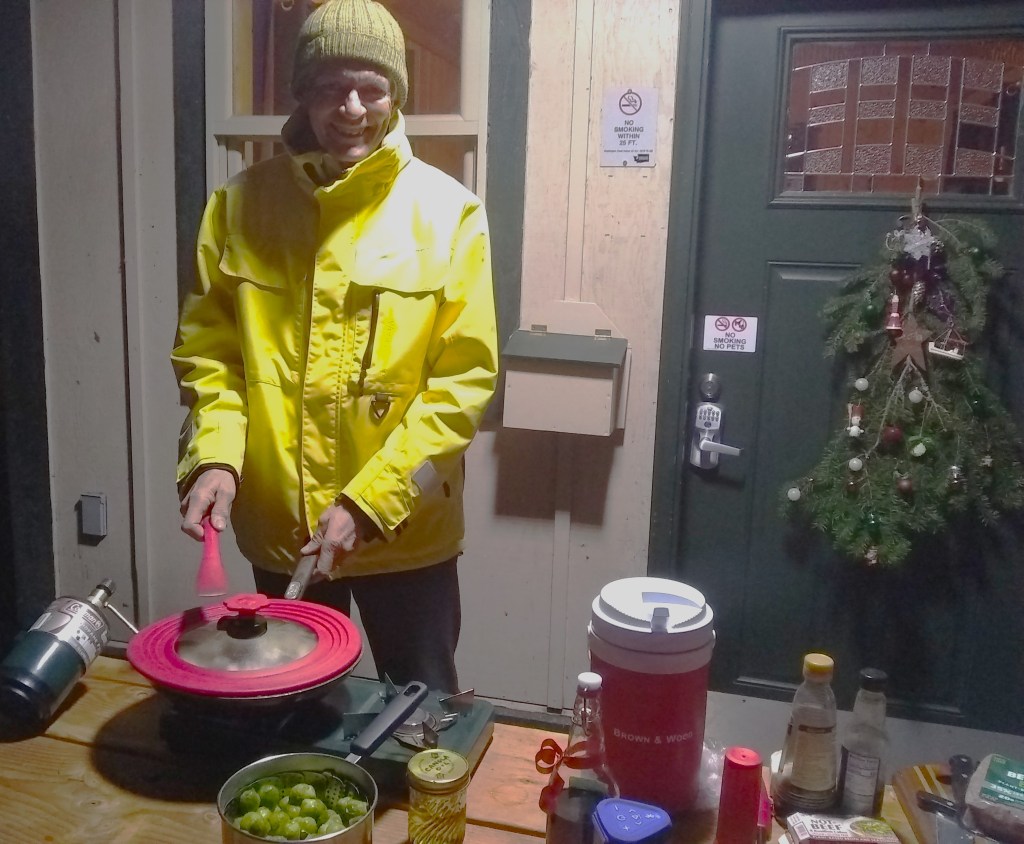
Your correspondent with Christmas dinner in the works: stovetop Shepherd’s Pie, with Brussels sprouts, spiced with fresh air.

Usually these outages are localized and fairly quickly resolved. But a call to our power cooperative informed me that the outage was countywide, caused by a system failure on the mainland. Uh-oh. That meant fixing it was up to Puget Sound Energy and Bonneville Power Administration, rather than our quick-responding, owner-operated Orcas Power & Light Cooperative (OPALCO). Our islands don’t always top the priority list for Puget Sound Energy, owned primarily by Canadian investors.

A recorded message said the power might be out at least four hours. Outside temperatures were in the low 20s. It would be a very cold night. After I’d risen every hour on the hour to stoke a fire in the woodstove, my lights came back on 13 hours later, at 6 a.m. Friday. I could cook again, but I was bleary eyed at the start of a very long day.

Friday didn’t warm up nearly as much as forecast. By the time I needed to head for the dock with my food, gifts, decorations, camping gear and warm clothing, eight inches of snow remained on the ground. The gravel roads were still coated in compact snow and ice. No traction for my golf cart or a community pickup truck, so I loaded baggage into my pushcart and trudged slowly across the island, 3/4 of a mile through freezing rain and light snow. Two trips, the last one in the dark. I really didn’t want to cancel Christmas with my daughter.

Happily, roads in Anacortes and the Skagit Valley had almost completely thawed. I made it to La Conner with barely a hitch. The only place I got stuck was trying to pull into my friends’ driveway, still a solid mass of snow. Luckily, I’d brought a shovel.
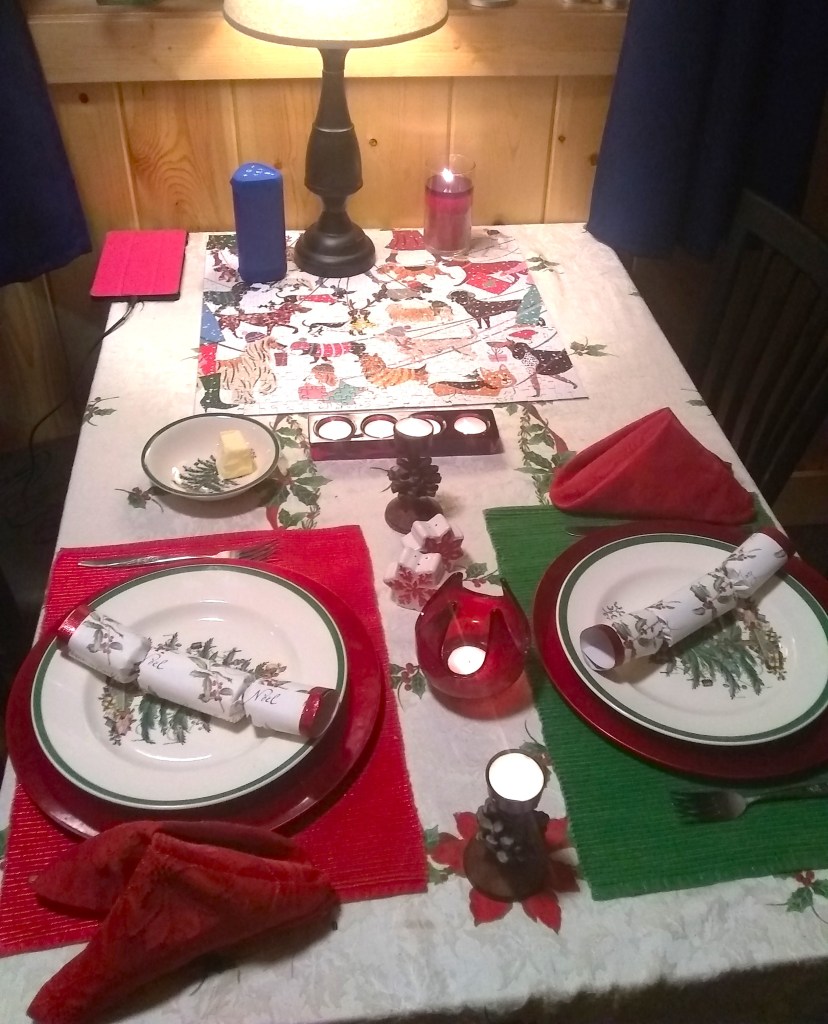
Our Christmas dinner table at the Camano cabin included prize-packed crackers, a fixture inspired by my late wife Barbara’s Australian upbringing.

At 8 p.m., I sat down to the sack dinner I’d brought. In a phone call to let the Mad Birder know I’d made it, he insisted I raid his liquor cupboard for a tot of Glenfiddich. This time, it was I who put up little resistance. If there’s a heaven, that man is going there.

The next day, Christmas Eve, Lillian and I made our rendezvous at the Camano cabin. It was basic, but cozy, with lights, heat, a fridge, a microwave oven and comfy beds. I set up my propane camp stove on a picnic table under the covered porch. Bathrooms and hot showers were 100 feet away.

We made the place festive, gathering fallen fir boughs for a window-sill vase and a swag on the door. Lights went up in a window and over the door. If there had been a hall, we’d have decked it. Heirloom treasures made for a holiday dinner table fancier than that place had ever seen, I’ll wager. I was glad to have trundled the Cantwell holiday trappings through the snow.

Meanwhile, I discovered that the San Juans had lost power again that morning. My kind neighbors were again sitting in the dark. Happily, power came back on just in time for their Christmas Eve dinner.

Christmas Day, my daughter and I breakfasted on almond-flour blueberry pancakes. We hiked through rain-washed woods to wander the beautiful cobbled beach, returning to the Christmas cabin to lunch on Stilton and Cotswold Double Gloucester cheeses on crackers while piecing together a new jigsaw puzzle. We played new board games before and after a savory dinner of camp-stove shepherd’s pie, which Lillian totally aced.

Your correspondent, left, and daughter in their Christmas crowns.

My dessert, Bûche de Noël, baked at home just before the power failed, was, um, a mixed success. The sponge was basically a failure — chewy and tough rather than airy and light. But if you smothered mocha-flavored whipped cream on cardboard, it would still be heavenly.

So, after all, in the end, the terrible December got better. The horrible weather didn’t defeat us. Christmas turned out more good than no good. And even my very bad dessert was tasty.

Is there a moral to the story? I guess it’s this: Let’s nurture resilience and hope. Let’s meet the challenges. Let’s trundle through the storms, no matter what 2023 throws our way. Happy new year, friends. And remember to bring your shovel.

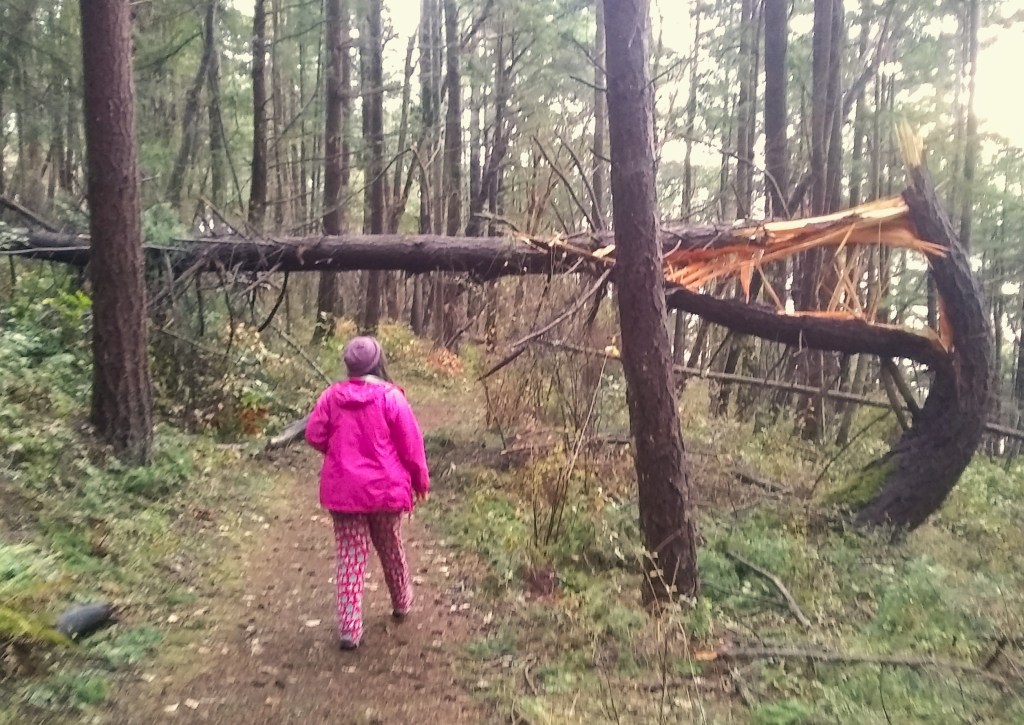
Winter winds had wreaked havoc in the woods at Camano Island. The fang-like splinters inspired Lillian to dub this the dragon tree.

Holiday multi-tasking on the mainland

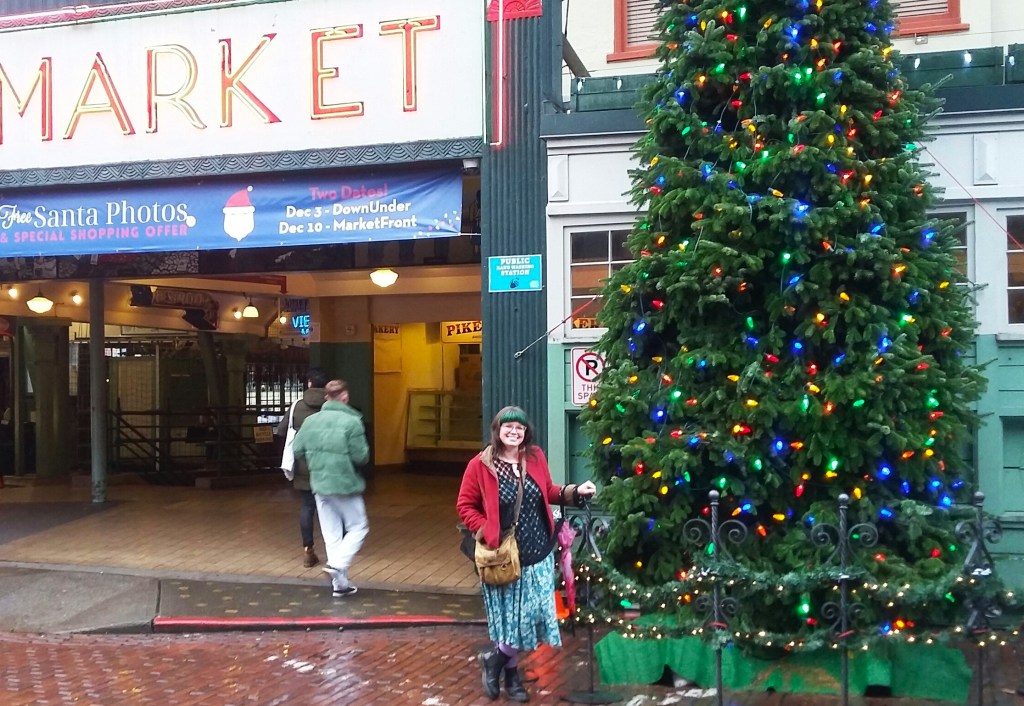
The aisles are empty for our early arrival at Seattle’s Pike Place Market. Daughter Lillian gathers her energy for a busy morning of holiday shopping.

I WON’T ASK FOR TOO MUCH SYMPATHY. Living on a small island in the San Juans isn’t too painful, I admit.

But this remote life with no stores, no garbage pickup, and no bridges to the mainland has its challenges. Anytime I leave Nuthatch Cabin for an overnight outing requires days of planning and preparation. And once I’m walking among the landlubbers, I’m a multi-tasking fiend. Especially as winter sets in.

Friends have expressed curiosity about my shopping and travel routines, so here’s an example from a recent four-day visit to the Outside (as bush-living Alaskans call the rest of the world).

Getting there

  • SEVERAL WEEKS in advance, I trade emails with friends or family to see if a guest room is available for me and possibly Galley Cat.
  • FIVE DAYS in advance: I text Paraclete Charters, my preference of the two local water-taxi services (because their boat has a cargo area protected from the elements). I request a booking for passage back and forth to their base at Skyline Marina in Anacortes. It’s a 35-minute boat ride from my Center Island dock, though that can be considerably longer when they stop at other islands. Rather than take my vintage runabout to Anacortes, I rely on the water taxi for the 5-mile crossing of Rosario Strait, which can kick up nasty any time of year. My Paraclete friends and I trade notes about preferred travel times; they make two or three round-trips to the islands each day. Once we’ve settled on an itinerary, they confirm my reservations.
  • A FEW DAYS AHEAD, I figure out how many cargo totes I’ll need. I pack one with bagged trash, to deposit in a mainland dumpster. Another carries snacks, cat supplies and a few food items; I usually try to contribute to a meal at my host’s home. I have a lot of grocery-shopping needs this time. I seem to have run out of everything at once, and winter is coming. I feel like a worried squirrel whose store of nuts is low. I bring a large hard-sided ice chest to transport frozen foods and an empty 18-gallon plastic tote to hold other groceries on my return trip. While nearby Lopez Island has a sizable supermarket and a well-stocked natural foods store, inflated island prices encourage me to do the bulk of my grocery shopping on the mainland. A small soft-sided suitcase takes my clothes, plus a soft-sided cat carrier for Galley Cat.
  • TIME TO CLEAN HOUSE. I hate to come home to a messy cabin. Out comes the vacuum, the broom, the duster and the spray cleaner. Galley, not a fan of roaring machines and spritzing spray bottles, flees outside for an hour.
  • PACKING clothes and supplies takes up the day before my departure. When Galley is to accompany me on a trip, I do packing the day before leaving. She is generally a good traveler on road trips, but by far prefers that we stay home by the fire. When the suitcase comes out and I start cleaning like a fiend, she knows she’s about to be scooped into her travel carrier, so she hides under a bed. Prying her out can be like wrestling a grumpy Tasmanian Devil from its den. So, on departure morning, 30 minutes before it’s time to load my baggage on to my golf cart for the trip to the dock, I pop her into the bathroom and close the door so as not to be chasing her frantically around the cabin when it’s time to catch the boat.
  • ON THE BOAT RIDE, when not looking out the window at Stellar sea lions that hang out on Bird Rocks, I write a check for the $38 fare (one-way) and text my Farmers Insurance agent letting her know I’ll be using the car for a few days. She takes my Honda Civic off the “storage” rate and I pay an extra $3 a day for insurance while I use it.
  • ROOM AT THE INN: After I drive south for a couple hours, sister- and brother-in-law Margaret and Tom Hartley host me and Galley at their comfortable home in Shoreline, just north of Seattle. I enjoy good company, a delicious home-cooked dinner and a DVD viewing of “Love Actually.” Galley stays in the guest room to avoid conflicts with my hosts’ tabby.

A multi-tasking whirl

  • SATURDAY, daughter Lillian and I wade out into the rain on our annual day of Christmas shopping at Seattle’s Pike Place Market, reached by a light-rail ride from Northgate. We start with Eggs Benedict for breakfast at the Athenian Restaurant, from which we gaze out the window to watch scuttling ferries on Elliott Bay. Favorite shopping stops include Perennial Tea Room, with loose-leaf teas galore, and Golden Age Collectables, which claims to be the world’s oldest comic-book store. We watch fish getting tossed, we have tea and crumpets for “elevenses,” and give a Christmas-sized tip to the busking piano man. By the time we head back to the rail station, our giant plastic shopping bag bulges with gift purchases.
  • SUNDAY, I spend the forenoon piling carts high with groceries at Trader Joe’s, Fred Meyer and Costco (the total tab: $435.90; I really was out of everything). At the car, playing something akin to Grocery Tetris, I meticulously wedge my purchases into totes for homeward transport. Next stop: Shoreline’s Holyrood Cemetery, where I place Christmas wreaths on the graves of my parents and in-laws and sing them a lonely carol. (The couples are buried about 100 yards from each other.) The day concludes with the annual Burns Family Christmas potluck at the Kenmore home of my sister- and brother-in-law, Sarah and Danny Mansour. The gathering is a highlight of the year for my late wife’s family, sharing good food, good drink and lots of socializing.
  • BUT IT’S NOT OVER YET: Monday morning at 7:45 I check in for an annual dental check-up and cleaning at Willamette Dental in Mountlake Terrace. Multi-tasking, remember? With a clean bill of dental health (and sparkling teeth), three hours later I’m the carpool driver for a couple of old friends, Kristin Jackson and Steve Miletich, on our way to a lunch gathering in Seattle’s Chinatown-International District with other former Seattle Times colleagues, Terry Tazioli and Lynn Thompson. The dim-sum carts don’t stop rolling at Joyale Seafood Restaurant. Eventually, we waddle back to the parking garage, and I buzz back to Shoreline to fetch my kitty cat and hit the highway back to Anacortes for a 4 p.m. sailing to Center Island. Among my many other purchases I’ve filled a 5-gallon jug with gasoline to add to the tank of my pickup truck next time I voyage to Lopez Island, where gas costs twice as much.

By 5 p.m., I’ve trundled all my groceries back to the Nuthatch, filled the fridge and freezer, lit a fire and poured a glass of wine. Time to rest up for the next trip to the mainland.

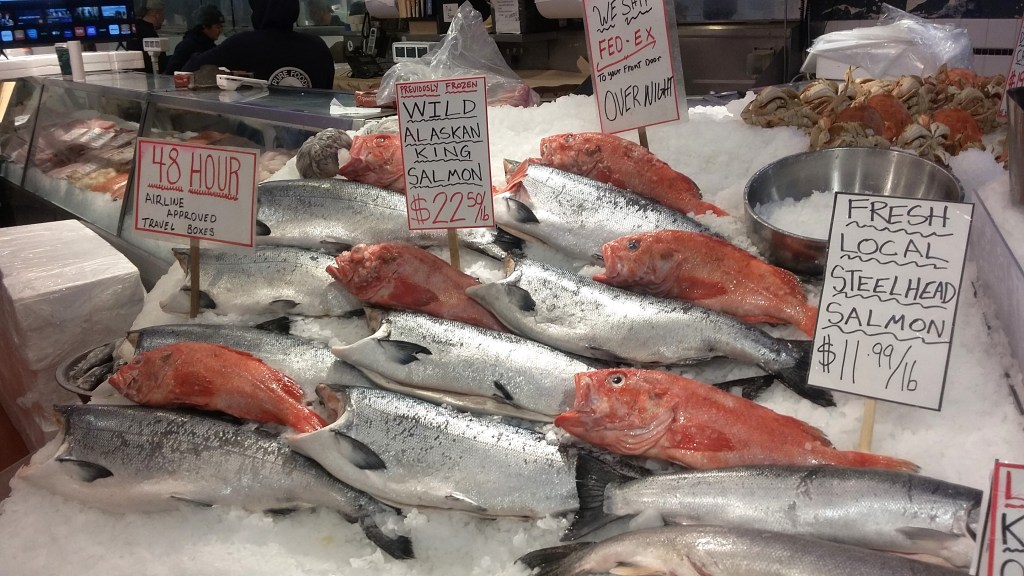
Meanwhile, happy holidays! May you all feast from a larder as full as mine. As a Christmas bonus, here are more colorful images from the Pike Place Market.

Fillets for flinging: Salmon and more wait for the fish-throwers to practice their sport at Pike Place Fish.
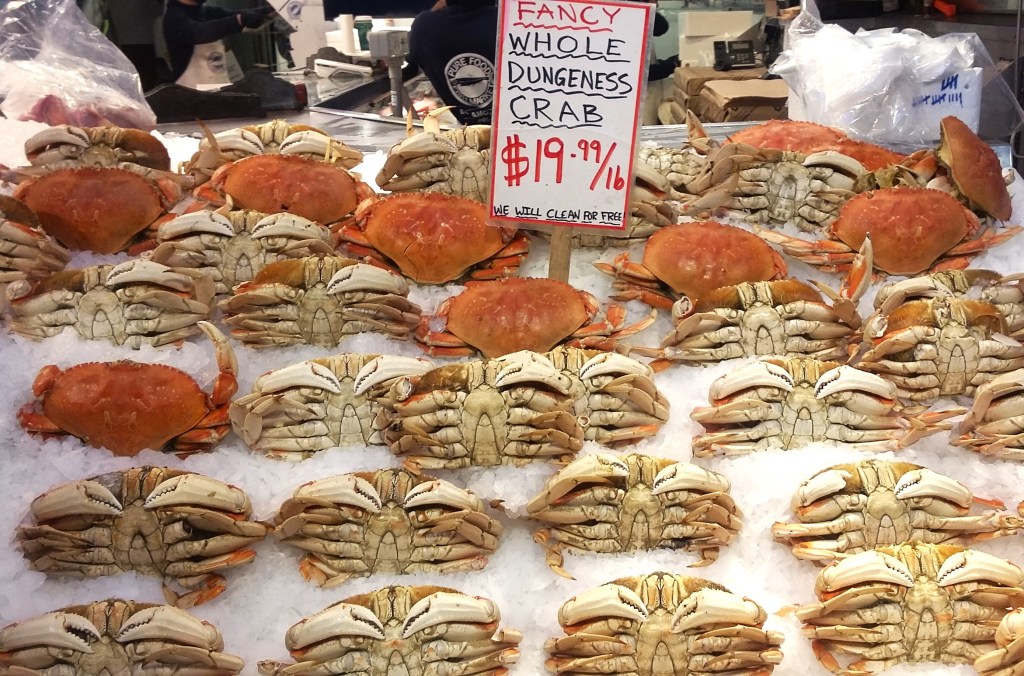
Crab priced like gold? Maybe a wise man will bring some as a gift to you on Christmas Eve.
Dazzling colors match the bold flavors for sale at a Pike Place produce stand.
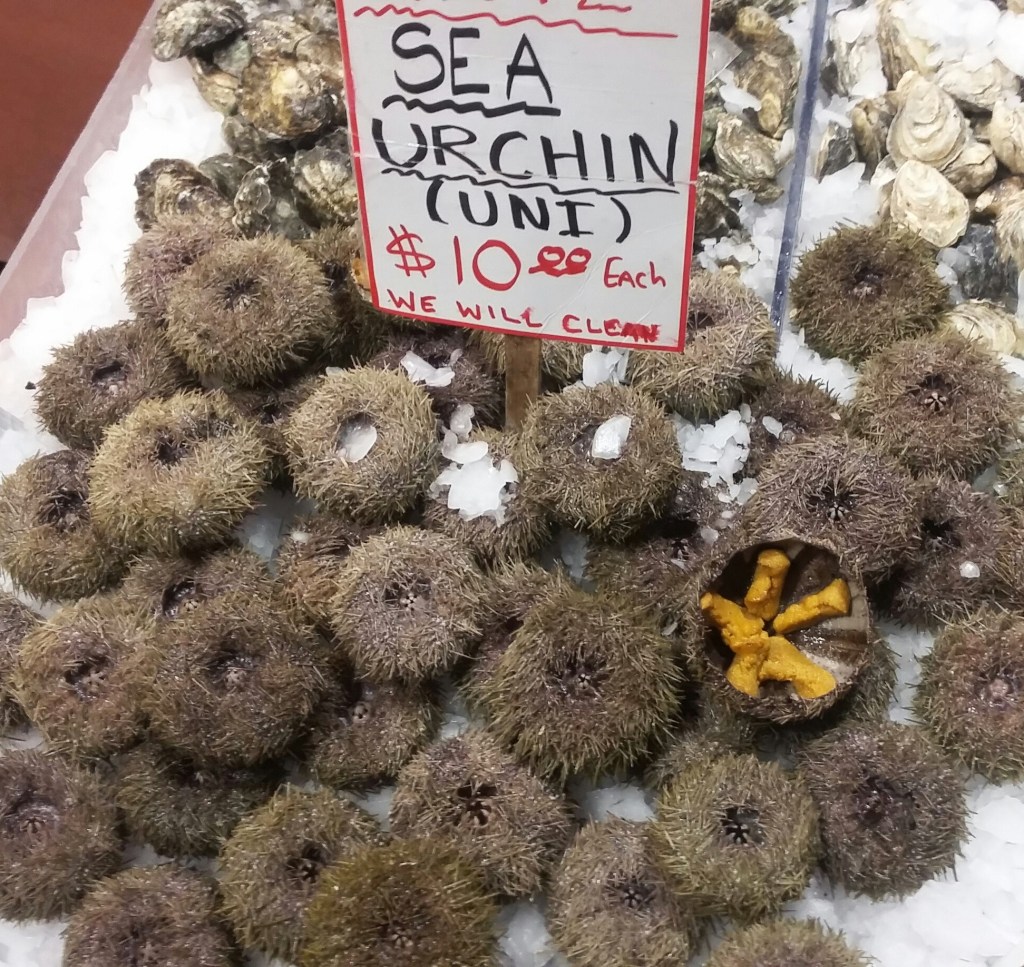
The scruffy urchins of Charles Dickens’ London have a spiny counterpart on the seafood counters of Pike Place Market.
Dungeness crabs line up for a photo.

A thankful time before the storms

Chris Noel and Lillian Cantwell on the edge of San Juan Channel at Lopez Island’s Shark Reef Sanctuary.

IT’S HUNKERING-DOWN SEASON in the islands.

But before the snow flies, Galley Cat and I enjoyed a Thanksgiving that evoked the true meaning of the day, with an enjoyable visit from daughter Lillian and her new partner, Chris. Lil is vegetarian and he eats vegan, so turkey wasn’t on our menu. Instead we fired up the charcoal barbecue — never a bad turn of events at the Nuthatch, in the view of this chief cook and bottle washer — to grill Beyond Meat burgers. For a Thanksgiving spin, we added sage to the plant-based “meat” (meet? mheet? mieht?) and a dollop of cranberry sauce on the buns. Sweet-potato fries and oven-crisped green beans were our sides. For dessert: Lillian’s homemade pumpkin pie. (The woman has the gift of pie crust, a skill that will serve her well in life.)

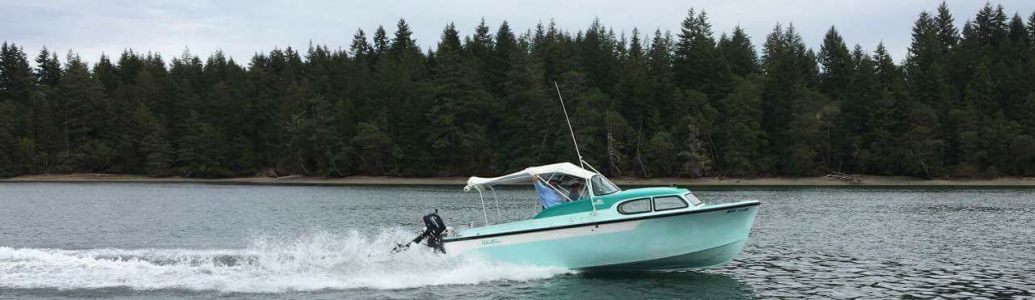
We played games by the fire. We watched favorite movies. The day after our fanciful feast we hopped aboard WeLike, the eldest but most colorful watercraft of the Cantwell fleet (turquoise was popular in 1957), and buzzed over to Lopez Island for a hike through woods to one of my favorite San Juan destinations, Shark Reef Sanctuary. As we looked out from a mossy cliff, whitecaps churned the wide Strait of Juan de Fuca, harbor seals and cormorants lounged on offshore rocks, and wind-riding bald eagles pirouetted above our heads.

Lil and Chris returned to Seattle on Saturday morning, and I soon set about preparing for winter. The weather forecast for this week frequently mentions the “S” word (snow), along with robust winds, pelting rain and nighttime temperatures below freezing.

I hoisted a brown triangular rain tarp between trees to help ease winter’s assault on the Nuthatch’s Electronic Personnel Transport, aka Mr. Toad, my 26-year-old golf cart. (A toad-size carport is still on the to-do list for coming summers.) I climbed aboard Center Island’s big orange Kubota tractor and pulled WeLike on to its trailer for winter storage, safe from battering waves. After spraying the boat’s canvas top with waterproofing gunk (to use the technical term), I snapped on the window covers and refreshed the boat cabin’s dehumidifiers with new calcium-chloride pellets.

So, let’s see. The woodshed is stacked high. The pantry is stocked. Extra cat food is on order. Tomorrow I will test-run the gas-powered generator and be sure the emergency candles are someplace I can find them in the dark, should it come to that.

Winter’s coming. On a small island nobody’s heard of, you gotta know when to hunker down.

Zen and the art of golf-cart maintenance (with a little ghostly help from a friend)

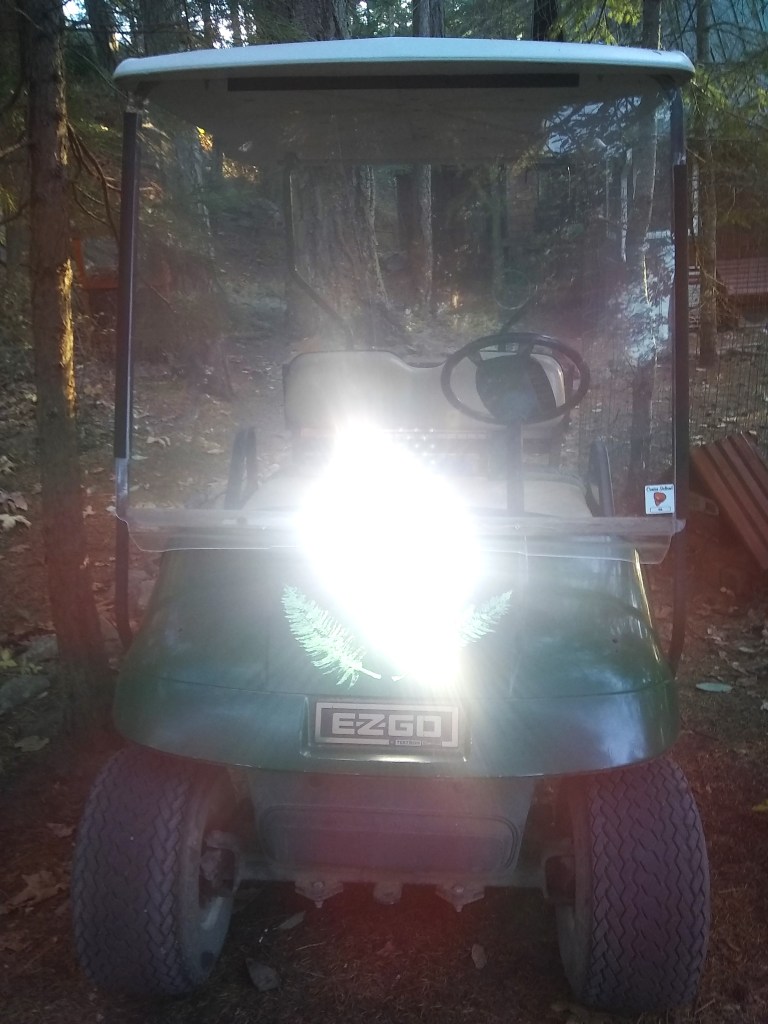
MR. TOAD HAS BECOME A CYCLOPS.

Yes, my snubnosed, bullfrog-green golf cart no longer has the two halogen headlights that gave it such a froggy face. The little flivver’s two “eyes” originally contributed to our decision to name it after the automobile-obsessed, speed-demon, amphibian antihero of “The Wind in the Willows.”

One of the headlights had long ago filled with water. The other recently decided to stop working for reasons unknown. With a rare need to do much night driving on Center Island, I coped with it. But now that Pacific Standard Time draws down the nightly veil around 4:30 p.m., and the afternoon Paraclete water taxi doesn’t get me back from Anacortes until nightfall, I’m driving home from my dock in blackness like a mortician’s hat.

When last I returned from a trip to Outside, I luckily had packed my battery-powered headlamp, of the type useful for night hiking. Unfortunately, wearing the headlamp while driving Mr. Toad was no help; the bright beam only reflected glaringly off the plexiglass windshield. So I had to hold the headlamp out to the side of the cart with my left hand while steering (and veering) with my right. At least I got home without swerving into the Nootka rose brambles.

The new LED headlight shines like a locomotive’s lamp from the front of Mr. Toad, my little green golf cart.

A few years of island pioneering has taught me to think ahead, however, so as I rambled along the gravel cowpath on the way to the Nuthatch that night, I had in my baggage a newly acquired LED headlight for Mr. Toad.

I’d shopped online first. (Hey, I live on an island with no stores.) But I always read the one-star reviews of any item before I hit “buy.” Most of the cheap, Chinese-made LED lights suitable for a golf cart came with obscure brand names such as “Turboo” and “Bliauto” (product description: “Lights Pod Is Bright Enough to Provide Visible for You to Observe the Road Conditions Around The Car During Travel”). Reviews were littered with words like “junk.” Many warned that the supposedly waterproof units filled with rainwater within weeks.

So I’d bucked America’s shopping trends and actually walked into an auto-parts store in Anacortes to find what I needed.

I was drawn to a four-inch-square, 13-LED “pod” manufactured by Sylvania, for many decades a reliable name in the American lighting industry (who manufactured this item in Mexico, according to the fine print, but oh, well).

The one headlight cost double or triple what I might have paid for two lights online. But often you really do get what you pay for. And because this 2,100-lumen light was designed for offroad use — the box pictured Jeeps, swamp buggies and farm machinery — and a diagram promised a wide floodlight shining more than 200 feet ahead, it seemed like just one of these puppies would suit Mr. Toad’s meanderings. I would mount it front and center.

Installing and wiring the new light was my next challenge. I’m a word guy, not a skilled mechanic, but I savor such projects. It’s so satisfying when I get it right.

However, it’s almost always more complicated than I expect.

But as I often tell people, “I ain’t Joe Cantwell’s son for nothin’.” My dad was an aerospace engineer, one of many who played a small role in producing the Saturn V rocket that put human beings on the moon. So, the genetic material is there. I’m no rocket scientist, but if I fumble around long enough I can usually figure stuff out.

I had hoped to reuse the existing switch and wiring. But my circuit tester revealed no life signs. Oxidation had blackened the copper wire. The chrome switch was rusty. Those ducks were dead.

So I methodically ripped out the old wiring clear to the battery and replaced it with fresh 14-gauge wire I had on hand. I hitched a boat ride to Lopez with John the Mad Birder so I could get a new 12-volt switch. Installing the light involved squeezing and twisting my arm through narrow openings beneath Mr. Toad’s fiberglass hood. Carefully snaking tools through holes in the dashboard to crimp and heat-seal new connectors. At the end of Day 3 on the project I was very close to finishing the last connections.

But it had been a long day. It was, yep, 4:30 and getting dark, when the Nuthatch Ghost talked some sense in to me.

My sweet Barbara was never a nag, but she always knew when I needed a gentle goad. As the sun sank behind Lopez Island and I wearily contorted my hand to attempt another connection, the recesses of my imagination lit up with words my late wife would have said about then.

“How’s it going, sweetheart, are you almost done?” she’d have called from the kitchen door. “Dinner is on the stove and it’s getting dark, so I’m getting a little concerned for you.”

She’s right, she’s right, I said to myself. I can’t see what I’m doing, I’m tired and I’m going to make a stupid mistake. Probably blow all the fuses in the golf cart. Drop a wrench across the battery terminals. It’s time to call it a night and finish this off fresh in the morning.

A friend who lost her spouse to cancer told me recently of the long conversations she has with her long-departed husband. So far, the Nuthatch Ghost and I aren’t on a regular conversational basis, but there’s that vibe in the air.

“You’re right, darling. Thank you,” I sighed as I stowed my tools for the night.

The next morning everything came together easily. The wires connected, the new switch fit the hole where the old one had been, and the new headlight shone brightly on cue.

Last night, before bed, I had some letters to put in the mail bag for morning pickup. I hopped in Mr. Toad, flicked on the new light and zipped down the road. I parked by the grassy airfield and walked across by flashlight to the mail shack. Halfway across, I looked up and stopped in my tracks. O, the stars!

I doused my light. No planes were in the air. Ahead, to my east, Orion lay on his back, as if taking a siesta on his jog around the galaxy. The three stars of his knee gleamed like a king’s jewels in the cold November air. Gazing straight up I saw Barbara’s favorite constellation, the pulsing, huddled coffee klatsch of stars called the Pleiades, also known as the Seven Sisters.

Huh. Barbara was one of seven sisters in her family. Looking up, I felt that connection again. That presence, that helped me replace a light. That helped me not blow up my golf cart. That now shone down, glowing faintly above the Earth for all to see.

“Hello, sweetie,” I whispered. “Hello.”

And now a word from our fragile democracy

JUST A FRIENDLY REMINDER that Tuesday, November 8, is the final day to cast your ballot in the mid-term elections.

On a remote island I can’t accomplish much good by holding a sign on a street corner, but I can do this much.

If you didn’t see the president’s gravely serious speech a few days ago, I urge you to give it a read.

Then, my friends, please vote like our American democracy depends on it. It just might.

After a bit of blue heaven, now comes the season of the webfoot

Viewed from the Paraclete water taxi’s transom on a pleasant first day of November, a ship on Rosario Strait churns southward toward the Strait of Juan de Fuca.

SUDDENLY IT’S SERIOUSLY NOVEMBER, and I’m back in my writing hut on the rocky knoll. The oil-filled radiator is cranked up high, warming my shivering knees. When did all this happen?

For the family Halloween party, daughter Lillian was a Gorgonzola (a, um, cheesy take on Medusa) and your correspondent was a giant wedge of cheese.
M.S. Burton photo.

After autumn’s sunny and dry debut until October’s final days, the Pacific Northwet is reasserting itself. About time. We have sorely needed the rain. In a matter of days, the 3-inch quilt of moss blanketing my knoll has returned from its anemic pallor to a vibrant lime green.

Still, we’ve had a happy mix of weather days. For a weekend getaway to the Long Beach Peninsula with old friends, we enjoyed a blueberry sky (on what’s sometimes regarded as the Cranberry Coast, because they grow them there). Back with Seattle in-laws two days later for the annual Halloween party, I sheltered from an onslaught of fire-hose rain.

Yet, November’s first day brought another blue-heavens afternoon. Galley Cat and I relaxed into a smooth ride on placid seas as the Paraclete water taxi transported us home to Center Island.

Now I sit with a high-intensity lamp gleaming on my keyboard to counter the mid-afternoon gloom. Rain pelts Wee Nooke’s cedar-shake roof. Outside the mullioned window, serviceberry leaves that have taken 40-degree nights like a tonic are suddenly a brilliant yellow, defying the gunmetal sky. On my desktop speakers, Bob Dylan drones his delightfully nasal “Like a Rolling Stone.” Outside, rapidly building winds set tall firs shimmying as the drumming raindrops transform from a rattly snare to a booming timpani.

It might be time to beat a retreat to the sturdier cabin and stoke a blaze in the woodstove. This is why I split all that firewood in September.

Stay dry if you can, fellow webfoots. Stay warm, however you may.

Galley Cat and me

In my recent life, as on road trips, Galley Cat has been my co-pilot.

I’M A WIDOWER, a word that through 99 percent of my life I never for a moment thought would someday apply to me. Any more than I imagined giving up journalism to become a Certified Public Accountant. Or developing a taste for lutefisk. Or voluntarily moving to Arkansas.

I was one of those lucky people who found the love of my life at a young age. She was also my best friend. In our optimistic youth, if Barbara and I ever talked about old age and death, we made a pact to blaze out together while making mad, passionate love until our wrinkled old bodies could take no more. The autopsy report would make interesting reading.

It didn’t work out that way, sorry to say. Damn, damn cancer.

I’ve kept it no secret that I’m no fan of solitude, but for better or worse I’m now the sole human occupant of Nuthatch Cabin, on a remote little island reached only by small boat or plane.

But I’m not here alone. I have a cat.

A dopey orange cat who has helped me weather loneliness and occasional depression over the past 18 months.

Galley Cat got that unusual name because she was a boat cat for most of her life. It was my lame play on “alley cat,” suggested as kind of a joke at the time. But it stuck. When Barbara and I visited a cat-rescue center in 2013, a few months after another well-loved kitty had taken up residence in the cat graveyard by the Nuthatch’s front path, my dear wife was lobbying for a sedate, older gray tabby. One that would be happy to snooze most of the day and come with no challenges.

But as a teenager I had grown up with a handsome orange cat that I adored. When the adoption-center aide showed us a beautiful little five-month-old tiger-striped ginger, still with kittenish ears too big for her head and an assertive, slightly pugnacious attitude despite her still-healing spay scar, Barbara’s hopes were dashed. She knew her husband couldn’t let that one go by.

Even at a very basic level, Galley is a rare animal. Because of a fluke of genetics, only one in five orange cats is female. Orange coloring in felines is carried by the X chromosome. Females possess two Xs and males possess an X and a Y. Male kittens need the orange gene only from their mothers to become a ginger, whereas females must inherit an orange X from both parents — making females much less likely to exhibit the trait.

Whether Barbara liked it or not, Galley had a particular fondness for her, obviously regarding her as a mother figure. When Galley’s cuddling and purring adoration went too far, Barbara would have to chuck her off her lap with protests of “Cat drool! I can’t stand cat drool!”

Galley Cat had a tough year just as I did when Barbara passed away in 2021, followed closely by the death of our older cat, Bosun, Galley’s buddy since the day we’d brought her home. That summer of 2021 was about the same time Galley started getting chased outside by wild foxes, which an idiot neighbor had trapped on a neighboring island and illegally released on Center Island because he apparently thought it would be fun to have more wildlife. (Even on the other island, these foxes are not native to the San Juans, but are an invasive species brought by humans.)

Can cats understand death? All Galley knew was that two of the beings she loved most had left her. And suddenly the woods she loved to roam weren’t safe anymore. More than once she’s had to bolt up a tree to escape a predatory fox. She became skittish and easily frightened. She would hiss at people she didn’t know. They thought she was a mean cat. She’s not mean, she’s just had her world shaken. I can sympathize.

She and I bonded in our solitude. After so many years of living on the boat, at age 10 she loves being outside, and I can’t deprive her of that, so I’m trusting that she’s learned how to escape foxes. I find joy — an emotion in short supply lately — when she gallops up the path to the top of the rocky knoll behind the cabin, sometimes continuing six feet up a maple tree before looking back to be sure I was watching. I cheer her on every time.

She has been good company in my months of adjusting to life without Barbara. Galley sleeps on my knees most nights, and sometimes noses her way under the blankets. Occasionally she’ll want to lick my face in the night. Kitty kisses are no substitute for Barbara’s, but they make me grin awkwardly until her rough tongue starts to take skin off and I have to push her away. Sometimes I get drooled on. (Like Barbara, I’m not wild about that.)

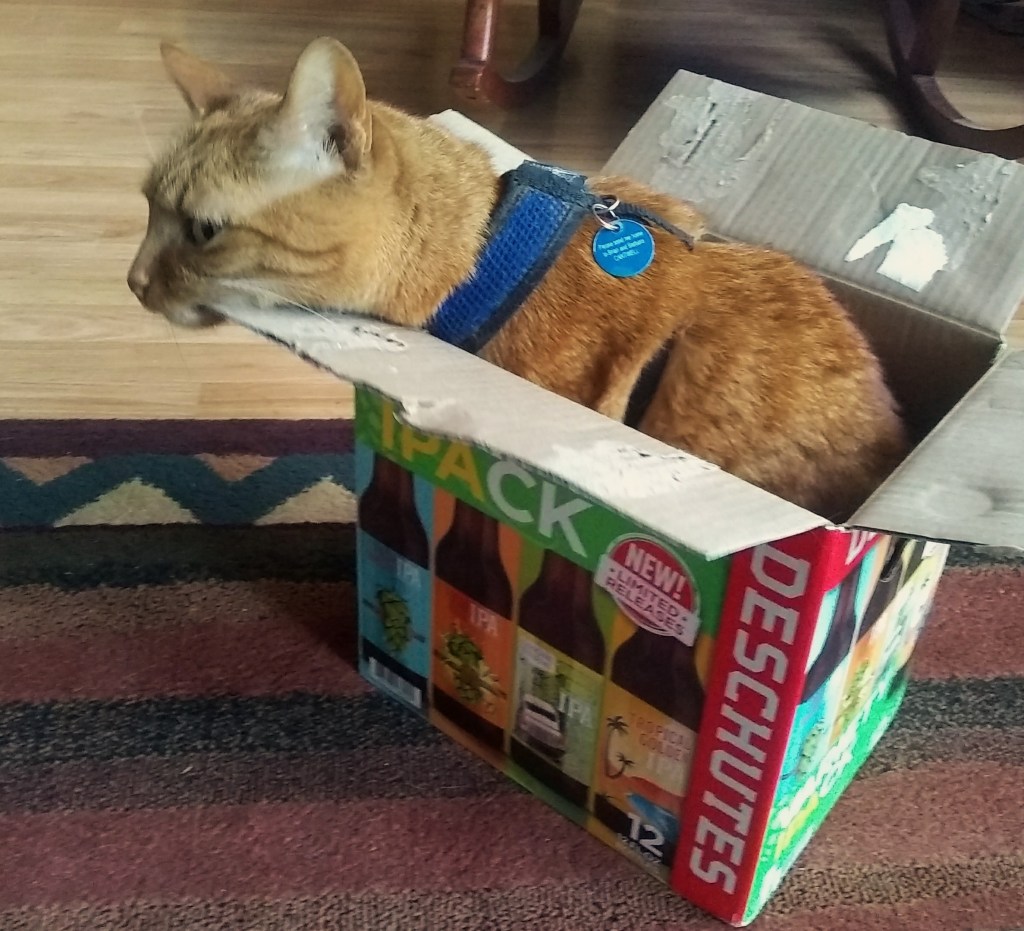
No cute cat videos, I promise, but this photo might help explain why I call her dopey. She’ll climb into any box, no matter the size, and try to hide.

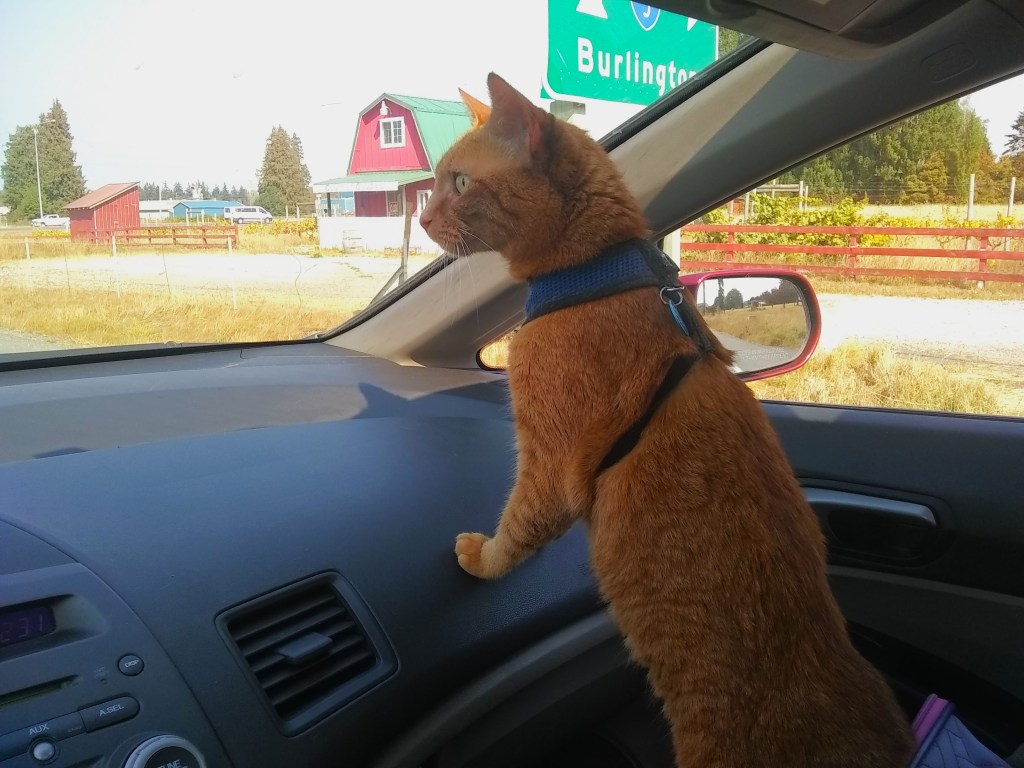
Having a pet limits my travels since I don’t have a regular cat-sitter. I hate to take her to a boarding kennel, and she’s made it clear that she, too, hates that experience. Sometimes she accompanies me when generous family members and friends don’t mind hosting both of us. I put that to a real test recently when Galley and I went on a road trip to visit a friend in Walla Walla, a long day’s drive over the Cascades and across the state. I provided her bowls of food and water on the floor in the Honda’s back seat, along with a small litter box should she need it. As long as I let her wander freely inside the car, snoozing when she chose, she didn’t seem to overly mind the long ride. At times, she would stand on the passenger seat with her rear paws on the seat and her front paws on the dashboard, looking ahead with interest. I don’t think she’d ever seen mountains before. Once again, she proved a good sidekick.

It’s hard to quantify the value of a friend, whether human or animal. All I can say is that, in the toughest time of my life, a dopey orange cat has helped get me through.

Three cheers! Three deers! Maybe I’ll have three beers!

After no deer for months, suddenly I had a herd in my front yard this morning.

WELL, MAYBE ONE BEER, ANYWAY.

Oddly enough, it’s something to celebrate on Center Island. Our deer are returning.

Loyal readers might recall that when I first made this rock my full-time home four years ago, I used to temper the monotony of my morning bike laps by counting how many deer I passed. Admittedly, since I rode a circular course, some were repeats, but my record for three laps of the airfield — about a 20-minute ride — was in the range of 45 deer.

The down side to that was that you couldn’t plant a new tree or shrub on Center Island without fencing it. And if you love swordferns like I do, you better get used to them being munched down to the hilt. Those guys can be voracious. Nonetheless, there was something peaceful and comforting about seeing the Center Island herd grazing the grass airfield on a misty morning. It was part of our bucolic island scene.

Alas, 2021 brought more than COVID, it brought a mysterious virus that killed most of the deer in the San Juan Islands. It’s been months since I’ve spotted Bucky or Bambi on my morning ride.

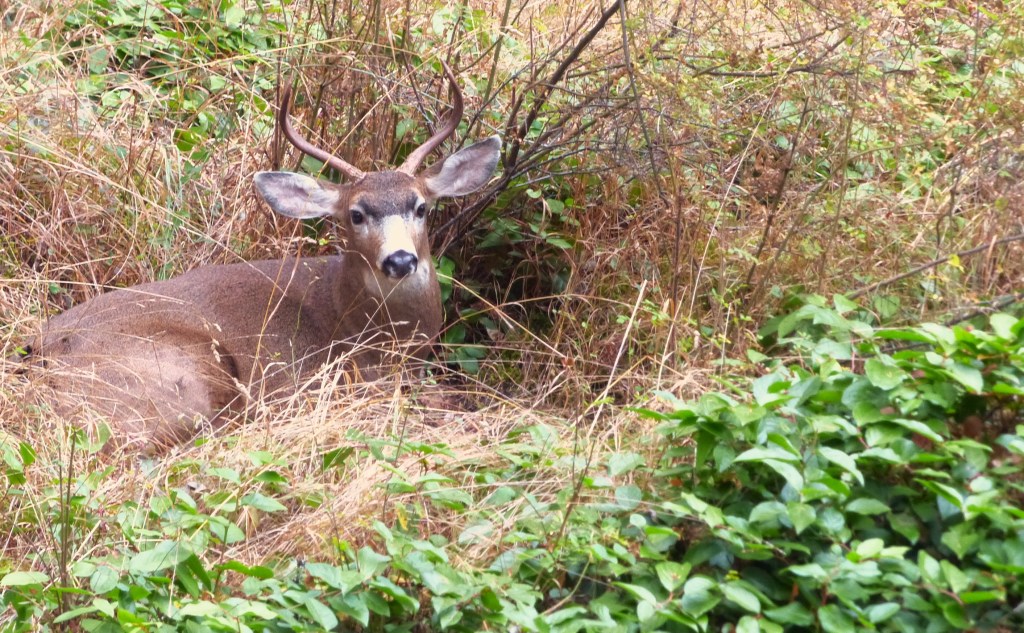
This morning, as I trundled downstairs to make coffee, the first thing I spied out front of The Nuthatch was a handsome buck, antlers proud and pointy, bedded down in the tall grass beyond the salal patch.

My morning visitor, bedded down in the tall grass.

He spent the morning. In fact, as I was lounging outside on the deck with my second cup around 11, taking a break from rebuilding the cabin’s back balcony, I was starting to worry about the guy. Was he hurt? Was he, shudder, sick?

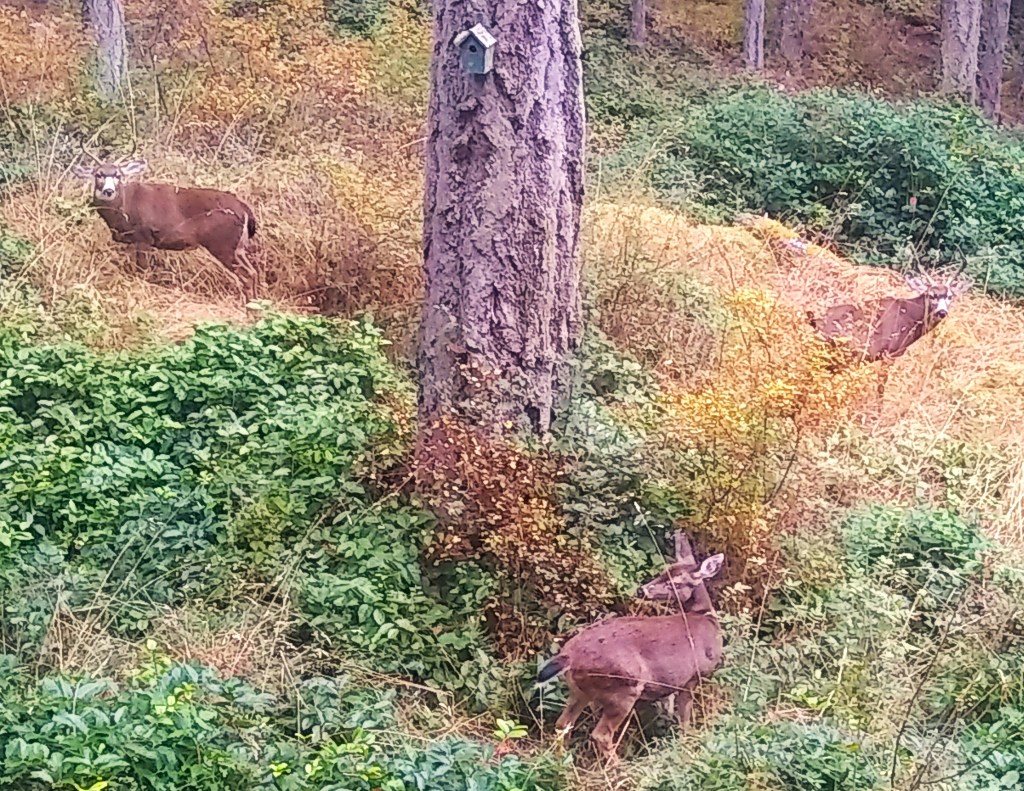
Just about then, a rustle sounded from deep in the salal, and out came a little doe. Wow, here come the deer, I reveled. And I bet a girlfriend will get his corpuscles puscle-ing.

But before he could rise and introduce himself, more rustles split the morning’s peace. And out of the shrubs came another buck, with antlers even pointier. I didn’t just have one deer in my yard, I had a whole new herd!

Just as things were looking up for the hoof-and-hatrack population, a fearsome thought sprouted in my bean: Would a battle over the doe ensue? Would this happy population explosion blow up in my face with a fight to the finish between these two young studs?

Naw.

Everybody just munched on my salal and hung out for a while. It was all chill.

Bucky, Bambi, welcome back. Just, please, leave the swordferns alone.

Fat berries, soft breezes herald a new San Juan season

It’s a rich season for berries and wild fruit in the San Juans. Plump wild currants nod to visitors at the front step of Nuthatch Cabin.

THE MESSAGE CAME IN A WHISPER. A whisper of breeze. “Autumn,” it sighed. “Autumn.”

I was enjoying a cloudless Tuesday morning, lounging in my Adirondack chair on the Nuthatch’s deck, from which I looked through mossy trees to the quiet waters of Lopez Sound. A warm September day. Not a breath of air moving. What was moving were a few midges that I swatted at between sips of my day’s second cuppa and my few daily minutes with a New York Times Sunday crossword.

That’s when the branches suddenly rustled, high in my biggest fir. A soft breath of wind came with the rustle. A cool breath, spiced with the scent of the woods.

“Ahhh,” I sighed back. “It’s here.”

For days, we islanders have known fall was coming. The berries and currants have swollen like pregnant bellies and ripened with a purple from the deepest sea. Flower baskets on decks have splashed color about like an artist who knows an international oil paint shortage is right around the corner. Endless weeks of sunshine have driven me and my splitting ax to the woodpile day after day, inspired perhaps by the same instinct that causes woolly bear caterpillars to grow blacker and fuzzier.

Center Island salal bushes have borne more and bigger berries in the wake of a cool, wet spring and a warm summer. Native tribes in olden days compacted the nutritious fruit into dried cakes to help carry them through Northwest winters.

Officially, the autumn equinox is at 8:03 p.m. PDT this Thursday. The equinox is when the sun shines directly on the equator, and the northern and southern hemispheres get the same amount of rays.

That’s the official time, and the scientific explanation. But I know a new season arrived on Center Island this morning around 10:30 when a cooling breeze gave me goosebumps and a few windblown fir needles pattered quietly down on my deck railing.

Welcome, I whispered back. Welcome.

Black-and-white petunias? My artist brother, Tom, found them at the Lopez Island hardware store. The plant is loaded with blooms in a basket on my deck.
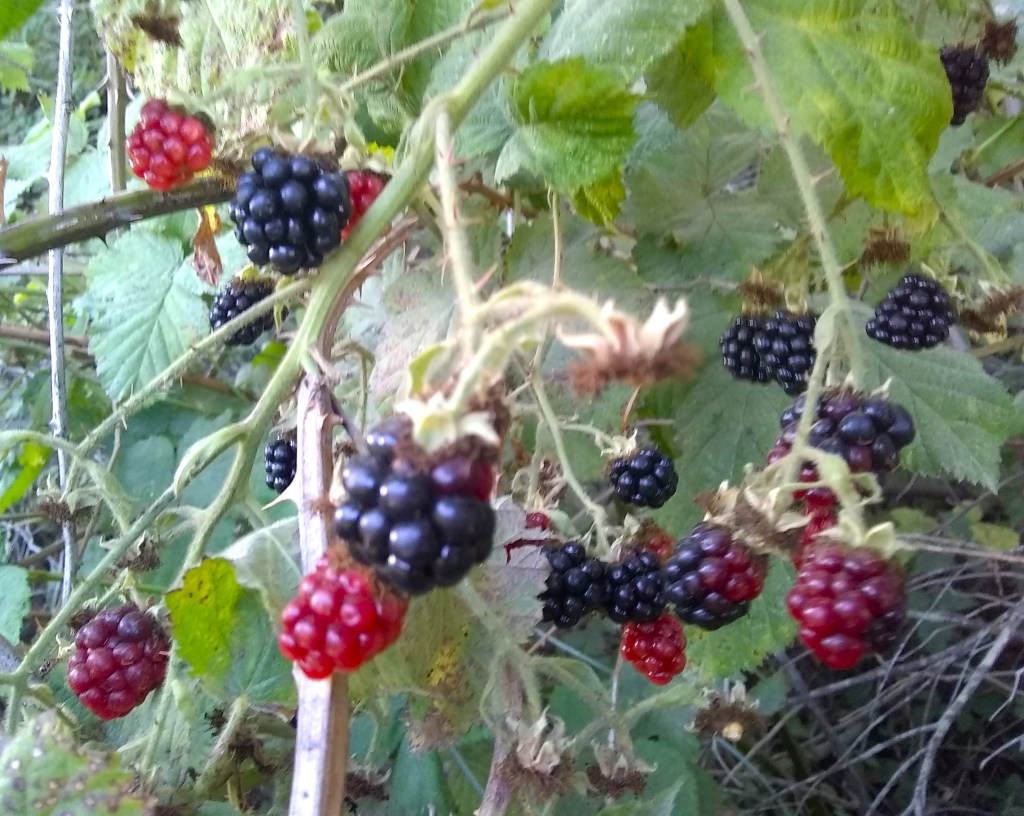
Blackberries, too, have prospered this year.
The sunny end of summer has brought out blossoms in a basket hanging from the Nuthatch’s eaves.
After days of buzzing the chainsaw and swinging the splitting axe, I have a satisfactorily bulging woodshed just in time for the first day of autumn. A bittersweet bonus: many lengths of maple from a beloved tree that came down on my roof in a freak May windstorm. I trade its years of splendid autumn color for one winter of crackling hot blazes in my woodstove.