We otter see plenty more marine life on this voyage of discovery

A sea otter floats in circles around our anchored boat in Bull Harbor, Hope Island, just off the northern tip of Vancouver Island, British Columbia.

THERE ARE ADVANTAGES AND DISADVANTAGES to being unwired for days at a time on the rainy and remote British Columbia coast. The good part of having no internet, and often no phone service: Who really wants to know what’s going on in the outside world? The down side: Friends and family wonder if my friends and I are still afloat.

We are, happily wending our way northward.

But it might be days between hooking up to the World Wide Web (which isn’t, quite yet, worldwide). So be patient. There’s nothing to worry about. Until you hear otherwise. I’ll post more when I can.

Here are my latest journal scribblings, as Osprey voyages toward Juneau:

Saturday, June 4

Three good things this day:

1. Woke to a beautiful sunny morning in Echo Bay, on Gilford Island, B.C. What a lift to our soggy spirits! Chatted with Jackson, the affable jeans-and-hoodie-wearing marina manager who quite naturally often ended sentences with “eh?” I also photographed Cocoa, the shepherd-husky mix, who had a healthy self-awareness of her photogenic qualities.

Cocoa, the lovable dock mascot at Echo Bay Marina on Gilford Island, B.C.

Jackson, a former tugboat skipper, offered us a good tip on how to get Osprey’s stern pointed off the dock for departure (looping a bow line on a cleat and motoring forward). He also knew how to scratch Cocoa on the rump just in that special place she could never reach herself. A friendship that will last, I think.

2. Wound our way through pretty, low rocky islands until we made a rough crossing of Johnstone Strait, then happily nosed into an easy spot at Telegraph Cove Marina with the help of the friendly son of the marina manager.

3. Spent a quite pleasant hour with my fellow crewmates drinking a pitcher of Nanaimo-brewed Longwood IPA and nibbling on calamari at the dockside pub at Telegraph Cove, where scenic shore-clinging homes connected by wooden boardwalks date to the 1930s. Ahhh. Chatted up the exotically-accented server, one of several young people from France who have come here to work for the summer. Canada’s bilingual nature makes it a good place to come learn English, she explained.

Sunday, June 5

We departed Telegraph Cove at 8:15 a.m. when our binoculars showed a lack of whitecaps on Johnstone Strait, and water in the marina was glassy calm. The forecast for coming days sounded bad for crossing Queen Charlotte Sound, one of our two expanses of open ocean on this journey. Taking advantage of what was expected to be a brief calm, we made tracks northward, regretfully skipping a planned stop at the renowned native cultural center at Alert Bay (vowing to put it on our homeward agenda). Instead we headed 25 miles north to tie up for the night at Port Hardy, the northernmost city on Vancouver Island.

Three good things this day:

  1. While our Telegraph Cove slip, wedged into a far corner of the marina, was easy to get into, it was decidedly not easy to back out of. But I piloted Osprey from its shoehorned space as smoothly as could be, backing and filling with the side thrusters, no longer a mystery to me. I’m also getting the touch of the touchy electronic throttle. We were all happy for an easy departure, starting to look like pros at this.
  2. Our first humpback whale of the voyage! As I piloted the boat past Alert Bay, I spotted a whale spout ahead and alerted the others. Three, four times more. Then, unexpectedly, a massive, gray-colored whale back broke the lightly rippled surface just 100 yards off our port beam. A small dorsal showed, then a massive forked tail rose clear of the water before it dove again. “Humpback!” my friends called out. Beautiful.
  3. As we scoped out a tie-up on a public port-authority dock in Port Hardy, a loon paddled directly in front of our boat, twice raising up from the bay’s surface to do its characteristic dance on the water. We opened a door to hear the iconic, high-pitched yodel call. Not two minutes later, as we edged toward a bank of mossy rocks revealed by low tide, a phalanx of white heads caught our eyes. Bald eagles had discovered a fish carcass or some other disgustingly tasty, decaying edible on the rocks. It was a collective feathery feast, full of shrill bickering. I counted 15 eagles competing for their lunch. This definitely isn’t Kansas, or Puget Sound, anymore.
  4. A fourth good thing this day: Osprey’s big Cummins diesel engine ran cool and happy today after shipmate Bill and I successfully cleaned out the big raw-water strainer that feeds the cooling system. Careful as we had been this past week to avoid floating puddles of eel grass and kelp, after long days of sucking up every kind of plankton and what we technically describe as “sea gunk,” the strainer had become heavily clouded. A challenge we soon discovered: We couldn’t locate what was obviously a specialized tool needed to remove the cap from the bronze strainer. Nothing in Osprey’s tool kit would fit the square keyhole in the cap’s center or the two “winglets” jutting up from each side. Bill was able to text our contact at San Juan Sailing in Bellingham. She contacted the boat’s maintenance team. The reply: They didn’t have the specialized tool either, but typically used a long screwdriver laid across the winglets to get leverage to loosen the cap. We improvised with a box wrench. It did the trick. We got the strainer open, degunked it with the high-pressure deck-wash hose, and today Osprey ran like a top.
At the public dock in Port Hardy, a Norwegian-owned ship that specializes in cleaning nets for aquaculture operations dwarfs Osprey.

Monday, June 6

Three good things this day:

  1. Barbara, Carol and I had a helpful and enjoyable visit with the commanding officer, Gary Deis, at the Port Hardy Coast Guard station, a 5-minute walk from our dock. We picked his brain for advice on our Queen Charlotte Sound crossing, where to spend the night before we leave, the best route, etc. He commands a 21-meter patrol vessel/lifeboat with a crew of five. At 59, he’s been in the service since age 17, and “came up through the hawsepipe,” as he puts it. He is happy that COVID travel limitations are no longer in force and tells tales of U.S. visitors who didn’t think the rules applied to them. “But it’s really starting to look like normal again now – the gill netters are moving around, cruise ships are going by, sailboats are coming in,” he said. We each bought a Canadian Coast Guard cap for $5 apiece. Great souvenirs. He proudly showed off a garden space his crew has decorated with old propellers and anchors.
  2. In a fir tree just above the Coasties’ station we spied an eagle nest and two eagle parents with an eaglet in the nest. We commented to Deis about the abundance of eagles around the bay, and he chimed in, “I’ve seen a hundred eagles right here (on the tidelands in front of the station). There’s a guy who throws some fish out and they’ll just come from everywhere!” I got some great photos of Mama on the nest with her goofy-looking, still-awkward offspring.
  3. A sea-otter extravaganza! We spied a sea otter near our dock last night — a real sea otter, not the river otters we see in the San Juans. This day on the way out of the bay we passed otter after otter, most floating on their backs and curiously watching us motor by. One group had half a dozen of these rare sea mammals, once hunted almost to extinction for their dense and warm furs. We continued to see them all day as we cruised 22 miles north to Bull Harbor on Hope Island. We had our own personal sea otter slowly floating around our anchored boat once we dropped the hook in the beautifully protected inner harbor. The island is property of a First Nations band, and going ashore was prohibited. Not a soul to be seen, though there were fish-raising pens at the bay’s mouth. Seeing all the otters is heartwarming evidence that endangered species can come back – and these guys are particularly charming.
A mother eagle perches in a nest in Port Hardy as her fuzzy-topped chick peeks out from beneath the top sticks.

Tuesday, June 7

          Three good things this day:

  1. We awakened to a blue-sky day, our first to last through till evening! Saw the crescent moon and Big Dipper in the night, a first in this cloudy corner of the continent. Bull Harbor, with a mid-entry island protecting the inner bay from winds, was as cozy as a baby’s crib, and the mud-and-shell bottom provided excellent holding for our big Rocna anchor. I was up first to watch the initial golden rays of the sun light the shoreside treetops and slowly come down like a theater curtain. I piloted us out on glassy waters. Never saw a human. We decided the otter was the native band’s caretaker.
  2. This day we crossed Queen Charlotte Sound, open to ocean swells and weather. Forecasters called for increasing storm winds as the week progressed, but we found a good weather window and went for it, raising anchor at 6:15 a.m. and motoring for 12 hours. Our fears proved groundless on the clear-sky, light-wind morning, and we rounded fearsome Cape Caution at 9:15 a.m. Mild ocean rollers rocked us gently. A cakewalk! Snowy peaks decorated the eastern horizon, a stunning panorama from our saltwater viewpoint. In the other direction: Japan. (OK, you have to squint.)
  3. An anchorage I had chosen, Kisameet Bay, turned out to be a dud, despite glowing recommendations in the guidebooks. (New since the last write-up: an unattractive floating dock with an “AREA CLOSED” sign. And our anchor kept dragging as we tried to set it.) So we quickly found another nearby option on the chart, Codville Lagoon. As we approached the lagoon, I chose to start dinner prep, as it was my night on the chore list. I told my friends I was available to help with anchoring if needed, but it was going on 6 p.m. and I knew all would be hungry, so I got rice cooking, asparagus cleaned and shrimp ready for the propane grill mounted on Osprey’s aft railing. My shipmates handled all the anchoring duties, found a great spot for the night, and soon we were celebrating our crossing with delightful gin-and-tonics on ice. The gin, a special bottle gifted to Barbara Marrett, was made in Haines, Alaska, where they apparently know how to make good gin. Who knew? And the shrimp dinner was savored by all. Onward!
Peaks of the Coast Range as seen from our crossing of Queen Charlotte Sound.

Bears, beauty and a backwoods character in B.C.

At Lacy Falls, foaming curtains of water thundered down a rock wall and into Tribune Channel.

MORE JOTTINGS from my Alaska-bound voyage aboard the 37-foot Nordic Tug, Osprey.

Tuesday, May 31

Three good things today:

  1. The peaceful patter of rain on Osprey’s roof, and the magical, misty morning as we departed Ford’s Cove, Hornby Island, B.C., at 6:30 a.m. in calm seas. A good breakfast of scrambled eggs with ham and cilantro, thanks to shipmate Bill Watson. Low clouds and low visibility lent a cocoon feel to the boat.
  2. No problems at Cape Mudge, where currents and winds can be nasty, enabling a noon arrival at the small city of Campbell River.
  3. Buying a new billed cap, with an embroidered eagle design by a Kwakiutl artist, at a First Nations gallery and gift shop, and finding bear spray at the big Canadian Tire store in the mall next to our marina. Friends who’ve traveled this coast say bear spray is a must-have if we want to go ashore.

Wednesday, June 1

        We departed Campbell River at 5 a.m. amid a glorious pink dawn to catch the 6:30 slack at Seymour Narrows, where currents have been documented to be some of the strongest and most dangerous on earth. Capt. George Vancouver described it as “one of the vilest stretches of water in the world.” By 8:30 a.m. we were northbound in Johnstone Strait in lightly rippled seas amid dramatic, fjordlike scenery with humpty green hills, snowy ridges and sculpted granite shorelines that resembled elephant skin – gray and wrinkled. Only one other vessel was in sight, identified by our AIS system as a 39-foot pleasure boat named “A Couple of Bucks.” “Two gay guys?” my shipmate Carol speculated.

We’d been worried we’d be in a nonstop parade of northbound boats in this post-COVID year (if indeed we can call it that), but now Bill has wondered repeatedly if everyone else has fallen off the edge of the earth. The seas are empty! And for a waterway notorious for steep waves and fierce winds, Johnstone Strait this day showed us its cultured, gentle side. If it was at a tea party, it would have been sipping with pinkie raised.  Snow-capped peaks laden with lots of snow peeked from the east, and it was chilly out on the transom where I wrote these notes. Our instruments said 48 degrees F. air temperature and water temperature of 49.

Three good things this day:

  1. The totally calm, pink-sunrise morning that enabled an easy exit from our Campbell River marina, with a dead-easy transit of notorious Seymour Narrows, which we caught at slack water between tides.
  2. Dolphins riding our bow wave! In the pancake-flat water, they were easy to see even underwater, and a treat to watch. They have so much fun! Shipmate Barbara Marrett identified them as Pacific white-sided dolphins. A half-dozen or so accompanied us as we headed north on Discovery Passage.
  3. Never thought this would be one of my “good things,” but we encountered our first cruise ship of the voyage as we approached Seymour Narrows. The pilot put out a “Sécurité” call on the VHF radio to alert other boats that he was approaching the narrows and asked for contact from any concerned vessel. The ship was less than a mile behind us and closing fast. I thumbed the button on the radio mike and conversed with the jovial pilot, who expressed sincere appreciation when I told him we’d pull aside into Menzies Bay and let him go through the narrows ahead of us so there would be no conflicts. We had been warned to just stay out of the way of cruise ships and expect no courtesy, so this was a happy surprise. The vessel, Star Breeze, was relatively small, probably carrying fewer than 1,000 passengers, we estimated.

We anchored for the night at Boughey (say “Boogie”) Bay, off Havannah Channel, around the corner from Johnstone Strait. It took two tries to anchor before we settled on a good spot. I barbecued vegetarian burgers on the grill, supplemented with a Greek salad.

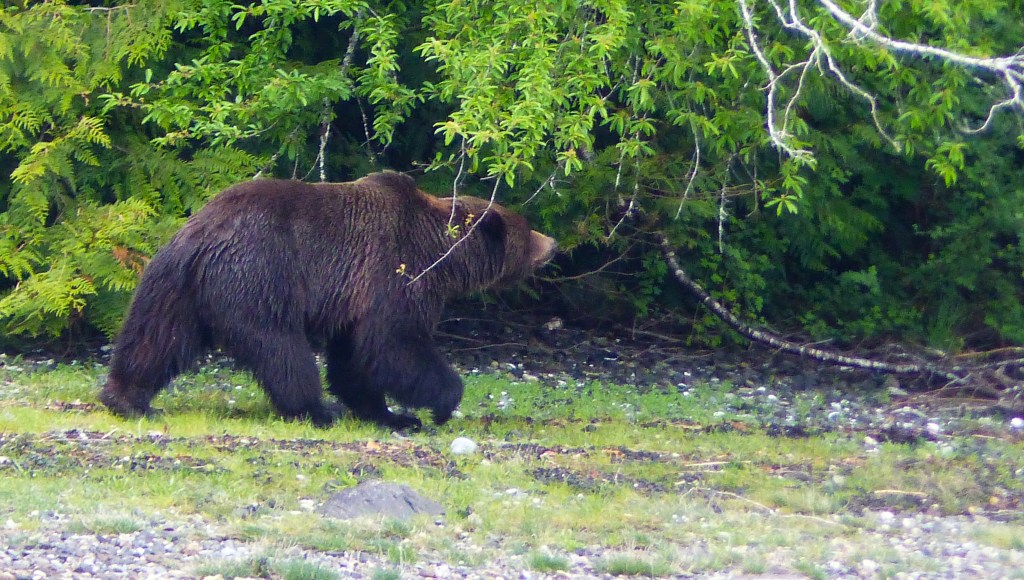
After dinner, around 7:45 p.m., Bill was peering out the stern window when he suddenly called out “Bear!” Sure enough, on the narrow shoreline about 50 yards from us a good-sized bear was lumbering along the beach. Woohoo! Our first bear sighting. We grabbed cameras and dashed out on deck. I thought it was a black bear, but my shipmates convinced me it was too brown. And it had a hump. It was a grizzly. What a thrill! Surprisingly, we had phone service in this remote and lonely spot, so I texted friends and family in excitement.

First bear of the voyage: A grizzly saunters along the beach 50 yards from our boat.

Thursday, June 2

Unrelenting rain dimpled the waters of Boughey Bay as we awakened to the early-morning sound of a foghorn on nearby Johnstone Strait. By the time I was up and making coffee, with the diesel heater warming the boat, visibility improved, but snatches of wispy cloud remained strewn across the dramatic landscape like crumpled tissues cast about by a sniffly mountain troll. Beautiful, in a somewhat forbidding way. It was another good day for cocooning on our cozy boat.

No sign this morning of our bear friend. I admit, I slept in the salon with the door to the transom firmly locked after Barbara and Bill laughed about how even their cat can open door handles like Osprey’s. If Spanky can, how about a griz? (And bears are good swimmers.)

Three good things from the day:

  1. Making almond-flour pancakes from daughter Lillian’s recipe, and getting raves from everyone around the breakfast table.
  2. Spotting two orcas just before we cruised in through narrow channels to see the tiny islands of Matilpi, just outside Boughey Bay. A white-shell midden marked the site of a long-deserted native village. Barbara and Carol noted that the whales and an eagle on the beach were likely spiritual descendants of the former villagers. The place felt mystical.
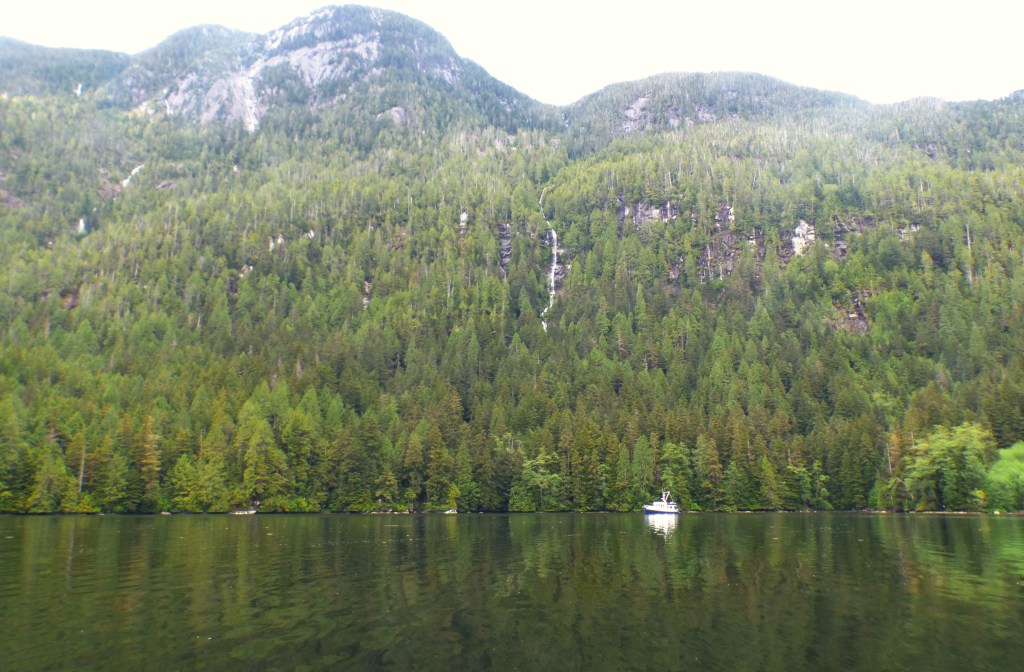
  3. Motoring through Chatham Channel, Call Inlet, Knight Inlet and 550-foot-deep Tribune Channel with waterfalls right and left and snowy mountains framed by forested saddles. We ended the day anchoring in 80 feet of water, using 300 feet of anchor chain, in gorgeous and tranquil Kwatsi Bay, where we were the only boat in a wide bowl of saltwater surrounded by mountains with five ribbon waterfalls plunging thousands of feet. Ahhh.
Osprey, all alone at anchor on remote Kwatsi Bay, B.C., looks like a toy boat amidst the overpowering landscape.

Friday, June 3

Waking up to pouring rain in Kwatsi Bay, I reflected on my recent visit to Hawaii, where I’ve always said that if it starts to rain, just wait five minutes and the sunshine will return. On this trip, my crewmates and I are coming to realize that if it stops raining on the B.C. Coast, just wait 5 minutes. It will start again.

The good news: We’ve been blessed by sun breaks every day around 5, just in time for Happy Hour in the Adirondack chairs on Osprey’s rooftop.

Three good things this day:

Local First Nations bands have donated several ceremonial masks to Billy Proctor’s Museum on Gilford Island.
  1. Lacy Falls! Wooo bloody hoo! I’ve never seen anything quite like it. Fueled by the heavy rain, from high above curtain after curtain of white water cascaded down a 100-foot-wide gray granite wall and into the saltwater of Tribune Channel. Truly spectacular. We all rushed to the transom to snap photos, and applauded as we departed. This was worth the whole trip – like ocean surf, but vertical! All framed by green conifers and wispy low clouds.
  2. It was my turn to prepare lunch. Everybody liked the grilled cheese sandwiches with dill pickles and sliced orange smiles on the side.
  3. From Echo Bay Marina on Gilford Island, escorted by Cocoa, the friendly husky-shepherd mix who is the marina’s mascot, we hiked through the woods (bear spray in hand) to Billy Proctor’s Museum. This 87-year-old fisherman, born on an island eight miles away, has spent a lifetime collecting everything from 150-year-old beer bottles to a jade skinning blade found on the beach when he was 5. An authentic, salty backwoods character, he has also been a political activist, marching on Victoria in opposition of fish farming in his local waters. We chatted about his colorful life and beautiful island home. What a good way to end an adventurous week.
87-year-old Billy Proctor welcomes boaters and other visitors to his homespun museum on Gilford Island, B.C.

Good things multiply on the way to the Last Frontier

Our chartered Nordic Tug named Osprey shares a dock with a burley Canadian tug named La Fille at Ford’s Cove on Hornby Island, British Columbia.

ONE OF MY NEW FRIENDS told me about a good way to work through difficult times: Every day, write down three good things that happened that day.

I tried it, and it has turned into my journal for our voyage to Alaska. Here are my entries for the first few days, featuring me and my three crewmates: Barbara Marrett and Bill Watson, from Friday Harbor, and Carol Hasse, from Port Townsend.

Saturday, May 28

  1. We departed on our great adventure to Alaska.
  2. We saw orcas! Just off Flattop Island as we motored from Bellingham to Sidney. Spouting and surfacing again and again. We throttled down, veered away, and oohed and ahhed.
  3. At the Sidney, B.C. customs dock, we met an extremely friendly and helpful crew of a Royal Canadian Mounted Police patrol boat. (On the side of the big, modern vessel was the silhouette logo of a Mountie on a horse.) They were the nicest federal agents you ever could meet. They gave us tips on where to find hot springs and great crabbing as we head up the British Columbia coast. O, Canada!

Early in the day, oil-pressure doubts delayed our Bellingham departure. The gauge was reading well below what the owner’s cheat sheet recommended (55 rather than 70-90), but after we took our worries to the charter office, Matt the mechanic came and gave his OK. We were misinterpreting the gauge reading as kilograms instead of PSI – pounds per square inch. Oh, well. Better cautious than stranded dead in the water.

We motored through nice, pancake-flat seas most of the way to Sidney. Caught a counter-current along the shore of Speiden Island, which sported a gorgeous, seasonally transitional mix of green and brown hillsides, sculpted like a shapely gelatin mold. Stately oaks punctuated hillsides grazed by Japanese deer, which previous owners of the island had imported long ago as part of a misguided exotic-game hunting scheme, briefly renaming the isle “Safari Island.”

Osprey skirts the shore of Speiden Island.

Carol donned her knitted maple-leaf tuque hat (complete with dorky chin straps and a beany on top) to raise the Canadian courtesy flag as we crossed the international border on Haro Strait. We sang the two bars of Canada’s anthem that we knew. I vow to learn the words before the voyage’s end.

Crew member Carol Hasse, aka Sea Goddess, raises the Canadian courtesy flag as Osprey crosses Haro Strait.

Sunday, May 29

Three good things today:

  1. How helpful and kind my three friends were when I, taking a turn at the helm, totally botched the dock departure from Port Sidney marina. (I looked at the side-thruster toggles and couldn’t for the life of me figure out which one to use as I backed out. For those familiar with the holiday film “A Christmas Story,” I pulled a Total Ralphie. “Football? What’s a football?”)
  2. On the way to Nanaimo, we navigated and transited our first major marine challenge, Dodd Narrows. We perfectly timed it, got there an hour before slack water and didn’t get stuck behind the waiting tug with a long raft of logs. We smiled and waved at a small crowd of spectators sitting on the rocky shore watching boats maneuver the often-swirling waters. Apparently it’s entertainment when you live in Nanaimo.
  3. We snagged a buoy tucked into pretty Mark Bay at Newcastle Island Provincial Park, with a smashing view across the harbor of downtown (with its three high-rise – 25-story? – buildings, which I don’t remember from when I was last there about 20 years ago). After a happy hour on Osprey’s sun-drenched rooftop, we went for a walk in Hasse’s “favorite park in the world” to see the big old-fashioned dance hall and lovely views of anchored freighters. Then all four of us scrunched into the dink to buzz across to neighboring Protection Island, a few hundred yards away, for dinner at the Dinghy Dock Restaurant, accessible only by boat. (A giant bowl of clam chowder for me.)
Nanaimo at sunset, as seen from our delightful moorage at Newcastle Island.

Monday, May 30

Three good things today:

  1. After lots of angst, angst, angst about the day’s planned destination of Comox, for which we didn’t have proper charts, the anchorage sounded dodgy, and the departure involved transiting a very iffy bar, we bailed on that idea. As we passed the gorgeous lighthouse on Chrome Island, we spied little Ford’s Cove Marina on neighboring Hornby Island. Hasse and I asked ourselves, “Why not here instead?” It would add just 12 miles to our planned 30-mile day tomorrow, I discovered with a quick flick of dividers on the nautical chart. So we headed in and tied up in one of the homiest, funkiest little non-tourist marinas this side of Mexico. We were the only visiting boat among an earthy, friendly community of locals and liveaboards who were out sanding rails and leaning against pilings. They reminded me of the Scottish townspeople in the movie “Local Hero.” A great little store, well-stocked, stood a few feet from a building housing terrible, stinky pit toilets. “Sorry, we’ve no running water,” explained the charmingly accented young harbormaster as we paid our $50 Canadian for a night.
  2. While Barbara and Carol went for a walk to a waterfall and other scenic wonders, I hung with Bill and prepared dinner: salmon steaks marinated in soy sauce, ginger, garlic, sesame oil and turmeric, with grilled fresh asparagus and quinoa with olive-oil toasted almonds. On our rooftop, we dined in the sun and listened to eagle calls and the echoing kettle-drum thumping of a woodpecker on a dead tree high on a wooded hillside above us. In the distance: snow-frosted mountains on Vancouver Island. Sublime!
  3. We ended the day with a lively round of Barbara and Bill’s favorite board game, “Ticket to Ride.” I almost won, laying down a rail route from Seattle to Montreal, but Barbara edged me out. Bill and I agreed to get up early the next day and shove off while the women slept in, so we could catch the tides right for our passage of dreaded Cape Mudge (you have to say it with a droning voice of fear, which Barbara has mastered) on the way to Campbell River, our stop for the night. I sat on the rooftop and wrote in my journal as the sun sank behind the mountains and a refreshing chill settled over the cove. The morning would bring rain, dramatic mists, and more adventures.
One of the full-of-character project boats at Ford’s Cove.

Heading northward, with the geese

The cover of our logbook for the coming journey. Osprey is our chartered 37-foot Nordic Tug, based in Bellingham, Washington.

TOMORROW AT NOON, I jump off my little world.

Well, sort of.

That’s when my brother Tom and I board the water taxi and I leave my little island for a big adventure.

We’ll load totes into my red Honda and meander our way across the Skagit Valley, dawdling a bit in the charming burg of Edison to look for roosting raptors in the Eagle Tree and pick up a loaf of Breadfarm bread. Then we’ll wind our way up Chuckanut Drive as it slithers the slopes of Blanchard Mountain to end up in Bellingham, where my adventure begins.

In this case, adventure lurks in the form of a 37-foot Nordic Tug named Osprey. Tom will drop me at Squalicum Harbor Marina and then make his way back to Center Island for cat-sitting, while three friends and I shoehorn a boatload of gear and provisions aboard the charter vessel that will be our home for weeks to come.

Saturday morning, my fellow voyagers and I shove off. Our direction: north. North, to Alaska.

For a year, we’ve been dreaming of and planning this trip up the famed Inside Passage. Our ultimate destination: Juneau, the capital of the state that pretty justifiably still calls itself the Last Frontier.

For some 900 nautical miles each way, at a speed of 8 knots — about 9.2 mph — we’ll explore a coastline of endless green forests and cool, misty shores. Armed with sharp binoculars and zoom-lens cameras, we’ll watch for whales leaping from the saltwater and bears sauntering the beaches. We’ll keep a sharp eye peeled for lurking rocks and half-sunken logs, and match our sea wits against whirlpooling currents and Pacific squalls. We’ll explore remote fjords all abob with icebergs. Like the giddy gold miners who flocked northward like geese in the 1890s, we’re bound for the wild unknown.

For me, it will also be a time for introspection and healing after a year of loss and, sometimes, loneliness. It will be 10 weeks of living in the now. I expect days of awe, bliss, exhilaration… perhaps interspersed with occasional moments of terror, depending on what the mighty Pacific throws our way. But with a stout craft and many sea miles between us, I’m confident we’ll make it through.

Grab a cup of good, strong coffee, buckle up your life vest, and stay tuned.

Like the cousins who come in May, and stay and stay, the goldfinches have arrived

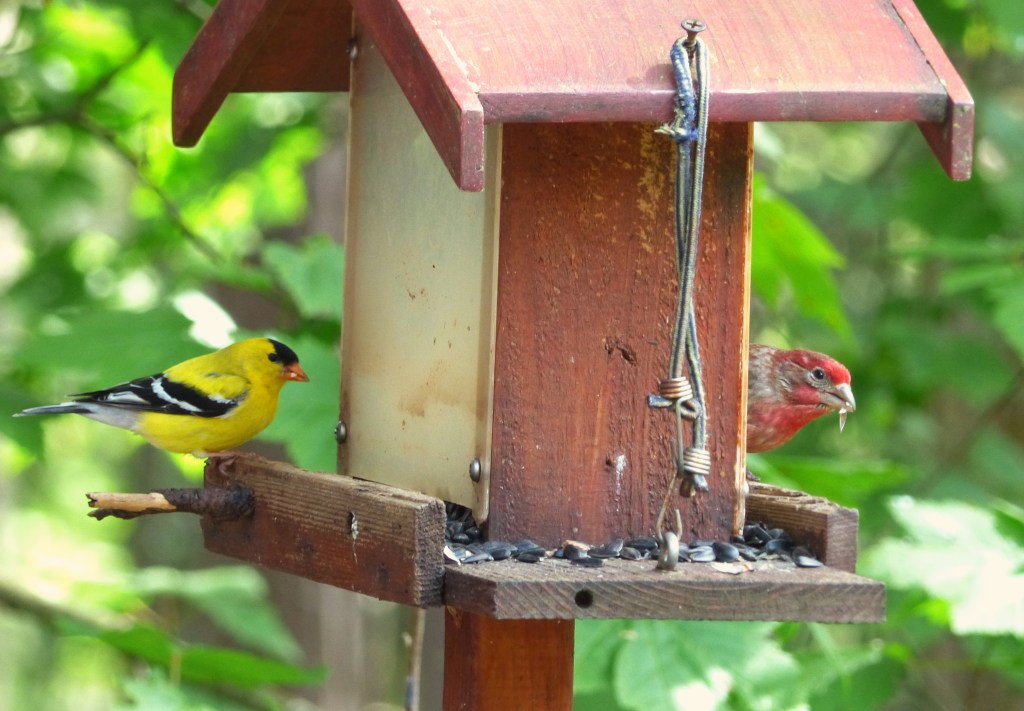
Working both sides of the feeder: A Purple Finch peeks around the corner as an American Goldfinch munches a seed.

MY FAVORITE SUMMER VISITOR showed up on Center Island last week. The American Goldfinch, our Washington state bird, is now mobbing my feeder.

Interesting goldfinch trivia from my neighbor, the Mad Birder: Goldfinches are one of the few land birds that migrate by daylight. Most fly cross-country at night, free of pesky daytime thermals — those sometimes wicked up-and-down bursts that prompt airline pilots to tell you it’s not a good time to toddle to the toilet. In darkness, birds also find it easier to elude predatory hawks and eagles.

To an eagle, the Mad Birder’s theory goes, the half-ounce bit of feathery lemon zest that is a goldfinch is dietarily akin to celery: You burn more calories in the chewing than you actually gain. “Oh, there goes one of those flashy little yellow guys. Not worth my time!”

But the goldfinches add so much color to the view out my front window, I’m happy to fatten them up on as many sunflower seeds as they can chomp. Welcome back, Washington’s trademark ball of fluff.

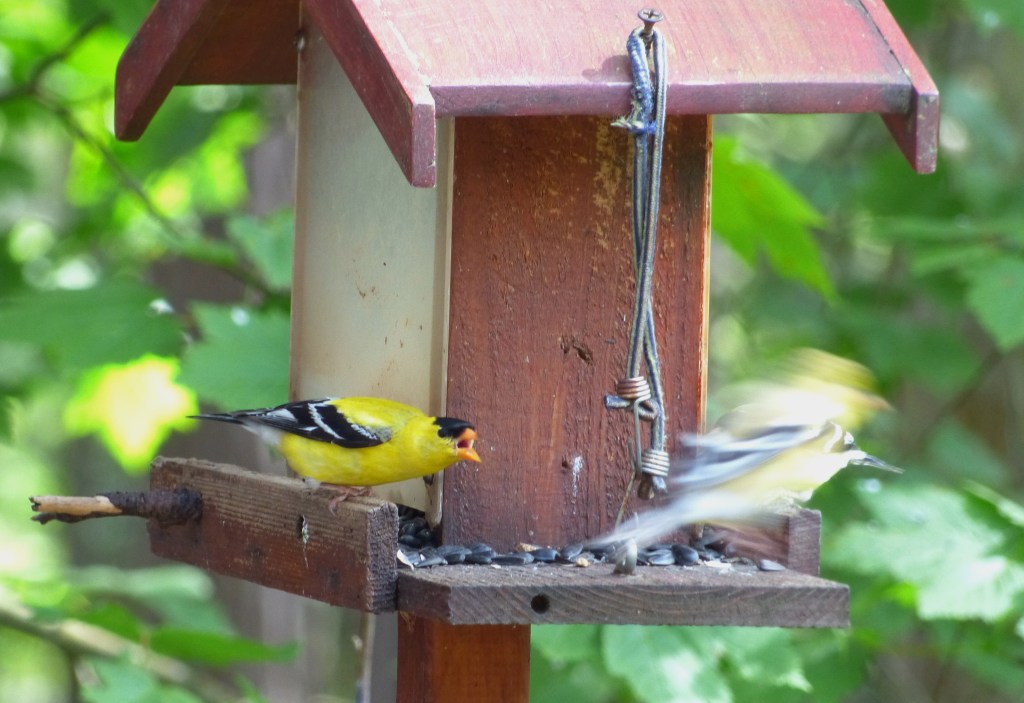
Ooooh, scary goldfinch face! It seems they don’t always want company at mealtime.
“Hey, there’s plenty for everybody, bud! Are we good now? Huh? Huh?”

Squish! Squish! Squish! The wildflowers are loving it.

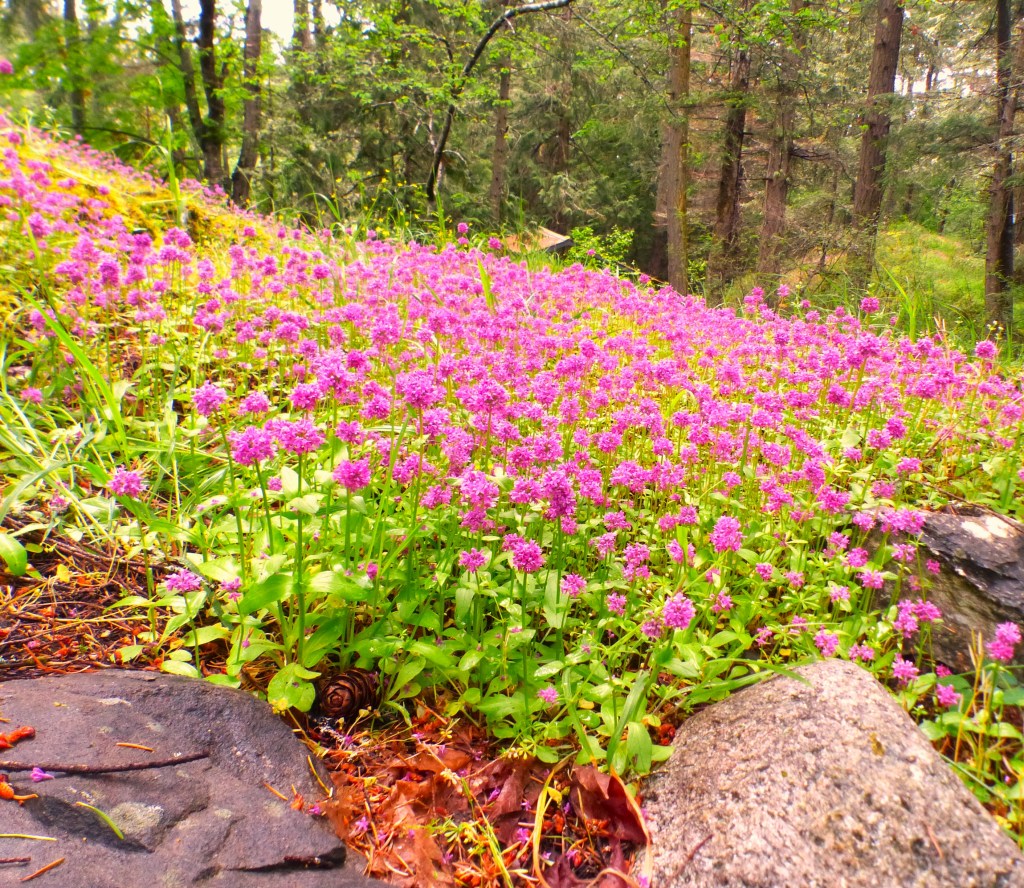
Sea blush adds a cotton-candy color to the rocky knoll behind Nuthatch Cabin. The native wildflower is more prolific than ever this spring on my island.

IT’S A SOGGY SUNDAY on Center Island, continuing a moist and cool spring throughout Western Washington. Halfway through May, Seattle has already recorded 2 1/2 times its historically average rainfall for the month.

Other than the extreme crankiness among Washingtonians who will wave their GORE-TEX-swaddled arms and shout that we get enough friggin’ rain in November, there’s good news and bad news.

The bad news is that invasive grasses and weeds are loving it. My little half-acre of paradise is looking like the 12-year-old kid who hates haircuts after spending a summer with his grandfather who doesn’t see too good. We’re talking shaggy.

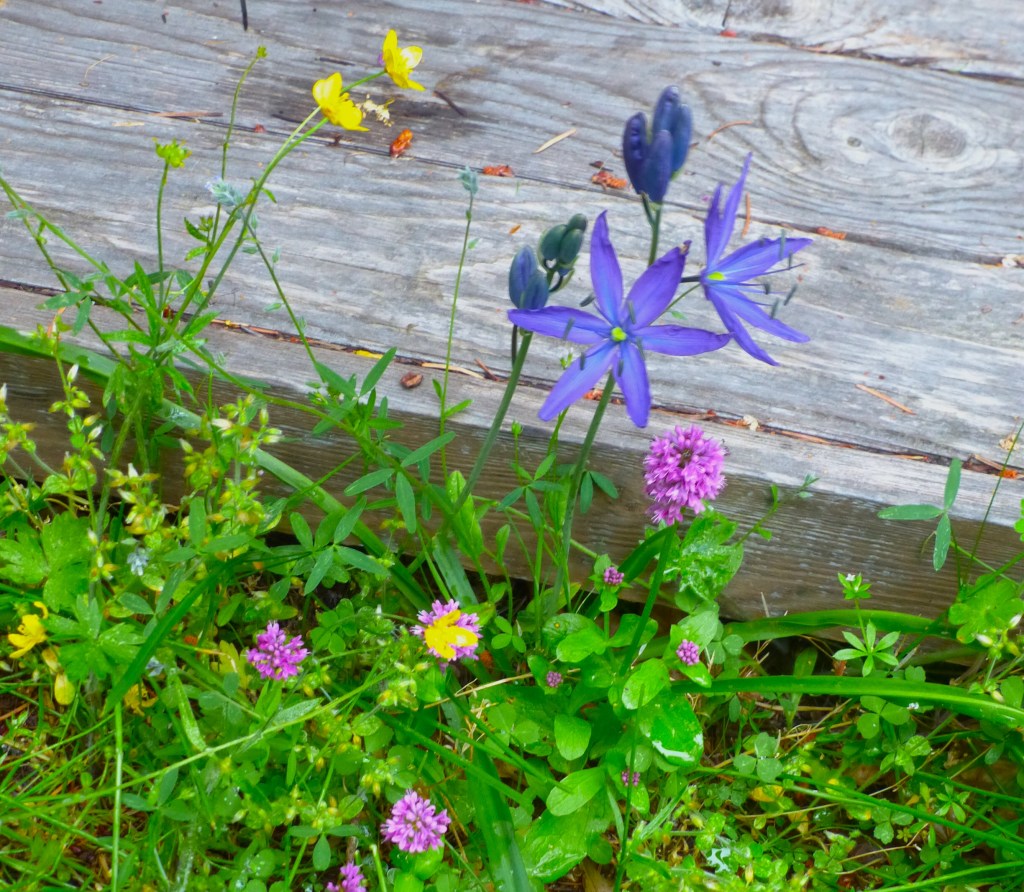
Blue camas mingles with other wildflowers by the front step of my writing hut. The starry flower’s bulbs were once a staple in the diet of Northwest tribes, who steamed them like potatoes. Don’t confuse the bulbs with those of the aptly named (and toxic) death camas, which has a spiky cluster of white inflorescence. The two types of camas often grow in close proximity.

The good news is that the wildflowers are going nuts, too. If you get a chance to take a hike soon at Iceberg Point on Lopez, Turtleback Mountain on Orcas, Young Hill on San Juan Island, or just about anyplace in the islands with an open meadow and occasional sunshine, prepare to be wowed. Blue camas flowers, golden buttercups, pink sea blush, chocolate lilies and more have been outdoing themselves this month. I need look only as far as the rocky knoll behind my cabin.

Rain, rain, go away. Soon. But thanks for watering the flowers.

This post is also available on audio. Listen to my Cantwell’s Reef podcast.

Big island or small, diverse skills make life in paradise possible

Daughter Lillian and her butterflies add to the colorful scene at Akaka Falls on the island of Hawaii.

This post is also available on audio. Listen to my Cantwell’s Reef podcast.

TO MY SMALL ISLAND NOBODY’S HEARD OF, I’ve just returned from nine days on a big island that everybody knows about: the island of Hawaii, home to Kona coffee, sweet papaya, Kealakekua Bay snorkeling, and one of the more active volcanic zones on Earth.

I’ve been to the island before, at least half a dozen times. I try not to consistently label it as “The Big Island,” in deference to locals who disdain that tourism-coined term for their proud and history-steeped island that gave its name to the whole archipelago, its ancient kingdom and, subsequently, the state. (I did enjoy a good snicker, however, at a T-shirt emblazoned with the silhouettes of all the Hawaiian islands and, next to this one, the slogan, “Mine is bigger than yours.”)

Daughter Lillian and I had originally booked this visit for last August as a sort of memorial to my late wife, Barbara, who dearly loved Hawaii. But then COVID’s Delta variant raged. We heeded Hawaii’s governor when he implored tourists to stay home.

Faced with a use-’em-or-lose-’em situation with the air tickets, we committed to late April for a visit that included four nights with my niece, Frances Hartley, and her family. They moved from Tacoma to the charming windward-side community of Honoka’a on Hawaii Island in July 2020, at COVID’s height. A brave couple in their 30s, they bought a home online, sight unseen.

In the subsequent two years, Fran and her husband, Arwain, and their two young children have carved a comfortable niche in the community. Another child is due in August.

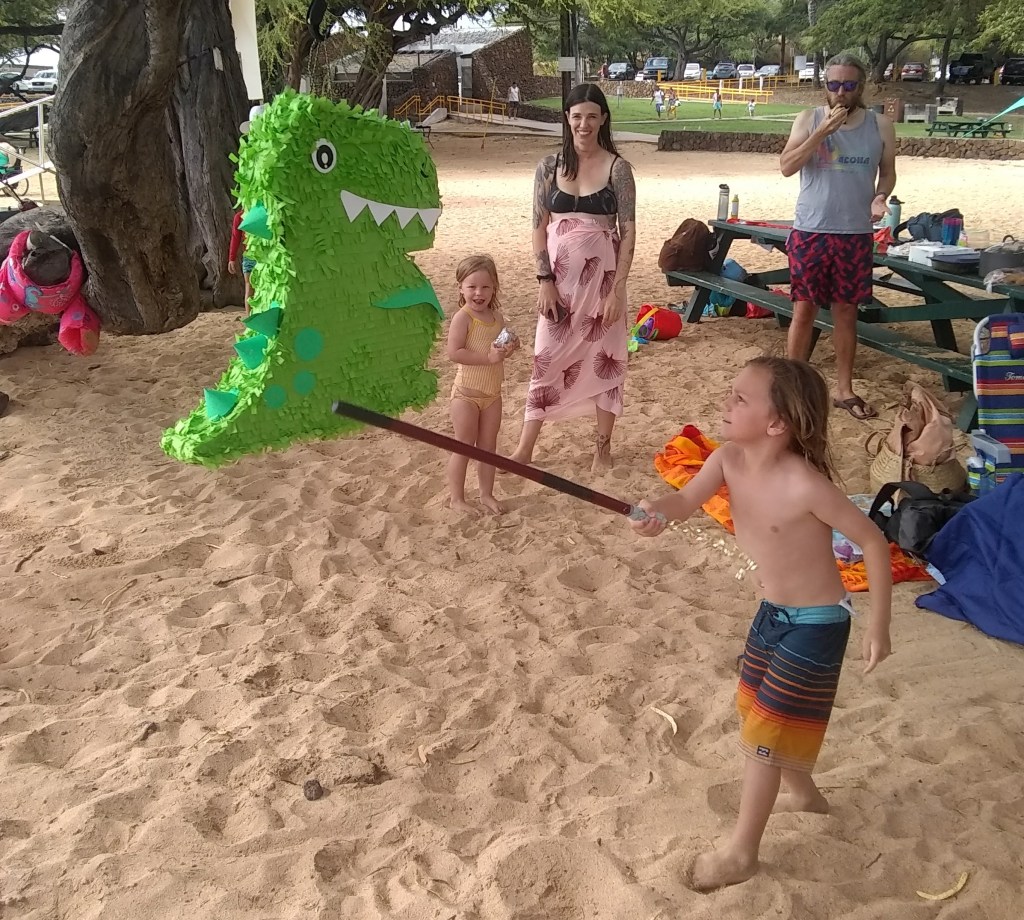
Our first day we spent with their family and friends at a sunny beach park celebrating their son Bodhi’s 6th birthday.

My niece Frances Hartley, center background, with daughter True, 3, watches as Fran’s son, Bodhi, celebrates his 6th birthday with a whack at a piñata handmade by a friend for his beach party.

I enjoyed those days getting to really know my niece and her husband. There are interesting parallels to living on islands, whether on a 172-acre dot in the San Juans or a 4,000-square-mile volcanic wonder in the Pacific. On my island, with no stores, no trash disposal and lots of firewood to cut, you must be a person of many skills. Arwain and Fran’s new life is similar. With its remote location and limited resources, Hawaii is an expensive place to live. Good-paying jobs are sparse. Happily, they are well-suited to it, with multiple talents. Fran is a trained lactation specialist who helps new mothers feed their babies in the healthiest way. Arwain is a man of many skills: university-trained computer-design engineer, day trader, home builder, bartender and more.

A showy heliconia bloom hung next to the shower stall in a lava-rock grotto outside my niece’s Hawaii home.

In addition to their comfortable old Hawaiian-style home high on a hillside overlooking the ocean, they’ve acquired two parcels of property with the intent of organic farming. After wading with machetes into one acreage to hack down invasive sugar cane and other “weeds,” they discovered scores of coffee trees, obviously planted years ago. Through such serendipity, they plan to become coffee farmers, among other hats they’ll wear. They invited Lillian, recently trained as a barista, to come back and help sell their wares at farmers markets when the time is right.

I volunteered to pick the coffee beans by hand. Me and Juan Valdez.

Their coffee wouldn’t be Kona, but Hamakua Coast-grown. There’s always room for a new coffee region among aficionados of America’s favorite breakfast bean, right?

If coffee farming doesn’t work out, Fran and Arwain can grow vegetables for the island’s many restaurants. If that doesn’t swim, they’ve several other potential income streams to tap. It’s the island ideal. Want to live in paradise? Diversify.

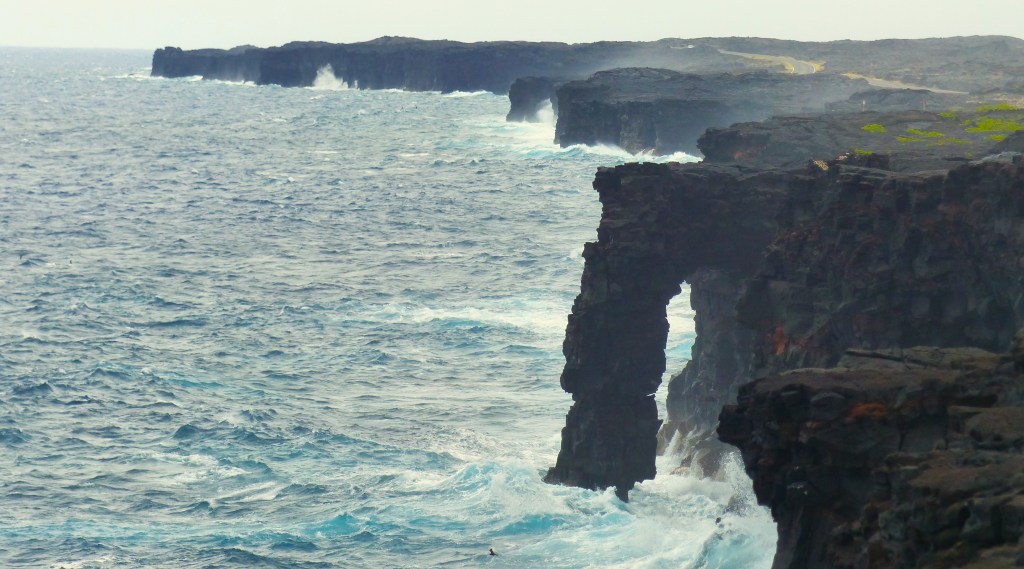
In Hawaii Volcanoes National Park, we drove to the end of Chain of Craters Road to see Hōlei Sea Arch.

Once we left Honoka’a, Lillian and I enjoyed circling the island, gaping at waterfalls, exploring a spooky lava tube, and poking along winding roads where dangling jungle vines tickled our foreheads as we drove in our rented convertible. On a bittersweet kayak paddle on Hilo Bay, we released a sealed bottle full of memories of Barbara, written by friends and family. On a catamaran tour to Kealakekua Bay, we snorkeled among teeming schools of tropical fish. I’ve never seen so many yellow tangs, like a lemony legion of finned ballerinas pirouetting on the tidal surge.

Back on Center Island, Galley Cat and a carpet of sea blush flowers welcome me home.

I love to visit such places. Yet I’m always happy to come home to Center Island. While I was away, the wildflowers bloomed. My rocky knoll is awash with a pleasing pink wave of sea blush. Buttercups and the first spiky flowers of blue camas add to the splendid scene.

And in three weeks I’m on a 37-foot boat headed to Alaska. It’s my season for the 49th and 50th states. Better catch my breath — and pack some warmer clothing.

‘Trawler 101’ and keeping busy with a birthday

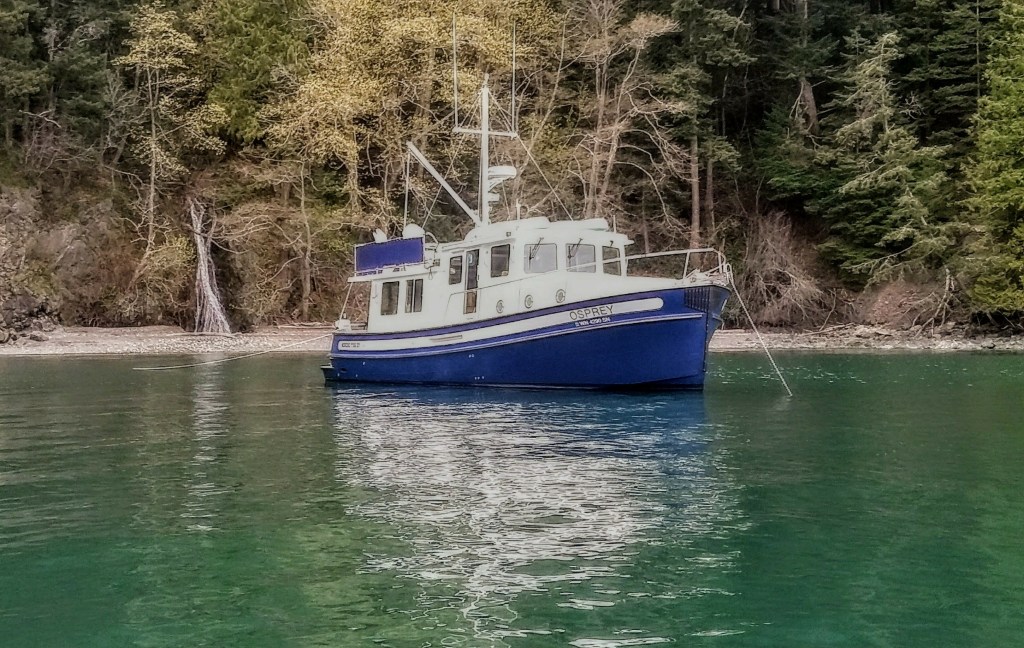
Osprey, the Nordic Tug that friends and I will take to Alaska in late May, sits at anchor by a spring waterfall edging pretty Inati Bay, Lummi Island. A productive weekend aboard helped us get to know the boat.

This post is available on audio. Listen to my Cantwell’s Reef podcast.

EVEN ON A REMOTE LITTLE ISLAND, with no job to go to and no stores to shop at, weeks can get busy. Which is why I’m only just now writing about the training cruise my fellow voyagers and I took 10 days ago aboard Osprey, the charter vessel we will point toward Alaska six weeks from now.

The four of us who will be on the first leg of the cruise are all seasoned sailors, which is one reason we needed a shakedown outing. The bulk of our many sea miles has been aboard sailboats, some of it long ago. So it was a smart idea to spend a weekend with a training skipper to help us learn the ropes (and the anchor, the engine, the modern navigation instruments…) of our 37-foot Nordic Tug trawler.

It was just an overnight out of the boat’s Bellingham base. We had hoped to get out to Sucia Island in the San Juans, but like the conscientious sailors we are, we took a close look at the weather forecast. Or I should say that Carol Hasse, our shipmate from Port Townsend, looked at the weather forecast, using SailFlow, a weather app she checks multiple times a day, a habit formed while sailing Lorraine, her no-frills 25-foot Nordic Folkboat sloop, built in Denmark in 1959.

(I should say that “Hasse,” as her friends often call her, is something of a legend in the Northwest boating community, having operated her own highly respected sail loft for many years. Aboard Osprey, her encyclopedic knowledge of everything nautical has already earned her the nickname “Sea Goddess.”)

Monitoring SailFlow, Hasse reported that a spring storm with gale-force winds would be visiting our corner of the Salish Sea about the time we headed home Sunday. So rather than fight the weather for so many miles on our homeward leg we stayed closer to the home dock, crossing Bellingham Bay to put in for the night at pretty little Inati Bay on the eastern shore of Lummi Island. For practice, we anchored with a tie to a log on shore, keeping our stern facing a waterfall that chattered onto the narrow beach. We had the quiet cove to ourselves for the night. Nice.

Training skipper Tim Hoving gave us a thorough grounding (in a good way, not the hitting-a-rock way) in becoming Ospreyites. Before leaving the marina, we took a detailed tour of the engine room. Then we each took the helm to back-and-fill the boat for a 180-degree turn in close quarters, and took turns docking, both at the helm and working the mooring lines. Once anchored at Inati, we staged a man-overboard rescue, using the trawler’s topside boom and tackle to hoist the “victim” back on to the boat. (We weren’t so heartless as to make the victim dive in to that frigid water; Osprey’s dinghy was our rescue platform.)

After Barbara Marrett’s delicious dinner of shrimp pasta, our day on the water ended perfectly with a DVD viewing in the boat’s salon of — what else? — “Captain Ron.”

The Sunday morning return to dock involved, as predicted, plenty of rocking and rolling. With Bill Watson at the helm through the worst of it, the boat proved itself reliable and stout. One hiccup: The china cupboard in the galley popped open more than once on a bumpy swell, sending coffee cups shattering on the counter. Tim added “stronger cupboard latch” to a short list of fixes needed before the boat heads north Memorial Day weekend.

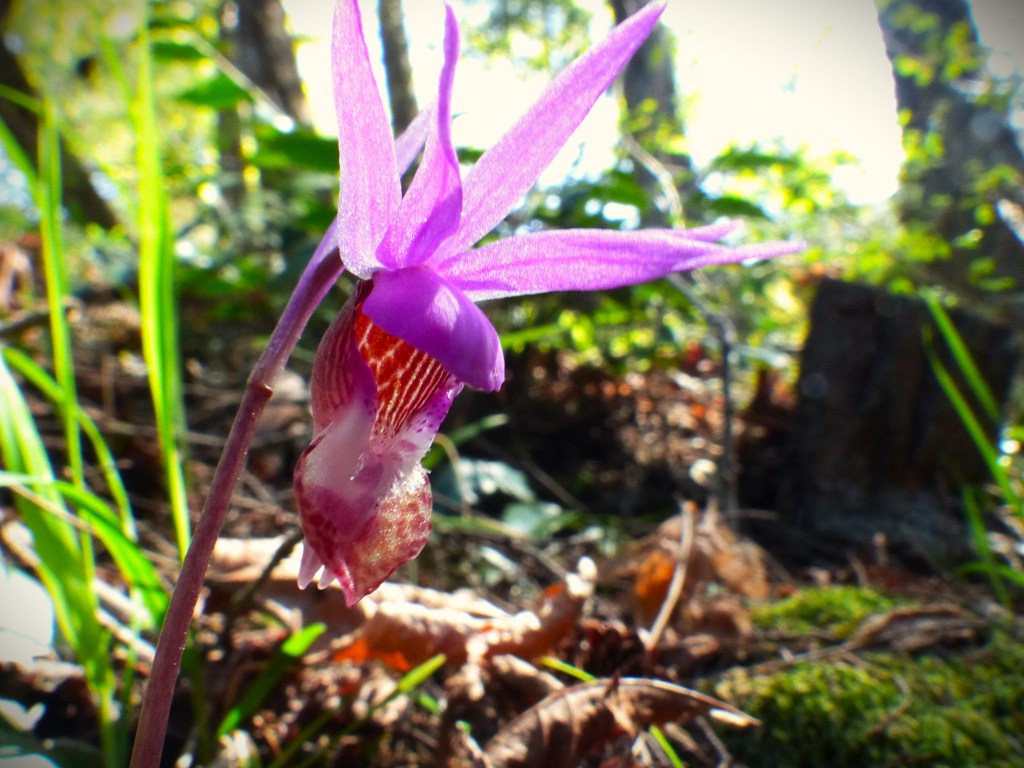
Magnified with a close-up lens, a tiny Calypso orchid, or Fairy Slipper, blooms on the hillside behind Nuthatch Cabin.

My past week was pleasantly filled with a visit from daughter Lillian, who arrived on my birthday and prepared a tasty dinner attended by my favorite next-door neighbors, The Mad Birder and his wife, Carol. The menu included toothsome jack-fruit tacos laced with pickled peppers and oven-toasted broccoli bits followed by a sugar-free birthday cake, tangily tasty with orange zest and topped by chocolate frosting. Keto ice cream gilded that lily.

Another highlight of last week: The tiny magenta Calpyso orchids, wildflowers affectionately known as Fairy Slippers, bloomed on my rocky knoll. Buttercups and pink Sea Blush are coming on quickly.

This week, my brother Doug visits from Santa Fe. Plans are to barbecue salmon one night and grill vegan burgers another. Maybe take WeLike for a spin on Lopez Sound. The fun rarely stops when you live on a small island nobody’s heard of.

Forever in our hearts: Barbara Alice Cantwell, February 10, 1955-April 1, 2021❤️

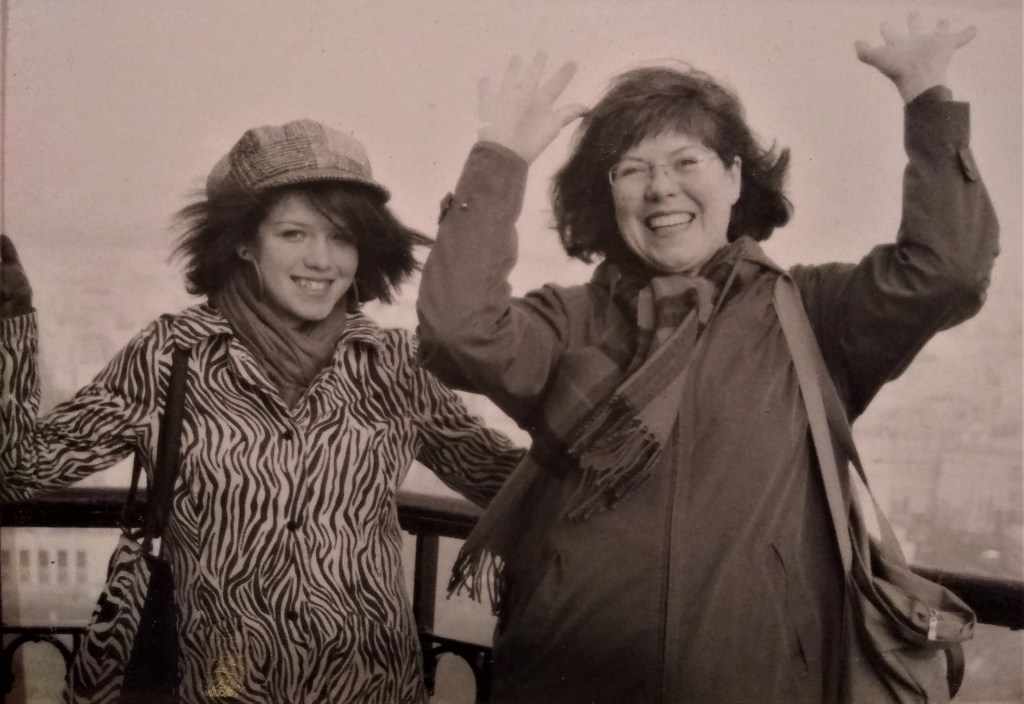
A favorite photo: Daughter Lillian, left, with her mum and my darling wife, Barbara, atop the Eiffel Tower in Paris, where we celebrated Barbara’s 50th birthday in 2005. They were throwing their arms in the air in reference to a famous tower-top dance scene from the 1957 Audrey Hepburn/Fred Astaire movie “Funny Face.” Barbara never looked happier.

The power of a San Juan spring

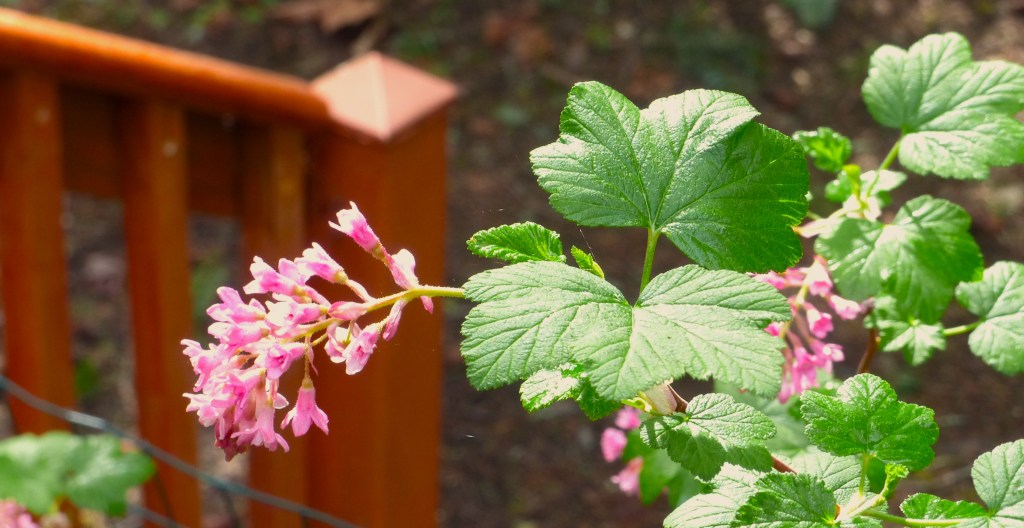
Wild-currant blossoms welcome visitors to the Nuthatch.

MY WILD CURRANT is madly blooming this spring. It’s a good tiding.

From the time Nuthatch cabin became ours in 2003, one thing I loved was the red-flowering wild-currant shrub that grew out of the rocky face just below our front deck. Its many clusters of dainty, trumpet-shaped blooms bobbed enchantingly above the deck rail and added a welcome early-spring splash of color to our view of woods and water.

Hummingbirds loved the flowers, and I mounted a bird feeder on the rail there so eager nuthatches, finches, juncos and towhees could use the currant’s branches as a perch while waiting their turn for a sunflower seed. It was akin to the queuing area at airport security. Always busy. And when fruit emerged later in the season, something of an avian snack bar.

I liked the wild currant so much that I planted another inside a deer fence next to the cabin’s front steps about 10 years ago. I gave the new planting plenty of water to get through dry summers. It grew large, with many branches and attractive foliage. But it didn’t flower much. Maybe just one little cluster of blooms each spring.

Meanwhile, after many seasons of enjoying the cliff-dwelling currant’s spring color, watering it in summer, seeing it get big and eventually rigging a supporting sling so it wouldn’t pull out of the rock, I waited in vain for new buds to emerge one February a few years ago. Barbara and I kept watching and hoping for a revival that sadly never came.

Its cliff-hanging location was a blessing and, probably, a curse. That hungry deer couldn’t reach it was likely the only reason it survived as long as it did. Yet the challenge of drilling roots into rock and finding necessary water probably doomed it.

Narcissus flowers add to the spring color outside the cabin.

Its gnarled old branches cobbled with lichen and bearded with moss, the dead shrub almost fell to my axe. But I stopped before the first swing. Why take it down? The birds continued to use it as a staging platform. It still served a purpose, and even without flowers or foliage it was pleasing to the eye.

Inside that deer fence, I planted another red currant next to the first. Tiny by comparison, it nonetheless produced a modest display of flowers the past two springs. Perhaps it finally shamed its big brother, which this spring has produced a robust display.

The new plants’ blossoms are more pink than red, whereas the cliff dweller wowed the eye with blooms of deep red to magenta. But this year’s dozens of flowering clusters have renewed my faith in the power of springtime in the San Juans.

To all my Northern Hemisphere friends, savor this season of renewal, whatever touches your heart.

NEW: This post available in audio. Listen to my Cantwell’s Reef podcast.