
This spring on Center Island, a full night’s sleep is but a flickering dream

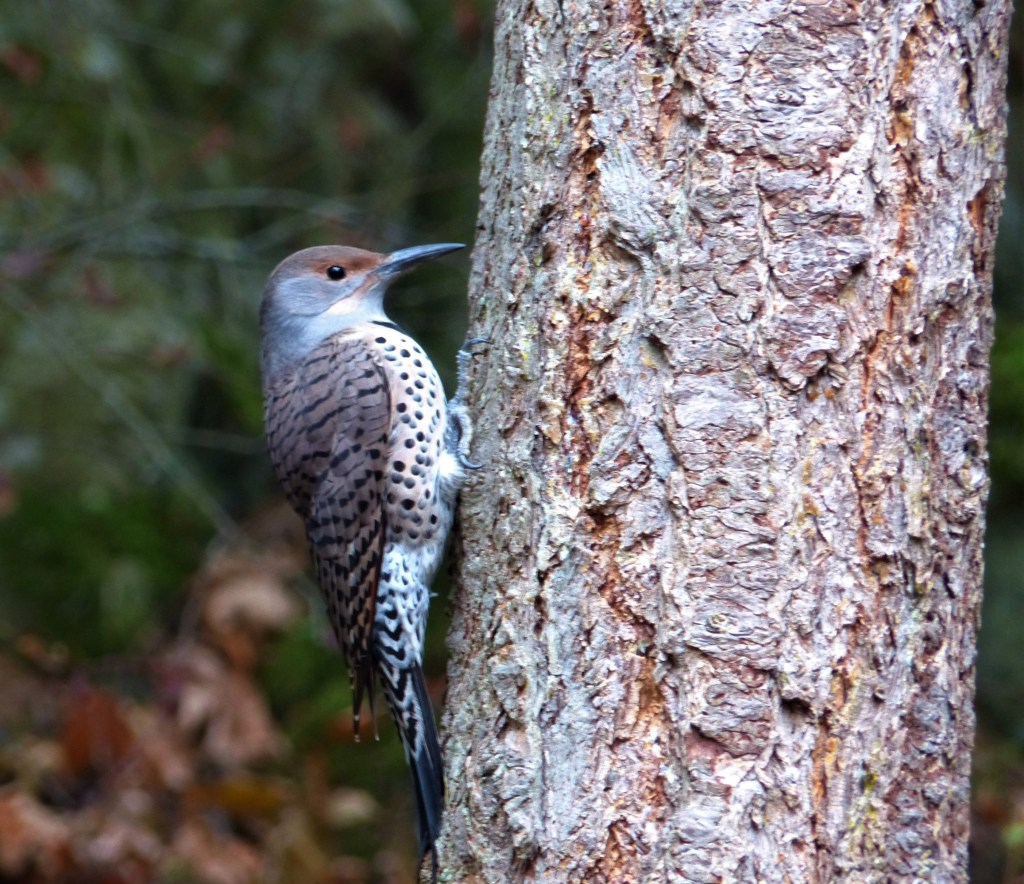
A female Northern Flicker clings to a fir outside Nuthatch Cabin. Male and female Flickers share similar markings except for the male’s dark “moustache” stripe from beak to cheek.

IT MUST BE SPRING. The jackhammers are waking me and Galley Cat in the morning.

Don’t get the wrong idea. I haven’t abandoned Nuthatch Cabin for a one-bedroom walk-up above a shawarma joint in Queens. No, this soundtrack of heavy construction is from my friend the Flicker.

Not “My Friend Flicka,” the 1950s TV series about a Wyoming kid and his horse. No, this disturber of my island peace is a Flicker. A Northern Flicker, to be precise. A type of woodpecker.

I’ve always admired these handsome birds with the gently curving beak. The speckled gray breast and darkly striped back suggests the look of a plump British earl in a satin vest and charcoal morning coat, off to see the horseraces. Possibly at the invitation of a duke.

But my admiration has come under strain on recent mornings.

It started about two weeks ago. About 7 a.m. I was jolted from a dreamy sleep. Galley, who usually snoozes on my feet, was up on all fours with wild eyes. A noise that seriously resembled a pneumatic jackhammer was reverberating throughout the cabin.

“A friggin’ woodpecker!” I quickly realized.

I bolted out of bed to run downstairs and out the front door, barefoot and in my nightwear, to look angrily roofward and shout the first forceful, manly exclamation I could articulate: “SHOO!”

The Nuthatch and its resident nut: The peaked metal roof is a favorite of Flickers.

A Flicker nonchalantly fluttered away to a tree next door.

Since then it has recurred every few days. Once, I spotted another Flicker (if not the Flicker) at the tiptop of my steeply peaked metal roof. The timing is always the same. I’ve been repeatedly rousted from my bed. This morning I tried to ignore it, but it didn’t stop. And the effect of the hammering on metal truly is like trying to relax inside a bass drum during a rousing Sousa march.

Interestingly, my friend Hilary on Bainbridge Island just recently told of a Flicker attacking her home’s metal gutters. And my island neighbor, the Mad Birder, said a big Hairy Woodpecker was after his metal roof a couple days ago. The odd thing is: In 23 years at the Nuthatch, this is the first time I remember this happening.

It’s a mating-season thing, the M.B. assured me. I figured it was a testosterone phenomenon, with boys trying to impress the girlies with that jackhammering on metal. But with woodpeckers, both genders drum to attract dates, M.B. pronounced. And just to cement his Mad Birder cred, he informed me that he could distinguish between different woodpeckers, sight unseen, simply by the cadence of their drumming. (I bow to genius. As long as he keeps sharing his Laphroaig when I visit.)

Anyway, happy springtime! You’ll understand if you spy me dashing out of my cabin in Dawn’s Early Light shaking a fist at the roof.

Just help me out by shouting “SHOO!”

THIS SATURDAY, MARCH 28: Friends, join me and millions of other Americans for the third nationwide No Kings Rally, likely to draw the largest turnout of any protest in history. Everybody and every body counts. Sign up and get details about a rally near you: Find the map and plug in your ZIP code at www.nokings.org.
Tiny Kinglets are good company

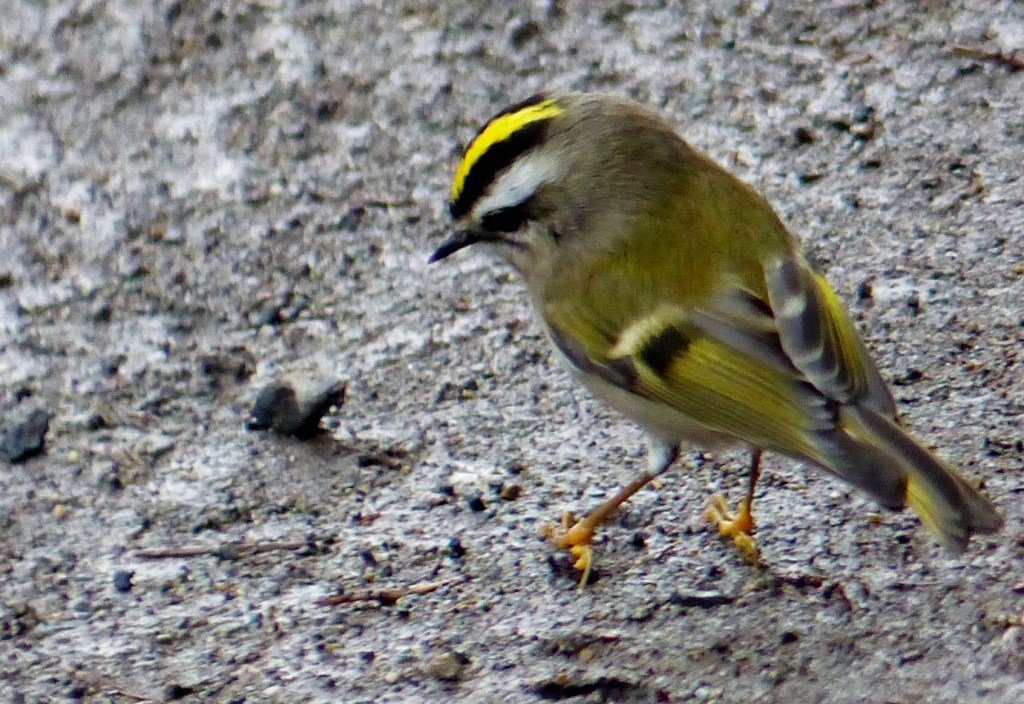
A Golden-Crowned Kinglet pecks for mites among the mud and gravel of a Center Island road.

THE ONLY OTHER LIVING BEINGS I saw today were Galley Cat and four Golden-Crowned Kinglets. Oh, and two squirming earthworms driven by heavy rains to the surface of my dirt road, much to the delight of the resident feline who found them almost as fun to play with as garter snakes.

Those were the only signs of sentient life on my corner of Center Island this January day. After a busy and well-visited holiday season, I was kind of OK with that.

Kinglets, regular winter visitors here, are tiny birds barely bigger than my thumb. Their nearly inaudible call, like the tinkling of a wind chime made of icicles, is an entrancing winter soundtrack when all else on my island is still and quiet.

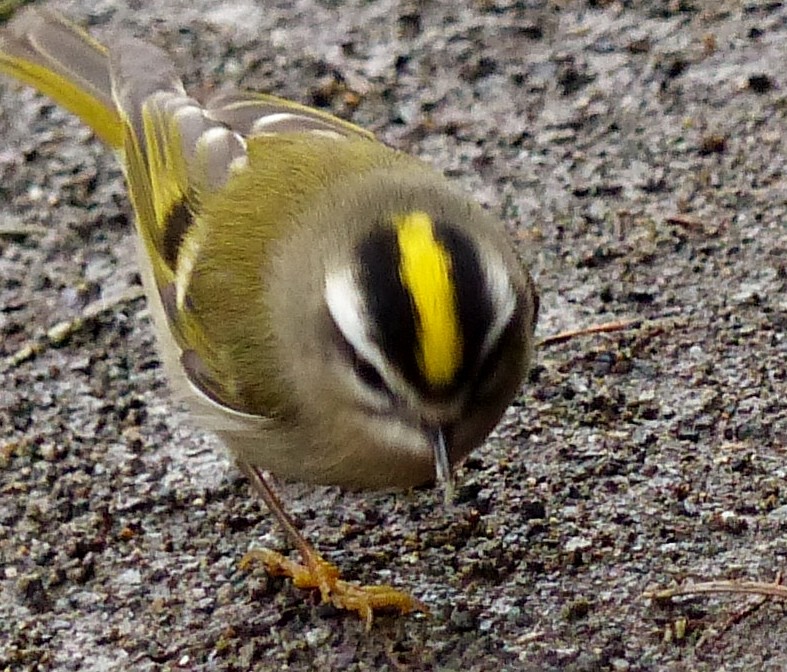
A Kinglet shows off its distinctive head decor.

I spied today’s first Kinglet as I tramped in my duck boots across our mushy, wet airfield to the mail shack late this afternoon. Kinglets are ground feeders, and this one was hopping among the wet grass finding something of culinary interest.

They are pretty little things with grayish-yellow bodies and a distinctive hairdo that is sort of a combination of black and white skunk stripes centered on a bright yellow Mohawk.

I came across a few more as I tramped homeward through the woods to my place. Kinglets are so small — about the weight of two pennies — and their call so elusive that I halted with a start when I suddenly realized several were pecking at the path just in front of me. They must be finding mites of some kind, my Mad Birder neighbor once suggested.

In a Robert Frosty moment I paused stock still in the dark and deep woods as I listened to the birds’ tinkling, what you might imagine from a parade of magical fairies. The Kinglets’ brilliantly striped heads were the only clear marker of their hops among the shadowy forest duff. I was enchanted.

It remains the gloom of winter on this remote little island nobody’s heard of. I live alone with my dopey orange cat, but even on the quietest days I don’t lack for good company.

P.S. Friends, the date on this post can’t go without comment. If you’ve not already ruminated on the fifth anniversary of the most shameful day in our nation’s history, let former Labor Secretary Robert Reich remind you in this salient essay. Thanks for reading.

The morning pause that refreshes

I enjoy coffee and toast with avocado and walnuts on the deck at Nuthatch Cabin, poised to take in an avian aria or two.

DO YOU EVER GET JADED BY BEAUTY YOU SEE EVERY DAY? In the Louvre of your mind, do you walk listlessly past Mona Lisa’s winsome smile? In your inner Florence, do you yawn at David’s washboard stomach? On a pristine spring morning in Seattle, does snowy Rainier not merit an “Oh, look, the Mountain is out!”

I had approached that enervating ennui on my little island of perfection. Daily routines had dulled senses and blinded my eye. But a pleasant phone chat with my brother Doug reminded me of his practice whenever he visits. He starts every day with coffee out on my deck to hear the dawn chorus. His example inspired me this morning.

If you’re not my neighbor the Mad Birder or one of his fellow travelers, you might not know: “Dawn Chorus” is the bird-lover’s label for the cacophonous birdsong that erupts with the sun’s rise in these warming months. It comprises the collective theme songs of scores of early birds determined to get their worms.

A nice thing about my island is we have so many birds that the chorus continues well into mid-morning, meaning I could catch today’s performance even after getting my required eight hours.

With no neighbors at home — the Mad Birder and his lovely wife are off on a madcap fishing trip in Nevada — I wasn’t shy about wrapping up in my bathrobe and slippers as I headed out to the Adirondack chair. In my hands was a breakfast of avocado toast and fresh drip coffee. It was 44 degrees F. outside. I was glad I’d pulled on long johns and that the coffee was blazing hot. Behind me, the sun was just rising over my rocky knoll to light up the treetops around me.

Sure enough, the birdies were belting out songs like Julie Andrews romping an edelweiss-laden Alp.

One virtuoso song, full of joyful trilling and punctuated by rising and falling scales broadcast at perfect pitch, turned my head and prompted a smile from my toast-munched mouth.

I regret that I’m not skilled at identifying many birds by their song, though I am often curious. My eyes scanned the treetops, finally spying a light-colored bird high at the tiptop of a dead fir, 100 feet up where the rising April sun was just warming the chill air.

He was too distant to identify by sight, but I relished the song, imagining the view from high up, and almost feeling the golden glow on my face as I lifted my eyes to the cloudless azure sky. I was the only human hearing his song, but I didn’t own it; the thrill belonged to this island and these woods.

Who was this bird of lilting forest melody? I couldn’t resist. I rose from my deck chair and tiptoed quickly inside, as if the bird would somehow hear me from that dizzying height. I returned with my binoculars. But the singer was gone, like a golden dream barely remembered after waking.

The entertainment wasn’t over, however. Countless songbirds zoomed and swooped in seeming games of tag among the fir limbs and maple catkins. Minutes later the singing bird returned to its perch. My high-powered lenses showed a Purple Finch (my best effort at identification), his rose-tinted head colored scarlet by the klieg-light sun. Besides the birdsong, calm and silence filled my woods but for the faintest background static, almost subliminal, of a passenger jet writing a contrail in the blue heavens. Some 30,000 feet up, its ear-budded transcontinental travelers knew nothing of this morning’s sweet aria from 100 feet above the forest duff.

With the bountifully-lunged singer in sight, I crept back inside for my camera with its 600-millimeter zoom. As I returned to my chair, a nearby nuthatch honked in merriment, taunting that the finch had again taken wing.

I kept watch, struggling for a photo of my elusive Pavarotti of the forest crown. He alighted atop another tree, but was brimming with springtime energy, resting only long enough for me to grab my camera, raise it to my eye, and … focus on an empty branch. Finally, after many tries, I caught a photo.

After many tries, my long-lens camera caught this lustily warbling songbird high atop a fir on a bluebird-sky Center Island morning.

Back atop the dead fir, another finch joined the first. Falling from the perch together they defied gravity, fluttering up, down and sideways like frenetic tiger swallowtails. The start of a hot date? Or two males in a chest-thumping challenge for territory? “Want me to scram? Who’s gonna make me? You and your mother?”

Their struggle against Earth’s pull reminded me of the classic aviator’s poem, “High Flight” (which, Wikipedia tells me, U.S. Air Force Academy students must memorize):

“Oh! I have slipped the surly bonds of Earth

And danced the skies on laughter-silvered wings;

Sunward I’ve climbed, and joined the tumbling mirth

of sun-split clouds — and done a hundred things

You have not dreamed of — wheeled and soared and swung

High in the sunlit silence…”

It was a good start to another day on this small island nobody’s heard of.