Getting to know you, all the San Juan Islands and your people

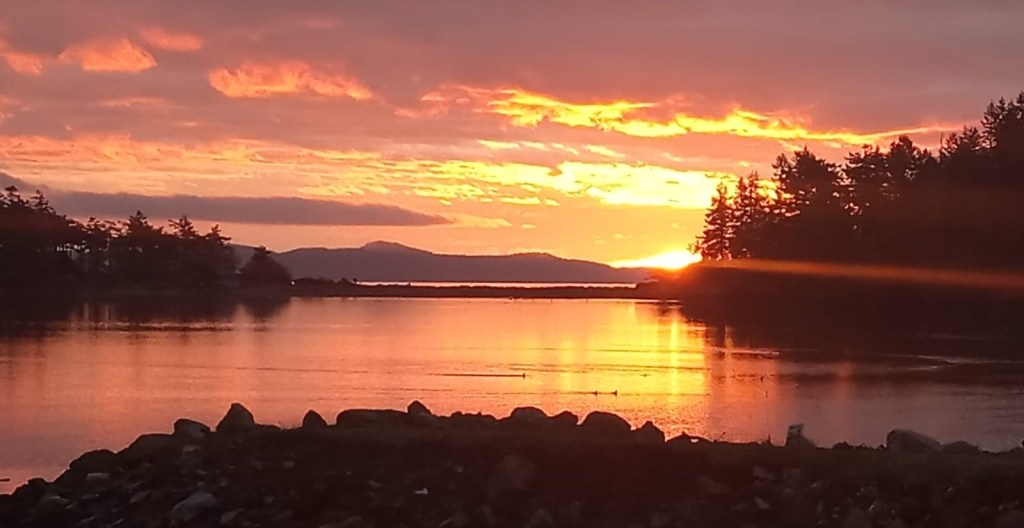
Cypress Island as seen from our Mount Pickett hike on Thanksgiving morning.

I’M LOVING THESE ISLANDS ever more as I get to know each from the land side rather than just from the water. And as I get to know more of the people.

For decades, my family and I toured on our sailboat every summer throughout the San Juans. We had a rule that every year we must discover at least one new scenic anchorage or hidden cove.

We saw a lot of the islands. But we didn’t meet a lot of the locals that way.

Two things have changed: (1) I live here full-time now and naturally have more chances to hop a ferry with my pickup or bicycle to visit other islands , and (2) My new gig as a tour leader with Road Scholar has rapidly introduced me to more people and places all over the archipelago. For example, while I’d visited the Sunnyfield Farm goat farm on Lopez Island several times before, this past summer I accompanied a Road Scholar group there for a guided tour by Andre, the farm owner and head cheesemaker, whom I’d previously only said hello to in passing. When I took a friend there later in the summer, Andre remembered me. Likewise, I’m now on a first-name basis with Kevin Loftus, the San Juan Historical Museum’s jovial director, a fount of knowledge about these islands. And so on.

I’ve also made a bunch of new local friends who work as guides for Road Scholar.

Orcas Island’s Odd Fellows Hall dates to 1891.

This Thanksgiving reinforced my feelings for other islands, each with their own character, when I spent the holiday with my friend Tom on Orcas Island.

At his suggestion, we joined the free community potluck at the 134-year-old Odd Fellows Hall overlooking the water in Eastsound. Organized by the Odd Fellows and with donated turkey and trimmings, it was open to all islanders as well as visitors, and they got a capacity crowd. I’d guess 200 people shared in the camaraderie and good food. Supplementing the usual fare, everybody brought their favorite holiday dish, from quinoa with salmon to old-fashioned mac ‘n cheese. Pumpkin pies, apple pies and flans! We shared a table with a local mom, Allison, her two teenage sons, and a friendly couple visiting from Tacoma. One of the best-organized volunteer events I’ve ever attended, it further warmed me to Orcas Island and its residents.

Before the feast, Tom and I started our visit with a luxuriant soak in the communal waterfront hot tubs at venerable Doe Bay Resort, about a mile from the cabin he shares with an orange cat named Boxer. We shared the tubs with a local man’s birthday party! We also stopped for coffee at the beautifully renovated Olga Store and toured the Orcas Island Artworks cooperative, housed in a historical strawberry-packing plant at the Olga crossroads. The island nurtures artists working in every medium.

My friend’s Orcas Island cabin, which he has dubbed Belly Acres.

On drizzly Thanksgiving morning, we set out on foot to explore the side of 1,750-foot Mount Pickett in a far-flung corner of Moran State Park. Our trail meandered past more than one monumental old-growth Douglas fir. Not another human to be seen.

Friday afternoon I boarded a homeward-bound water taxi from Obstruction Pass Public Dock for a 20-minute ride back to Center Island.

You may have read previously of my plans to exit these islands. Now, feeling more and more like an at-home San Juanderer, I’m in no hurry to go.

After Christmas with my daughter and her partner on Center Island, I have plans to spend New Years with friends in Friday Harbor, tentatively to include the annual New Year’s Morning bike ride, another fun community event organized by friendly islanders.

Happy holidays, friends near and far.

The social whirlwinds of October

On the airfield: Neil Johannsen and Hilary Hilscher, of Bainbridge Island, visit a small island nobody’s heard of. Hilary holds an apple from one of Center Island’s old fruit trees.

I’VE RARELY HAD such a sociable October on my little rock in the San Juans. It’s been a happy whirlwind of visitors.

My buddy Tom from Orcas Island came over on the state ferry for a couple of days the first week of the month. A few days later longtime friend Patti, of another sailing family, visited from Walla Walla and stayed three nights. And I bid farewell yesterday to Hilary and Neil, birder friends from Bainbridge Island. Galley Cat and I feel like quite the social butterflies.

It’s been a good month for stocking up on visitors. Just as I’ve been busily cutting and splitting firewood in preparation for winter, I’m stockpiling social occasions that will by necessity dwindle as winter squalls set in for the long haul till March.

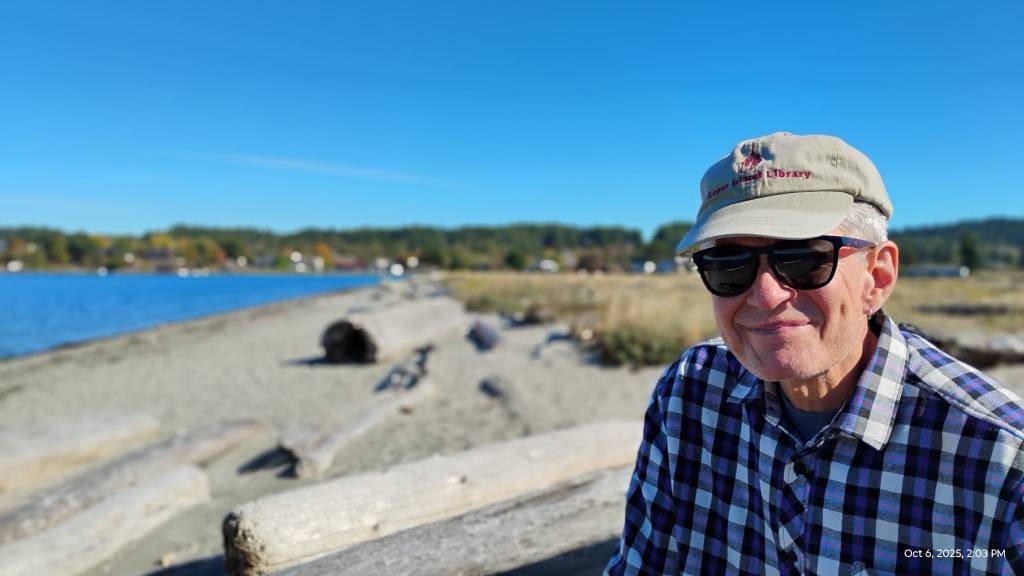
Your loyal correspondent on the beach at Fisherman Bay Spit, Lopez Island. Tom Willard photo.

The October weather has been a mixed bag, but every visitor got at least one dreamy day. Tom and I ate a sack lunch on the sunny beach at Fisherman Bay Spit on Lopez. I hiked with Patti through a canyon of salal to the rocky shoreline at Shark Reef County Park on a pristine autumn day. While Hilary and Neil experienced buffeting winds and horizontal rain, observed mostly from in front of my woodstove’s blazing fire, blue skies opened up the next day in time for an enjoyable walk circling Center Island. Our big-leaf maples are turning honey gold, an eye-candy complement to the darkly brooding evergreens.

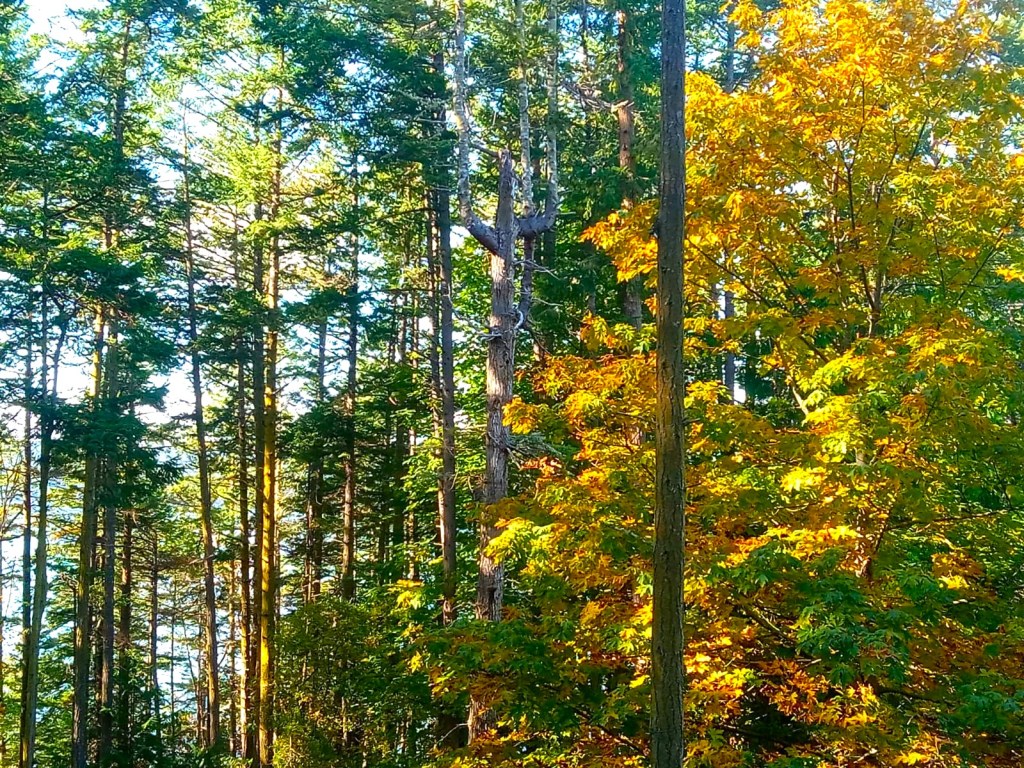
October’s golden maples are a pleasing contrast to my island’s evergreens.

But the visitor season is drawing to a close. In anticipation of Sunday’s storm I hauled WeLike, my aqua-glorious 1957 cuddy-cabin cruiser, out of the water and tarped her on her trailer — probably until January tempests pass.

For the long, quiet months ahead, I’ve filed away some good memories: Teaching a new board game to Patti. (She won. Twice!) Watching a whimsical Jim Jarmusch film with Tom. (His favorite director, my newly acquired taste.) Smacking lips over my second helping of Hilary’s tasty enchilada casserole. (Gotta love visitors who bring dinner!) Witnessing confirmed feline-friend Neil’s jovial adoration of Galley Cat. (Even though she hissed at him in a moment of forgotten manners.)

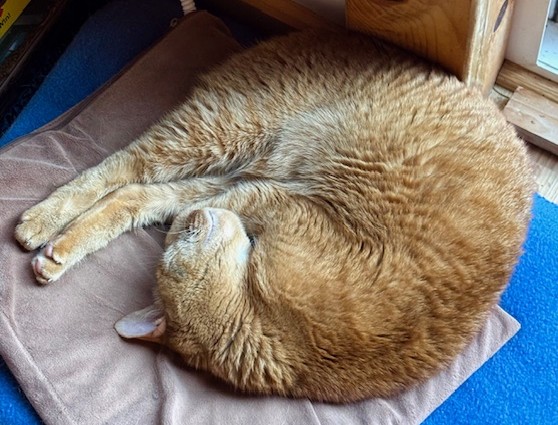
Galley Cat on her pet heating pad. Few cats sleep so soundly. Neil Johannsen photo.

As with these memories, I’ve also stocked up on winter firewood. Our community association recently hired a woodcutter to take down dead or dying trees along our island roads. He cut 60 trees in one day. The supply of firewood has never been so profuse. Thanks to my handy new Husqvarna, my wood rack overflows with new rounds of Doug fir awaiting room in the woodshed.

Unfortunately, the tree cutting has also resulted in an Everest-like mound of trimmed branches awaiting burning at the end of our grass airfield. When the island caretakers torch that sucker it will likely be seen from outer space. Another unfortunate side-effect: Last week a San Juan Airlines single-prop plane delivering UPS packages to our island landed amidst a tailwind capable of lifting a Kansas farmhouse to Oz. Unable to stop at the field’s far end, the plane nosed into the brush pile, just enough to require a complete replacement of propeller and engine. (Anytime a plane’s prop hits something, the engine must be rebuilt or replaced for fear that delicate inner workings might have been thrown off-kilter.) For four days a repair crew brought replacement parts by air and sea. I lent a hand on our dock the day a boat arrived with one of the biggest, oddest-shaped cardboard boxes I’d ever seen. On it, large letters declared: “Contents: airplane propeller.”

So, rarely a dull moment on my remote little island of which few have heard. Not this October.

Rainy day brings green (moss), clean (air) and relief from a health scare

The thick moss that upholsters the rocky knoll behind Nuthatch Cabin gets lusher with a summer rain.

FEW THINGS COULD HAVE BEEN MORE WELCOME this morning than to awaken to the patter of raindrops on my Center Island roof.

My rooftop is metal. When I’m abed in my loft, my head is inches from the sharply sloping knotty-pine ceiling and not much farther from the roof outside. Raindrops are like a percussive lullaby, and morning raindrops mean I have the day off from outdoor projects.

It was a celebratory lie-in for me, reading a good book, sipping good coffee and munching toast. The celebration was two-fold: (1) We really needed the rain on my parched and crispy island, and (2) I don’t have thyroid cancer.

I had returned from Seattle yesterday afternoon, following a Monday fine-needle biopsy of a suspicious lump on my thyroid gland.

The thyroid “nodule” (as the docs called it; a less-alarming word than “lump”?) was among discoveries when I did hospital time last December with multiple scans of my innards. After recovering from the ulcer that prompted emergency surgery on Christmas Day, I had a late-January visit with a Swedish Cancer Institute hematologist to find out if the lesions seen on my spleen were something to worry about (apparently not, he decided).

By comparison, the thyroid nodule sounded minor, and frankly I was fed up with being poked and prodded, so I conveniently forgot about it. But my primary-care physician didn’t, and a few weeks ago he prodded me (there’s that word again) to get another ultrasound look at the thing.

The nodule hadn’t disappeared on its own, and on a standard scale used to judge such things, mine was of a size to prompt a FNA, I learned in a MyChart report.

Had to Google that, of course. “FNA” stands for fine-needle aspiration (poking, what did I expect?). It’s a type of biopsy.

“Biopsy.” There’s an ugly word I hadn’t personally experienced before. It meant I had to be tested for cancer.

To ratchet up my apprehension, my primary-care guy phoned me in person less than an hour after the ultrasound finding posted. He’d never done that before. It was no emergency, but he wanted me to schedule the biopsy soon.

So there I was Monday afternoon at the high-rise Optum clinic at 7th and Madison, just off Interstate 5 in Seattle, getting a needle poked into my neck five times while the radiologist attempted to get enough “stuff” (the actual term the doc used) for a reliable analysis. Ick.

It wasn’t pleasant, and I hope not to repeat it. But he gave me a local anesthetic of lidocaine, the same numbing agent most dentists use these days. So all I felt was some unpleasant prodding. Not much poking. In fact, it was a lot like a dentist visit, blessedly without the noise of the high-speed drill and the occasional whiff of smoke from the grinding of tooth enamel.

Absent any actual cutting, the only bandage I wore home was a standard Band-Aid.

I slept on the couch in daughter Lillian’s Roosevelt-district apartment that night. She and a friend had generously taken me out for dinner and a movie to distract from the worry. The doc had said results could take a week.

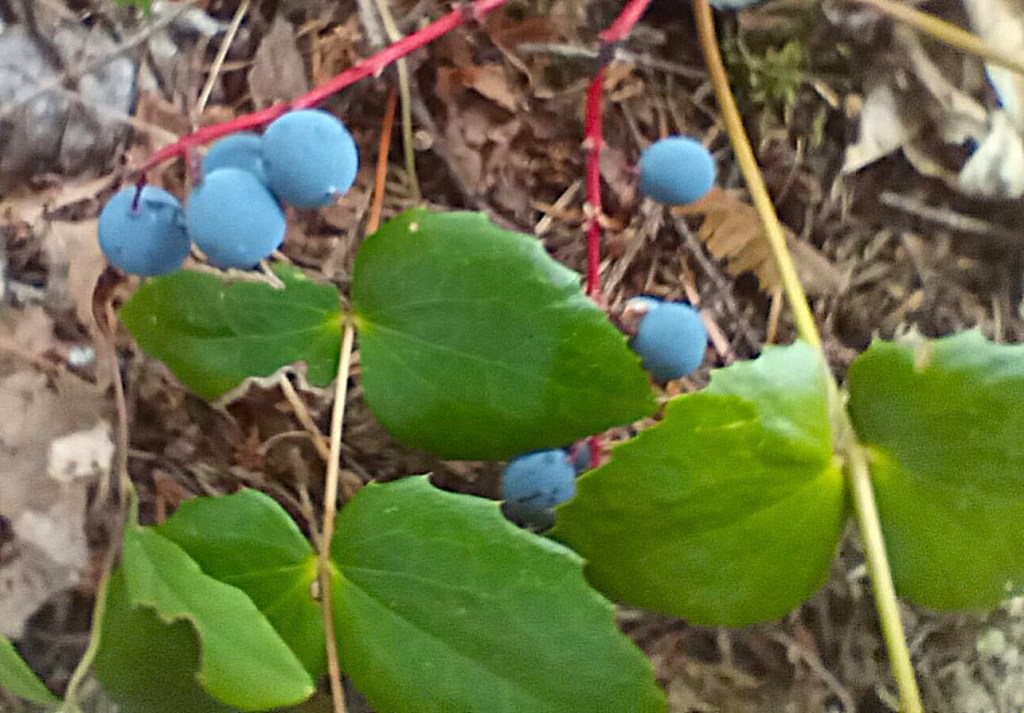
The dusty blue fruit of Oregon Grape is among this summer’s bumper crops on Center Island.

Tuesday, I did mainland grocery shopping before returning on a 3 p.m. water taxi to my island. The day was muggy and the air unpleasantly smoky from wildfires in the region. As I awakened from a pre-dinner nap, I heard the first of patters on my roof. Stepping to the door, I relished the smell of the freshly rain-washed air, like the aroma of clean sheets on a clothesline. It was a brief reprise of spring rains that nurtured a healthy crop of berries and seedlings in recent months.

I checked my email and with a mild jolt saw that I had a test result waiting on MyChart. I gulped and steeled myself for the news.

It took a moment for me to wade through medical terminology until the word “benign” jumped out at me.

What a relief. For this resident of a remote little island, a cancer finding could have changed my future. Or the rest of my summer, for sure.

Instead, I’m enjoying this showery Wednesday. Breathing deep. Taking a break from outdoor projects. Writing in my hut on the rocky knoll. My happy place.

As my siblings and I often say, getting old ain’t for sissies. For now, though, I feel good, full of energy — and relieved. Stay healthy, friends.

Ding, dong, the deck is done!

IT WAS DOWN TO THE FRIGGIN’ WIRE, but at 5:32 p.m. on July 31, 2025, I jubilantly fulfilled my pledge to be done by the end of this month with replanking the sizable deck that wraps around Nuthatch Cabin. It was a project begun several years ago.

Whew!

The final stretch, just completed. The lighter planks at the far end will match the rest after a second coat of stain.

I’d have finished last Sunday if I’d not discovered serious dry rot in one of the very last supporting beams I exposed when prying up old planks. Once I’d scraped out the rotten wood I could almost stick my fist into the hole.

I solved that with a can of Bondo, the gooey, hard-curing polyester putty from 3M that car restorers love. It has brought new life to many a rusted out fender on a ’53 Studebaker. I happened to have an unopened can I’d bought years ago for another project but never used. It was still in good shape (no rust on the can!) and did a dandy job repairing the rotting beam.

While that repair cured good and hard, I took a couple of days off the deck repairs for an overnight campout aboard WeLike with my friend Tom from Orcas Island. We lucked into dock space at Prevost Harbor and had fun exploring Stuart island.

Tuesday sunset at Prevost Harbor in the San Juans.

Back at the project today, I finished the last 10 square feet of deck replanking. All that remains is trim work on the railings and a second coat of wood treatment on the final new planks. But it’s done enough to celebrate.

Over the month of toil, I’ve memorized the words to every song on Jimmy Buffett’s “Beaches” album, gotten a tan George Hamilton might have envied, battled sciatica (all that bending) and carpal tunnel issues (all that prying and hammering), and done my best to keep Galley Cat from leaving paw prints in the fresh stain.

Cheers, friends! Tomorrow is August. Right now, I’m pouring a glass of wine and putting my feet up.

It’s July! All hands on deck!

Hemlock (the darker wood) started my deck project, with golden cedar now the lumber of choice on this completed first phase of my deck renovation. But it’s not all done yet…

A QUICK JULY HELLO from Center Island, where summer means outdoor projects.

Months ago I committed to setting aside this summer to finally complete the replanking of my 25-year-old, rapidly rotting cedar deck, which had never been treated with any preservative. I started the project a few summers ago in bits and snatches.

The lumber must all be brought over from Sunset Builder’s Supply on Lopez Island. That endeavor is limited by how many 8- and 9-foot planks I can fit into the back of my old Ford pickup, Ranger Rick, and into the cabin of my 20-foot cruiser, WeLike.

The thickness of my wallet has played a role as well. Cedar decking currently sells for $1.06 per foot on Lopez. That’s about 7 cents more than it goes for in mainland Mount Vernon, but a relative bargain compared to the $1.50+ I was paying on Lopez at the height of supply-challenged COVID.

So it’s been a piecemeal effort, involving many hours of yanking nails, prying up old planks, sawing new planks, staining them with a cedar-tone preservative, and drilling and screwing them into place. I’ve even been adding waterproofing caulk atop underpinning supports to lengthen their lifespan.

So, expensive, slow and methodical.

Despite the tortoise pace, over the course of several summers I’ve managed to renew the largest deck area, the 15-foot-by-19-foot surface where I have Adirondack chairs and an umbrella table for entertaining when neighbors drop by for a cold beer or a barbecue.

But plenty remains. Five-foot-deep sections of deck span the front of Nuthatch Cabin and wrap around to the front steps. Here, while I’ve concentrated efforts elsewhere, planks have been gradually collecting moss and lichen and slowly rotting away to the point that arriving guests might just fall through next time they visit. Not quite the welcome I’m looking for.

So, at the end of June I got out the measuring tape. I determined that I needed 651 board feet of lumber to complete the project.

New cedar planks are gradually replacing old across the front of Nuthatch Cabin.

Without delay, I hopped aboard WeLike and spent day after day ferrying cedar from Lopez Island. Other than one quick mid-month trip to Seattle for a doctor appointment and a bit of socializing with friends, I’ve set aside the entire month of July to finish the rebuild. (Today is a rare day of rain, so I get a day to write.)

Just checked my bank statement. I’ve already spent $617 on lumber for this final phase of the rebuild. Not to mention the cost of caulk, stain, deck screws and new Velcro-fastened kneeling pads. The old ones, purchased at the rebuild’s outset, were now held together by duct tape and about as effective as strapping old kitchen sponges onto my 69-year-old knees.

With the mostly sunny days we’ve had, the work has been pretty much nonstop. The days can be hard but the progress is satisfying. In college I read Robert Pirsig’s “Zen and the Art of Motorcycle Maintenance.” This is like that, but for homeowners. When I groaned a bit about aching joints, my friend Daniel comforted (?) me with a reminder. “The deck lasted 25 years. You’ll never have to replace it again!”

Unless I live to be 94. Not going to think about that.

Keep in mind that I live on a remote island with no trash-removal service. So once the deck is all done, I need to dispose of a large pile of old rotten wood. Can you guess where I’ve been storing it in the meantime? Under the deck!

I’m not going to dwell on that right now, either.

Even in the San Juans, I need time to rest up from retirement

Galley Cat recuperates in the island sunshine. A trip to the vet can be a marathon when you live on Center Island.

WHEW! It’s been a week.

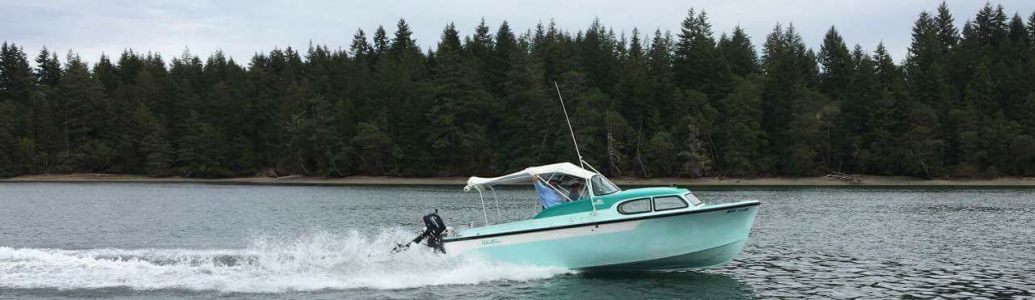
The good news: WeLike, the much-adored, well-restored 1957 Skagit Express Cruiser that is my island fun boat, is once again spic-and-span and back in the water after a long winter on a trailer.

The boat’s canvas is all mended. The bottom paint is fresh. The decks are scrubbed. In addition, the rocky knoll has had its weeds whacked and moss de-mapled. And Galley Cat is on the mend. More about that in a moment.

Bringing WeLike back to glory has been almost two weeks of intense labor on the part of yours truly. After my wintertime health issues and a long, wet San Juan Islands spring, instead of getting my beloved turquoise tub out on Lopez Sound by March, here it was June already.

The first task was remedying a, um, self-inflicted injury. Last summer when I went to clean her canvas top, I used a handbrush that I found in a gear locker. The brush came with the boat but I had never pulled it out before. As I had the top soaped and sudsy, I scrubbed away like a dedicated washerwoman taking a stain out of the king’s robe. Too late, I realized the brush’s plastic bristles were so stiff they were almost like wire. As I rinsed away the soap, I saw that I’d decimated many rows of stitching.

Luckily, the canvas held together for the summer. But I knew I needed to repair it. Originally it had been sewn on a machine but all I could do was stitch it by hand.

A leather sailor’s palm helped push the needle through canvas as I repaired the top on WeLike.

I ordered sail needles and UV-proof thread from Sailrite, and 10 days ago I got busy. I unzipped the canvas from its frame and for three solid days, stood in the boat’s cabin, all alone under the sun, and stitched. I told myself it was peaceful. Satisfying, rather than tedious. Listened to a lot of Jimmy Buffett.

Just to break up the routine, one day I knocked off early, came home to the cabin and worked for three solid hours with my weed whacker, cutting huge swaths of yard-high grasses on the rocky knoll. Yes, it was a wet spring, and everything grew. Besides weeds, it appeared that every maple seedling ever to drop from my trees had taken root and sprouted on the mossy rocks. A few inches high now, the tiny maples were easy to pull. In another month or two, they’d have real roots. So I labored away, yanking or whacking hundreds of them.

Back to the boat this week, I spent a day rolling new bottom paint, which isn’t so easily done when the boat sits on a low trailer. For one thing, you miss the spots where the hull sits on the trailer pads, but it’s the best I can do without hauling out in a boatyard. Only once did I begin to panic when I momentarily managed to get sort of pinned beneath the trailer axle as I scooted around on my back trying not to drip paint in my eyes as I applied it. One of those fun boat jobs!

WeLike shines when she shines.

The next day I fired up the island tractor and hauled the boat down by the shoreline where I could spray water about without making mud puddles around other trailered boats. On a warm and sunny day, I worked from 10:30 in the morning until 5 p.m., scrubbing every inch of the deck, the hull, the detail work. I used a deck brush in some places and a toothbrush in other spots.

I had consulted the tide chart to see when water would be high enough to use our community launching ramp. Five o’clock it was. So once again in the tractor seat, I backed my newly glittering Express Cruiser down the ramp and into the water.

Before unhooking from the trailer, I needed to be sure the engine started. After sitting untended since October, my beloved (this week) 90-horse Evinrude fired up on the first crank. (Some freshly added non-ethanol gas in the tank probably didn’t hurt.) There was only one catch: After returning forward to unhook from the trailer winch, when I climbed back up onto the boat’s bow and managed to limbo from the side deck into the cabin without falling in the bay, I perched in the skipper’s seat and applied reverse throttle. The engine responded, the water churned. And nothing happened.

I’d backed the trailer deep enough. WeLike should have floated off. I applied more reverse. The outboard roared. Water swirled like a Deception Pass whirlpool. But WeLike wouldn’t budge. After sitting on the trailer’s carpeted pads for eight months, it seemed she was literally stuck.

Happily, the tide was still coming in. I waited five minutes and tried reversing again. No luck. I wondered how many neighbors were now peering toward the harbor, curious at the sound of my roaring outboard on the launch ramp.

Finally, I clambered back out of the cabin, on to the bow, and gingerly stepped down on to the trailer’s tongue. Paranoid now, I first checked that I had indeed released the winch hook from the bow eye. No, I hadn’t made that mistake. So what to do?

As a last resort, balancing on tiptoe on the trailer tongue, I put all my weight into shoving the bow seaward. I shoved, I bounced, I muttered curses. And WeLike finally began to inch deeper into the water.

I quickly climbed back aboard, and all went routinely from there as I found a spot for her at the dock. It was dinnertime after a long day’s toil, so I wasn’t going anywhere on the boat that night. But maybe take her out for fun the next day?

Not to be. By late evening, Galley Cat convinced me she had a problem. For several days she’d been lingering oddly in her litter box. I finally got the message and analyzed the litter scoopings. For several days, she had hardly peed at all. A Google search convinced me that could be serious. Bad Kitty’s Dad for not picking up on it earlier.

I texted Island Express, who kindly offered an earlier-than-usual 7:30 pickup the next morning. By 8:45 Galley was getting an initial exam at the Pet Emergency Center near Mount Vernon. The initial triage by an aide indicated a possible urinary tract infection, but the veterinarian was just going into emergency surgery. The wait for official prognosis would be long.

My homemade sign for No Kings Day on Lopez.

It was very long. We gave them my cell number and drove to a shady park in town. To make this story shorter, I’ll just say that at 4:30 that afternoon we were finally departing the clinic with a UTI diagnosis, meds in hand and $500 added to my Visa bill. We were home around 6.

Sadly, I’m having to cancel my Father’s Day visit with daughter Lillian in Seattle. Got to take care of my kitty cat.

Galley and I both had a lazy day today. Boy, did we need it.

Tomorrow, I’ll be back at it. I’m taking the boat to Lopez with a friend to get rid of trash and pick up lumber for my deck renewal. Saturday, I’m returning for the No Kings Rally in Lopez Village. Today, I made a sign to wave.

This is my relaxing retirement, on a remote little island nobody’s heard of. Summer’s almost here. I hope yours holds promise.

Keeping island wheels turning

Mr. Toad, my 29-year-old golf cart, sits on jackstands in Center Island’s community workshop. The new steering gear shows a silver gleam, with pesky tie rods below.

IT’S BEEN THE SEASON OF THE TOAD on Center Island. And boy am I glad to have it done with.

This isn’t a story about cute hoppy amphibians. This is about basic transportation and how to keep the wheels turning on my remote little island in the San Juans.

Mr. Toad is the name of my 29-year-old toad-green golf cart, named for the demon-at-the-wheel protagonist in author Kenneth Grahame’s classic “The Wind in the Willows.” Unless you want to walk, even when toting a month’s worth of groceries back from the mainland, electric golf carts are the primary means of getting around my island. Two reasons: (1) Our narrow gravel roads definitely aren’t suited to a giant RAM pickup truck, and (2) Forward-thinking community founders back in the 1960s or so chose to prohibit privately owned internal-combustion vehicles on our community roads. So most property owners have battery-powered golf carts. It makes for a quieter, more-peaceful island with fresher air.

A caveat or two: We do share three community-owned, gas-powered Ford Ranger pickups for times when you’re bringing a new sofa or a replacement refrigerator to the island. And with the world’s trend toward electric vehicles of every shape and size, our restriction on gas power has been broadened to include a size limit. “Small is beautiful” seems to be the watchword.

I bought Mr. Toad, a 1996, 36-volt E-Z-Go golf cart, from an island neighbor for $1,200 in the summer of 2020. Not content with average, I added a stained-cedar baggage platform with finned side panels and asked daughter Lillian to help gussy things up. She gathered swordferns and leaves of salal, Oregon grape, and maple, daubed them with paint and printed the cart with nature’s images.

Galley Cat visits the revitalized Mr. Toad.

Since then Mr. Toad has been a reliable helper for the most part. But as I’m learning every day, time marches on and every body needs upkeep. Including a motorized toad.

A few months back, that became clear when Mr. Toad got shy about turning left. If I drove sedately, all was fine. But the moment I emulated my golf cart’s reckless namesake and tried a quick left turn at anything like rambunctious speed, the steering wheel shuddered and clicked and Mr. Toad continued in a straight line. It could get exciting.

As with many challenges life throws at us, I learned to compensate. I rarely informed a friend hitching a ride of my conveyance’s guidance-system peculiarity. As long as I went slowly or circled the island clockwise, it was no problem. It went on the “got to fix this someday” list.

Before I had a chance at that, Mr. Toad threw me another challenge. On a day of endless and soaking rain in early April, I was returning from a long day’s outing to Friday Harbor. As dusk approached I was glad to be nearing home in Mr. Toad, peering through the rain-spattered plexiglas windshield that does not feature wipers. A half-mile from the cabin, I approached what we call Little Cardiac Hill (the full-size Cardiac Hill is on the far side of the island). Mr. Toad’s batteries had been showing signs of anemia lately (in sympathy with me, perhaps?). So, I switched on the voltmeter to see how my battery bank fared as I floored the accelerator and started up.

The voltage immediately sank like a skydiver with no chute. Toad got halfway up the hill and stalled out. Cursing blue-blazes hot enough to defrost the foggy windscreen, I let the cart roll back to the base of the hill to rest a minute before trying again.

The rain spattered in on me from the cart’s open sides. I didn’t want to sit for long. So I floored the pedal and again climbed a few feet up the hill. Pungent electrical smoke puffed from the battery compartment directly beneath me. If I kept trying I would literally be in a hot seat. This time I rolled backward into a neighbor’s front path, where Mr. Toad promptly got mired in mud.

I’d had a long day. I had groceries in plastic totes on the luggage carrier. I couldn’t walk home alone. I had to call a friend to come out in the incessant rain and give me a homeward lift .

So replacing Toad’s ailing batteries was the first order. The same friend who came out to rescue me in the rain suggested it was time to convert to lithium-battery power. The new style of battery was known to be powerful, fast to recharge, and long-lasting if well-monitored. And for Mr. Toad, one 63-pound sealed 36-volt battery (requiring no maintenance) would replace six 80-pound, 6-volt lead-acid batteries. Mr. Toad would have more power while hauling 420 fewer pounds of battery! Woo-hoo! Speed-demon time!

The clincher came when I looked on Amazon and found a suitable Chinese-made battery for $600 (pre-tariff), including a new charger. I’d pay double that to replace my lead-acid batteries.

But life in the islands is tricky. The new battery could be shipped at no cost, but not to my island. United Parcel Service, the shipper of choice for most Amazon goods, subcontracts Center Island deliveries to little San Juan Airlines. The small planes cannot carry anything classified as hazardous, which includes lithium batteries (as well as boat paint and a long list of other items). And I could find no nearby brick-and-mortar stores that sold similar batteries at a low price.

My creative solution: Ask a friend in Friday Harbor if I could have the battery shipped to her home. Shipments to the bigger islands of the San Juans arrive by truck on a state ferry.

I would be staying in my friend’s guest room three times in April for training sessions with Road Scholar. So when the battery arrived, I took my pickup truck on the ferry and brought the battery back to Lopez Island. On the final stretch to Center Island the big battery was strapped to a hand truck aboard the Island Express water taxi.

The lithium battery being installed in Mr. Toad: One battery replaced six.

Installing the new lithium battery meant modifying and rebuilding the battery platform under Mr. Toad’s seat, along with some new wiring and installation of a battery meter. That took a week of trial and error, considering that the few installation instructions were either in Chinese or barely intelligible English. (Yes, cheap goods come with tradeoffs.) In the end, I learned that my battery was Bluetooth-enabled and I could monitor its charge status using an app on my phone. Easy pie!

That accomplished, I gave myself a day off before moving Mr. Toad to the community workshop where I put him on stands and went to work replacing the steering gearbox. At $170, this was another Amazon acquisition, but this one came right to me. Here’s where I thanked the digital genies that provide YouTube instructional videos on how to do almost anything. A nice gentleman on the DIY Golfcart YouTube channel gave precise step-by-step instruction on how to replace the steering gear on my exact make, model and year of golf cart. I have some mechanical know-how, but I will just say this: Bless you, DIY Golfcart man.

The only catch: In his demonstration, all the nuts and bolts came off and went back in with ease. Not so in real life, on a cart like Mr. Toad that has never had anybody fiddle with some of those bolts. Not since Toad left the factory when Bill Clinton was president.

But I yanked and grunted, twisted and turned and managed to get the first round of old parts loose. When it came time to release the tie rods from the worn-out steering gear, I watched my video friend casually pop the rods loose with his little finger. Then I spent two unsuccessful hours with wrenches, hammers, WD-40 and a brief moment with a propane torch. I got the nuts off, but the tie-rod bolts wouldn’t budge from the steering bracket. Not for love, money or colorful language.

Gloom-ridden at the prospect of failure, I decided to call it a day and tackle it fresh in the morning. I went home and — why not? — Googled “how to get tie rods off a steering gear on a 1996 E-Z-Go golf cart.” The digital wizards chuckled merrily as they revealed Amazon’s listing for the Astro Pneumatic Ball Joint Separator, a specialized little tool made for precisely this purpose. Apparently I’m not the only mechanic to have rammed my head into this brick wall.

I hit the “order” button, pausing only briefly to grumble about the $28 price. Amazon informed me that this item was in a nearby warehouse and would arrive the following day. It was my turn to merrily chuckle. They didn’t know about my island and just how long it takes things to get here. One day? Ha!

But I could hope.

The next morning I was back at the workshop by 10. The caretaker who handles our mail stopped by with a box that had arrived from Amazon. It was a big box. My hopes momentarily soared, until I yanked the box open to find six rolls of Scott paper towels I had ordered days earlier.

For another 20 minutes I went back to poking and prodding at the reluctant bolts until the caretaker drove by again and handed me a small package from Amazon. It rattled as if it was something metallic. Could it be?

The magic tool that came in the mail.

Sure enough, it was my ball-joint separator, which I have to say sounds vaguely like an instrument you’d find in an urologist’s office. It kind of looked like an alarming medical device, too. Metallic jaws flexed in the middle, driven tighter by a screw big enough to hold the fender on a giant RAM pickup truck.

It took a bit of hammering to get it into place, but once I’d figured it out a few turns of the screw head neatly popped the bolt out with a noise like a pickup fender falling off.

I won’t say it was all a cinch after that, but I followed my video friend’s instructions to the letter, sweated and cursed a bit more, and before 6 p.m. I was lowering Mr. Toad from the jackstands and sweeping out the workshop. The front wheels turned right and left on demand, behaving like a charm.

I loaded up my tools and headed home in triumph, zooming up Little Cardiac Hill.

Last night, I was still relishing two big jobs done well (with a little luck). Ready to head for bed a little after 10, I looked out the window at Mr. Toad, parked under the limbs of my 15-foot high sequoia tree. A yellow moon shone from high in the sky.

I wasn’t ready to sleep. I pulled on an insulated vest and my Elmer Fudd hat, stepped into the cool darkness and climbed into Mr. Toad’s driver seat. I turned the key, flicked on the headlight and zoomed up my back driveway for an invigorating 10-minute joy ride around the island.

As I’ve said before, take joy where you can find it. I turned left anytime I darned well felt like it.

Sharing smiles where I find them

The Prince of Whales whale-watching boat zips past my lunchtime viewpoint on Upright Head, Lopez Island.

IT’S BEEN TOUGH keeping up with the blog in these troubled times. We all have plenty of worries as the Trump Regime does its best to bully the world, trash our constitution and cripple the economy. Almost every one of us has seen our life’s savings swirling down the toilet.

But I resolved to help support my community in the face of the onslaught, so I’m here to tell about the good things in my island life.

Tiny calypso orchids are blooming with gusto on Center Island this spring. This flower is about 3 inches high.

Spring weather has finally arrived and we have a bumper crop of calypso orchids, aka fairy slippers. Buttercups are in bloom and ferns are uncurling new fronds like the gentle beckoning of an octopus tentacle. When I tap away at the keyboard in Wee Nooke, the cedar writing hut on the rocky knoll behind my cabin, I might still crank up the heater at first, but by afternoon I’ve opened a window to admit soft and salty breezes.

My big news is that I’ve landed a gig with Road Scholar, the not-for-profit tour operator that offers educational trips catering to travelers 50 and older worldwide. My Friday Harbor friend Barbara Marrett, retired from a career as communications director for the San Juan Islands Visitors Bureau, went to work with Road Scholar a year ago. She convinced me it would be a good fit for me, and kindly recommended me to the local leadership affiliated with Mount Vernon-based Skagit Valley College, which has a branch in Friday Harbor. I will be involved as a paid trainee with three of their week-long tours in my San Juan Islands starting in mid-May. Next year, I will likely be a group leader.

It’s a bright spot on my personal horizon. Living with just a fuzzy feline companion on my remote island, I need more human interaction. And some 20 years of exploring these islands with my family aboard our sailboat, writing about the San Juans as a travel journalist, and making a home on this little island nobody’s heard of seems to uniquely qualify me to help newcomers learn about the San Juans, too.

So far, the Road Scholar leadership has been tremendously accommodating and good to work with. When I told them I had been reserving the summer for overdue cabin projects that got a bit neglected last summer, they responded by assigning me to trips in May, September and October. Perfect! Itineraries will include boat trips to Sucia and other outer islands, a kayak tour and a three-island sampler.

I’ve already attended three training sessions in Friday Harbor, including a first-aid and CPR refresher course, a general leadership orientation, and training in how to safely drive their fleet of 11-passenger vans. That’s kept me busy in recent weeks traveling back and forth to Friday Harbor, a significant endeavor when I don’t yet have my restored 1957 cruiser, WeLike, commissioned for the season. (We’ve not had the weather for it until now.)

Ranger Rick looking spiffy and clean.

So I booked passage on the water taxi from Center Island to Hunter Bay Public Dock on Lopez Island ($76 round-trip), where I keep my good old pickup truck, Ranger Rick. I drove the pickup 25 minutes to the ferry terminal on the north end of Lopez and either parked it there and walked on the state ferry (for no charge to Friday Harbor) or drove aboard ($28 round-trip) when I wanted wheels at the other end. On one trip, I took advantage of the opportunity to drive Ranger Rick to the Friday Harbor car wash where I gave him a much-needed bath. There are no car washes on Lopez. He had gotten positively mossy.

These outings have made me thankful that I don’t often rely on Washington State Ferries, plagued by staffing shortages that commonly cause last-minute cancellations of scheduled runs. When one of my Friday Harbor boats was canceled and the next wasn’t for two hours, I “made lemonade” and took my sack lunch on a pleasant hike to a viewpoint in the San Juan County Land Bank’s Upright Head Preserve, adjacent to the ferry terminal. Couldn’t have been better if I planned it, I thought, as I watched whale-watching boats and big cabin cruisers plow through the water below the mossy bluff where I munched my tuna wrap.

Lumberjack Brian: A newly cleared building lot meant felled trees were available for firewood.

The arrival of spring weather already has me busy with outdoor projects around the cabin. When a nearby lot got cleared for construction of a new cabin the cut trees were available for firewood. Time to fire up my chainsaw and start replenishing my wood stack for next winter. (I had to watch a YouTube to figure out why the saw wouldn’t start after hanging in my shed for the winter, but soon had it roaring and spewing sawdust. When you live on a remote island, you learn to fix stuff yourself.)

My other adventure has been digging on hands and knees with a hand trowel to locate my septic drainfield so I can install capped, upright 4-inch PVC pipes that function as inspection ports, now required by the county if I ever wish to sell my place. One port is installed, one more to go. The joys of home ownership. Nothing that a clothespin to the nose can’t make more pleasant.

Amid all this, daughter Lillian visited to help me celebrate my 69th birthday and neighbors John “The Mad Birder” and Carol showed up with recently dug razor clams they were generously willing to fry up for friends. (Yum.) Lillian showed off her new skills as a patisserie baker by making me the world’s best sugar-free chocolate cupcakes with buttercream frosting. (Ditto yum.)

That’s the April report from Center Island, friends. Find joy where you can. Remember to support your friends, family and other good guys. We all need it now more than ever.

Season of hope is more welcome than ever

The miniature daffodils outside my cabin are a welcome harbinger of spring on Center Island.

DESPITE WHAT THE GROUNDHOG SAID, spring is arriving early this year. The equinox for my friends on the West Coast occurs overnight tonight at 2:01 a.m. PDT, on March 20. Not the 21st as we often experience.

Here’s what the equinox is all about, according to the National Weather Service, part of the National Oceanic and Atmospheric Administration (which I value and respect even if Trump and Musk don’t, which says something about how much I value and respect them):

EQUINOX: There are only two times of the year when the Earth’s axis is tilted neither toward nor away from the sun, resulting in a nearly equal amount of daylight and darkness at all latitudes. These events are referred to as equinoxes (spring and autumn). The word equinox is derived from two Latin words – aequus (equal) and nox (night). At the equator, the sun is directly overhead at noon on these two equinoxes.

That’s the scientific explanation of spring’s arrival. The esoteric and spiritual part of spring, the season of hope and renewal, is what most of us grapple to our bosoms.

The misnamed Purple Finch (with flashy red plumage) has returned to the Nuthatch cabin’s feeder after a long winter.

Boy, do we need it now, with the dumbest, meanest, biggest lying snakes of all time running our government into the ground and targeting their sputum at the most vulnerable among us. (Yes, it’s time to speak plainly.)

Wild currant blooms outside the cabin. Recently cut firewood rounds in the background show that I’m already prepping for next winter.

On my little island, I gauge spring’s arrival by the blooming of the wild currant, the arrival of birds I’ve not seen all winter, and the blooming of daffodils in my yard. Spring brings hope for warmer days, wildflowers and long walks with old friends.

Maybe find one of those vulnerable people and walk with them, too. Make a new friend. Shield them from the storm.

Happy spring! Cherish the hope. Hold it close.

Life, death, COVID and recovery among the wonders of winter

A gray squirrel pauses after raiding the Nuthatch’s bird feeder on a snowy February morning.

LAST NIGHT AS I WATCHED NETFLIX between frequent refueling of my cabin’s woodstove on a frozen February eve, outside the Nuthatch’s dark windows new snow came unbeknownst to me. It arrived secretly and silently, as if on little cat feet.

OK, apologies to Carl Sandburg. But I did get a poetic surprise when I peered out of the sliding door at bedtime and discovered the pristine new blanket of white seamlessly spread like a puffy down comforter across my deck.

FOG

The fog comes
on little cat feet.

It sits looking
over harbor and city
on silent haunches
and then moves on.

Carl Sandburg

No flakes were falling then. They had come while I wasn’t looking, anointing my island with a fresh and lovely purity.

This is the peaceful time of a San Juan Islands winter. No raging winds, no worries of losing lights and firing up generators.

This morning I relished the view from my loft. Having trundled back to bed with a gripping Michael Connelly novel, fragrantly fresh-ground coffee, and toast satisfyingly smeared with avocado, I watched through my front wall of windows as sunshine first lit the tall firs’ white-frosted branches.

Ahhhh.

I have a certain license to be lazy, and it’s kind of nice. On a phone consult yesterday, my Seattle hematologist told me it could be six months before my hemoglobin levels return to normal after a bleeding ulcer sapped my energies at Christmas. It means I’m anemic. So I’m giving myself permission to take it kind of easy. To devote myself to eating and sleeping well. Gradually building up my exercise routine.

The morning view from my loft.

I’m dedicated to all that once again after a drastic diversion last week. My dear Aunt Jeanne McLean, my mother’s youngest sibling and the last survivor of that family’s five children, died at age 96. I made the pilgrimage to South Dakota for her funeral.

I debated whether I was strong enough to travel, but my family had always been close to my aunt and her family. As a teen I had invested paper-route money in a Greyhound ticket from Seattle to visit the Dakota relatives on my own. I wanted to go now. I needed to go.

My brother Doug, who would also attend the funeral, made it easy for me. His partner, Lori, whose career tasks included travel arrangements for a globe-trotting employer, suggested I hop a direct flight on Alaska Airlines from Seattle to Denver. Doug would drive from their home in Santa Fe, New Mexico, to meet me and we would have a brotherly 400-mile road trip from Denver to Rapid City in his new Outback, sharing hotel rooms along the way.

Your scribe with cousin Tami McLean Bishop of Rozet, Wyo.

Smiling weather gods gave us a week of sunshine, the funeral service was nicely done, and reconnecting with cousins from across the West was soul-nourishing.

I moved more slowly through airports than is my norm, but I managed fine. And my brother and I saw a whole lot of scenery, from the snow-frosted Colorado Rockies, to the wide, wide wilds of Wyoming, to South Dakota’s beautiful Black Hills.

At 80 mph on U.S. 85, my brother Doug and I traversed hundreds of miles of snow-frosted, wide-open Wyoming.

I returned to the Nuthatch last Saturday just ahead of the snow, and I’m happy to hunker down here again. I’ve returned to what amounts to a Center Island COVID epidemic, affecting at least eight of my neighbors, some 50 percent of our winter population. So I’m being more of a hermit than usual.

That’s OK, Galley Cat is keeping me company. I hope my fellow islanders feel better soon. I plan on staying warm. I plan on staying well. Wishing the same for you.

My Aunt Jeanne McLean was buried at Black Hills National Cemetery, S.D., in the same plot occupied since 2006 by her late husband, Calvin McLean, a Korean War vet.