Season of hope is more welcome than ever

The miniature daffodils outside my cabin are a welcome harbinger of spring on Center Island.

DESPITE WHAT THE GROUNDHOG SAID, spring is arriving early this year. The equinox for my friends on the West Coast occurs overnight tonight at 2:01 a.m. PDT, on March 20. Not the 21st as we often experience.

Here’s what the equinox is all about, according to the National Weather Service, part of the National Oceanic and Atmospheric Administration (which I value and respect even if Trump and Musk don’t, which says something about how much I value and respect them):

EQUINOX: There are only two times of the year when the Earth’s axis is tilted neither toward nor away from the sun, resulting in a nearly equal amount of daylight and darkness at all latitudes. These events are referred to as equinoxes (spring and autumn). The word equinox is derived from two Latin words – aequus (equal) and nox (night). At the equator, the sun is directly overhead at noon on these two equinoxes.

That’s the scientific explanation of spring’s arrival. The esoteric and spiritual part of spring, the season of hope and renewal, is what most of us grapple to our bosoms.

The misnamed Purple Finch (with flashy red plumage) has returned to the Nuthatch cabin’s feeder after a long winter.

Boy, do we need it now, with the dumbest, meanest, biggest lying snakes of all time running our government into the ground and targeting their sputum at the most vulnerable among us. (Yes, it’s time to speak plainly.)

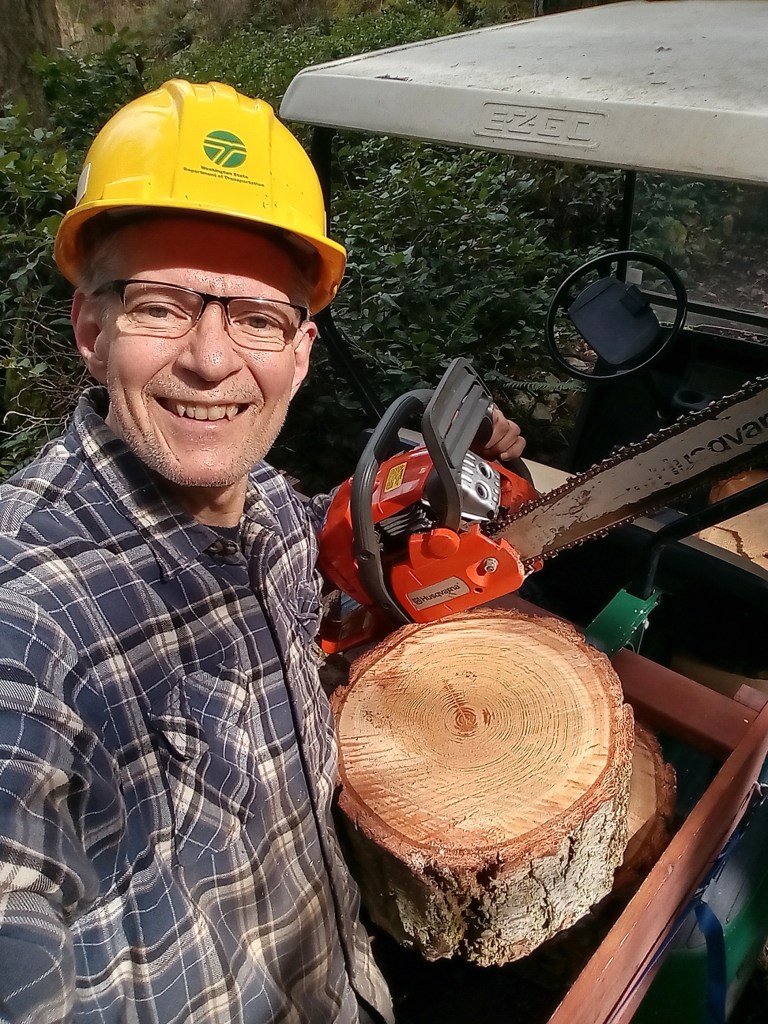
Wild currant blooms outside the cabin. Recently cut firewood rounds in the background show that I’m already prepping for next winter.

On my little island, I gauge spring’s arrival by the blooming of the wild currant, the arrival of birds I’ve not seen all winter, and the blooming of daffodils in my yard. Spring brings hope for warmer days, wildflowers and long walks with old friends.

Maybe find one of those vulnerable people and walk with them, too. Make a new friend. Shield them from the storm.

Happy spring! Cherish the hope. Hold it close.

Life, death, COVID and recovery among the wonders of winter

A gray squirrel pauses after raiding the Nuthatch’s bird feeder on a snowy February morning.

LAST NIGHT AS I WATCHED NETFLIX between frequent refueling of my cabin’s woodstove on a frozen February eve, outside the Nuthatch’s dark windows new snow came unbeknownst to me. It arrived secretly and silently, as if on little cat feet.

OK, apologies to Carl Sandburg. But I did get a poetic surprise when I peered out of the sliding door at bedtime and discovered the pristine new blanket of white seamlessly spread like a puffy down comforter across my deck.

FOG

The fog comes
on little cat feet.

It sits looking
over harbor and city
on silent haunches
and then moves on.

Carl Sandburg

No flakes were falling then. They had come while I wasn’t looking, anointing my island with a fresh and lovely purity.

This is the peaceful time of a San Juan Islands winter. No raging winds, no worries of losing lights and firing up generators.

This morning I relished the view from my loft. Having trundled back to bed with a gripping Michael Connelly novel, fragrantly fresh-ground coffee, and toast satisfyingly smeared with avocado, I watched through my front wall of windows as sunshine first lit the tall firs’ white-frosted branches.

Ahhhh.

I have a certain license to be lazy, and it’s kind of nice. On a phone consult yesterday, my Seattle hematologist told me it could be six months before my hemoglobin levels return to normal after a bleeding ulcer sapped my energies at Christmas. It means I’m anemic. So I’m giving myself permission to take it kind of easy. To devote myself to eating and sleeping well. Gradually building up my exercise routine.

The morning view from my loft.

I’m dedicated to all that once again after a drastic diversion last week. My dear Aunt Jeanne McLean, my mother’s youngest sibling and the last survivor of that family’s five children, died at age 96. I made the pilgrimage to South Dakota for her funeral.

I debated whether I was strong enough to travel, but my family had always been close to my aunt and her family. As a teen I had invested paper-route money in a Greyhound ticket from Seattle to visit the Dakota relatives on my own. I wanted to go now. I needed to go.

My brother Doug, who would also attend the funeral, made it easy for me. His partner, Lori, whose career tasks included travel arrangements for a globe-trotting employer, suggested I hop a direct flight on Alaska Airlines from Seattle to Denver. Doug would drive from their home in Santa Fe, New Mexico, to meet me and we would have a brotherly 400-mile road trip from Denver to Rapid City in his new Outback, sharing hotel rooms along the way.

Your scribe with cousin Tami McLean Bishop of Rozet, Wyo.

Smiling weather gods gave us a week of sunshine, the funeral service was nicely done, and reconnecting with cousins from across the West was soul-nourishing.

I moved more slowly through airports than is my norm, but I managed fine. And my brother and I saw a whole lot of scenery, from the snow-frosted Colorado Rockies, to the wide, wide wilds of Wyoming, to South Dakota’s beautiful Black Hills.

At 80 mph on U.S. 85, my brother Doug and I traversed hundreds of miles of snow-frosted, wide-open Wyoming.

I returned to the Nuthatch last Saturday just ahead of the snow, and I’m happy to hunker down here again. I’ve returned to what amounts to a Center Island COVID epidemic, affecting at least eight of my neighbors, some 50 percent of our winter population. So I’m being more of a hermit than usual.

That’s OK, Galley Cat is keeping me company. I hope my fellow islanders feel better soon. I plan on staying warm. I plan on staying well. Wishing the same for you.

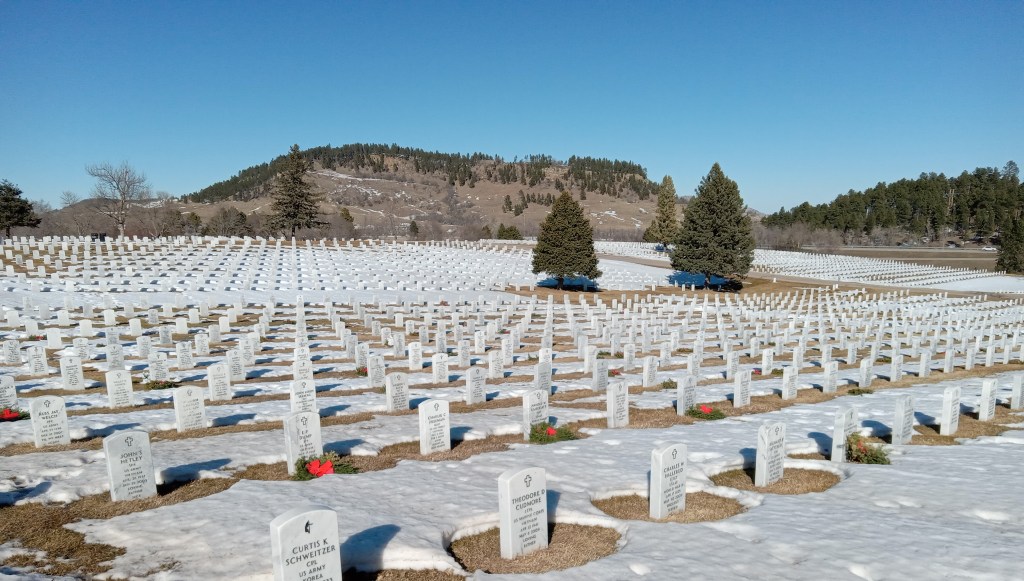
My Aunt Jeanne McLean was buried at Black Hills National Cemetery, S.D., in the same plot occupied since 2006 by her late husband, Calvin McLean, a Korean War vet.

Relieved to be home on my rock after Brian’s Dreadful December

AT LEAST IT DIDN’T HAPPEN on my remote little island nobody’s heard of. No helicopter evacs were involved, thank God.

That’s the best thing I can say about my recent up-close-and-personal encounter with America’s emergency health-care system.

Your faithful scribe and cat, happy to be back at the Nuthatch.

Loyal readers, if you were wondering about my long absence from the Reef, it was because I was busy living Brian’s Dreadful December.

When last we shared screen time, I was in the midst of a six-week housesitting stint in the lovely bayview home of friends Daniel and Jean in Olympia. In fact, after the presidential election I had resolved to make Olympia my next home.

That housesitting assignment was to conclude December 15. My plan was to return to my island for a week before hotfooting it back down the highway to spend Christmas with Portland friends Ken and Kate. Their daughter had orchestrated a plan for Christmas Eve dinner at Portland’s posh Ritz-Carlton hotel, followed by a couple of nights for family and friends at her Oregon Coast holiday home.

For me, all those holiday plans began to unravel on Friday the 13th (just like a bad movie).

After three days of serious digestive dysfunction in Olympia, I was on the phone at 7 in the morning to an old college friend — Kathy Pruitt, to whom I’m forever indebted — begging a ride to the nearest Emergency Room.

I had managed to pick up a nasty intestinal bug that over the course of the week had dehydrated me such that my blood pressure registered just 60/30 when they cuffed me in the St. Peter Hospital E.R. Never had I seen so many medical professionals swoop around me so quickly with armloads of I.V. bags, tubes and needles.

I was in the hospital four days before I.V. hydration, a liquid diet and a course of serious antibiotics set me right.

The lost time canceled my December return to Center Island. After a couple days of convalescence with my now-returned Olympia hosts, I packed up Galley Cat and drove straight to my Portland friends’ floating home on the Portland shore of the Columbia River.

On a back channel of the Columbia in Portland, my friends’ floating home is moored behind their sailboat, outlined in lights.

We had a nice few days. Toured a collection of Paul McCartney’s photos at Portland’s art museum. Shopped a holiday bazaar. Had a lovely little solstice party.

Then my digestion went south again. At 7 in the morning on Christmas Eve, I asked my hosts to drive me to another E.R.

I didn’t know it at the time, but the bug I’d suffered had a common side-effect: ulcers of the bowel. Admitted to a hospital in Vancouver, Washington, I got transfusions of five units of blood, then underwent emergency surgery on Christmas Day to stop the bleeding from a duodenal ulcer. Four hours on the table with only a local anesthetic while a surgeon probed my arteries. Ack.

Five more days in a hospital. My holidays were a culinary blur of green Jell-O and steaming yellow broth rumored to have once met a chicken. A far (and gastronomically anguished) cry from the Ritz.

Throughout the ordeal, my chums in Olympia and Portland showed me what true friendship means. The day after Christmas, daughter Lillian flew out from her new home of Philadelphia. Three weeks of her unsparing help and support was a godsend as I convalesced, first at my friends’ homes down south and finally at the Seattle-area home of my ever-generous sister-in-law Julie. I struggled to overcome stamina-robbing anemia and low blood-counts. In a quick trip to Center Island last weekend Lillian helped me transport my belongings and a carload of groceries homeward before I had to return to Seattle for final medical exams.

Tuesday night I drove Lillian to catch a Philly-bound plane. Wednesday, already halfway into January, I finally returned on my own to Nuthatch Cabin for some long-anticipated nesting and recovery time with Galley Cat.

With temperatures stuck in the 40s here, last summer’s fuchsias are still blooming on my deck. Blazes in the wood stove cheer the cabin nightly. Awakening mornings in my loft, I look out to watch each day unveil itself, whether wrapped in mist or warmed by the sun’s first lemony fingers caressing the treetops.

I’m getting back into my fitness routine, including a daily half-hour on the stationary bike. So far, so good. (Thursday I included two naps in my day’s itinerary. So I’m not overdoing.)

I’m working to boost my hemoglobin count, including another in a lineup of steak dinners tonight. Red meat isn’t my dietary norm but it helps bolster my blood, along with iron supplements.

For now, Galley Cat and I are both just glad to be home on our island. She’s back hunting the mice that live under the woodshed. I’ve returned to pleasant afternoons tapping the keyboard in my writing hut. Day by day, I’m encountering the rock’s few winter neighbors and chatting them up after my long absence. Sunny skies and coppery sunsets are a healing balm.

For now, I want to pull up the drawbridge and never leave. I hope your January offers comforts as dear.

Letter from Olympia on Nov. 4

One of my first activities in Olympia: joining a men’s hiking group on a pleasant autumn trek on Sequalichew Creek, near Dupont.

THIS ISLANDER IS ON SABBATICAL, but my island’s wild winds have followed me to Washington State’s capital city.

Here’s my quick day-before-the-election report.

I awakened today to lashing rain. Fierce winds are ripping golden leaves from the autumn trees and prepping them for winter. Lights in the house are occasionally flashing here on Oly’s West Bay Drive, where I look out through a bank of picture windows to Budd Inlet and the cityscape of sailboat masts, new apartment buildings and a broad swath of state offices. I’m house-sitting for six weeks for my friends Daniel and Jean.

I’ve been here a week. Took a hike with Daniel’s all-male hiking group, a bunch of gray-headed guys with tales to tell, many of them from influential positions in state government. Took a long solo walk down Olympia’s Fourth Avenue, past Bohemian coffee shops and cafes, more than one “junque” store selling other people’s discarded treasures, and a few boarded-up storefronts. But there’s also the elegant new Assyrian restaurant, and the soon-to-open holiday skating rink with a view of the stately capitol dome. Ended up at Olympia Coffee Roasters, where I plunked down 20 bucks for a bag of delicious Ethiopian Abore medium-roast beans (“flavors of berries, chocolate and cream”).

I’m here, in part, to decide if this is where I want to live next. Part of my long-term Center Island exit strategy. I’ve joined a gym. I’ll go to local events and shows. I’ll get reacquainted with the community where I went to college almost 50 years ago.

But I’ve another objective in writing today.

Tomorrow is Election Day, the final day to cast our votes in the most important election of our lives. A day when we choose to keep our freedoms or give them up to an unbalanced, narcissistic tyrant. A day when America chooses to give democracy another chance or gives up on everything everybody has fought for and lets chaos reign.

It’s that simple. We’re like the Germans in the early 1930s. The choice we make tomorrow, for good or bad, will shake our world.

I’ve done what I can to help the good guys. I’ve written 250 get-out-the-vote letters to swing states of Pennsylvania, Michigan, North Carolina, Georgia and Arizona. I’ve donated $1,500 of my meager bank account to the Harris campaign.

I’m not looking for credit or thanks for that. But I am asking loyal readers to stop and think: Have you cast your ballot yet? Has everyone in your family cast their ballot? Does anybody you know need help or encouragement to cast their ballot? This is not an election to sit out. If there’s anybody you know who needs help or persuasion, today is the day. Please write or call your friends, family and neighbors. Make sure they’ve voted.

Keep up the hope. Keep up the optimism. But, please, do what you can for the good guys.

Then we’ll all keep our fingers crossed.

Thank you,

Brian

The social butterfly of autumn

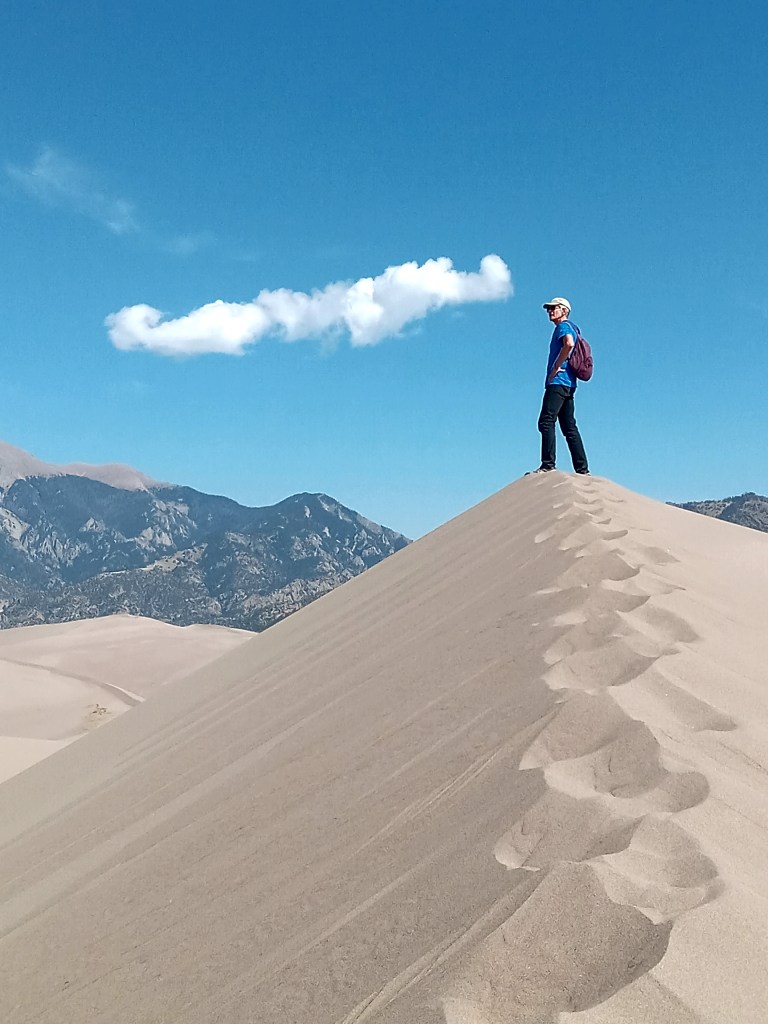
Your loyal correspondent tops out on a 700-foot+ dune in Great Sand Dunes National Park in southern Colorado. North America’s tallest dunes build from windblown grains of sand at the base of the Sangre de Cristo Mountains, seen in the background. Photo by Douglas Cantwell.

ISLAND LIFE CAN BE LONELY AT TIMES, you’ve heard me say. With Center Island’s year-round population hovering around 20, the social life has its limitations.

But, boy, loneliness hasn’t been an issue for me this fall.

So far, my autumn has been a dizzying — and delightful — whirlwind of visits by family and old friends, along with travel to visit family and friends in locales ranging from Orcas Island to Moscow, Idaho, to Santa Fe, New Mexico.

Hilary, Christi and me on Center Island. I love visitors, and I’ve had a few good visits lately.

It began with my Labor Day outing to Sucia Island with daughter Lillian, closely followed by a visit here by Hilary Hilscher and Christi Norman, two longtime friends. I first got to know them through their association with Audubon Washington, for which they drove all over the state together in a sort of “Thelma and Louise Go Birding” partnership about 20 years ago to create the Great Washington State Birding Trail. Laid out in a set of seven detailed and beautifully illustrated maps, the Birding Trail comprises the state’s best bird-watching sites. As outdoors editor for The Seattle Times, I piggybacked on their great work with a regular newsfeature called “Birders’ Top Spots,” spotlighting sites from their maps. (Six of the seven maps, published between 2002 and 2011, are still available to order online here for $4.95 apiece).

Hilary and Christi, who both live with their husbands in the greater Puget Sound area, have been regular readers of “Cantwell’s Reef” and decided they wanted to see my little rock. We ate lots of good food, drank good wine, and enjoyed renewing our friendships.

The same can be said of a visit shortly thereafter by Ken and Kate Brinkley of Portland. I first met Ken on an impromptu shared sailing afternoon out of Orcas Island’s Rosario resort in the 1980s. He became a lifelong friend. Ditto with Kate when she married him.

Ken, Kate and yours truly among Center Island madronas.

Not long after the Brinkleys departed in late September I left my island for a marathon day’s drive across the state to visit a new friend, R.J. (for Robert James). He lives in Moscow, Idaho, just across the state line from Washington State University, where he manages a library. I guess I’m partial to librarians. I met him online, which is a good way to make friends when you live on a small island nobody’s heard of. We’ve become chums.

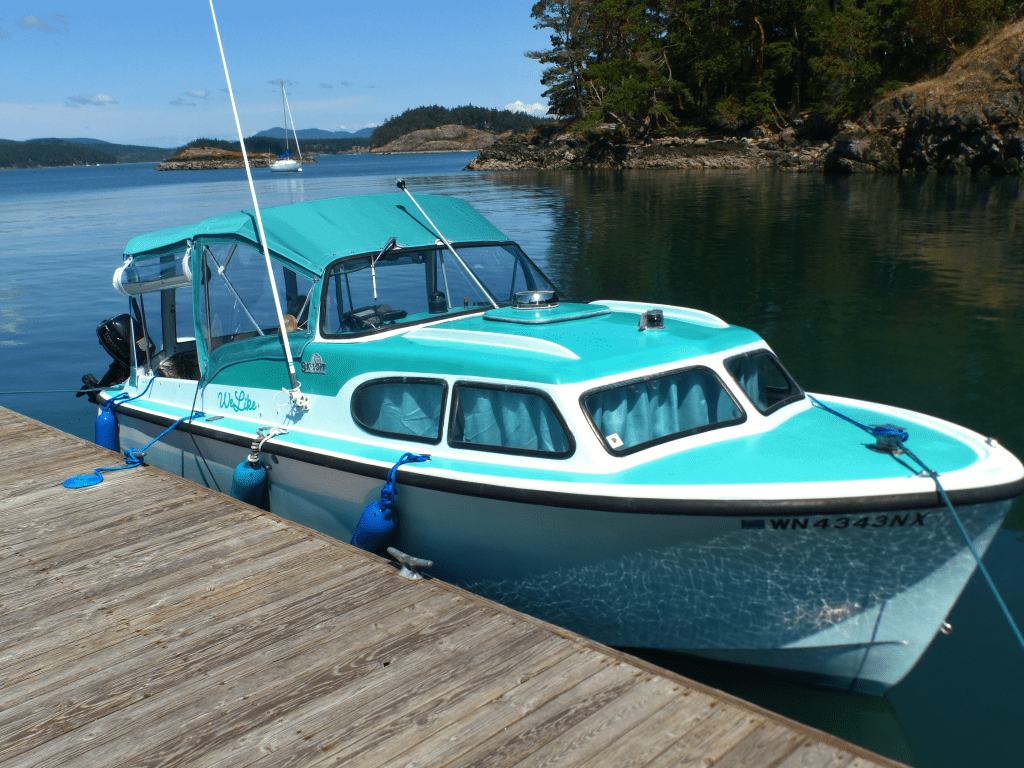
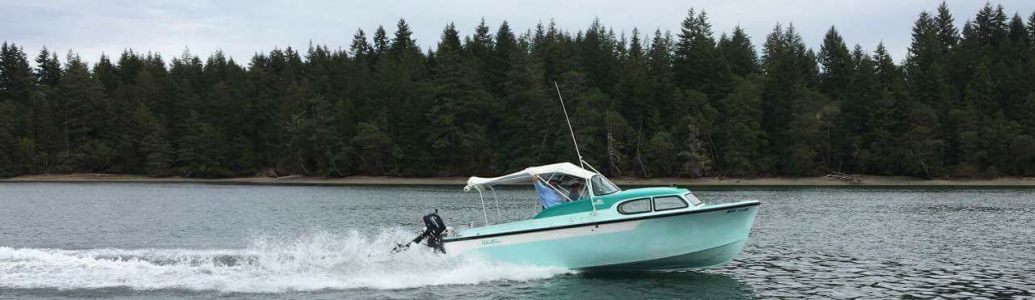
Sandwiched in there somewhere was a visit with another friend discovered online, Tom, on Orcas Island. My boat, WeLike, got me there. It’s nice to find local buddies, too.

Doing the Idaho road trip in one day each direction was exhausting but also a treat. It had been a while since I’d seen so much of my home state, from the San Juans to Seattle, over the Cascades, to a bit of Coulee Country before navigating the rolling and roiling Palouse. I renewed acquaintance with phenomenal State Route 26, which slices straight as a razor across much of its 114 miles of Eastern Washington as it blazes a path toward Pullman.

Farmers had just completed the wheat harvest. The bright yellow-white stubble glowed in the sunshine as I crossed into Whitman County, where welcome signs boast that it grows more wheat than any other county in America. (In 2015, growers there harvested nearly 30.5 million bushels, according to the National Agricultural Statistics Service.)

Less than a week after my return to Center Island I again caught the Island Express water taxi. I was bound for the Seattle airport, where I hopped an Alaska 737 for Albuquerque, via a layover in Phoenix (where I was glad I didn’t need to step outside into the 108-degree October heat). New Mexico was more clement, with daytime highs in the 70s and low 80s.

My brother Doug met me and drove us the hour to Santa Fe and the lovely adobe home he shares with partner Lori, whom I enjoyed meeting for the first time.

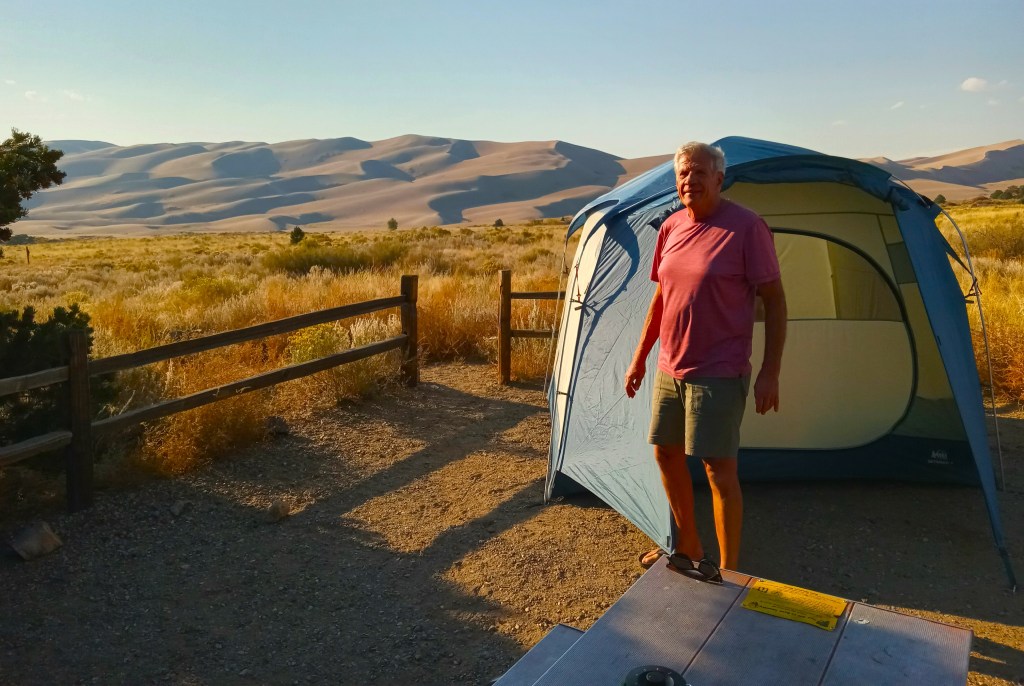
My brother Doug Cantwell at our Great Sand Dunes National Park campsite in Colorado, about three hours from his Santa Fe home.

The next day I acclimated with a pleasant hike with Doug on the outskirts of his town at 1.3 miles of elevation (blowing a raspberry at your Mile-High City claim, Denver). A day later we aimed Doug’s shiny new Outback at southern Colorado for a three-night campout at stunning Great Sand Dunes National Park. I’d never heard of the place, which became a national park at the end of the Clinton administration, but I won’t soon forget it. North America’s highest dunes pile up against the base of the Sangre de Cristo mountains, dominated by 13,297-foot Mount Herard, of which we had a front-row view from our campsite that Doug had hand-picked from a prior stay.

Autumn colors are spectacular among Colorado’s aspens, willows and cottonwoods.

Piñon Flats Campground was named for the scrubby pines that this year were groaning with cones bearing the famed pine nuts that are so good on salads and in sauces. For two geezers whose combined ages approach 140, there was one advantage to having to rise from our cozy sleeping bags in what’s aptly called the “wee hours”: With a combination of dry air, little light pollution, and high elevation, Great Sand Dunes is certified as an International Dark Sky Park. “Wow” and “whoa” dominated our midnight vocabulary as we encountered Orion, the Pleiades, and a bright, night-piercing Jupiter, high in the eastern sky. Doug spotted more than one shooting star.

Though I puffed from the 8,800-foot elevation (I live just above sea level, remember), Doug and I made it to the top of a 700-foot+ dune, often slipping and sliding in the sand that dominant winds bring from afar. During my visit, warm sunshine brought out the startling gold of the area’s aspens and willows. An afternoon thunderstorm swirled towering black clouds around the mountain tops. And, after a half-day drive to the top of 10,856-foot Wolf Creek Pass on the Continental Divide, we experienced a wind-blown snow shower.

This past Saturday, before Doug and Lori dropped me at Albuquerque International Sunport (rivaling in airport-marketing silliness the “Sky Harbor” of Phoenix), we witnessed the final hour of a mass ascension, part of the final 2024 weekend of Albuquerque’s famed Balloon Fiesta. The colorful event draws some 600 hot-air balloons each year.

Frank Boy, a sort of young Frankenstein balloon, came from Brazil for Albuquerque’s 2024 Balloon Fiesta.

I’m back at the Nuthatch today, catching my breath. Over the next two weeks I plan to buckle down and write more get-out-the-vote letters for Vote Forward, which expects to contact 10 million voters before November 5. Ten days ago I mailed 140 letters to Pennsylvania, North Carolina, Georgia and Arizona. Doug will be busy in coming days, too, having committed to 200 letters. There’s still time if you want to join us with your pen.

All the socializing and travel has been great, truly. But sometimes I love my quiet island. A good place to write.

Rites of island autumn include loading the larder

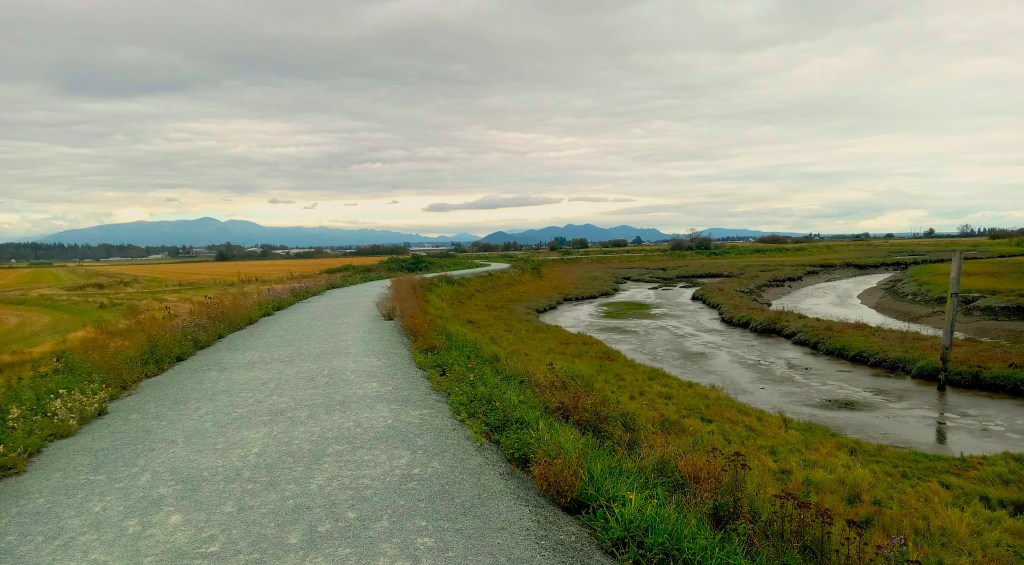
Soft autumnal colors stretch to the Cascade foothills as the Padilla Bay Shore Trail winds along Little Indian Slough in the Skagit Valley.

I KIND OF LOVE MY ROUTINES on this little outpost surrounded by saltwater. Maybe it says something about me. I’m an island dweeb.

For example, the Big Monthly Shopping Trip to the Mainland is one of my highlights. And if I don’t follow a set routine I don’t get everything I like to have in my fridge and pantry.

So I keep a magnetized pad on my fridge and add to my shopping list every time I notice I’m low on something. If I don’t immediately add it to the list, chances are I’ll dork out at the grocery and forget about it. And next week I don’t get my nightly piña colada yogurt treat. No cinnamon to sprinkle on a ripe pear. No peanut butter in which to dip my lunchtime celery. (Horrors!)

That might all sound trivial to the landlubbers among you — those who don’t have to cross a saltwater strait to find a Fred Meyer or Costco. But it’s a serious concern when one lives on an island with no stores, where even a 7-Eleven would be luxury. (Access to a rotisserie hot dog, just down the block, rain or shine, any day of the year? You better know how lucky you are.)

Yesterday was my big monthly shopping day, and as my shopping days go, it was Extra Big. The larder was low. The pantry cupboards were no longer sagging under the weight of extra Paul Newman pasta sauce, flagons of avocado oil, or lashings of Chunk Light Tuna. Autumn is here, it’s time to stock up!

I grabbed the shopping list on my way out the door to catch the 9 a.m. Island Express water taxi to Anacortes. I would have until 5 p.m. before catching the last boat back. Plenty of time to shop, right?

As is my custom, I used the morning boat ride to divvy up the shopping among my three customary shopping venues: Costco, Freddy’s and Trader Joe’s.

With TJ’s in the plan, that meant a drive to Bellingham, Joe’s nearest locale. Even better, as shopping days went: extra adventure in one of my favorite towns. Brew pubs! Waterfront trails! Food trucks!

Also on the to-do list was a stop at a post office for more stamps for my Vote Forward letter-writing efforts, along with a haircut. (I really don’t do well cutting it myself I conceded after that time with the big bald patch on one side.)

I roughly calculated the time needed for all these stops, and realized I might be running for that 5 o’clock boat. So I prioritized. First stop: the cheap hair salon in Mount Vernon. The hair was getting seriously bush-like.

After a half hour of rapid snipping, oddly chopping and “how high is your part usually?” questions, the obviously inexperienced young woman behind the scissors set me loose considerably more light-headed, if slightly off-kilter up top.

On the chance that Bellingham was too ambitious, I decided to do the bulk of my shopping in nearby Burlington. First stop: Costco.

Though the prices and quality are good, Costco infuriates me with (A) the quantity you must purchase (Nuthatch Cabin doesn’t have storage for 30 rolls of T.P.!), and (B) the lack of basic supermarket organizational signage indicating which aisle holds canned corn and which is home to raisins.

So I had no choice but to race up and down every food aisle in search of the dozen items on my list. When driving one of those Costco carts that could double as a minivan for a family of four, speed is dangerous. I nearly took out several track-suited homemakers on a field trip from Sedro-Woolley and had a near miss with an octogenarian couple deep in debate over whether to get the regular prunes or pop for the organic.

But I had Bellingham on my mind. Dassn’t tarry.

After spending $191 at Costco, I lucked into a parking space within sight of Fred Meyer’s front door. I grabbed a large cart and tackled the longest part of my shopping list. I bought every carton of piña colada yogurt in their dairy case. Picked out enough shiny red apples to bake a crumble and slice for lunches for weeks. Piled the cart high. Filled seven bags at checkout. The tab: $174.

Back at the car, I laboriously packed my purchases into plastic totes and insulated cold-bags, then jumped in, steered toward Interstate 5, and put the pedal down for B-Town.

As I sped northward at 74 mph, my mind caught up with my accelerator foot. I let up on the gas a bit. Did I really need a Trader Joe’s stop? I might miss the extra bag of dry roasted but unsalted almonds. Or the frozen French green beans. But I had already bought almost $400 worth of groceries. Did I really need more?

I could probably make it to Bellingham and back, but I’d be racing. No time for a brew pub, or anywhere else. And I hate being late for my water taxi.

So I hit the signal and pulled into the exit for Bow Hill Road. I turned left and headed for the charming little Skagit Valley communities of Bow and Edison. A scenic route across the Samish Flats would lead me back toward Anacortes. At a leisurely pace.

Happy serendipity: One of the few structures composing the tiny burg of Bow was a tiny U.S. Post Office. I pulled in to the lot and interrupted the lone clerk who was vacuuming his itsy-bitsy lobby, seemingly surprised to get a visitor. I purchased a pane of fall-color stamps, which will help me encourage voters in Pennsylvania and North Carolina to go to the polls this election.

Along my pleasant drive across the valley, I stopped at a self-serve farmstand in Edison for a pint of fresh blueberries. I craned my head to try to count the number of fisher-folk wading in the Samish River, which must be having a big coho run. I stopped and hiked a mile on the Padilla Bay Shore Trail, from which I enjoyed expansive views of the Cascade foothills beneath multi-toned layers of soft September cloud. A lone heron was the only fisher here.

For me, this “Plan B” was so much better than racing about like a chicken with its head cut off, as my farm-raised mother used to say.

I paused at Seafarers Memorial Park in Anacortes for a few minutes of in-car shut-eye, then got my latest COVID vaccination and flu shot at the Safeway pharmacy, and made it to my boat with time to spare.

Home again, home again. Larder loaded. Sitting pretty, with autumn arriving.

These busy August memories will warm my island winter

SUMMER ADVENTURES help erase memories of winter storms and lonely January days on my island, where Galley Cat and I represent about one-tenth of the off-season population.

Stevie Lennartson and Kevin Rineer exchange vows in Walla Walla as your correspondent officiates in his father’s old captain’s cap.

These past 10 days I’ve crisscrossed the state by car, officiated at a wedding, experienced broiling temperatures as well as chilly tempests, and reconnected with high-school buddies and the journalism teacher who helped launch us in our careers.

The wedding was in Walla Walla, uniting my friends Stevie Lennartson and Kevin Rineer. Stevie is the daughter of Patti Lennartson and her late husband, my old friend Barney Lennartson. Our families met when we lived on our sailboats on the same dock on Seattle’s Lake Union in the mid-1990s. Our daughters grew up together, and we shared sailing adventures from the San Juans to the British Virgin Islands.

This was the first time I’ve officiated at a wedding. I wore my father’s old captain’s hat — he was an avid sailor — because everybody knows sea captains can perform marriages. (The couple made it official at the Walla Walla courthouse, so I didn’t have to go online to get legal with the Universal Life Church.) It was an emotion-packed experience as I spoke about what made my own 41-year marriage strong.

The 11 a.m. ceremony for family and friends, outdoors by a fountain in Walla Walla’s gorgeous Pioneer Park, was perfectly timed for pleasant temperatures in the 70s. Late that afternoon, the heat topped out at a blistering 97.

The weekend held many highlights, including the groom’s parents’ hosted dinner at a Greek restaurant in Walla Walla’s pleasant downtown. Post-wedding, we enjoyed a catered taco-lunch reception in the park, and a ham dinner at Patti’s house to wind things down. Friends and family came from Florida, Montana, California and all across Washington.

For me and daughter Lillian, who traveled with me, a “low-light” was when the air conditioning failed in my old Honda, converting it to the role of mobile sauna in the Eastern Washington heat. Ah, well, these things build character, right?

After a quick return to my island for a couple days, I was off again to stay at the Hood Canal waterfront cabin of high-school friend Mark Morris, who was a photographer for Totem Talk, our Sammamish High School newspaper, back in the 1970s. Steve Miletich, another buddy and former Totem Talk staffer, joined us, along with his wife, Emily Langlie. Mark’s brother Matthew and his Bernese Mountain Doodle dog, Tigger, rounded out the party.

Mark, Steve and I — and my late wife, Barbara — were students of Sammamish journalism teacher Dianne Hanson. From her class, I ended up as Travel and Outdoors Editor at The Seattle Times. Steve was a Pulitzer Prize-winning reporter at the Times. Mark became Director of Photography at California’s Sacramento Bee.

The evening at Mark’s cabin was a fun mini-reunion, in a delightful setting. Mark’s family had numerous friends who played influential roles around Seattle, and famed architect Victor Steinbrueck, who led the battle to preserve and restore the city’s beloved Pike Place Market, had designed their distinctive cabin. At high tide, Hood Canal’s saltwater rippled and seal heads bobbed just yards outside the windows. Following Mark’s excellent salmon dinner, we buoyed our already-high spirits by tuning in Vice President Kamala Harris’s feisty and fearless nomination-acceptance speech at the Democratic National Convention. Proper journalists have to believe in democracy and the American constitution, and both are on the line this fall.

From left: Your loyal correspondent, with Dianne Hanson, Steve Miletich and Mark Morris, on the deck at Stretch Island. Jim Hanson photo.

The next morning, after Mark filled us with French toast topped by four types of berries, he, Steve and I drove 25 minutes south to another remote Salish Sea island: 300-acre Stretch Island, on the far southern reaches of Puget Sound. Dianne and Jim Hanson have retired there in a modern cabin perched on a hillside almost 100 stair-steps above the water.

My buddies and I recently attended our 50-year high-school reunion, so it stands to reason that few of our teachers are still alive. But Dianne Hanson (nee White, when she first started teaching) was a special case: Two years before taking on the challenge of corralling our Class of ’74 news staff and containing the mayhem we tended to strew, she started teaching at age 21. In her first months, she was barely three years older than some of her students. But her energy trumped experience at the time, and her freshly-minted degree made her a font of contemporary knowledge. Exercising a firm hand with us when appropriate, Ms. Hanson loosened the leash when we were investigating and writing with the righteous zeal of youth. Among other things, our newspaper played a key role in blocking ROTC training from the school, on the grounds that it represented political indoctrination of teens not yet old enough to vote. Our writing on the subject attracted Seattle TV stations to cover a school-board hearing where the proposal was quashed in a 2-1 vote.

Having started teaching so young, Dianne is now only in her early 70s, and apparently never learned about the aging process. OK, she’s coloring her hair with more gray highlights, but that’s about it.

Dianne was delighted that we’d tracked her down, and we had a pleasant lunch and hours of catching up with her and “Jaunty Jim,” as we bratty students had dubbed her affable husband when he was in his 20s. Because publishing the newspaper regularly involved hours of after-school work at a professional print shop in Seattle, back in the day Jim often stopped by after work to check in with his wife. We had all become friends. This visit, we all vowed to meet again.

From Stretch Island, I drove friend Steve back to his family’s summer beach-home on northern Puget Sound. His wife, Emily, is a granddaughter of Arthur B. Langlie, a one-time Seattle mayor and three-term Washington governor, whose family has spent many decades of summers at their beach home.

August seemed to morph into November that afternoon. Low clouds doused the sun and shrouded the distant view of the Seattle skyline. A brisk southerly sent Puget Sound waves dancing as if a kid was kicking autumn leaves. Despite the tumult, Emily went for her daily swim, espousing the health benefits of a cold-water dip. (Her family’s Norwegian heritage might have something to do with that.) I shivered and cautioned her about hypothermia. At dinnertime, from the front windows of the Langlies’ delightfully creaky, century-old, salt-pickled beach house we enjoyed nature’s own choreography as we filled up on chicken curry and sipped a good rosé.

Today, back at the Nuthatch, with a happily dramatic reversal of weather, I’m toiling over the keyboard in my cheerful writing hut and listening on my desktop speakers, appropriately, to Johnny Nash singing about a “bright, bright sunshiny day.”

Summer continues on my little island nobody’s heard of. I’m going to keep storing up memories for the winter ahead.

Seeking a Center Island exit strategy

Over the years, winter scenes like this gave me plenty to write about from Nuthatch Cabin. Next winter might be my last here.

THE PENDULUM SWINGS. It’s one of life’s absolutes. Things change, even on Center Island.

I started “Cantwell’s Reef” six years ago with the loosely defined purpose of writing about “ditching the office and making a life on a small island nobody’s heard of.”

The love of my life, Barbara, was my partner in that adventure. The bustling Seattle Times newsroom was the office I had fled. In countless blog posts, I told about learning our way as full-time Center Islanders, situating a cool old boat at the dock and a tough old pickup truck on neighboring Lopez Island. Month after month, my writing marked the turning of seasons, with the arrival of enchanting wildflowers, summer dog days, autumn harvest fairs and winter snows. It’s been a full life.

Now, I turn to my exit strategy.

Cancer took Barbara from me in 2021. The Times newsroom is but a distant memory to me, and in the wake of COVID many staffers work from home. To everything there is a season. Turn, turn, turning pages.

Since Barbara’s death, Galley Cat and I have toughed it out here on our own for three years, but it’s time to look for a new home with more social engagement.

That bell tolled in a way I couldn’t ignore when The Mad Birder and his spouse, my next-door neighbors who have become dear friends and frequent dinner hosts, announced recently that they were putting their cabin up for sale.

The MB just turned 70, and it seems that continuing health challenges and the march of time told him and his dear wife it was time to simplify life and solidify their base in Skagit County, where they have another home.

That seemed like a sign. It is time for me to think about moving on. I will hate to leave this beautiful place, this comfortable cabin, this friendly little island, and my perfect writing hut. But the time is coming.

I won’t move quickly. It will be at least a year before Nuthatch Cabin is ready to put on the market. That deck rebuild needs finishing, for one. An electrical circuit needs repair, the chimney needs replacing, the roof needs a good cleaning, etc. I have no idea where all the travel souvenirs and family mementos will go; I long ago vowed: No more storage units. If I want to flush money away, I own a toilet.

There are challenges, of the type faced by many of my peers in the 65-and-older crowd.

If I sell the house I live in now, which just fits in my retirement budget, will I be able to afford replacement housing anywhere nearby?

I’ve heard the same quandary from friends. Home prices in Western Washington — and pretty much anywhere down the West Coast — are crazy high. And nobody I know wants to move to Arkansas or Oklahoma or pretty much anywhere that’s considered affordable. Most are red states. No thank you.

Because of Barbara’s illness, I retired early, meaning my retirement savings and Social Security income took a hit. The silver lining is that I qualify for housing programs aimed at the low- and middle-income populace.

In choosing a new locale, I have a growing wish list, beyond basic political compatibility. I’m hoping for good parks and trails and maybe a hiking club. A pleasant and walkable downtown with a good coffeehouse or two. I’d like to be near water so I can keep and enjoy my great little boat. I’d like the option of satisfying part-time work as well as volunteer opportunities. Good healthcare. A lively arts scene.

A place where I already have friends would be a big plus.

With the help of friends, I’ve started looking. Daniel and Jean Farber some months ago launched a campaign to get me back to their hometown of Olympia, where I shared a 1970s college-days house with Daniel and fellow students of The Evergreen State College. The latest development: They offered and I accepted a six-week housesitting gig late this fall while they spend quality time with a new grandson in California.

Galley Cat explores the rocky knoll behind the Nuthatch.

The Oly time will help me decide if that’s where I want to live again, with plenty of time to look at the local housing stock and living costs. Galley Cat will accompany me, which is great, though I’m sure she’ll miss roaming the island woods.

No sooner did I announce my Olympia plan than friends on San Juan Island countered with a strategy to keep me in the islands. (It’s nice to be wanted.)

Barbara Marrett and Bill Watson educated me about various affordable-housing projects in and around Friday Harbor. When I visited them recently, Barbara generously drove me around town to inspect every one of those housing developments, including one cluster that consisted of charming old homes that had been lifted from their original sites and barged to Friday Harbor from Victoria, B.C. The San Juan Community Home Trust keeps homes affordable, in part, by selling the house only. Buyers than lease the homesite from the trust at a low monthly rate. There are many such tools to create alternatives to traditional market pricing.

Homes barged from Victoria, B.C., are among affordable housing offered in Friday Harbor.
San Juan Community Home Trust photo

When I had lunch with a new friend on Lopez last week, he told me that Lopez, too, has an affordable-housing project worth a look. While Olympia has its allures, I would love to stay in the San Juans.

So that’s Chapter 1 in the Great Center Island Exit Strategy. More ideas are welcome, shoot me a note. I’ll keep you posted, my friends.

Summer is an island of bliss in a stormy year

Ivory flowers of Oceanspray brighten the June woods on Center Island in the San Juans.

HAPPY SUMMER SOLSTICE on this glorious island day with a perfect 72-degrees Fahrenheit, klieg-lit skies of royal blue and not a single pesky cloud between here and Hurricane Ridge. I hope you’re sharing such dreamy weather.

If the weather gods haven’t convinced you already, the meteorologists will tell you that summer officially began this afternoon at 1:50 p.m. PDT.

Mr. Fix-It. The deck progresses.

The past week on this remote little island nobody’s heard of has been a welcome and peaceful lull between the holiday crowds of Memorial Day and July Fourth, and a welcome diversion from the weird and weirder news of the world. (If you’re a praying person, pray for democracy.) It’s also been a time for me to relax into my summer chores. I’ve planted my deck garden, whacked the weeds on my rocky knoll and replaced more planks in my years-long deck-replacement project. (It’s a bit like painting the Golden Gate Bridge; once done at one end, I’ll start over at the other.)

The wildflowers that gauge the advance of our springtime have mostly come and gone. But June is the season for Oceanspray, the shrub bearing thousands of tiny ivory flowers that in combination give the plant its name, adding a dreamy, creamy sort of surf effect to our sea of evergreens and maples.

George and me at Kapalua Bay, Maui.

For me, the beautiful week on my island is a double dessert in this month’s feast of life. I just returned from a week on Maui with my travel buddy, George, who lives in Seattle. From a comfortable condo in Kihei, we had adventures in snorkeling, beachcombing, trekking ancient lava flows at wild La Perouse Bay, food-truck dining, and luxuriantly lolling around a palm-shaded swimming pool that featured its own cool little waterfall. Even got a tan. It’s good to have a new companion who enjoys travel and adventure as much as I do.

Meanwhile, Galley Cat enjoyed a week’s vacation hosted by Auntie Julie and dog Nigel in their comfortable home in the garden spot known as Brier. Galley and I honor them.

This season makes up a lot for those January days of whistling 50-mph winds and freezing pipes in the San Juans, let me just say. My best wishes to you for good companionship, memorable family fun, idyllic outdoor dining, silly yard games, lazy beach bumming, energetic boat rowing and more this fine summer.

This summer’s deck garden at Nuthatch Cabin.

Sweet roses on a rain-washed island, with thoughts of friends old and new

Despite cool temperatures, wild roses are blooming this Memorial Day in the San Juan Islands.

IT WOULD BE A LOVELY DAY if this were March, I suggested with a smile to fellow islanders as we passed each other on morning walks around our little rock this morning.

But it’s Memorial Day weekend, and I was kitted out in raincoat, Pendleton hat and woolly gloves. It was cold. It was wet. It’s supposed to be late May, for goodness sakes.

The up side: My island, which was already getting crunchy underfoot from a dry spring, is no longer crunchy. We’ve had two much-needed long, soaking rains in the past week. My only worry is that I might have to repeat my usual once-a-year weed whacking, completed last week on the Cantwell little-half-acre.

This Sunday morning rain-washed air as fresh as a tightly furled rosebud lured me outside, and I saw many rosebuds on my walk. Yes, it’s bloom time for the Nootka rose, one of our colorful native plants in the San Juans. The Sea Blush and blue Camas have pretty much come and gone, but for now we have the wild pink roses, and in June we’ll see the creamy, filigree blossoms of Ocean spray.

As I walked, I also met and welcomed our new caretakers, Steve and Nancy, as they circled the island in their red pickup. They are temporary summertime replacements for Rich and Maria, who recently were wooed away by a community association on nearby Blakely Island. Rich, a former state parks ranger, and Maria, a retired school librarian, were wonderful overseers of our island for several years.

Steve and Nancy, who hail from Lake Tahoe, California, these days, have been frequent visitors to friends who have a place on Center Island, so they are well familiar with this little rock. Steve is a retired police chief from the California State University system, and Nancy spent 33 years as an educator in public schools. A teacher and a cop should do OK keeping things in order around here, I expect. But they didn’t seem like disciplinarians, they seemed very friendly.

They will stay through the summer, giving our homeowners association a few more months to find permanent replacements to live in the little blue house next to our clubhouse.

Best wishes for the rest of your Memorial Day weekend, with appreciative thoughts of all the friends and loved ones who’ve come and gone.