When the Web breaks in the islands

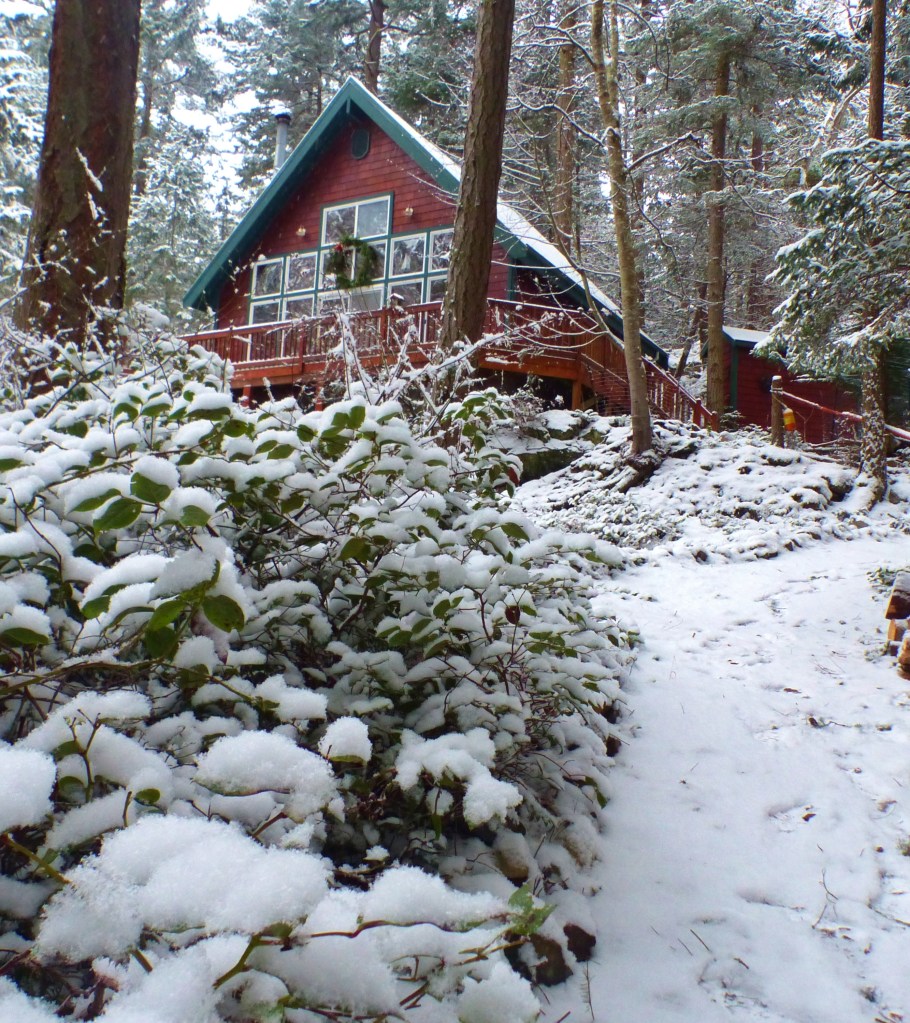
Nuthatch Cabin’s old-school, hard-wired communications center: When the wire gets cut, we’re screwed.

OMG, MY INTERNET WAS DOWN FOR A WEEK. Need I say more?

It’s true that many of us spent much of our lifetimes communicating on phones that weren’t any smarter than Bevis or Butthead, and we survived. But that was then.

These days, especially if you live on a remote little rock, home Wi-Fi is what keeps you in touch with the rest of the planet, the World Wide Web that keeps us island spiders fed — with news, with social interaction, with Wordle and the Sunday Crossword, with televised entertainment that streams as easily as the tidal current in Rosario Strait.

Until the Wi-Fi goes dark, as it did about 10 days ago.

As removed from population centers as my Nuthatch Cabin may be, it is served with most of what we call the “mod cons.” Potable water fills the sink when I turn a faucet handle. The toilet flushes. Buried power lines set lights ablaze. Other underground wires bring land-line phone service and, yes, DSL Internet, courtesy of CenturyLink, the Louisiana-based telecom.

Through some convoluted happenstance of old-school technology from the 1990s, never before have my land-line phone and the Internet gone dead at the same time. When it happened this time, I knit my brows.

Already after regular office hours that Thursday, a cell-phone call to CenturyLink led me to a text exchange that I strongly suspect was conducted by an AI entity at the other end. There were too many formulaic responses. Whomever was helping me, I’ll call them “the entity.”

The entity first tried to set a repair appointment a week in the future. It ignored my protests that I depended on my Wi-Fi for keeping linked in so many ways to the outside world. That continued until our text exchange was winding up and I was asked if my problem had been addressed satisfactorily.

“No, the week wait isn’t acceptable,” I texted.

And suddenly the entity found it possible to schedule an appointment for the next day. I explained that I lived on an island with challenging access and offered suggestions for how a repair tech could get here. “I’ll add that to the report,” the entity told me.

All good, it seemed. The problem was that I sat at home all the next day waiting to hear from a repair tech, who was supposed to arrive before 5 p.m. At 4 p.m., CenturyLink texted me that its technician had visited me but was unable to gain needed access to the inside of the premises. Patently false; I hadn’t left home all day. Nobody had showed up.

I got on the phone to a live human being this time. From the accents encountered in several calls, I’m guessing the call center was in India, or maybe Sri Lanka. Bangladesh? Understanding their patois was a challenge. My only comfort was that I could have been trying to wade through a Louisiana drawl thick as gumbo.

Surprise, they now told me, 24 hours after my first report: The problem had been identified as an area outage, affecting more than just my residence. No, they couldn’t say how wide an area was affected. They had no idea when it might be fixed.

That was late Friday, May 10. The call center was closing for the weekend. I would wait, vaguely hoping someone was working on Center Island’s outage. And over the weekend I would watch old DVDs instead of streaming the latest from Netflix. I would walk across my island to check my email at the clubhouse, which is served by Elon Musk’s satellite-based Starlink Internet. (As much as I’ve tried to ‘X’-out Musk from my life, I ruled out switching to Starlink only when I learned that not only would it cost me $25 more per month, but I would have to invest in $600 worth of equipment. And neighbors told me that tall firs on our side of the island make for poor Starlink reception anyway.)

Monday morning I phoned South Asia again. Another new development: My area outage had been repaired, they now claimed. But my phone and Internet are still dead, I protested.

OK, we’ll set up a new repair visit, my customer-service rep said. For the end of the week. “For tomorrow,” I insisted. OK, for tomorrow. Not once did I hear an apology for Friday’s no-show.

Just out of curiosity, I phoned the Washington Utilities and Transportation Commission consumer complaints office, which oversees telecoms. Legally, I could file a complaint two business days after a phone outage, a staffer told me. That meant the end of Monday. But CenturyLink had a poor record of quickly resolving complaints — it could take months — and the commission’s enforcement powers seemed weak.

Tuesday morning I finally heard from the repairman, a gentleman named Armando whose 360 area code indicated he was actually calling from this hemisphere. I told him I’d heard that several of my island neighbors had also lost their CenturyLink service. That was news to him. Mine was the only service request, he said.

He’d secured a plane ride that day to neighboring Decatur Island, which he would have to visit first. Apparently there’s some sort of switchbox on Decatur that controls service to Center Island.

Then he’d need a boat ride to Center Island. That was a problem. My boat was on its trailer, out of the water, and a fluke of the tides was such that water would not be high enough all week to use our launch ramp in daylight hours. I suggested he hire a water taxi. He was unenthusiastic.

I hung up, thought about it for a minute, and phoned a neighbor to ask a favor. His boat was at the dock, and the ride across the bay to Decatur was only 5 minutes. He agreed to help, so I called back to Armando, who said he’d probably be ready for a lift in 20 minutes. He would phone to let me know.

Two hours later, after more than one try, I got through to Armando again. Oh, it appears that all Center Island customers have lost their service, he told me. (Surprise.)

And here’s some irony. It happens that, as a result of the Biden Administration’s American Rescue Plan Act of 2021, San Juan County-based Rock Island Communications won grants to expand fiber-optic broadband service to 1,000 island residents, including us folks on Center and Decatur islands. The digging of trenches and laying of cable had already begun on Decatur Island. And guess why CenturyLink’s old-school DSL service went out?

Yep, while laying lines, the forces of new-and-improved cut the old cable. Oops.

Armando told me he didn’t know where the cable was severed, but that the problem was clearly on Decatur. The good news: He didn’t need a boat ride. But he offered no optimism for a repair.

Bad, bad news, I thought. Why would CenturyLink now want to spend potentially big bucks to fix a broken line serving only a handful of customers on a little island nobody’s heard of? Admittedly, my neighbors and I will all likely abandon their antiquated service as soon as broadband switches on (at $10 less per month, with much faster uploads and downloads).

Commiserating with another Internet-less neighbor at our clubhouse, I learned that CenturyLink had scheduled him for a service call the next day, Wednesday. I wondered if that offered any hope.

I guess it did. Around 1 p.m. Wednesday, my long-silent land-line phone rang with a loud electronic burble. “It lives!” I shouted to Galley Cat as I ran to pick up the call. Leaping frantically from the cozy bed atop her kitty condo, Galley apparently didn’t share my thrill. (She’s always been a Luddite.)

Armando was calling from Decatur Island. The broken cable was repaired. Service was restored. It was unexpected good news.

On reflection, I realize that while Internet is nice to have, I could survive without it. Just as I did for more than half my life.

Meanwhile, I had re-watched a bunch of old “West Wing” episodes on DVD. I love Joe Biden, but God, I wish Jed Bartlet was on the ballot this year.

Cart blanche: Rebuild frees islander of too many treks up the dock

The rebuilt cart on the dock at Center Island: a key link in my island’s transportation network, ready for more seasons of service.

WHEN YOU LIVE ON A REMOTE ISLAND with no shops or garbage pick-up, all your groceries must be transported up a dock and all your trash gets packed the other way. You really come to appreciate a good dock cart.

Anybody who’s had a boat in a marina knows of what I speak: the boxy two-wheeled conveyances with tires the size of a small bicycle’s, usually pushed by a large, U-shaped metal handle. Often capable of carrying two Rubbermaid totes and maybe a Trader Joe frozen-food bag. They do their job handily. No big deal.

But when the cart comes in a large, economy size, carrying two additional totes and maybe a couple of 5-gallon gas cans as well, you fall in love. Such Cadillacs of conveyance halve your required treks up and down the dock ramp, which on a minus tide can almost require ropes and a belaying harness. If you’ve just arrived home from a Costco run, kitted out with a six-month supply of pasta and several half-gallon jars of Adams peanut butter, the unashamed among us dash off the water taxi, pass up the “normal”-size carts and nab the stretch-limo of grocery transport.  

For years, Center Island’s “A” Dock has had such a cart. For years, it has been slowly falling to pieces.

The big cart was home-built long ago of thin plywood. Had the cart ever seen stain or paint, such protectants had long ago thrown in the towel against Northwest winters and retired to Arizona. The plywood’s raw, gray edges had started shredding like store-bought hash browns. On parts of the metal chassis, rust was holding the rust together. Our island’s caretaker kept up a brave campaign of replacing nuts and bolts, evidenced by shiny bits of metal among the oxidized. But as of late the cart’s front panel was falling out, threatening to dump into Read’s Bay one’s warehouse-store flagon of Mrs. Butterworth’s or body bag of Cap’n Crunch.

In places, rust was holding the rust together on the old dock cart.

For ease of reference here, we’ll call the big cart Otto (preferred pronouns: “It” and “Its”). Last fall, with winter looming, on a whim I asked Center Island caretaker Rich if I might tackle an Otto rebuild over the cold, long months ahead. It would be something to do, of benefit to me and all my neighbors. Rich enthusiastically nodded.

Then, you know how things go. I got busy. A bunch of holidays came along. Winter was shorter than usual, I’m certain of it. By April, Caretaker Rich had announced a pending move to another island, where pay was better and duties lighter. (These remote islands-nobody’s-heard-of can be cutthroat when it comes to poaching caretakers.)

Meanwhile, Otto was a wreck. Nuts were rusting to dust. L-braces once holding panels together twirled loosely as screws gave way. I felt bad I hadn’t fulfilled my aspiration and hated for Rich to depart thinking me a slacker. In late April, I queried him if I could take Otto out of service for a couple of weeks and proceed with the makeover. The nod was even quicker.

I wasn’t talking about a refresh. That elderly plywood needed full replacement. I hoped enough of the metal chassis would be reusable once sanded and given new coats of Rust-Oleum.

With gorgeous spring weather arriving, I loaded Otto into an island truck and transplanted it cross-island to the deck outside Nuthatch Cabin. Outfitted in my grubbiest old paint-splattered jeans and T-shirt, like a surgeon’s scrubs after 48 hours of brain surgery, I began the dissection.

With a can of WD-40 at my elbow, I twiddled and twisted, grunted and groaned. I removed a brimming jarful of old nuts, bolts and washers, which I set aside for triage as to possible reuse. Several bolts sheared off with a flick of my socket wrench. A saltwater environment does that.

 The old plywood I set aside for a trip to the Lopez Island dump.

It was a 10-day project, involving three boat trips to the Lopez hardware store/lumberyard. The new plywood was $70. The dump bill, $15. The new nuts and bolts added up quickly, plus about eight cans of spray paint. Otto’s rusty u-shaped handle – already splinted in two places – was a write-off so I hopped on Amazon and ordered a new 1½-inch-diameter aluminum handle made by a manufacturer of industrial hand trucks.

Once Otto’s old metal frame was fully exposed, two corners looked like the work of rust-spewing moths – with more holes than solid surface. I fired up the Sawzall and excised those ends with a few moments of shrieking metal-saw demolition. With sharp edges sanded away, enough solid framing remained to support the cart. The axle and wheels were in good shape.

I painted the new wood in appetizing tones of green – “sage” and “oregano” – and tacked protective rubber edging to the plywood’s perimeter. Metal parts were sanded and sprayed with a rust-transforming undercoat topped by a rust-blocking Hunter-green enamel. To guard against theft, Caretaker Rich suggested I label the cart, which usually means scrawling it with the letters “CIA” (for Center Island Association). I chose to make it friendlier, daubing “Welcome to Center Island” on the end panel. Affixing our island’s name decreases the chance that Otto gets pirated to a neighboring port.

The last step was to install the hefty aluminum handle. Finally, without ceremony, last Friday I deposited the rebuilt cart at the head of A dock, ready for a new lifetime of grocery grunting and trash toting.

All seemed good. Then, Saturday afternoon, when neighbors joined me for a sun-drenched happy hour on the Nuthatch’s deck, I learned that another friend had a hair-raising mishap with the rebuilt cart. As he wheeled three heavy bags of trash down the steep dock ramp during an extreme low tide, the cart’s new handle worked free from its metal anchor loops. The loaded cart careened down the ramp.

Thank god, the ramp was clear. Nobody was hurt. Nothing ended up in the bay.

 Another islander had subsequently reattached the handle to its anchor loops with metal screws, whereas I had relied on pressure from neoprene firmly packed inside the straps. The neoprene gave a solid seal with no wobble, fine for use on level ground but apparently not up to heavy loading on a precipitous ramp. Oops.

I tossed and turned that night, haunted by the fact that my good deed nearly ended in disaster. Finally, I set an alarm for early rising and resolved to inspect the cart first thing Sunday, with tools in hand.

By 7:30 I was in the island workshop adding two more anchor straps to the cart’s handle, satisfied that the unidentified Samaritan’s repair job looked good but convinced that overkill wasn’t bad in this case. While at it, I added half a dozen more bolts and an extra L-brace to reinforce the cart at every edge. Once bitten…

As the rebuilt cart has gotten more use, neighbors have voiced smiling appreciation. It’s the island way. Many pitch in to keep life chugging along on our little rock.

And saving extra trips up the dock with my Costco hauls will keep me smiling, too.

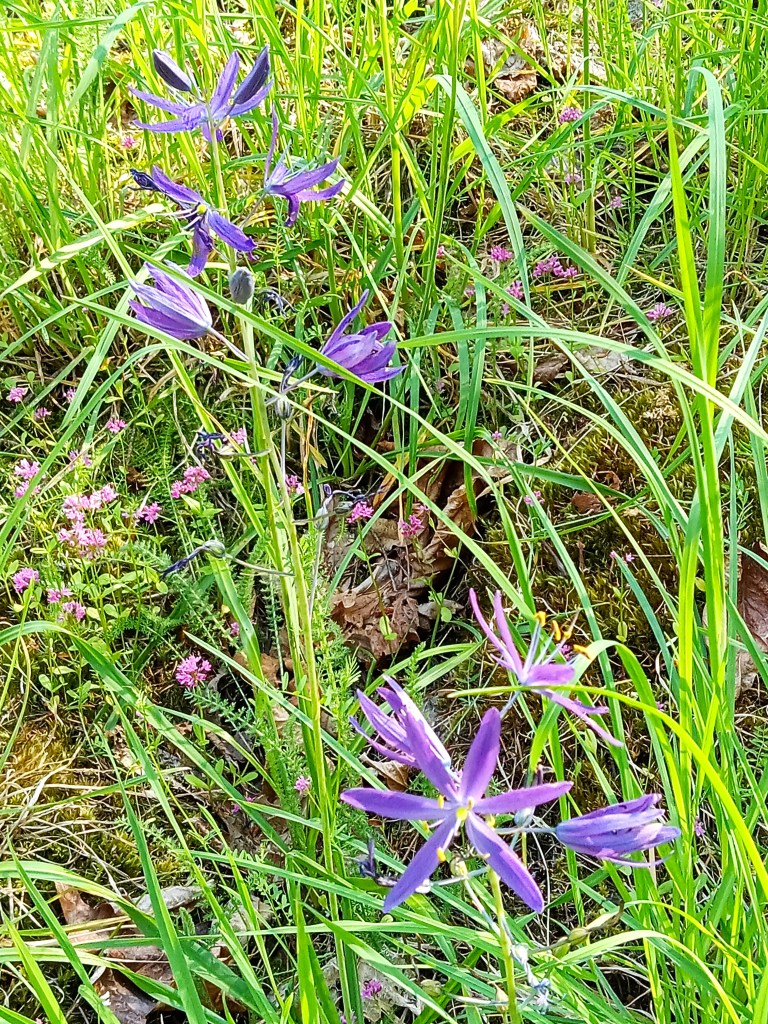
BONUS PHOTOS: It’s wildflower season on the rocky knoll behind Nuthatch Cabin. Blue Camas flowers, above. Below: A white inflorescence of Death Camas — toxic, but pretty — among the purple/pink of Sea Blush.

The morning pause that refreshes

I enjoy coffee and toast with avocado and walnuts on the deck at Nuthatch Cabin, poised to take in an avian aria or two.

DO YOU EVER GET JADED BY BEAUTY YOU SEE EVERY DAY? In the Louvre of your mind, do you walk listlessly past Mona Lisa’s winsome smile? In your inner Florence, do you yawn at David’s washboard stomach? On a pristine spring morning in Seattle, does snowy Rainier not merit an “Oh, look, the Mountain is out!”

I had approached that enervating ennui on my little island of perfection. Daily routines had dulled senses and blinded my eye. But a pleasant phone chat with my brother Doug reminded me of his practice whenever he visits. He starts every day with coffee out on my deck to hear the dawn chorus. His example inspired me this morning.

If you’re not my neighbor the Mad Birder or one of his fellow travelers, you might not know: “Dawn Chorus” is the bird-lover’s label for the cacophonous birdsong that erupts with the sun’s rise in these warming months. It comprises the collective theme songs of scores of early birds determined to get their worms.

A nice thing about my island is we have so many birds that the chorus continues well into mid-morning, meaning I could catch today’s performance even after getting my required eight hours.

With no neighbors at home — the Mad Birder and his lovely wife are off on a madcap fishing trip in Nevada — I wasn’t shy about wrapping up in my bathrobe and slippers as I headed out to the Adirondack chair. In my hands was a breakfast of avocado toast and fresh drip coffee. It was 44 degrees F. outside. I was glad I’d pulled on long johns and that the coffee was blazing hot. Behind me, the sun was just rising over my rocky knoll to light up the treetops around me.

Sure enough, the birdies were belting out songs like Julie Andrews romping an edelweiss-laden Alp.

One virtuoso song, full of joyful trilling and punctuated by rising and falling scales broadcast at perfect pitch, turned my head and prompted a smile from my toast-munched mouth.

I regret that I’m not skilled at identifying many birds by their song, though I am often curious. My eyes scanned the treetops, finally spying a light-colored bird high at the tiptop of a dead fir, 100 feet up where the rising April sun was just warming the chill air.

He was too distant to identify by sight, but I relished the song, imagining the view from high up, and almost feeling the golden glow on my face as I lifted my eyes to the cloudless azure sky. I was the only human hearing his song, but I didn’t own it; the thrill belonged to this island and these woods.

Who was this bird of lilting forest melody? I couldn’t resist. I rose from my deck chair and tiptoed quickly inside, as if the bird would somehow hear me from that dizzying height. I returned with my binoculars. But the singer was gone, like a golden dream barely remembered after waking.

The entertainment wasn’t over, however. Countless songbirds zoomed and swooped in seeming games of tag among the fir limbs and maple catkins. Minutes later the singing bird returned to its perch. My high-powered lenses showed a Purple Finch (my best effort at identification), his rose-tinted head colored scarlet by the klieg-light sun. Besides the birdsong, calm and silence filled my woods but for the faintest background static, almost subliminal, of a passenger jet writing a contrail in the blue heavens. Some 30,000 feet up, its ear-budded transcontinental travelers knew nothing of this morning’s sweet aria from 100 feet above the forest duff.

With the bountifully-lunged singer in sight, I crept back inside for my camera with its 600-millimeter zoom. As I returned to my chair, a nearby nuthatch honked in merriment, taunting that the finch had again taken wing.

I kept watch, struggling for a photo of my elusive Pavarotti of the forest crown. He alighted atop another tree, but was brimming with springtime energy, resting only long enough for me to grab my camera, raise it to my eye, and … focus on an empty branch. Finally, after many tries, I caught a photo.

After many tries, my long-lens camera caught this lustily warbling songbird high atop a fir on a bluebird-sky Center Island morning.

Back atop the dead fir, another finch joined the first. Falling from the perch together they defied gravity, fluttering up, down and sideways like frenetic tiger swallowtails. The start of a hot date? Or two males in a chest-thumping challenge for territory? “Want me to scram? Who’s gonna make me? You and your mother?”

Their struggle against Earth’s pull reminded me of the classic aviator’s poem, “High Flight” (which, Wikipedia tells me, U.S. Air Force Academy students must memorize):

“Oh! I have slipped the surly bonds of Earth

And danced the skies on laughter-silvered wings;

Sunward I’ve climbed, and joined the tumbling mirth

of sun-split clouds — and done a hundred things

You have not dreamed of — wheeled and soared and swung

High in the sunlit silence…”

It was a good start to another day on this small island nobody’s heard of.

Fairy slippers lead parade of island wildflowers

A Calypso Orchid, aka Fairy Slipper, opens like a peacock’s tail among the forest duff behind Nuthatch Cabin.

A MILD WINTER MEANS EARLY WILDFLOWERS in my beautiful San Juan Islands. Easter weekend brought the first blooms on my back-40 of a perennial favorite, Calypso Orchid, also known (because of its tiny size) as Fairy Slipper.

The fairies that visit Center Island seem a careless lot, leaving more and more of their delicate magenta slippers behind every spring.

Visiting friend George and your humble scribe, on James Island

The Oregon grape and buttercups are blooming, too, on my rocky knoll. And when a visiting friend, George Moua, and I hopped aboard WeLike and buzzed over for a sack lunch and hike on delightful James Island on Saturday, I was amazed to see a Giant White Fawn Lily in bloom alongside a trail. Usually these starburst-shaped flowers wait until May to add a splash of delight to our forest understory. Another hiker had seen blooming blue Camas, another surprise at this early date. George, a Seattleite who shares my love of the outdoors, was lucky to encounter such early treats on this, his first visit to the San Juans.

Coming soon: The diatom-sized pink flowers of Sea Blush will roll like an ocean wave across the curvaceous landscape of my knoll, accented by ivory florescence of Death Camas (there’s a fun name), royal blue Camas and more white Fawn Lilies. It’s Center Island’s own grand floral parade. Time to get the lawn chairs ready.

Alone again (naturally)

February sun glitters on Lopez Island’s Fisherman Bay during my Friday escape from The Rock.

I’VE BEEN OUT OF THE DATING POOL for more than 50 years. I guess it shouldn’t be a surprise that I muffed things with my first love affair since I became a widower three years ago.

I won’t bandy the details, other than to say the parting was amicable and now I’m back to spending solo days on my remote rock in the San Juans.

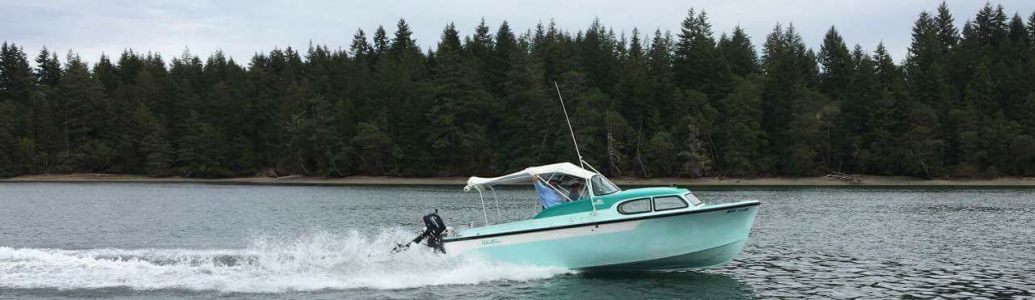
So when February granted us winter-weary islanders a brief break in the rain and cold, I Carpe’d the damn Diem, as my brother and I like to say. I fired up the community tractor and launched WeLike, my restored 1957 Skagit Express Cruiser, for the first time since autumn. Gave Galley Cat a pat, told her I’d return soon, and cruised over to Lopez Island for the day. It had been a while.

It had been a while, with plenty of fir needles and a little bit of moss to hose off of WeLike before she dared show her bow to the public at Hunter Bay Public Dock, the Lopez locale where I keep my old Ford pickup, Ranger Rick.

Lopez gave me a sunny day, surprisingly warm. I ditched my winter coat as soon as I tied up the boat. It was so warm that a gaggle of swimsuit-clad youths was just arriving at the dock with towels. With a smile I gave them “the talk” (about hypothermia). They promised to jump out as quickly as they jumped in.

“We just want the experience,” one girl told me happily. Oh, yeah, I sort of remember being that young.

For me it was a day of running errands, mostly. A stop at NAPA Auto Parts to get a bottle of stuff to treat watery gasoline so I could get my backup outboard running smoothly. (Gas-tank condensation is a hazard of sitting unused through a long winter.)

A whimsical sign crafted from castoffs welcomes patrons to the Lopez Dump.

Second was a much-needed stop at the Lopez Dump — really just a transfer station — to jettison two big totes of recyclables at the island’s remarkably thorough and well-managed recycling center. The recycling combined with home-composting my produce waste meant my actual trash (the dump management labels it “Absolute Garbage”) was limited to one small Rubbermaid tote. The bill: $5.

Next came some fun: a stop at the Lopez Island Library. When my late wife, Barbara, and I moved to Center Island in 2018, we shelled out the $50 non-resident fee to become borrowers from the excellent little library that occupies an old schoolhouse on the edge of Lopez Village.

I knew which aisle I wanted, and quickly found a book to occupy me through perhaps the rest of winter: “A Column of Fire,” Welsh author Ken Follett’s 900+-page sequel to his masterwork “The Pillars of the Earth,” which chronicled construction of a British cathedral in medieval times.

Coffee and a good book on the deck at Isabel’s.

More fun at my next stop: Isabel’s Espresso, to redeem the full punchcard I’ve been carrying in my wallet for months. I talked sailboats (and the idea of February swimming) with the jovial, dreadlocked barista while he brewed my free 16-ounce half-caff latte. I sat outside on the sunny deck, sipped my coffee from a massive ceramic cup and cracked the first pages of the Ken Follett. Ahhh. Does life get better?

But eventually necessity called. Among other motivations to make the trip: My fridge was out of fresh produce.

Rarely have I gone through a checkout counter with more fruit and vegetables than that visit to Lopez Village Market. Honeycrisp apples were on sale, as were white mushrooms and tomatoes-on-the-vine. Got a giant handful of organic kale and some overpriced broccoli crowns. There was no price posted for the celery. I learned why when I saw it ring up at almost $5, which is highway robbery for a vegetable whose fiber is really its only nutritional value. However, I like it as a vehicle for peanut butter.

Dog walkers navigate the isthmus between Fisherman Bay and San Juan Channel, at Otis Perkins Park.

Taking care of things that needed taking care of, I stopped near the supermarket’s gas island for the annual addition of air to Ranger Rick’s tires. It was going on 3 in the afternoon before I finally pulled in to the gravel lot at Otis Perkins Park, edging broad San Juan Channel, to eat my sack lunch. When I looked up from my book, my view was of a big white-and-green state ferry chugging past Shaw Island.

A Friday Harbor-bound ferry rounds Shaw Island, as seen from Otis Perkins Park.

The sun had dropped behind the crest of the island as I returned to my boat around 4. With the sun went the warmth. Shivering, I pulled my coat back on as I loaded aboard my groceries and empty trash bins.

Happily, even after the winter’s hiatus, my big Evinrude ran perfectly as WeLike sprinted like a greyhound back to Center Island.

Alone again, this winter. But spring is on its way. And Galley and I have lots of plans.

The view from the helm as WeLike threads the channel approaching Center Island.

Of frozen pipes, boiling water, and small island pleasures

Wee Nooke is my 6 foot-by-6 foot writing hut on the rocky knoll behind Nuthatch Cabin.

HOORAY, I’M BACK IN THE NOOKE, with no more water to boil. That’s my good news for the day on Center Island in the San Juans. (More about boiling water in a minute.)

Sitting here eating my sack lunch in Wee Nooke, the tongue-in-cheeky P.G. Wodehouse-inspired name for my writing hut, is good news because I just love working here. Perched on the rocky knoll behind Nuthatch Cabin in a little meadow that dazzles with wildflowers each May, the Nooke is a 36-square-foot cedar hut. First erected as a playhouse for then-preteen daughter Lillian 20 years ago, it came on a couple of pallets as a potting-shed kit from British Columbia.

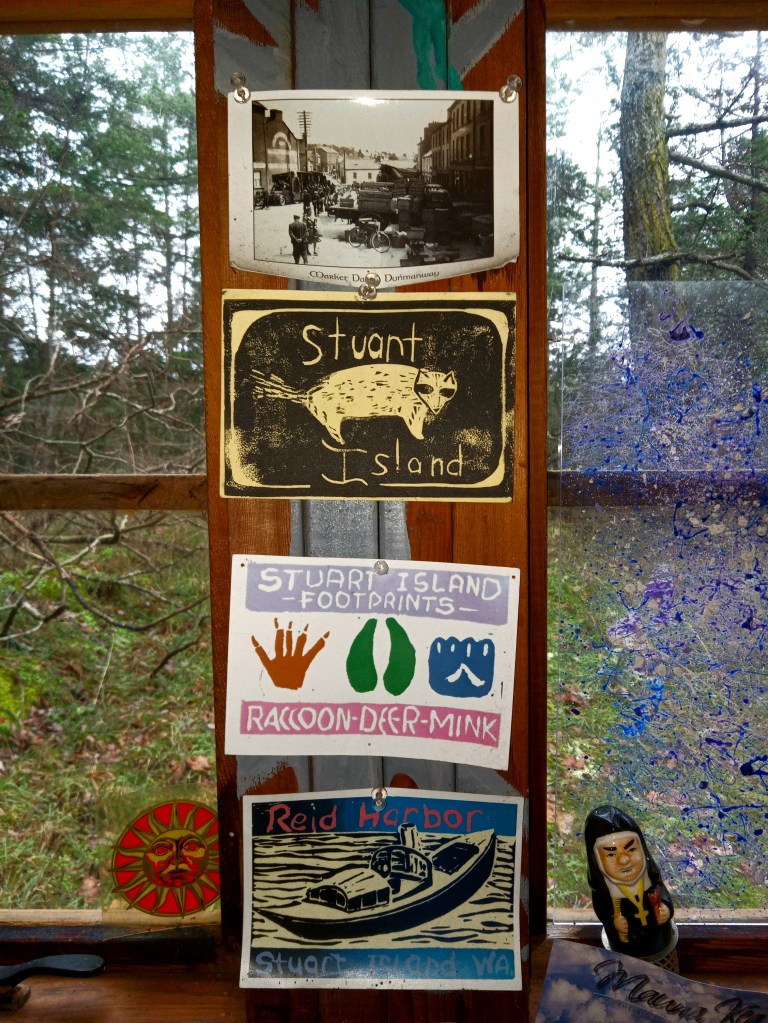
Handmade postcards from Stuart Island, a neighbor in the San Juan archipelago, festoon Wee Nooke’s walls between windows that can open to welcome breezes on warm days.

It did its duty as a daughterly retreat for several years, hosting at least one rather cramped sleepover with one of her middle-school girlfriends before Lillian handed off the keys — or the padlock combination, as the case may be — to her old man.

I installed a small writing desk with lamp, snaked an ethernet cable up the rocks and added an electric oil-filled radiator for January days like this. With a wall of mullioned windows looking out on craggy firs and the occasional grazing deer, it became the perfect place to write, even with the retained pre-teen decor of zebra-striped rug and beaded entry curtain.

Besides countless installments of the “Reef,” the Nooke and I have produced a handful of freelance travel stories, a recreation section of the Mountaineers-published “We are Puget Sound” book, and (with Barbara’s collaboration, in her day) more than one mystery novel.

Mailbox as art: Rescued from Lopez Island Dump, it perches on Wee Nooke’s front railing. The flag is always up.

My custom is to bring a lunch up with me, along with a Thermos of hot water. A tiny table holds a variety of teas and instant coffee. As I write, I usually listen to my favorite music-streaming channel. Jackson Browne, Cat Stevens, Bill Withers and other mellow rockers of the 1970s ring out from the nice Polk Audio computer speakers I got for free at the Lopez Island Dump’s Take It-or-Leave-It warehouse. When the weather doesn’t keep her curled up in the cabin, Galley Cat is a regular visitor as I work. I slide open the door whenever I hear her scratch, and she leaps up on to a bookshelf to be rewarded with cat treats. On a warm day, she’ll be in and out every five minutes. (She shirks duties as a mouser, however. I must set traps on occasion.)

Lillian made this sign for the writing hut.

Yes, I love the Nooke. With the portable radiator pulled under the desk this afternoon, I’m snug as a bug in a rug.

Oh, and that bit about boiling water. It’s just a reminder that this is still January in the winter-wild San Juans. When I returned Sunday from visiting my sweetheart in Thurston County, our island’s community water system was under a “boil water” order until further notice. In the hard freeze while I was gone, our water system froze up again. With the required rerouting to different pipes and another reservoir tank, once water was flowing again the purity couldn’t be trusted.

A jug of emergency water ensured that I could brush my teeth without worry.

But Monday morning our caretaker took a sample to the mainland for testing. By Tuesday we got the “all clear” signal to again drink our tap water without first bringing it to a roiling 212 degrees F.

So, yes, living on a remote island has its challenges, sometimes big. But it always has its wee delights.

With howling winds and picture-postcard snow, winter keeps us guessing

The rambunctious Chevy dog tugs owner Carol on a snow-frosted January morning in rural Thurston County. Winter weather wasn’t as benign in other parts of Western Washington, including my San Juan Islands.

WINTER THROWS ITS TANTRUMS whether I’m on my island or off. This most petulant of seasons stomped into the San Juans last night with puffed out cheeks and a decidedly icy demeanor.

I left Center Island Wednesday to spend 10 days or so with my sweetheart in rural Thurston County, where we’ve been enjoying a scenic Friday of light snow. Because the National Weather Service predicted frigid temperatures on the way to my island, before leaving I took measures to ensure that Nuthatch Cabin would weather the deep-freeze. Among other things, this involved clearing out the kitchen pantry’s bottom shelf, yanking up an access hatch in the floor and doing a couple of fancy limbo maneuvers to fold my lanky 6-feet-two past the upper shelves of spare olive oil and unopened pancake syrup and down into the dank and murky crawlspace that is the dominion of spiders, water pipes and the occasional hapless mouse.

I use the term “crawlspace” advisedly. With maybe two feet of clearance between the plastic-draped earthen floor and beams above me, I did more wriggling on my belly than actual crawling. The objective: placement of two low-wattage air-dryer units, leftovers from my sailboat-owning days, beneath water pipes that snaked from beam to beam. That done, I plugged the warming units in to a heavy-duty extension cord that I led back up through the pantry to an electrical outlet in the living room. Frozen pipes prevented, I’m hoping.

In addition, I plugged in a small oil-filled radiator next to the bathroom toilet (I’ve seen the tank’s water freeze solid once) and put another portable radiator next to the kitchen sink. As always before departing, I turned off the cabin’s water main and drained faucets.

Such prep seemed justified Thursday as I sat in Tenino reading an email from Center Island’s caretaker. He warned all island homeowners of a forecast for frigid northerly winds by the weekend.

Galley Cat looks out on my sweetheart’s snowy garden in Thurston County this morning.

“It is possible that we may not be able to provide water during the coldest part of this cold snap due to reservoir freezing. If you’re here on island, it’s a good idea to have some fresh water reserved for your household use,” he wrote.

It wouldn’t be the first time the island’s water system had seized up when the mercury took a skydive. I already had two five-gallon jugs of emergency drinking water stored on my back porch.

So I assumed all was well Friday morning when we awakened here in Tenino to an inch of sparkling snow on the ground, my first of the season, with temperatures in the low 20s Fahrenheit. The sky soon cleared to a perfect January blue, as pastel-soft as a baby boy’s blanket. My sweetie and I enjoyed walking Chevy, the high-energy dog, on an icy back road to a sun-dappled lake where armadas of winter waterfowl seemed bent on paddling fast enough to keep the water from freezing. It was a beautiful winter day.

On our return, however, a text from my conscientious island neighbor, the Mad Birder, gave me a big chill.

Fallen limbs litter the front steps at Nuthatch Cabin on Center Island this morning after a frigid windstorm. John Farnsworth photo.

He attached photos showing two very large fir branches — themselves almost the size of small trees — that had plummeted from far above on to my cabin around dawn after a night of banshee winds. M.B. described it as a “massive crash” that made him and his wife think fallen timbers had smacked their own roof.

I soon exhaled with relief as the missive suggested almost no damage to my cabin. A photo showed a large tangle of limbs and fir needles that had come to rest on my front steps.

A phone call to M.B. confirmed that the cabin’s metal roof appeared essentially unscathed, and the stairway’s railing suffered only scratches that could be sanded out.

Winds had diminished, but temperatures hadn’t risen. While we basked in the mid-20s in Tenino, Center Island’s high for the day was about 9 degrees, M.B. told me. I was glad for leaving heat on, and thankful for my generous neighbor who used his chainsaw to clear the mess.

Center Island wasn’t the only place feeling this first seasonal barrage, of course. Harboring hopes for some downhill adventures with my new honey, I’d recently signed up for the daily snow report from White Pass Ski Area, 69 miles from Tenino. A couple days ago the report showed mountain winds gusting in excess of 100 mph. Under “conditions” was just one word, all in caps: BLIZZARD.

I think of how native Northwest tribes ascribe wily ways to wildlife such as ravens. It seems to me that winter has its own wily ways, and I’m probably right in guessing there are more wiles on the way. Enjoy January’s beauty as you can. But let me just say “brrrrr.” Stay warm. Stay safe. And if you’re walking through woods on a blustery day, keep looking up.

Remember, 2024 is the year we can save democracy or lose it. Please join me and other Vote Forward volunteers in writing letters to encourage voting among marginalized citizens in swing states where our nation’s fate will be decided. It’s a strategy with proven results. Get details at votefwd.org.

Does absence makes the moss grow lusher? Island homecoming is sweet

Behind Nuthatch Cabin, Galley Cat explores the rocky knoll where spongy moss has grown thick with winter rains.

HOMECOMINGS OFTEN TOUCH THE HEART, and my Wednesday return to the Nuthatch was no exception.

Galley Cat and I had departed Center Island on the Island Express water taxi along with daughter Lillian and our friend Lux on the day after Christmas. My destination was the home of my new sweetheart, Carol, three hours south. The next day was her birthday, which we would spend in a beachfront rental looking out on stormy seas at Moclips on the Washington Coast.

I spent another week with Carol and her rambunctious dog, Chevy, at their home in rural Thurston County. Her home sits on five wooded acres a short walk from the pretty Deschutes River, the waterway that skirts the old Olympia Brewery at Tumwater and feeds into Capitol Lake in the shadow of our state’s capitol dome.

This time of year, her neck of the woods feels even moister than mine. In fact, much of her acreage is classified as wetland because of the marshy soil. Alders and cottonwoods are draped in lichen and fringed with moss. Fog frequently lurks among the trees this time of year. On a nearby lake, trumpeter swans paddle in the mist.

Wednesday, Carol was due to fly away to visit her daughter who lives in Washington, D.C., so I dropped her at the airport and came back to my island to rekindle the home fires.

While Carol’s marshy environs are beautiful in their own right, my rocky knoll seems much different. Rather than adorning trees, spongy, emerald-hued moss cushions the island rocks. After plenty of winter rains, the moss is inches thick and vibrantly green. In the mild season we’re experiencing, I still have fuchsias struggling to bloom in planters on my deck.

Galley seems glad to be home. At Carol’s, coyotes are a threat so Galley stays inside unless I take her out on a leash to stroll the garden. The only wildlife threat on Center Island is from foxes ill-advisedly (and illegally) imported by a neighbor. But there aren’t many, and Galley has proven herself adept at quickly climbing a tree if foxes are about.

In our haste to depart on Boxing Day, we left the Christmas tree up. Happily, it has lost few needles, so I’ve left it up for me and Galley to enjoy for a few more days. Tomorrow I start stowing ornaments back in my dad’s old Army trunk — the one that crossed the Atlantic with him aboard the Queen Mary.

Today, I look out the windows of my writing hut as Galley perches on the desk next to my keyboard and meows for kitty treats. Watching through the mullioned windows as trees dance in the wind, listening to Gordon Lightfoot and the Lovin’ Spoonful on my desktop speakers, we are content for a few days to be back at our home, sweet home.

Remember, 2024 is the year we can save democracy or lose it. Please join me this year in writing letters to encourage voting among marginalized citizens in swing states where our nation’s fate will be decided. It’s a strategy with proven results. Get details at votefwd.org.

Gifts of gold and friendship

My writing hut looks out on a rocky knoll agleam with golden maples.

NOVEMBER CAN BE LONELY on my island in the San Juans.

It’s rarely quieter. I’ve gone days without seeing another human being. Galley Cat and I have kept each other company as the rains have made it a time for quiet indoor days of writing, reading and a good quotient of pleasant napping. For me, a new friendship is blossoming as we correspond by email. So not so lonely.

Perceptions sharpen among the peace and quiet. Stepping up the back path on a walk with Galley this morning, I noticed with a start, as if a breeze had snatched my hat: The maples have changed.

Just yesterday I noticed that maples around my place were still mostly green with leaf, unusual this far into the season.

But overnight that changed, adding splashes of soul-gladdening color among the evergreens. It’s a short period every autumn, but memorable for how the maples enliven the landscape with this painterly contrast of gold peeking from the green.

My heart swelled at the sight, and I ran for my camera.

Like a dash of sriracha in a stir-fry, a fallen maple leaf nestles among a swordfern on my hillside.

Another happy note: The Mad Birder and his lovely wife, Carol the Wonderful Watercolorist, have arrived next door for a few days’ visit, and I’m invited to dinner. I baked cookies to take for dessert. Maybe Carol will daub a painting of the maples while she’s here. Perhaps an overflight of southward honking geese will catch M.B.’s ear.

As November arrived, the island was cold and wet. Tonight it’s feeling warmer. I’m enjoying a visit with friends, and a gift from Mother Nature.

And the drizzle comes

Maple leaves are falling on my knoll. Along with raindrops. Not much autumn color happening.

IT WAS A DRY SUMMER on Center Island, other than the bizarre 48-hour thunderstorm with hourly downpours that we experienced a month or so ago.

But since yesterday, the first full day of autumn, we’ve aptly experienced the weather phenomenon for which the Pacific Northwet should be deservedly famous: drizzle.

In fact, I glanced at the weather forecast yesterday morning — rain for the next week — and dashed outside in robe and slippers, before my first cup of coffee even, to put away the deck furniture for the season. Not that Galley Cat and I ever leave things to the last minute at Nuthatch cabin.

Many non-webfooted outsiders think Seattle is the wettest city in the United States, with constant downpours, but with only about 37 inches of rain in the average year (drizzle, drizzle, drizzle), it’s not even in the top 10. The wettest American city of more than a million people? A place most people go when they want get a tan: Miami, Florida, averaging 64.7 inches of annual liquid sunshine. (Rounding out that top 10 list, based on NOAA records: New Orleans, Birmingham, Houston, Memphis, Orlando, Nashville, Atlanta, New York and Tampa.)

Center Island, in the Olympic rainshadow, gets only about 13 inches a year. Drizzle, drizzle, drizzle, drizzle, drizzle.

It’s cozy inside looking out. I might build a fire in the woodstove. Maybe make a cuppa tea. Happy Sunday, all. Batten down.