
This preteen island feline rocks with surf-and-turf and the ‘Lollipop’ tune

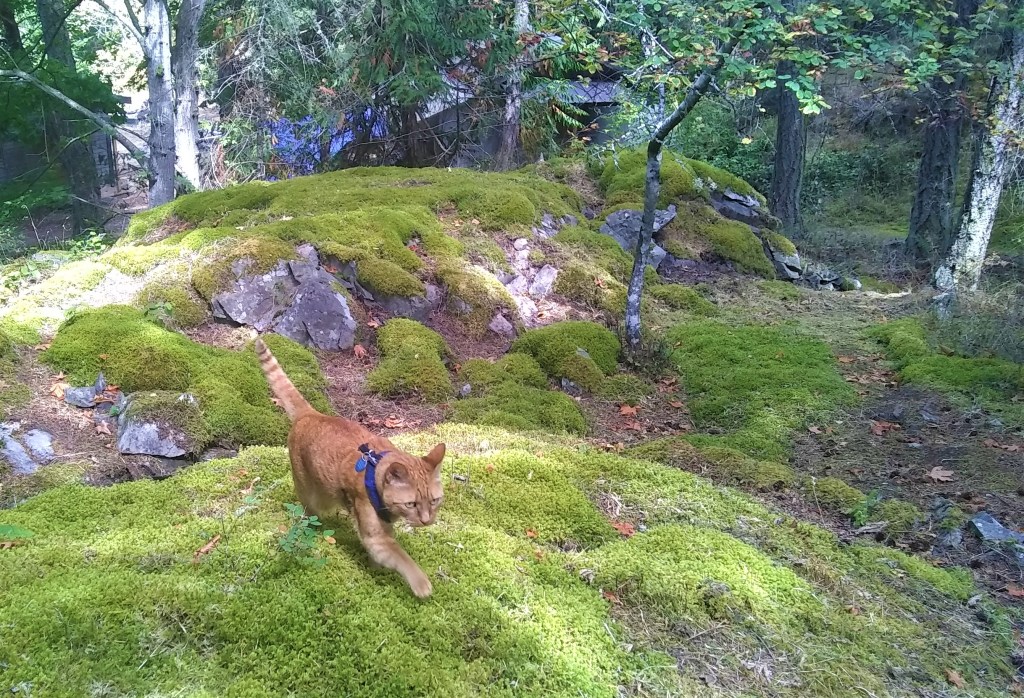
Galley Cat, who only admits to being 9, trots across the mossy top of our rocky knoll on Center Island.

THE MARKETING PEOPLE saw me coming. Today is Galley Cat’s birthday, so I bought a big packet of BIRTHDAY beef-and-lobster flavored kitty treats.

That’s how the package is labeled, with “birthday” in all caps, along with graphics of party balloons, confetti, and a rather crazed birthday-hat wearing cat opening a beribboned gift box from which a frantic lobster and a pop-eyed steer are madly trying to escape. Surf-and-turf, wrapped and ready to munch and crunch.

The escape motive is my reading of the situation, presuming that the crustacean and the cow are properly reading the context.

On normal days, Galley gets three bite-sized cat treats every time she comes in from outdoors. They aren’t usually BIRTHDAY cat treats, but made by the same manufacturer, with a wide variety of flavors, most of which have an ingredient list prominently featuring the words “by-product,” “Ferrous Sulfate” and “dried cheese.” Basically, they’re Cheetos for cats, but without the orange powder that can be so pesky on the paw.

My late wife, Barbara, established this treats-when-you-come-inside protocol years ago on the premise that it would encourage our adorable feline to come home instead of taking up residence with a neighbor whose grass might seem greener — or supply of cat treats more reliable.

Galley has always liked this policy. In fact, she likes it so much that she will often go outside and come back inside every five minutes. Thank you, dear spouse.

Like a special promotion at McDonald’s, today is Double Treats Day at the Nuthatch cabin. On this eleventh anniversary of her debut to kittenhood, Galley is getting six of these special BIRTHDAY treats every time she comes inside.

I don’t think she knows what it’s about, but she seems to approve.

On the topic of her natal day: I’ve had a lot of cats in my life, but Galley is the first whose actual birth date I’ve known. Most other cats have either been mysterious strangers who wandered by the Cantwell manse (strays) or adoptees we liberated from chokey (shelter cats) who didn’t come with a pedigree. But Galley came from a newfangled pet adoption center in Woodinville that made sure every adoptee was spayed or neutered, immunized, and came with a birth record.

Galley Cat, whose adoption-center name was Mabel, or Marvis, or something equally unsuitable, came from Ellensburg, we were told. She was born on August 17, 2012. I’ve always imagined her one of a litter of very cute kittens born in a hay-lined box in a warm barn. (The “warm” part is a good bet, being mid-August in Central Washington. If she was actually born in a ditch behind a dive bar, I don’t want to know.) Little did she imagine, I imagine, spending half her life on a sailboat and the rest on a small island cooled by marine breezes.

Besides the extra rations today, we’re just having a small, quiet celebration with a few friends, mostly nuthatches and towhees.

Oh, and instead of the traditional birthday song, at my friend Dave Kern’s suggestion I will sing her theme song. (Doesn’t every pet have a theme song?) Hers goes something like, “Galley Cat, Galley Cat, oh Galley Galley Galley.” It sounds better when you set it to the tune of the Chordettes’ 1950s pop hit “Lollipop, Lollipop.” Click and enjoy.

Galley especially enjoys the part where you make the pop noise with your finger in your cheek. (How did Andy Williams get in this music video?)

Off my island and off my rocker

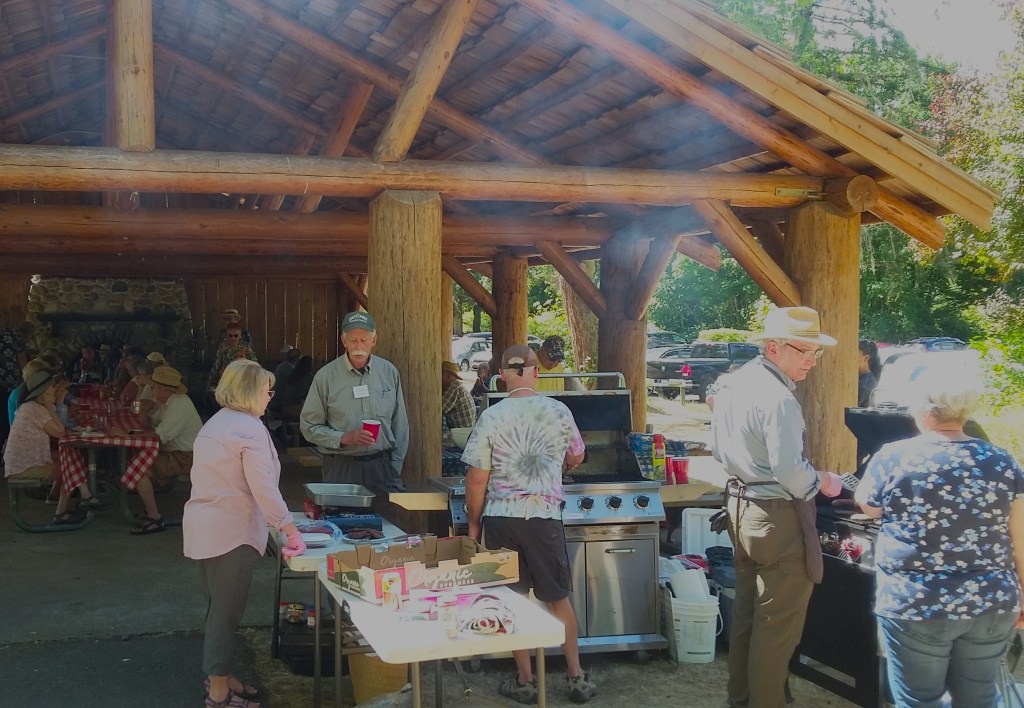
Barbecue smoke wafts lusciously through a Schafer State Park picnic shelter during a recent celebration staged by park lovers.

FEELS LIKE I’VE BEEN off my island as much as on it lately. And so busy, feeling a little bit off my rocker.

Daughter Lillian and I are in the final throes of selling our dear old sailboat, Sogni d’Oro, and it’s kept me hustling with last-minute fixes and general spiffing up so I can feel as good as I can about the whole process. It’s a bittersweet occasion, giving up the Westsail 32, Hull No. 777, built in 1977 (good karma, right?). The boat was my family’s home for the better part of 30 years, enabled us to explore almost every nook (and most crannies) of the San Juan Islands, and took us on one of our biggest life adventures, a 1990s sailing trip to Mexico’s Sea of Cortez.

But it’s time for a new skipper to love her, and we’ve found a buyer with the right enthusiasm, energy and dreams — a close friend of Lillian’s, who over the past two months has become my friend, too.

Daughter Lillian makes Sogni d’Oro beautiful during a boatyard haulout last September. The boat’s name is the Italian version of “Sweet Dreams.”

Galley Cat and I spent a week early this month staying aboard the boat as I worked to resolve an electrical glitch in the engine room. The week reminded me of how at home I feel in marinas: Sipping the day’s first coffee in the sailboat’s teak-floored cockpit on a flat calm morning when the sun is just starting to glint off the other hulls. Watching a well-laden boat head northward on the first morning of a summer cruise. Ahh, we enjoyed many of those 7 a.m. departures.

More recently, I was on the mainland for a week of visiting with friends in Seattle and Olympia. Drinking good wine and eating delicious food during a sunset dinner on the deck of the lovely old Magnolia Bluff home of Carol Pucci and Tom Auciello (the “Puciellos,” we call them), all with an entertaining vista of passing ships and shuttling ferries. Two nights followed with Olympia friends Daniel and Jean Farber, where entertainment from the front window included an eyepopping view of Mount Rainier turning pink and purple with every sundown, and sailing dinghies scooting like water bugs across Budd Inlet.

My Olympia visit included two unique celebrations of Americana. Saturday, it was a gathering of Washington State Parks retirees, supporters and friends at Schafer State Park, a sweet little park on the Satsop River. The park hides out along a narrow and winding road between Montesano and Shelton in the most rural reaches of decidedly non-urban Mason County. This park rivals those previously-undiscovered-until-2021 Amazon Basin natives for being off the beaten path.

The Schafer gathering was sponsored by FOSLS (Friends of Schafer and Lake Sylvia), a group of local folks who successfully battled plans to close “their” parks during one of Olympia’s budget crises of recent decades. On a perfect summer day, this soiree featured free hot dogs and hamburgers fresh off the grill, along with groaningly well-laden potluck tables of toothsome salads (I love that one with broccoli, raisins and bacon) and desserts (from hunks of crimson watermelon to squares of sweet apfelkuchen).

Upcoming FOSLS events that might be worth a visit

Lake Sylvia Fall FestivalSeptember 1010 a.m.-4 p.m.
Schafer Park Salmon BakeOctober 71 p.m.
Schafer Park Yule Log CelebrationDecember 31 p.m.

After a tour of the park’s astonishingly well-groomed new campground, we tapped toes to the music of the Grays Harbor Banjo Band, complete with a washtub bass, like they had detoured through Mayberry on their way from Hoquiam and signed up Ernest T. Bass. The band’s emcee possessed the self-effacing humor to tell banjo jokes. (My personal favorite, which I wish I’d stood up and shared: “A banjo player bemoaned the crime wave gripping his city. He told how he had parked on a city street and locked his car with his banjo on the back seat. When he came back to the car, a window was broken and someone had thrown in another banjo.”)

Topping the day, I won the big door prize: a state parks Discover Pass.

Back in Olympia on Sunday, Daniel sang in his synagogue’s choir during a street festival celebrating the 150th anniversary of organized Judaism in Washington State. Daniel’s place of worship, Temple Beth Hatfiloh, is the present-day offspring of the state’s first Jewish fellowship, established in 1873. Sunday, the temple was also marking the 50th birthday of their rabbi, and his 20th year of service in Olympia. This time, the hot dogs were kosher.

My friend Daniel Farber, right, pitches in with his temple’s choir. Oy, this number was easy to sing along with.

Back in Seattle, I spent another day working on the boat’s electrical problem. No joy; I ordered a new alternator. More satisfying was the next day, when Lillian and I scrubbed and polished Sogni d’Oro together. Almost ready for the hand-off day.

As much as getting away and visiting friends is good for me, it was with fondness and relief that I returned to the Nuthatch cabin yesterday. I reunited with Galley Cat, who had spent the week at the cabin with cat-sitters in the personages of niece and nephew Sarah and David and their two young boys. “They were fine, but I missed ya’, Pops!” Galley told me. Have I mentioned how she calls me “Pops”?

Likewise, I said. As I missed afternoons such as this, sitting in my writing hut with sun streaming in and a luscious light breeze cooling me through the open door as I peck away at my laptop and listen to Carole King, Bill Withers and the occasional Spotted Towhee. Galley sprawls in the sun on the front stoop. She doesn’t care who’s on the stereo.

Ahhh. It’s good to be home on my island. Back in the rocker, so to speak.

Emulating the ant and rockin’ the grasshopper, at solstice time

My project for last week: refinishing the lightboards from my sailboat. Beyond the deck rail blooms the creamy flowers of oceanspray, a shrub native to Northwest woods.

SUMMER ARRIVES this week, the season when islanders like me try to blend the virtues of the ant and the grasshopper.

The Aesop’s Fable, you might recall, tells of the ants who spent their summer busily storing up food for the winter while their grasshopper neighbor spent all summer making music on his fiddle. By season’s end the grasshopper had good memories, and no doubt had polished up some catchy tunes, but faced a hungry winter ahead. When he asked for a handout, the ants told him to bugger off and go dance the winter away.

Therein lies the problem with old Aesop: His righteous protagonists can be mean-spirited bastards. But I digress.

Arriving at a happy medium in the ant-vs.-grasshopper industriousness quotient is my goal on Center Island. I also strive not to be as snotty as the ants.

Saturday, we had an island work party that hit just the right notes. I and 15 or so of my neighbors worked from 9 to noon on projects to preserve and prettify our community assets. I helped to scrape and repaint the railing on our upper dock, while some weed-whacked the boat yard and others did carpentry repairs on the clubhouse.

After three hours, we all gathered on the clubhouse deck for grilled brats and shared some island camaraderie and a pony keg of good IPA from Anacortes Brewery. Ants and grasshoppers. Too bad nobody brought a fiddle.

There’s lots to do around Nuthatch cabin this time of year. I continue to rebuild my deck a few planks at a time, with Lopez Island lumber-yard cedar ferried here on WeLike, 64-board-feet at a time. I try to restain one side of the cabin every summer. There’s lots of firewood to be split. And this summer I’m also doing projects related to my sailboat, Sogni d’Oro, in preparation for its sale.

Sogni d’Oro moored off Puget Sound’s Blake Island, July 2018.

Yes, an era is ending, as daughter Lillian and I have decided it’s time to find someone new to love the dear old Westsail 32, which has been ours since 1989. We have a prospective buyer, one of Lillian’s close friends in Seattle, someone who fits our hopes for a new steward who will give the boat care, energy, love and fresh adventures. I’ve promised a few restoration efforts first, and the sale depends on a satisfactory inspection, but hopes are high.

On Center Island, my summer routine has kicked in. I rise around 7 or 8, with coffee and a breakfast of avocado toast topped with walnuts. Once I’m dressed and more or less cleaned up (one doesn’t really need to shower unless you have visitors, right?) I often go for a bike ride (three brisk one-mile, through-the-woods laps of a route encircling our airfield), then devote a half-hour to a New York Times crossword before getting busy with some project for the day.

Foxgloves are June bloomers on Center Island.

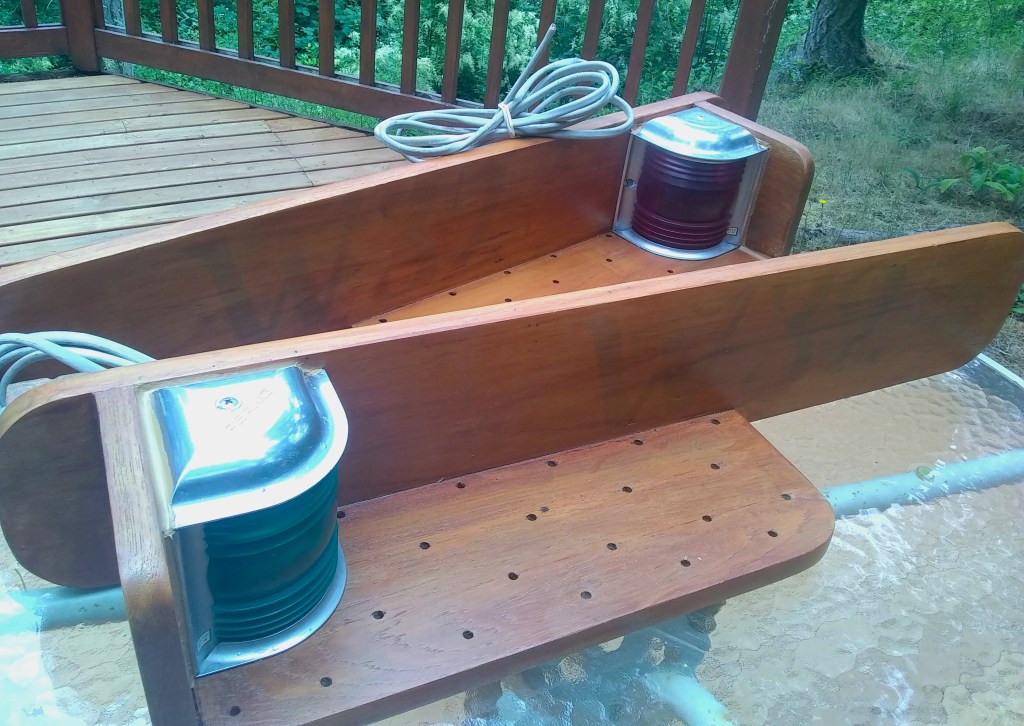
This past week that involved stripping the spoiled old varnish and refinishing the sailboat’s teak lightboards — beautiful craft pieces my father built 30 years ago to hold the boat’s big, vintage zinc-alloy running lights. I cut the wires, detached the boards from the boat’s shrouds and brought them to my island for refinishing. Two days with a heat gun and a sander, then two coats of a heavy-duty waterproofing wood finish. I’ve ordered cutout birchwood lettering from a manufacturer in Idaho to match the Westsail’s sail emblem (a stylized capital W, with 32), which I’ll epoxy to the lightboards as my father did. He made the original cutouts by hand, bless him.

The refinishing project was a lot of work, but satisfying. And doing the work outside on my deck in the June sunshine, with wild foxgloves and oceanspray blooming nearby and twittering birds complementing the Jimmy Buffett tunes on my bluetooth speaker, wasn’t too painful. Galley Cat wandered by every few minutes to meow a hello and roll luxuriantly on the sun-warmed cedar deck.

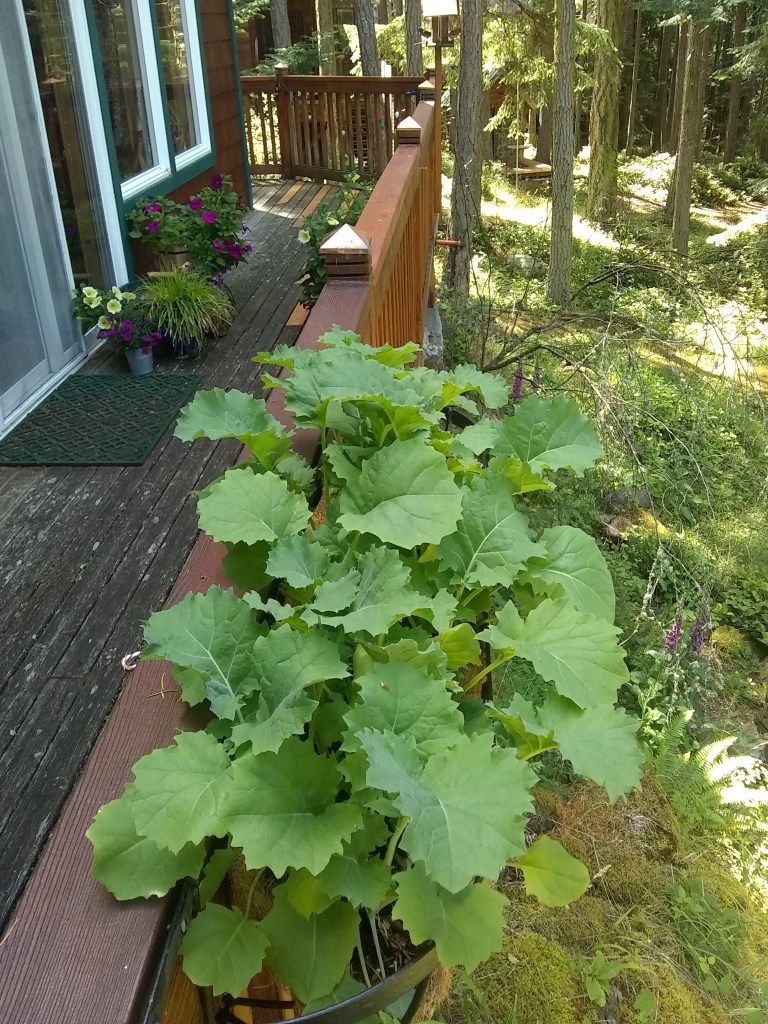
The healthy 2023 kale crop in the Nuthatch’s rail-mounted planter.

That’s the antsy part of my day. The grasshopper kicks in around 5 when Galley and I indulge in what my daughter calls a “snooze read” (bedding down with a favorite book until one’s eyes close) up in the loft for a half-hour. Then it’s time for me to cook up a good dinner (tilapia tacos, say; maybe a stir-fry with fresh kale from my deck-rail planter) while cranking up more tunes and sipping a glass of good New Zealand sauvignon blanc from my monthly Costco run. The best offerings on Netflix often finish off the evening. (Even small islands nobody’s heard of get the internet these days. In fact, fiber-optic broadband is coming, we’re told. Yikes.)

That’s it. A day in the life of this antsy grasshopper on Center Island in the San Juans. Come 7:57 a.m. (PDT) Wednesday, happy summer solstice to my Northern hemisphere readers. Don’t forget your warm-weather chores. But remember to fiddle now and then, too. Maybe even dance.

The almost-finished product, awaiting new lettering to match the Westsail’s mainsail emblem. The red light goes on the boat’s port side, green on starboard.

Glory be, what a month it’s been

Betsy Davis’s classic double-ender motoryacht Glorybe, built in 1914 and rebuilt after a 2002 fire, looks highly decorative in a May sunset while riding a mooring just off Center Island.

OH MY, OH MY, my May.

Here it’s already Memorial Day weekend, one year since my crewmates and I shoved off for our 10-week voyage up the Inside Passage to Alaska, and I’ve had such a busy month of visiting with other friends that I need to catch up with you, loyal Reefers.

Getting too busy with friends can be a rare thing when you live on a small island nobody’s heard of. Lots of comings and goings this month. For me, that’s a good thing. Winters can get lonely when the winds howl.

Jean and Daniel Farber, May 2023 park hosts at Lime Kiln Point State Park, with an old lime kiln in the background.

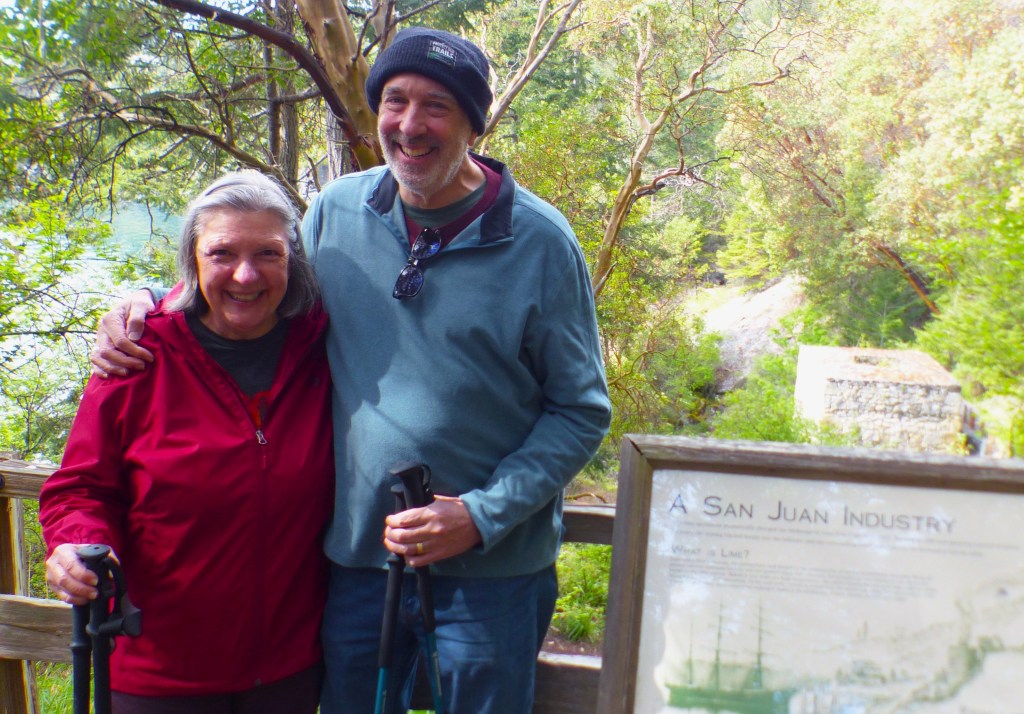
Early in the month, I had a pleasant stay with friends (and Inside Passage crewmates) Bill Watson and Barbara Marrett on San Juan Island, paired with a bonus visit with old chums Daniel and Jean Farber. Usually at home in Olympia, they’ve spent the whole month of May living in a travel trailer on San Juan Island where they’ve served as interpretive park hosts (and ruthless wranglers of invasive blackberry vines) at Lime Kiln Point State Park.

Daniel, who retired from a distinguished career with Washington State Parks, once again proved his acumen as a parks pooh-bah by leading me on a walking tour rich in historical narration of Lime Kiln’s old quarries and upland trails. For example, little did I know that Lyman Cutler, the American farmer whose famous shooting of a British pig touched off the Pig War standoff here in 1859, was also a founder of the quarrying business at Lime Kiln Point, which shipped lime to be used in cement for building cities up and down the West Coast. Added trivia from my own research: After Cutler sold his interest, the mining company ultimately dissolved when one partner murdered another — proving, I guess, that it’s dangerous to be a mining baron, or a pig, on San Juan Island.

A curious red fox met us in the woods at Lime Kiln.

If you’re interested in island-living lore, my trips to San Juan Island aren’t quick or easy. I hire the Paraclete Water Taxi to take me from Center Island across Lopez Sound (3 miles, $38) to the Hunter Bay County Dock on Lopez Island, where I keep my faithful old Ford pickup, Ranger Rick (county parking permit, $25 annually for homeowners on neighboring Center and Decatur islands). I drive Ranger Rick 11 miles to park in the public lot (72 hours free) at the state ferry terminal, load my Rubbermaid tote (aka San Juan Samsonite) on my old red handtruck and walk it on to the next ferry bound for Friday Harbor (often waiting longer than expected because ferry runs get canceled due to crew shortages). The good news: the ferry ride is free for interisland walk-ons.

Ten days after my return from that adventure, Galley Cat and I were on the road to Walla Walla to visit my friend Patti Lennartson. Galley Cat usually vocally protests the idea of leaving the cabin overnight, and hides under a bed if she cottons to the fact that I’m packing again. But once she was in the car and set loose from her carrier to be a free-range travel cat (as free as she can be in a Honda Civic), she seemed fine with it. As usual, she often stretched from the passenger seat to put her front paws on the dashboard to watch the world go by. I think she likes high speeds. Crossing Snoqualmie Pass, she seemed fascinated by snowy peaks, as only makes sense for someone who has spent 99.9 percent of her 11 years at or near sea level. (She lived on a boat half her life.)

Latina dancers whirl and twirl at the College Place Block Party, near Walla Walla.

Walla Walla was sunny and hot. But Patti had the A.C. cranked up in the guest room, and Galley and I enjoyed a dose of extra Vitamin D when we got outside. Along with Patti’s daughter Stevie and her partner, Kevin, we drank some good Walla Walla wine, watched a Latin dance troupe at a street fair in College Place, ate good tacos and wood-fired pizza with fresh asparagus, and generally had a fine time.

Dancers balance beer trays on their heads in College Place. That’s talent.

Came back to lovely 65-degree days on my island, where the wildflowers are almost played out. The blue camas (with edible bulb) is almost done, though the appropriately named death camas (whose foliage and bulb are poisonous) is parading white stalks of flowers in a come-hither display. Happily, Galley ignores the siren call. She likes plain old grass.

Just when I was going to get down to work replacing planks on my deck, a delightful respite presented on Wednesday when dear friend Carol Hasse, another of my Inside Passage crewmates, texted to ask if she and shipmates on the beautiful, century-old wooden motoryacht Glorybe, moored that day at Jones Island, might put in at Center Island on Thursday.

Always say yes, friend Daniel and I have pledged, when serendipity knocks. So I got on the phone to island buddy Dan Lewis, who didn’t hesitate when I asked if his mooring buoy might be available. It was a perfect bluebird-sky May afternoon when Hasse, Glorybe skipper Betsy Davis, and fellow crewmate Ace Spragg came for a happy hour and fish-taco dinner on the Nuthatch Cabin’s deck (which will have new cedar planks soon enough).

From left, Betsy Davis, Ace Spragg and Carol Hasse depart my island.

Hasse, as anybody who has set foot on a sailboat in this hemisphere probably knows, recently retired from a renowned sailmaking business in Port Townsend. Betsy, former director of Seattle’s Center for Wooden Boats, these days helms the NorthWest School of Wooden BoatBuilding in Port Hadlock when she isn’t at the wheel of Glorybe. Ace is that school’s education director after serving 11 years as sailing director, among other salty hats she wore, at Port Townsend’s Northwest Maritime Center. All this pedigree talk is simply to say that over beer, wine and a bit of good grub, we had a boatload of good nautical chat to share. I loved Ace’s stories about her idyllic childhood days of building and piloting rafts on the Chesapeake Bay (and constructing a five-story treehouse from which she and other kids dropped eggs — and anything else that seemed interesting — just to watch them splat).

The thing to remember is, friends don’t let friends work too hard. Tomorrow I get busy on the deck. Have a memorable Memorial Day.

The avian gold standard

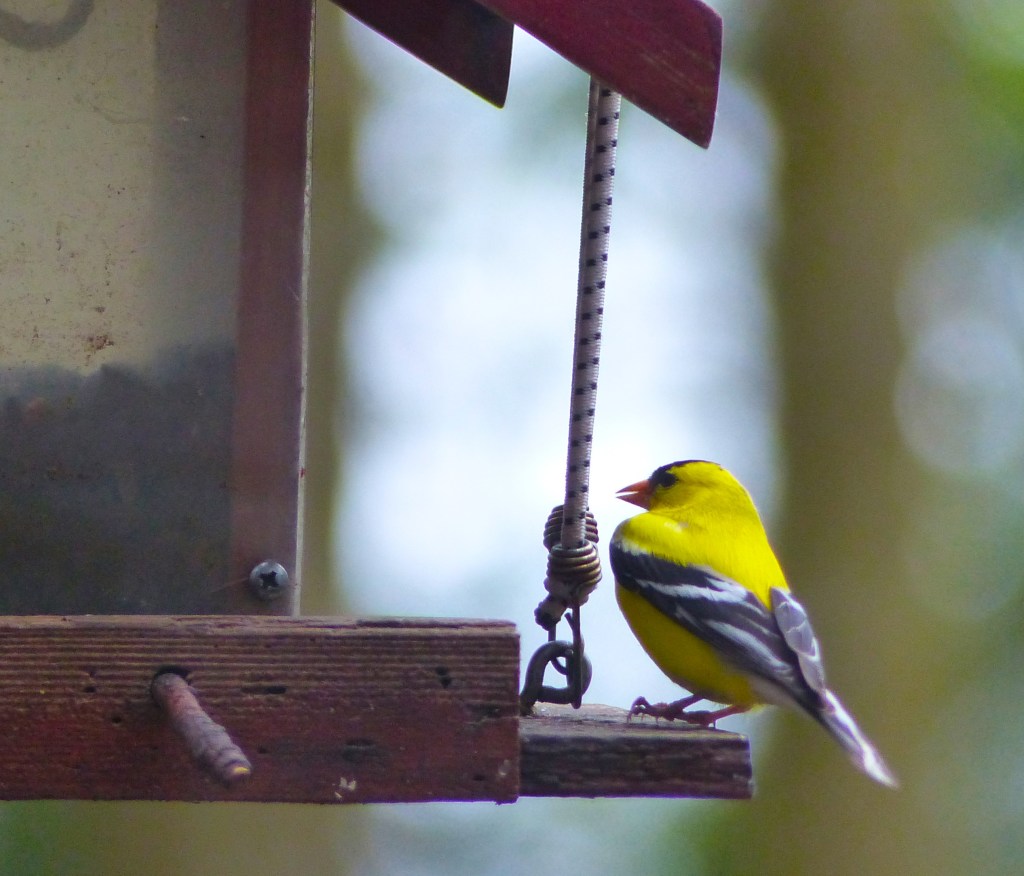
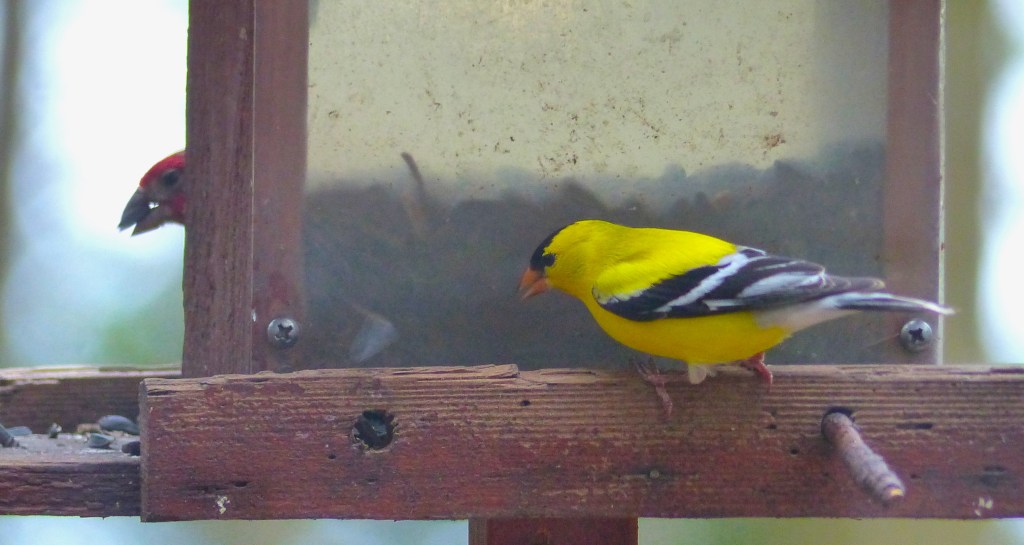
NOT MY BEST-EVER Goldfinch photos, but worth sharing. These migratory songbirds are such a delight when they arrive in crowds, brightening the scene in early May. Another treat will come in June or so when new fledglings appear at the feeder: miniature, brightly feathered, not quite yet knowing where their feet are — a bit like human newborns. But could you fly at the age of 11 days?

Peek-a-who? That’s a Purple Finch, no slouch in its showy crimson feathers, peering around the corner of the Nuthatch Cabin’s well-used feeder. But a recently arrived American Goldfinch steals the show in its splendid lemony plumage.

Glorying in a few days of spring

Sailboats sit at moorings on Fisherman’s Bay, just off Lopez Village, as seen from my lunch spot.

THE OFFICIAL, FARMER’S ALMANAC-SANCTIONED spring equinox might not be until 2:24 p.m. PDT Monday. But spring arrived today in the San Juan Islands.

Hallelujah.

The sky was clear, the seas were calm, the thermometer pushed 60 degrees, and Center Island’s docks were nearly full. All over my island people were outside hammering, hoeing, washing down and tidying up — doing all the celebratory puttering that comes with the end of a long winter.

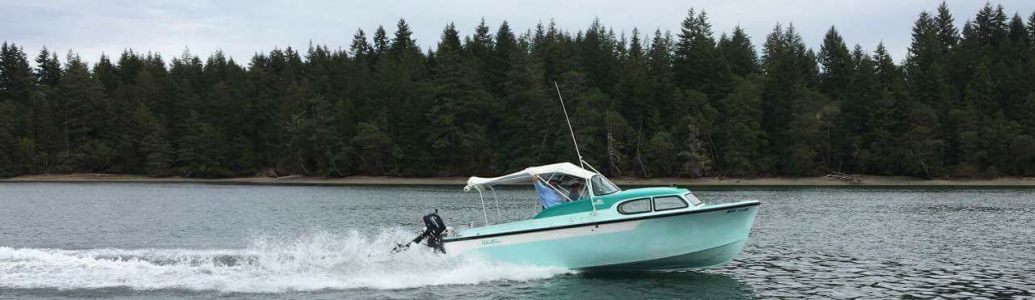
I celebrated a few days early by relaunching my 1957 runabout, WeLike, on Thursday. It had sat forlornly on a trailer since November. Doing my part as a spring-inspired islander, I checked over the boat’s electrical system, added fresh fuel, drained the water strainer, ran the bilge pump and gave the boat a good scrub.

Then I buzzed over to Lopez Island yesterday for a blissful day of normal stuff you do when it’s not winter.

At Isabel’s Espresso, I sat outside on the deck and read a book while I sipped a good coffee. I stopped in at the supermarket for fresh produce. I took a sack lunch and strolled out to a favorite bench at Fisherman Bay Spit, where rogue daffodils were starting to bloom in the pasture of a long-deserted farmstead. I ducked into the public library and checked out a real book. What a delight! One gets overly reliant on Kindle when you live on a remote island.

Galley Cat, too, is reveling in the warmer days, gamboling up and down the rocky knoll. Returning inside today after an hour out inspecting the grounds, she smelled all sun-washed and fresh, like linen sheets that had dried on a clothesline.

It’s supposed to rain on Monday, the Weather Service says. But for a few days, we got a jump on the season of renewal, in all its glory. Hallelujah.

Practicing catch-and-release with my cabin’s chimney. (Sheesh)

A Dark-eyed Junco like this explored my chimney and woodstove this morning.

ALL’S WELL THAT ENDS WELL, Will S. wrote, and as I breathed a sigh of relief this morning I decided he was right.

But this is definitely the year I replace my chimney.

Being Daylight Savings Sunday, I was lolling in bed reading John Grisham and finishing my coffee and avocado toast at what some might call a late-ish hour of the morning. But I had that “spring ahead,” lose-an-hour-of-sleep excuse for lolling.

That’s when I heard the skittering.

For a moment I tried to convince myself it was a Nuthatch — the bird for which my cabin is named — outside messing about in my metal roof’s gutter, as they often do. Getting a sip of water, perhaps; the drainage isn’t all that great.

But then I heard it again: a sound like fingernails lightly brushing metal, and it wasn’t coming from outside. I recognized that sound.

Damn.

I had another bird down my chimney.

Loyal Reefers might recall a couple Novembers ago when this happened before. That time, I got paranoid about what was in my chimney, imagining anything from a hapless bird to a squirrel or raccoon (or, as several merciless readers suggested, a skunk).

At that time, try as I might I couldn’t figure out how to open up the chimney and release the creature, which had fallen into the lowest reaches of the woodstove’s metal flue, the eight feet or so that connect the stove with the cabin ceiling. The chimney has a conical cap up top and I expect it was screened when it was new, but the screen has probably disintegrated with rust and heat over the years. Rising high above my rooftop, it’s not easily inspected.

Unable to catch-and-release that first time round, I went with Undesirable Choice No. 2: Refrain from building a fire and let nature, uh, take its course. It was several days before the skittering stopped.

Eventually I discovered a way to remove the fire bricks at the top of the woodstove and was able to remove the poor dead sparrow.

As I lolled in the loft this morning, I resigned myself to another unpleasant days-long “death watch.”

But then I realized: Now I know how to open up the stove from inside. I could try to get the bird out. If I could free it from the chimney, maybe I could capture it in a large trash bag and set it free outside, hopeful that it wouldn’t be caked with soot and creosote. I had to try.

Meanwhile, Galley Cat, who usually snoozes the morning away on her heated cat bed downstairs, had come up to the loft to see me. Vocal and wide-eyed, she was clearly trying to tell me something.

Descending the stairs and crossing the living room, I saw what she was trying to communicate: “Pops!” (she calls me “Pops”)… “Pops, there’s a birdie in the woodstove, you can see it in there!”

Sure enough, this bird was no longer caught in the chimney, it had squeezed its way down past the firebricks and made it into the stove’s main chamber. There it was, clearly visible, fluttering behind the glass: a very unhappy Dark-eyed Junco. For goodness’ sake.

OK, Rescue One, suit up and respond to an avian distress call at 1366 Chinook Way.

Adrenaline flowing, I grabbed a trash bag from the pantry. Plopped the feline in the bathroom, behind a closed door. (She was certain she could help. I demurred.) I hoped to bag the victim as I cracked open the stove door, but in case it got past me I opened wide the glass slider and a side door.

Happily, the Junco wasn’t caked with creosote. It remained perfectly mobile, which it proved the moment the door was cracked. Despite my best efforts with the trash bag, I had a Junco flying around my living room.

Unfortunately, it didn’t find the open doors. It bumped against one of the big front windows, then flew through the kitchen and thumped against a window by the sink, where it decided to stay and flutter about.

Now, I have to say this for that bird. Whether or not it knew I was trying to help, it did me one huge favor. Anybody who has heard the sad tale of the duck that got into our sailboat’s V-berth, which ended with a very long afternoon at the laundromat getting our bedding de-ducked, will know these things can end badly. I’ll just say it bluntly: No matter how frightened it may have been, the Junco did not shit inside my house. Thank you. Were the roles reversed and a giant songbird was chasing me with a trash bag the size of Mount Constitution, I can’t promise I’d have been so reserved.

Anyway, I sidled over to the kitchen with my trash bag opened wide. The bird tried to take cover in a potted plant sitting behind the sink, but I swooped and scooped.

As first, I didn’t think I’d caught it. Songbirds don’t weigh much, and under the feathers there’s not a lot of bulk. I very lightly gripped the bag closed while I searched around the plant and among the dishbrushes. My home invader wasn’t there. So I carefully peeked into the plastic bag cradled in my fist and saw a pair of fragile bird feet sticking out. It wasn’t struggling, perhaps just resigned to its fate.

Keeping my grip loose, I quickly strode out onto the deck, put the bag down and opened it wide. The Junco flew away, and I don’t think it stopped until it hit Lopez Island.

All’s well that ends well. But, sheesh, it’s time to get a chimney with a screen.

Fleeing my rock for the City of Subdued Excitement

Sailboats scoot across Bellingham Bay.

SOMETIMES A MAN JUST HAS TO GET OFF HIS ROCK.

When I flee the seemingly endless winter on Center Island and seek a place with more live humans, I guess you might call me an “off-my-rocker.” Kind of goes along with living in a cabin called the Nuthatch.

Anyway — forging prosaically on — when I need to get away and have just a day, I like to go to Bellingham.

This week I decided a necessary grocery-shopping trip would be a good opportunity for a northward pilgrimage to the City of Subdued Excitement, as Bellinghamsters like to call their town.

OK, I mean, right there — not only does the place have a great self-deprecatory, tongue-in-cheek slogan, but residents go by a name that conjures a vision of a town full of anthropomorphized rodents driving around in little cars. I appreciate a community with a sense of humor.

They also have almost as many craft breweries and brew pubs as Bend, Ore., which everyone knows adds significantly to the quality of life.

When my family returned from a 1990s sailing trip to Mexico after two years of being off the grid careerwise, Barbara and I realized we could start afresh wherever we chose. We hoped to make a go of it in Bellingham, a congenial college town on a beautiful bay, a half-day’s sail from the San Juans and practically in the shadow of Mount Baker and its razzle-dazzle ski area.

Unfortunately, it didn’t work out. Newspapering was my life, and I did get hired and worked for one day at the local daily, the Bellingham Herald. But I was young, a bit cantankerous, and just returning from the freedom of the wild seas. That first day on the job, after I’d expressed enough disagreements with the corporate policies of the Herald’s parent company, Gannett, one of America’s worst newspaper chains, the newspaper’s H.R. director and I mutually agreed that it just wasn’t a match made in heaven. So my family sailed south into Puget Sound and I ended up at The Seattle Times. A happy ending, as it turned out.

From a viewpoint along Chuckanut Drive, the road to Bellingham offers panoramas of islands and saltwater in a varied palette of blues.
Chuckanut Drive curves

But I’ve always enjoyed visiting Bellingham, about which I wrote numerous travel stories for the Times. These days I like going even if only for a quick trip to the sole Trader Joe’s in Northwest Washington. From the water-taxi dock in Anacortes, it’s an easy hour’s drive.

I got a pleasant sunny day for this trip, and I found time to get off Interstate 5 and chug northward on scenic and serpentine Chuckanut Drive, the original northbound road that skirts the base of the Chuckanut Mountains, a foothill spur that geologists say is the only place the Cascade range meets the sea. It adds only about 15 minutes to the trip, but it’s a superb quarter hour. Starting from the Samish Flats, where I saw a fluttering flurry of snow geese, my red Civic snaked along boulder-strewn cliffs, passed chattering waterfalls and skirted moody panoramas of islands and saltwater.

An overwater boardwalk is part of the waterfront trail crossing Bellingham’s Boulevard Park.

Reaching town, I navigated the old-town Fairhaven district and pulled off at Boulevard Park. A narrow strip of land between the bay and the main north-south railroad tracks, the park offers shoreside benches, picnic tables, a kids’ playground and a waterfront path and overwater boardwalk that stretches miles into downtown. It’s my chosen stop when I pack a lunch. On breezy days, I’ve watched kiteboarders fly high out in the bay. The park even has a good, locally run coffee shop. Very civilized.

After lunch, my day was devoted to grocery shopping. But if you’re there with more time, Bellingham has a bunch of fine museums, dedicated to history, art, and even electricity (the eyepopping Spark Museum); a distinctively spired performing arts center (the 96-year-old Mount Baker Theatre); a variety of pleasant walking trails (such as a waterfront amble on Lake Whatcom), and the aforementioned breweries.

The excitement, though tastefully subdued, is earned.

Source: Google Maps

Febrrrr-uary ends frostily

Cottony clouds crowd the Cascades on a recent sunny but cold day. Looking east from Center Island across Decatur Island to Rosario Strait.

DECEMBER TOOK A JAB AT IT, but February has again tussled its way to the title as the San Juan Islands’ winter month with the most unpredictable and weirdest weather.

We’ve had hail (pelting down like a million icy little meteorites on my deck, more than once). We’ve had frigid Fraser Valley gales (combined with big tidal swings that make crossing Rosario Strait to Anacortes a rocking, sloshing, life-challenging adventure, more than once). We’ve had blowing snow, we’ve had frosty nights. And, yes, we’ve also had pristine sunny days, such as today, most of which have never warmed above freezing. And, oh my, the starry nights.

Galley has donned a cunning Argyle sweater against the February cold.

“I’m done with the cold,” the Mad Birder grumped on a recent visit. He moved here from California, which by rights might make him bitter about our February freezes, but today Los Angeles has blizzard warnings, so go figure.

Extreme cold tends to keep us otherwise hardy islanders indoors by blazing fires much of the time. By now, with the month of March parading our direction as if to a John Philip Sousa composition, our feet are decidedly itchy.

I have done a few things other than binge-watch all four seasons of “New Amsterdam” in recent weeks. On a day when the earth wasn’t frozen I finally dug a hole in which to plant the five-foot Charlie Brown fir tree that had been living in a root-bound pot on my deck for many months. Daughter Lillian brought the tree up a couple years ago. It was Nuthatch cabin’s Christmas tree in 2021. When much smaller, it had served as her Christmas tree on the sailboat in 2020, after being dug up on Auntie Sarah’s Camano Island property. So it’s a well-traveled little tree, finally properly planted and surrounded by deer fencing next to the porch of Wee Nooke, my Center Island writing hut.

Wee Nooke’s newly planted tree.

Wee Nooke needed a new tree. We originally erected the 36-square-foot cedar shed in the shade of a sizable shore pine that leaned artfully over its roof until the pine blew down a few winters ago. Had the tree fallen about 10 inches to the left my Nooke would have been transformed from man cave to matchsticks. If the Charlie Brown tree ever gets big and old enough to blow down, I am confident I won’t be around to be squished. Always look on the bright side of life, I say.

I bottled a gallon of beer this week, brewed on the Nuthatch’s stovetop a couple weeks ago with the help of Lillian and partner Chris when they were up for a quick visit. The beer fermented in a jug next to a miniature electric radiator beneath an upturned plastic storage tote behind my bed. I got to drift off to sleep to the comforting “boop-boop” of the jug’s venting gases that told me the yeast was happily working its magic.

Made with a popular strain of pungent, citrus-scented hops called Cashmere, this brew is dubbed Cashmere Blonde. Lillian educated me that cashmere wool comes from Cashmere goats, so I found an image of a wildly-horned, blonde Cashmere goat to go on the bottle label. The ale will be properly bottle-aged in time for me to quaff with Lil and Chris on their next visit, possibly while we brew another batch, in mid-March.

Meanwhile, if robins are harbingers of spring (a highly dubious assumption, I see them here in December) (but I digress)… If robins are harbingers of spring, we should be headed for warmer days. Yesterday I saw about a hundred of the red-breasted harbingers pecking for worms on the grassy field that is Center Island International. So I guess “seeing red” isn’t always a bad thing.

Until spring has sprung, Galley Cat and I send warm thoughts your way.

The latest label from Nuthatch Brewing.

Boatyard daze: Pondering the future with a salty old friend

Daughter Lillian shines our sailboat’s green stripe as the boat perches on stands in Seattle’s Canal Boatyard. Unintentionally but appropriately, the boat’s color scheme of green, white and red mirrors the Italian flag.

CAN A MAN HAVE TOO MANY BOATS?

Naw. What kind of a question is that?

I’m enjoying a lazy day back on my island after six days away, four of which were spent in hard physical labor at Seattle’s Canal Boatyard during the necessary every-three-years haulout of my beloved old Westsail 32 sailboat, Sogni d’Oro.

Daughter Lillian and I sanded and repainted (two generous coats) the boat’s ample, full-keeled bottom, among other tasks. A modified-epoxy, copper-infused antifouling paint is key to keeping barnacles and long streamers of kelp from taking up residence on the hull of Sogni d’Oro, whose name is the Italian version of “sweet dreams.”

The Cantwells haven’t a drop of Italian blood, as far as I know. But my late wife Barbara and I had enjoyed memorable travels in Italy in 1989, the year we made the boat ours. (“Bought” isn’t the right word.) At the time, we were smitten with all things Italian. These things happen.

If nothing else, the exotic name is a good dockside conversation starter with folks who ask “what’s that mean?” and “how the heck do you say it?” (“SO-nyee DOH-ro”). My daughter and I still say it to each other when we bid each other good night.

The boat means much to me and Lillian. My family lived aboard the sailboat for the better part of 25 years. When Lil was born in 1991, Barbara and I brought our little girl home from the hospital to a marina on the Columbia River in Portland, where we lived at the time. In the mid-’90s, we took a great sailing adventure to Mexico’s Baja Peninsula and the Sea of Cortez. The full-keel boat was meant for ocean cruising, and given the right wind and sail handling, she charged through waves like a sea-going locomotive. On one memorable passage, hundreds of leaping dolphins surrounded us as we plunged through the seas.

Once settled in Seattle, for 20 years we threw off the mooring lines and spent two weeks every summer exploring every cove and cranny of the San Juan Islands. It’s how Barbara and I fell in love with these islands and ended up retiring here.

When her mum and I moved to Center Island in 2018, now-adult Lillian moved back aboard Sogni d’Oro at Seattle’s Shilshole Bay Marina. She and her cat, Tiberius, are the boat’s liveaboard stewards now — with a healthy bit of elbow grease and wallet-loosening from Papa come haulout time.

In recent years, the boat has mostly been “dock sailed,” as sailors snickeringly describe it when a vessel doesn’t leave the marina. It’s a matter of some regret for us. But sometimes rocks poke up in your life’s plotted course.

For me, these four days in the boatyard were like an intimate reunion with a salty old friend. In our head-to-toe Tyvek painting suits (which on a warm day feel a lot like wearing a portable sauna), Lil and I scraped barnacles from the prop and restored the bronze shine. We applied $500 worth of paint. We hand-cleaned and polished the fiberglass topsides and the gleaming green stripe beneath the teak cap-rail. Lillian sanded and refinished 32-feet of rub rail. Everything below the waterline got inspected, cleaned and restored.

In the Travelift’s slings, a spiffed-up Sogni d’Oro sails through the boatyard on the way to relaunch. A somewhat unnerving development since our last haulout: The boatyard’s new Travelift is operated by remote control. Nobody sits in the driver’s seat.

Someone asked if this might be my last haulout. It’s a lot of work. I’ve always insisted on doing it myself, and ain’t nobody getting any younger. I love my good old boat, but, I admit, Lil and I discussed whether it might soon be time to find someone new to love her.

For now, I’m still basking in the glow-slash-exhaustion from all that we did to spiff her up.

I do still have a lovingly restored 1957 runabout, a 10-foot plywood sailing dinghy, an 8-foot inflatable Zodiac with outboard, and a two-person inflatable kayak. I still have boats to “mess about in,” as Kenneth Grahame memorably put it.

Too soon to say. In the end, I might just find someone new to love my island cabin, and move back aboard Sogni d’Oro. Lots of sweet dreams happened there.