The social whirlwinds of October

On the airfield: Neil Johannsen and Hilary Hilscher, of Bainbridge Island, visit a small island nobody’s heard of. Hilary holds an apple from one of Center Island’s old fruit trees.

I’VE RARELY HAD such a sociable October on my little rock in the San Juans. It’s been a happy whirlwind of visitors.

My buddy Tom from Orcas Island came over on the state ferry for a couple of days the first week of the month. A few days later longtime friend Patti, of another sailing family, visited from Walla Walla and stayed three nights. And I bid farewell yesterday to Hilary and Neil, birder friends from Bainbridge Island. Galley Cat and I feel like quite the social butterflies.

It’s been a good month for stocking up on visitors. Just as I’ve been busily cutting and splitting firewood in preparation for winter, I’m stockpiling social occasions that will by necessity dwindle as winter squalls set in for the long haul till March.

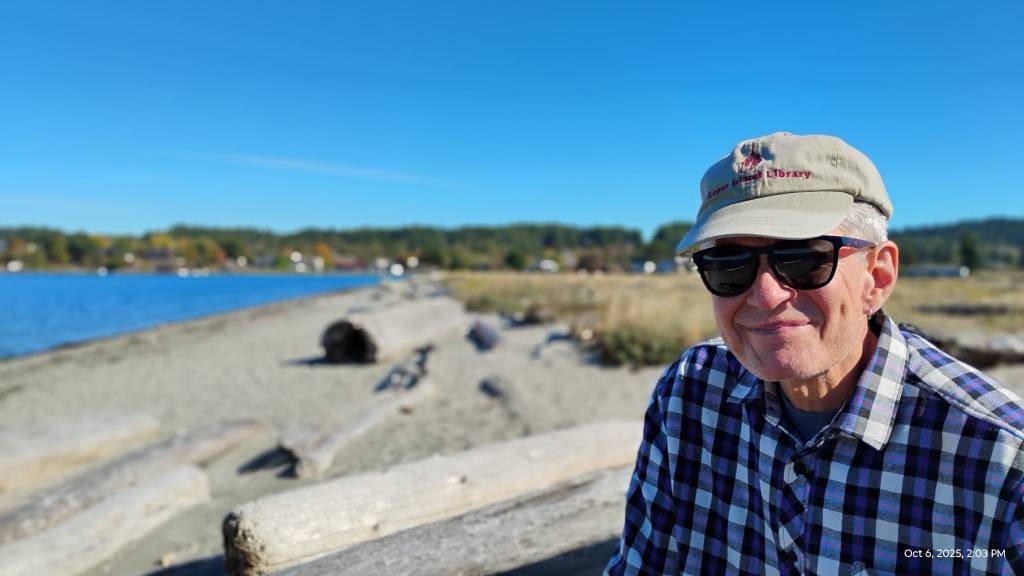
Your loyal correspondent on the beach at Fisherman Bay Spit, Lopez Island. Tom Willard photo.

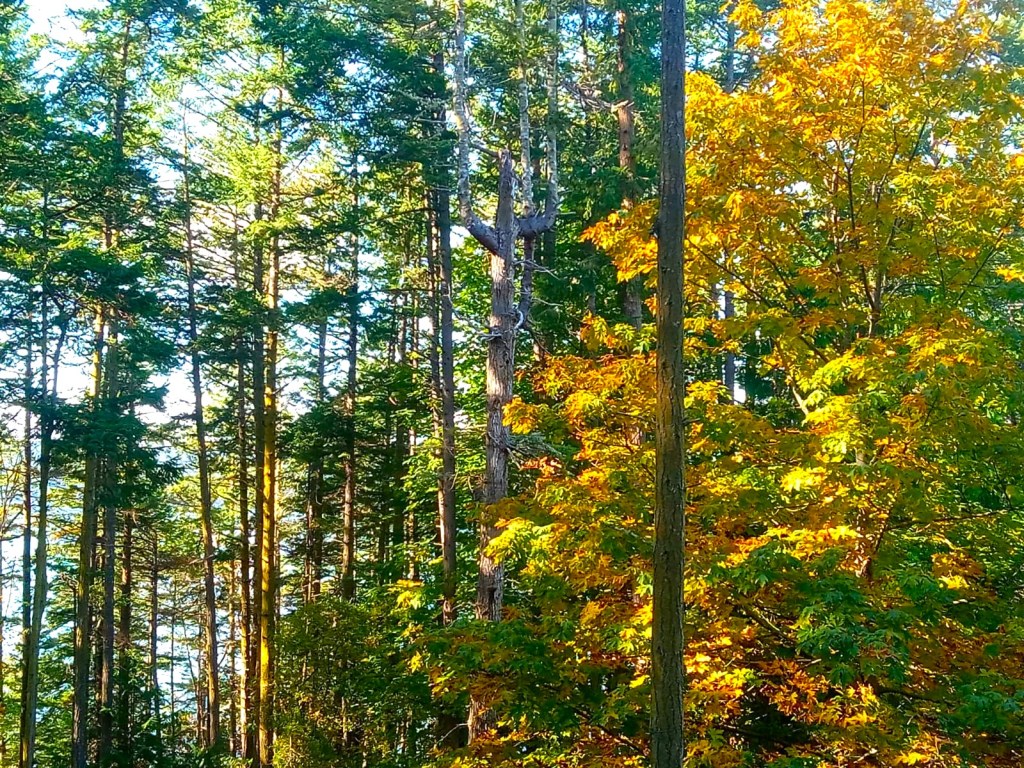
The October weather has been a mixed bag, but every visitor got at least one dreamy day. Tom and I ate a sack lunch on the sunny beach at Fisherman Bay Spit on Lopez. I hiked with Patti through a canyon of salal to the rocky shoreline at Shark Reef County Park on a pristine autumn day. While Hilary and Neil experienced buffeting winds and horizontal rain, observed mostly from in front of my woodstove’s blazing fire, blue skies opened up the next day in time for an enjoyable walk circling Center Island. Our big-leaf maples are turning honey gold, an eye-candy complement to the darkly brooding evergreens.

October’s golden maples are a pleasing contrast to my island’s evergreens.

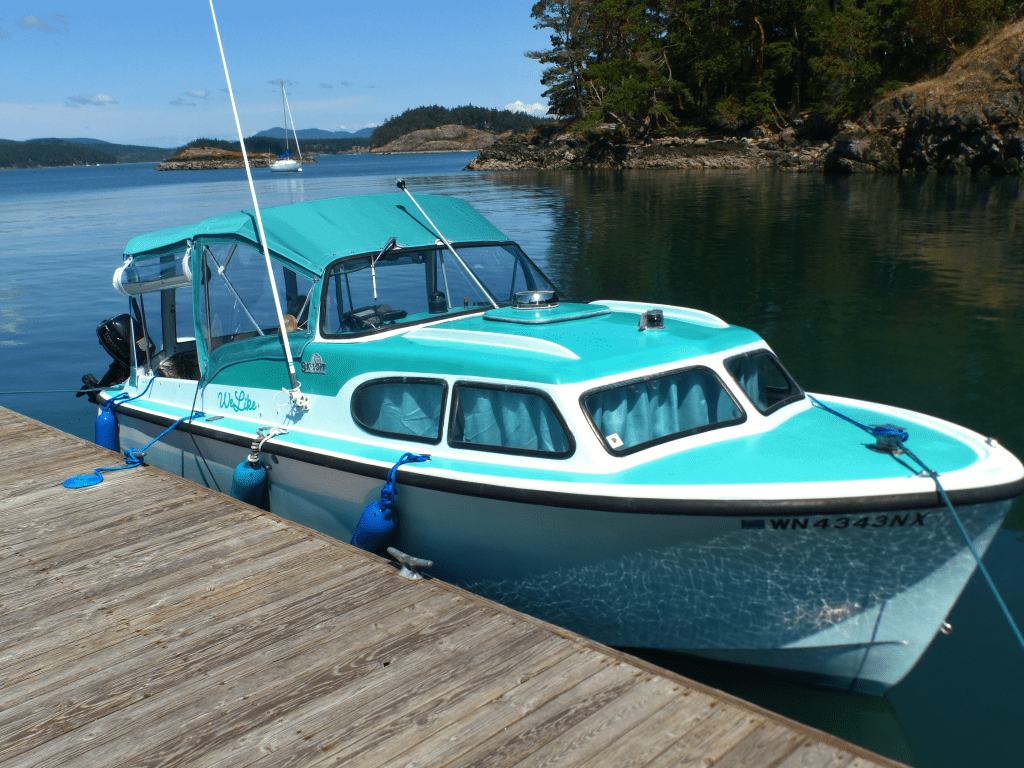
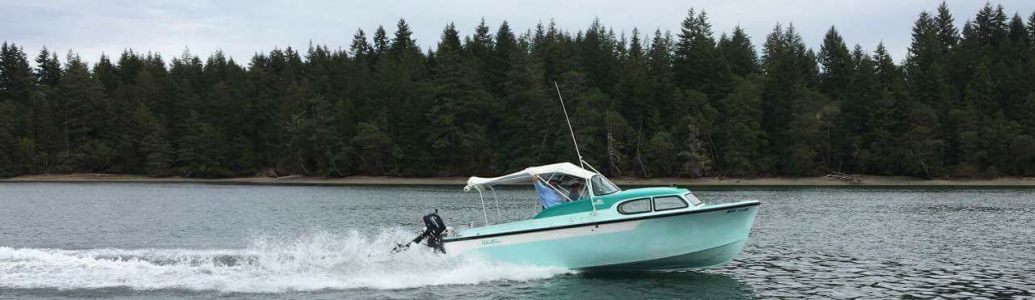
But the visitor season is drawing to a close. In anticipation of Sunday’s storm I hauled WeLike, my aqua-glorious 1957 cuddy-cabin cruiser, out of the water and tarped her on her trailer — probably until January tempests pass.

For the long, quiet months ahead, I’ve filed away some good memories: Teaching a new board game to Patti. (She won. Twice!) Watching a whimsical Jim Jarmusch film with Tom. (His favorite director, my newly acquired taste.) Smacking lips over my second helping of Hilary’s tasty enchilada casserole. (Gotta love visitors who bring dinner!) Witnessing confirmed feline-friend Neil’s jovial adoration of Galley Cat. (Even though she hissed at him in a moment of forgotten manners.)

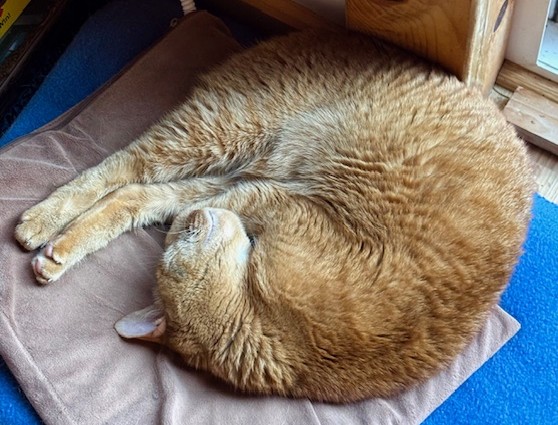
Galley Cat on her pet heating pad. Few cats sleep so soundly. Neil Johannsen photo.

As with these memories, I’ve also stocked up on winter firewood. Our community association recently hired a woodcutter to take down dead or dying trees along our island roads. He cut 60 trees in one day. The supply of firewood has never been so profuse. Thanks to my handy new Husqvarna, my wood rack overflows with new rounds of Doug fir awaiting room in the woodshed.

Unfortunately, the tree cutting has also resulted in an Everest-like mound of trimmed branches awaiting burning at the end of our grass airfield. When the island caretakers torch that sucker it will likely be seen from outer space. Another unfortunate side-effect: Last week a San Juan Airlines single-prop plane delivering UPS packages to our island landed amidst a tailwind capable of lifting a Kansas farmhouse to Oz. Unable to stop at the field’s far end, the plane nosed into the brush pile, just enough to require a complete replacement of propeller and engine. (Anytime a plane’s prop hits something, the engine must be rebuilt or replaced for fear that delicate inner workings might have been thrown off-kilter.) For four days a repair crew brought replacement parts by air and sea. I lent a hand on our dock the day a boat arrived with one of the biggest, oddest-shaped cardboard boxes I’d ever seen. On it, large letters declared: “Contents: airplane propeller.”

So, rarely a dull moment on my remote little island of which few have heard. Not this October.

It’s July! All hands on deck!

Hemlock (the darker wood) started my deck project, with golden cedar now the lumber of choice on this completed first phase of my deck renovation. But it’s not all done yet…

A QUICK JULY HELLO from Center Island, where summer means outdoor projects.

Months ago I committed to setting aside this summer to finally complete the replanking of my 25-year-old, rapidly rotting cedar deck, which had never been treated with any preservative. I started the project a few summers ago in bits and snatches.

The lumber must all be brought over from Sunset Builder’s Supply on Lopez Island. That endeavor is limited by how many 8- and 9-foot planks I can fit into the back of my old Ford pickup, Ranger Rick, and into the cabin of my 20-foot cruiser, WeLike.

The thickness of my wallet has played a role as well. Cedar decking currently sells for $1.06 per foot on Lopez. That’s about 7 cents more than it goes for in mainland Mount Vernon, but a relative bargain compared to the $1.50+ I was paying on Lopez at the height of supply-challenged COVID.

So it’s been a piecemeal effort, involving many hours of yanking nails, prying up old planks, sawing new planks, staining them with a cedar-tone preservative, and drilling and screwing them into place. I’ve even been adding waterproofing caulk atop underpinning supports to lengthen their lifespan.

So, expensive, slow and methodical.

Despite the tortoise pace, over the course of several summers I’ve managed to renew the largest deck area, the 15-foot-by-19-foot surface where I have Adirondack chairs and an umbrella table for entertaining when neighbors drop by for a cold beer or a barbecue.

But plenty remains. Five-foot-deep sections of deck span the front of Nuthatch Cabin and wrap around to the front steps. Here, while I’ve concentrated efforts elsewhere, planks have been gradually collecting moss and lichen and slowly rotting away to the point that arriving guests might just fall through next time they visit. Not quite the welcome I’m looking for.

So, at the end of June I got out the measuring tape. I determined that I needed 651 board feet of lumber to complete the project.

New cedar planks are gradually replacing old across the front of Nuthatch Cabin.

Without delay, I hopped aboard WeLike and spent day after day ferrying cedar from Lopez Island. Other than one quick mid-month trip to Seattle for a doctor appointment and a bit of socializing with friends, I’ve set aside the entire month of July to finish the rebuild. (Today is a rare day of rain, so I get a day to write.)

Just checked my bank statement. I’ve already spent $617 on lumber for this final phase of the rebuild. Not to mention the cost of caulk, stain, deck screws and new Velcro-fastened kneeling pads. The old ones, purchased at the rebuild’s outset, were now held together by duct tape and about as effective as strapping old kitchen sponges onto my 69-year-old knees.

With the mostly sunny days we’ve had, the work has been pretty much nonstop. The days can be hard but the progress is satisfying. In college I read Robert Pirsig’s “Zen and the Art of Motorcycle Maintenance.” This is like that, but for homeowners. When I groaned a bit about aching joints, my friend Daniel comforted (?) me with a reminder. “The deck lasted 25 years. You’ll never have to replace it again!”

Unless I live to be 94. Not going to think about that.

Keep in mind that I live on a remote island with no trash-removal service. So once the deck is all done, I need to dispose of a large pile of old rotten wood. Can you guess where I’ve been storing it in the meantime? Under the deck!

I’m not going to dwell on that right now, either.

Even in the San Juans, I need time to rest up from retirement

Galley Cat recuperates in the island sunshine. A trip to the vet can be a marathon when you live on Center Island.

WHEW! It’s been a week.

The good news: WeLike, the much-adored, well-restored 1957 Skagit Express Cruiser that is my island fun boat, is once again spic-and-span and back in the water after a long winter on a trailer.

The boat’s canvas is all mended. The bottom paint is fresh. The decks are scrubbed. In addition, the rocky knoll has had its weeds whacked and moss de-mapled. And Galley Cat is on the mend. More about that in a moment.

Bringing WeLike back to glory has been almost two weeks of intense labor on the part of yours truly. After my wintertime health issues and a long, wet San Juan Islands spring, instead of getting my beloved turquoise tub out on Lopez Sound by March, here it was June already.

The first task was remedying a, um, self-inflicted injury. Last summer when I went to clean her canvas top, I used a handbrush that I found in a gear locker. The brush came with the boat but I had never pulled it out before. As I had the top soaped and sudsy, I scrubbed away like a dedicated washerwoman taking a stain out of the king’s robe. Too late, I realized the brush’s plastic bristles were so stiff they were almost like wire. As I rinsed away the soap, I saw that I’d decimated many rows of stitching.

Luckily, the canvas held together for the summer. But I knew I needed to repair it. Originally it had been sewn on a machine but all I could do was stitch it by hand.

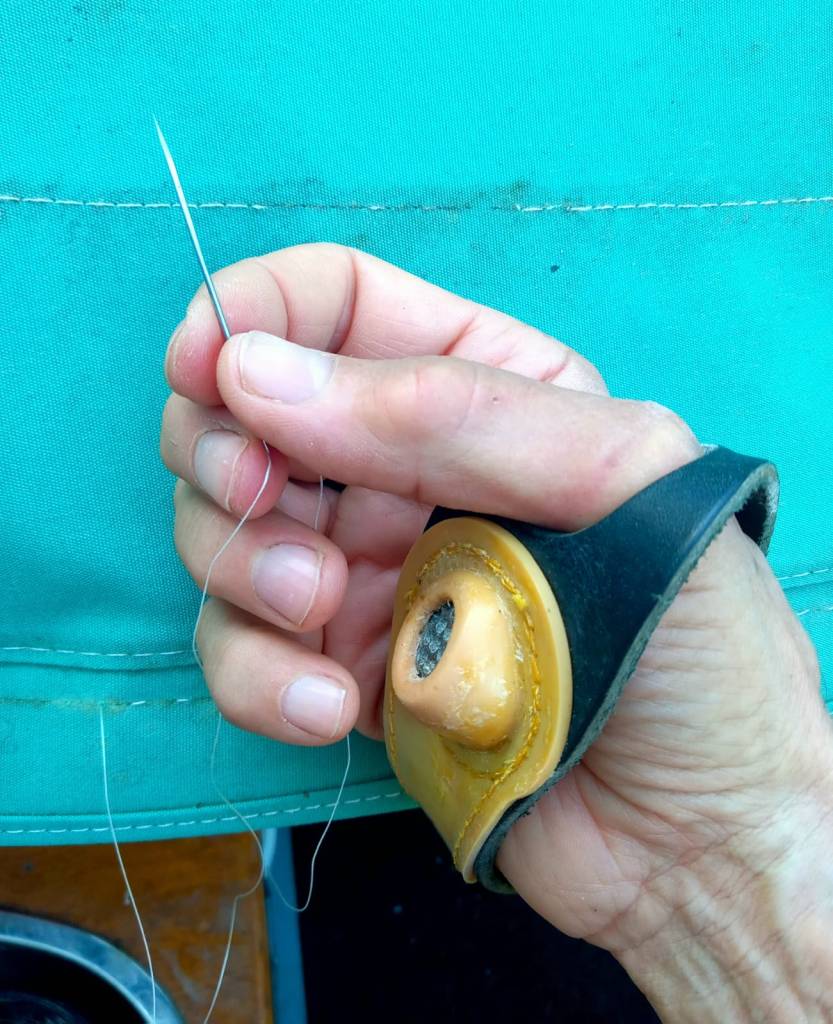
A leather sailor’s palm helped push the needle through canvas as I repaired the top on WeLike.

I ordered sail needles and UV-proof thread from Sailrite, and 10 days ago I got busy. I unzipped the canvas from its frame and for three solid days, stood in the boat’s cabin, all alone under the sun, and stitched. I told myself it was peaceful. Satisfying, rather than tedious. Listened to a lot of Jimmy Buffett.

Just to break up the routine, one day I knocked off early, came home to the cabin and worked for three solid hours with my weed whacker, cutting huge swaths of yard-high grasses on the rocky knoll. Yes, it was a wet spring, and everything grew. Besides weeds, it appeared that every maple seedling ever to drop from my trees had taken root and sprouted on the mossy rocks. A few inches high now, the tiny maples were easy to pull. In another month or two, they’d have real roots. So I labored away, yanking or whacking hundreds of them.

Back to the boat this week, I spent a day rolling new bottom paint, which isn’t so easily done when the boat sits on a low trailer. For one thing, you miss the spots where the hull sits on the trailer pads, but it’s the best I can do without hauling out in a boatyard. Only once did I begin to panic when I momentarily managed to get sort of pinned beneath the trailer axle as I scooted around on my back trying not to drip paint in my eyes as I applied it. One of those fun boat jobs!

WeLike shines when she shines.

The next day I fired up the island tractor and hauled the boat down by the shoreline where I could spray water about without making mud puddles around other trailered boats. On a warm and sunny day, I worked from 10:30 in the morning until 5 p.m., scrubbing every inch of the deck, the hull, the detail work. I used a deck brush in some places and a toothbrush in other spots.

I had consulted the tide chart to see when water would be high enough to use our community launching ramp. Five o’clock it was. So once again in the tractor seat, I backed my newly glittering Express Cruiser down the ramp and into the water.

Before unhooking from the trailer, I needed to be sure the engine started. After sitting untended since October, my beloved (this week) 90-horse Evinrude fired up on the first crank. (Some freshly added non-ethanol gas in the tank probably didn’t hurt.) There was only one catch: After returning forward to unhook from the trailer winch, when I climbed back up onto the boat’s bow and managed to limbo from the side deck into the cabin without falling in the bay, I perched in the skipper’s seat and applied reverse throttle. The engine responded, the water churned. And nothing happened.

I’d backed the trailer deep enough. WeLike should have floated off. I applied more reverse. The outboard roared. Water swirled like a Deception Pass whirlpool. But WeLike wouldn’t budge. After sitting on the trailer’s carpeted pads for eight months, it seemed she was literally stuck.

Happily, the tide was still coming in. I waited five minutes and tried reversing again. No luck. I wondered how many neighbors were now peering toward the harbor, curious at the sound of my roaring outboard on the launch ramp.

Finally, I clambered back out of the cabin, on to the bow, and gingerly stepped down on to the trailer’s tongue. Paranoid now, I first checked that I had indeed released the winch hook from the bow eye. No, I hadn’t made that mistake. So what to do?

As a last resort, balancing on tiptoe on the trailer tongue, I put all my weight into shoving the bow seaward. I shoved, I bounced, I muttered curses. And WeLike finally began to inch deeper into the water.

I quickly climbed back aboard, and all went routinely from there as I found a spot for her at the dock. It was dinnertime after a long day’s toil, so I wasn’t going anywhere on the boat that night. But maybe take her out for fun the next day?

Not to be. By late evening, Galley Cat convinced me she had a problem. For several days she’d been lingering oddly in her litter box. I finally got the message and analyzed the litter scoopings. For several days, she had hardly peed at all. A Google search convinced me that could be serious. Bad Kitty’s Dad for not picking up on it earlier.

I texted Island Express, who kindly offered an earlier-than-usual 7:30 pickup the next morning. By 8:45 Galley was getting an initial exam at the Pet Emergency Center near Mount Vernon. The initial triage by an aide indicated a possible urinary tract infection, but the veterinarian was just going into emergency surgery. The wait for official prognosis would be long.

My homemade sign for No Kings Day on Lopez.

It was very long. We gave them my cell number and drove to a shady park in town. To make this story shorter, I’ll just say that at 4:30 that afternoon we were finally departing the clinic with a UTI diagnosis, meds in hand and $500 added to my Visa bill. We were home around 6.

Sadly, I’m having to cancel my Father’s Day visit with daughter Lillian in Seattle. Got to take care of my kitty cat.

Galley and I both had a lazy day today. Boy, did we need it.

Tomorrow, I’ll be back at it. I’m taking the boat to Lopez with a friend to get rid of trash and pick up lumber for my deck renewal. Saturday, I’m returning for the No Kings Rally in Lopez Village. Today, I made a sign to wave.

This is my relaxing retirement, on a remote little island nobody’s heard of. Summer’s almost here. I hope yours holds promise.

Relieved to be home on my rock after Brian’s Dreadful December

AT LEAST IT DIDN’T HAPPEN on my remote little island nobody’s heard of. No helicopter evacs were involved, thank God.

That’s the best thing I can say about my recent up-close-and-personal encounter with America’s emergency health-care system.

Your faithful scribe and cat, happy to be back at the Nuthatch.

Loyal readers, if you were wondering about my long absence from the Reef, it was because I was busy living Brian’s Dreadful December.

When last we shared screen time, I was in the midst of a six-week housesitting stint in the lovely bayview home of friends Daniel and Jean in Olympia. In fact, after the presidential election I had resolved to make Olympia my next home.

That housesitting assignment was to conclude December 15. My plan was to return to my island for a week before hotfooting it back down the highway to spend Christmas with Portland friends Ken and Kate. Their daughter had orchestrated a plan for Christmas Eve dinner at Portland’s posh Ritz-Carlton hotel, followed by a couple of nights for family and friends at her Oregon Coast holiday home.

For me, all those holiday plans began to unravel on Friday the 13th (just like a bad movie).

After three days of serious digestive dysfunction in Olympia, I was on the phone at 7 in the morning to an old college friend — Kathy Pruitt, to whom I’m forever indebted — begging a ride to the nearest Emergency Room.

I had managed to pick up a nasty intestinal bug that over the course of the week had dehydrated me such that my blood pressure registered just 60/30 when they cuffed me in the St. Peter Hospital E.R. Never had I seen so many medical professionals swoop around me so quickly with armloads of I.V. bags, tubes and needles.

I was in the hospital four days before I.V. hydration, a liquid diet and a course of serious antibiotics set me right.

The lost time canceled my December return to Center Island. After a couple days of convalescence with my now-returned Olympia hosts, I packed up Galley Cat and drove straight to my Portland friends’ floating home on the Portland shore of the Columbia River.

On a back channel of the Columbia in Portland, my friends’ floating home is moored behind their sailboat, outlined in lights.

We had a nice few days. Toured a collection of Paul McCartney’s photos at Portland’s art museum. Shopped a holiday bazaar. Had a lovely little solstice party.

Then my digestion went south again. At 7 in the morning on Christmas Eve, I asked my hosts to drive me to another E.R.

I didn’t know it at the time, but the bug I’d suffered had a common side-effect: ulcers of the bowel. Admitted to a hospital in Vancouver, Washington, I got transfusions of five units of blood, then underwent emergency surgery on Christmas Day to stop the bleeding from a duodenal ulcer. Four hours on the table with only a local anesthetic while a surgeon probed my arteries. Ack.

Five more days in a hospital. My holidays were a culinary blur of green Jell-O and steaming yellow broth rumored to have once met a chicken. A far (and gastronomically anguished) cry from the Ritz.

Throughout the ordeal, my chums in Olympia and Portland showed me what true friendship means. The day after Christmas, daughter Lillian flew out from her new home of Philadelphia. Three weeks of her unsparing help and support was a godsend as I convalesced, first at my friends’ homes down south and finally at the Seattle-area home of my ever-generous sister-in-law Julie. I struggled to overcome stamina-robbing anemia and low blood-counts. In a quick trip to Center Island last weekend Lillian helped me transport my belongings and a carload of groceries homeward before I had to return to Seattle for final medical exams.

Tuesday night I drove Lillian to catch a Philly-bound plane. Wednesday, already halfway into January, I finally returned on my own to Nuthatch Cabin for some long-anticipated nesting and recovery time with Galley Cat.

With temperatures stuck in the 40s here, last summer’s fuchsias are still blooming on my deck. Blazes in the wood stove cheer the cabin nightly. Awakening mornings in my loft, I look out to watch each day unveil itself, whether wrapped in mist or warmed by the sun’s first lemony fingers caressing the treetops.

I’m getting back into my fitness routine, including a daily half-hour on the stationary bike. So far, so good. (Thursday I included two naps in my day’s itinerary. So I’m not overdoing.)

I’m working to boost my hemoglobin count, including another in a lineup of steak dinners tonight. Red meat isn’t my dietary norm but it helps bolster my blood, along with iron supplements.

For now, Galley Cat and I are both just glad to be home on our island. She’s back hunting the mice that live under the woodshed. I’ve returned to pleasant afternoons tapping the keyboard in my writing hut. Day by day, I’m encountering the rock’s few winter neighbors and chatting them up after my long absence. Sunny skies and coppery sunsets are a healing balm.

For now, I want to pull up the drawbridge and never leave. I hope your January offers comforts as dear.

The social butterfly of autumn

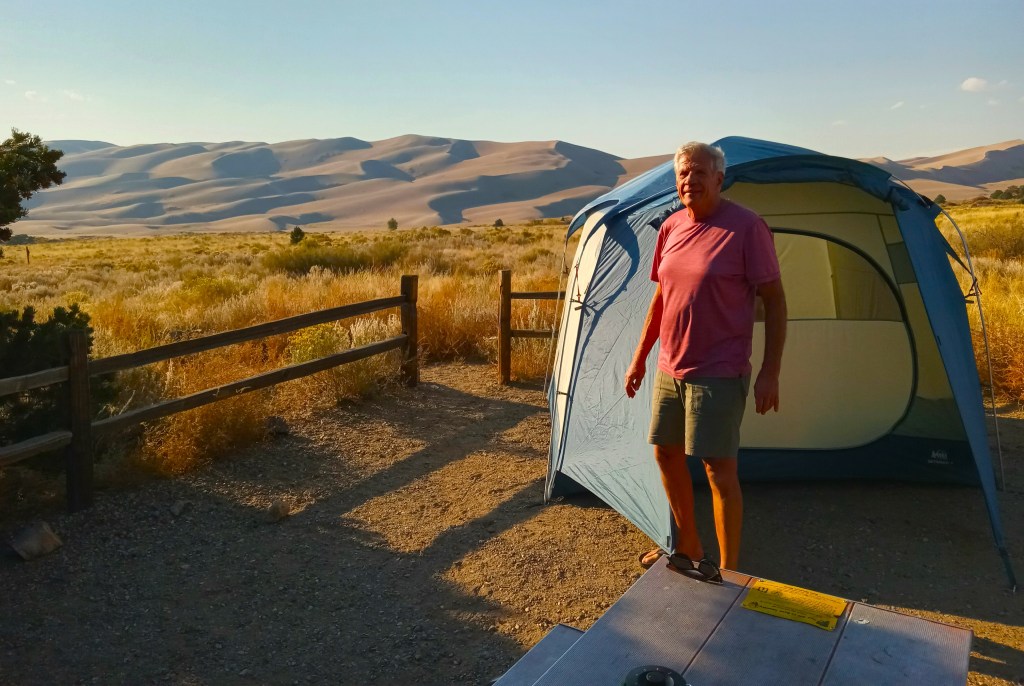
Your loyal correspondent tops out on a 700-foot+ dune in Great Sand Dunes National Park in southern Colorado. North America’s tallest dunes build from windblown grains of sand at the base of the Sangre de Cristo Mountains, seen in the background. Photo by Douglas Cantwell.

ISLAND LIFE CAN BE LONELY AT TIMES, you’ve heard me say. With Center Island’s year-round population hovering around 20, the social life has its limitations.

But, boy, loneliness hasn’t been an issue for me this fall.

So far, my autumn has been a dizzying — and delightful — whirlwind of visits by family and old friends, along with travel to visit family and friends in locales ranging from Orcas Island to Moscow, Idaho, to Santa Fe, New Mexico.

Hilary, Christi and me on Center Island. I love visitors, and I’ve had a few good visits lately.

It began with my Labor Day outing to Sucia Island with daughter Lillian, closely followed by a visit here by Hilary Hilscher and Christi Norman, two longtime friends. I first got to know them through their association with Audubon Washington, for which they drove all over the state together in a sort of “Thelma and Louise Go Birding” partnership about 20 years ago to create the Great Washington State Birding Trail. Laid out in a set of seven detailed and beautifully illustrated maps, the Birding Trail comprises the state’s best bird-watching sites. As outdoors editor for The Seattle Times, I piggybacked on their great work with a regular newsfeature called “Birders’ Top Spots,” spotlighting sites from their maps. (Six of the seven maps, published between 2002 and 2011, are still available to order online here for $4.95 apiece).

Hilary and Christi, who both live with their husbands in the greater Puget Sound area, have been regular readers of “Cantwell’s Reef” and decided they wanted to see my little rock. We ate lots of good food, drank good wine, and enjoyed renewing our friendships.

The same can be said of a visit shortly thereafter by Ken and Kate Brinkley of Portland. I first met Ken on an impromptu shared sailing afternoon out of Orcas Island’s Rosario resort in the 1980s. He became a lifelong friend. Ditto with Kate when she married him.

Ken, Kate and yours truly among Center Island madronas.

Not long after the Brinkleys departed in late September I left my island for a marathon day’s drive across the state to visit a new friend, R.J. (for Robert James). He lives in Moscow, Idaho, just across the state line from Washington State University, where he manages a library. I guess I’m partial to librarians. I met him online, which is a good way to make friends when you live on a small island nobody’s heard of. We’ve become chums.

Sandwiched in there somewhere was a visit with another friend discovered online, Tom, on Orcas Island. My boat, WeLike, got me there. It’s nice to find local buddies, too.

Doing the Idaho road trip in one day each direction was exhausting but also a treat. It had been a while since I’d seen so much of my home state, from the San Juans to Seattle, over the Cascades, to a bit of Coulee Country before navigating the rolling and roiling Palouse. I renewed acquaintance with phenomenal State Route 26, which slices straight as a razor across much of its 114 miles of Eastern Washington as it blazes a path toward Pullman.

Farmers had just completed the wheat harvest. The bright yellow-white stubble glowed in the sunshine as I crossed into Whitman County, where welcome signs boast that it grows more wheat than any other county in America. (In 2015, growers there harvested nearly 30.5 million bushels, according to the National Agricultural Statistics Service.)

Less than a week after my return to Center Island I again caught the Island Express water taxi. I was bound for the Seattle airport, where I hopped an Alaska 737 for Albuquerque, via a layover in Phoenix (where I was glad I didn’t need to step outside into the 108-degree October heat). New Mexico was more clement, with daytime highs in the 70s and low 80s.

My brother Doug met me and drove us the hour to Santa Fe and the lovely adobe home he shares with partner Lori, whom I enjoyed meeting for the first time.

My brother Doug Cantwell at our Great Sand Dunes National Park campsite in Colorado, about three hours from his Santa Fe home.

The next day I acclimated with a pleasant hike with Doug on the outskirts of his town at 1.3 miles of elevation (blowing a raspberry at your Mile-High City claim, Denver). A day later we aimed Doug’s shiny new Outback at southern Colorado for a three-night campout at stunning Great Sand Dunes National Park. I’d never heard of the place, which became a national park at the end of the Clinton administration, but I won’t soon forget it. North America’s highest dunes pile up against the base of the Sangre de Cristo mountains, dominated by 13,297-foot Mount Herard, of which we had a front-row view from our campsite that Doug had hand-picked from a prior stay.

Autumn colors are spectacular among Colorado’s aspens, willows and cottonwoods.
Piñon Flats Campground was named for the scrubby pines that this year were groaning with cones bearing the famed pine nuts that are so good on salads and in sauces. For two geezers whose combined ages approach 140, there was one advantage to having to rise from our cozy sleeping bags in what’s aptly called the “wee hours”: With a combination of dry air, little light pollution, and high elevation, Great Sand Dunes is certified as an International Dark Sky Park. “Wow” and “whoa” dominated our midnight vocabulary as we encountered Orion, the Pleiades, and a bright, night-piercing Jupiter, high in the eastern sky. Doug spotted more than one shooting star.

Though I puffed from the 8,800-foot elevation (I live just above sea level, remember), Doug and I made it to the top of a 700-foot+ dune, often slipping and sliding in the sand that dominant winds bring from afar. During my visit, warm sunshine brought out the startling gold of the area’s aspens and willows. An afternoon thunderstorm swirled towering black clouds around the mountain tops. And, after a half-day drive to the top of 10,856-foot Wolf Creek Pass on the Continental Divide, we experienced a wind-blown snow shower.

This past Saturday, before Doug and Lori dropped me at Albuquerque International Sunport (rivaling in airport-marketing silliness the “Sky Harbor” of Phoenix), we witnessed the final hour of a mass ascension, part of the final 2024 weekend of Albuquerque’s famed Balloon Fiesta. The colorful event draws some 600 hot-air balloons each year.

Frank Boy, a sort of young Frankenstein balloon, came from Brazil for Albuquerque’s 2024 Balloon Fiesta.

I’m back at the Nuthatch today, catching my breath. Over the next two weeks I plan to buckle down and write more get-out-the-vote letters for Vote Forward, which expects to contact 10 million voters before November 5. Ten days ago I mailed 140 letters to Pennsylvania, North Carolina, Georgia and Arizona. Doug will be busy in coming days, too, having committed to 200 letters. There’s still time if you want to join us with your pen.

All the socializing and travel has been great, truly. But sometimes I love my quiet island. A good place to write.

Cart blanche: Rebuild frees islander of too many treks up the dock

The rebuilt cart on the dock at Center Island: a key link in my island’s transportation network, ready for more seasons of service.

WHEN YOU LIVE ON A REMOTE ISLAND with no shops or garbage pick-up, all your groceries must be transported up a dock and all your trash gets packed the other way. You really come to appreciate a good dock cart.

Anybody who’s had a boat in a marina knows of what I speak: the boxy two-wheeled conveyances with tires the size of a small bicycle’s, usually pushed by a large, U-shaped metal handle. Often capable of carrying two Rubbermaid totes and maybe a Trader Joe frozen-food bag. They do their job handily. No big deal.

But when the cart comes in a large, economy size, carrying two additional totes and maybe a couple of 5-gallon gas cans as well, you fall in love. Such Cadillacs of conveyance halve your required treks up and down the dock ramp, which on a minus tide can almost require ropes and a belaying harness. If you’ve just arrived home from a Costco run, kitted out with a six-month supply of pasta and several half-gallon jars of Adams peanut butter, the unashamed among us dash off the water taxi, pass up the “normal”-size carts and nab the stretch-limo of grocery transport.  

For years, Center Island’s “A” Dock has had such a cart. For years, it has been slowly falling to pieces.

The big cart was home-built long ago of thin plywood. Had the cart ever seen stain or paint, such protectants had long ago thrown in the towel against Northwest winters and retired to Arizona. The plywood’s raw, gray edges had started shredding like store-bought hash browns. On parts of the metal chassis, rust was holding the rust together. Our island’s caretaker kept up a brave campaign of replacing nuts and bolts, evidenced by shiny bits of metal among the oxidized. But as of late the cart’s front panel was falling out, threatening to dump into Read’s Bay one’s warehouse-store flagon of Mrs. Butterworth’s or body bag of Cap’n Crunch.

In places, rust was holding the rust together on the old dock cart.

For ease of reference here, we’ll call the big cart Otto (preferred pronouns: “It” and “Its”). Last fall, with winter looming, on a whim I asked Center Island caretaker Rich if I might tackle an Otto rebuild over the cold, long months ahead. It would be something to do, of benefit to me and all my neighbors. Rich enthusiastically nodded.

Then, you know how things go. I got busy. A bunch of holidays came along. Winter was shorter than usual, I’m certain of it. By April, Caretaker Rich had announced a pending move to another island, where pay was better and duties lighter. (These remote islands-nobody’s-heard-of can be cutthroat when it comes to poaching caretakers.)

Meanwhile, Otto was a wreck. Nuts were rusting to dust. L-braces once holding panels together twirled loosely as screws gave way. I felt bad I hadn’t fulfilled my aspiration and hated for Rich to depart thinking me a slacker. In late April, I queried him if I could take Otto out of service for a couple of weeks and proceed with the makeover. The nod was even quicker.

I wasn’t talking about a refresh. That elderly plywood needed full replacement. I hoped enough of the metal chassis would be reusable once sanded and given new coats of Rust-Oleum.

With gorgeous spring weather arriving, I loaded Otto into an island truck and transplanted it cross-island to the deck outside Nuthatch Cabin. Outfitted in my grubbiest old paint-splattered jeans and T-shirt, like a surgeon’s scrubs after 48 hours of brain surgery, I began the dissection.

With a can of WD-40 at my elbow, I twiddled and twisted, grunted and groaned. I removed a brimming jarful of old nuts, bolts and washers, which I set aside for triage as to possible reuse. Several bolts sheared off with a flick of my socket wrench. A saltwater environment does that.

 The old plywood I set aside for a trip to the Lopez Island dump.

It was a 10-day project, involving three boat trips to the Lopez hardware store/lumberyard. The new plywood was $70. The dump bill, $15. The new nuts and bolts added up quickly, plus about eight cans of spray paint. Otto’s rusty u-shaped handle – already splinted in two places – was a write-off so I hopped on Amazon and ordered a new 1½-inch-diameter aluminum handle made by a manufacturer of industrial hand trucks.

Once Otto’s old metal frame was fully exposed, two corners looked like the work of rust-spewing moths – with more holes than solid surface. I fired up the Sawzall and excised those ends with a few moments of shrieking metal-saw demolition. With sharp edges sanded away, enough solid framing remained to support the cart. The axle and wheels were in good shape.

I painted the new wood in appetizing tones of green – “sage” and “oregano” – and tacked protective rubber edging to the plywood’s perimeter. Metal parts were sanded and sprayed with a rust-transforming undercoat topped by a rust-blocking Hunter-green enamel. To guard against theft, Caretaker Rich suggested I label the cart, which usually means scrawling it with the letters “CIA” (for Center Island Association). I chose to make it friendlier, daubing “Welcome to Center Island” on the end panel. Affixing our island’s name decreases the chance that Otto gets pirated to a neighboring port.

The last step was to install the hefty aluminum handle. Finally, without ceremony, last Friday I deposited the rebuilt cart at the head of A dock, ready for a new lifetime of grocery grunting and trash toting.

All seemed good. Then, Saturday afternoon, when neighbors joined me for a sun-drenched happy hour on the Nuthatch’s deck, I learned that another friend had a hair-raising mishap with the rebuilt cart. As he wheeled three heavy bags of trash down the steep dock ramp during an extreme low tide, the cart’s new handle worked free from its metal anchor loops. The loaded cart careened down the ramp.

Thank god, the ramp was clear. Nobody was hurt. Nothing ended up in the bay.

 Another islander had subsequently reattached the handle to its anchor loops with metal screws, whereas I had relied on pressure from neoprene firmly packed inside the straps. The neoprene gave a solid seal with no wobble, fine for use on level ground but apparently not up to heavy loading on a precipitous ramp. Oops.

I tossed and turned that night, haunted by the fact that my good deed nearly ended in disaster. Finally, I set an alarm for early rising and resolved to inspect the cart first thing Sunday, with tools in hand.

By 7:30 I was in the island workshop adding two more anchor straps to the cart’s handle, satisfied that the unidentified Samaritan’s repair job looked good but convinced that overkill wasn’t bad in this case. While at it, I added half a dozen more bolts and an extra L-brace to reinforce the cart at every edge. Once bitten…

As the rebuilt cart has gotten more use, neighbors have voiced smiling appreciation. It’s the island way. Many pitch in to keep life chugging along on our little rock.

And saving extra trips up the dock with my Costco hauls will keep me smiling, too.

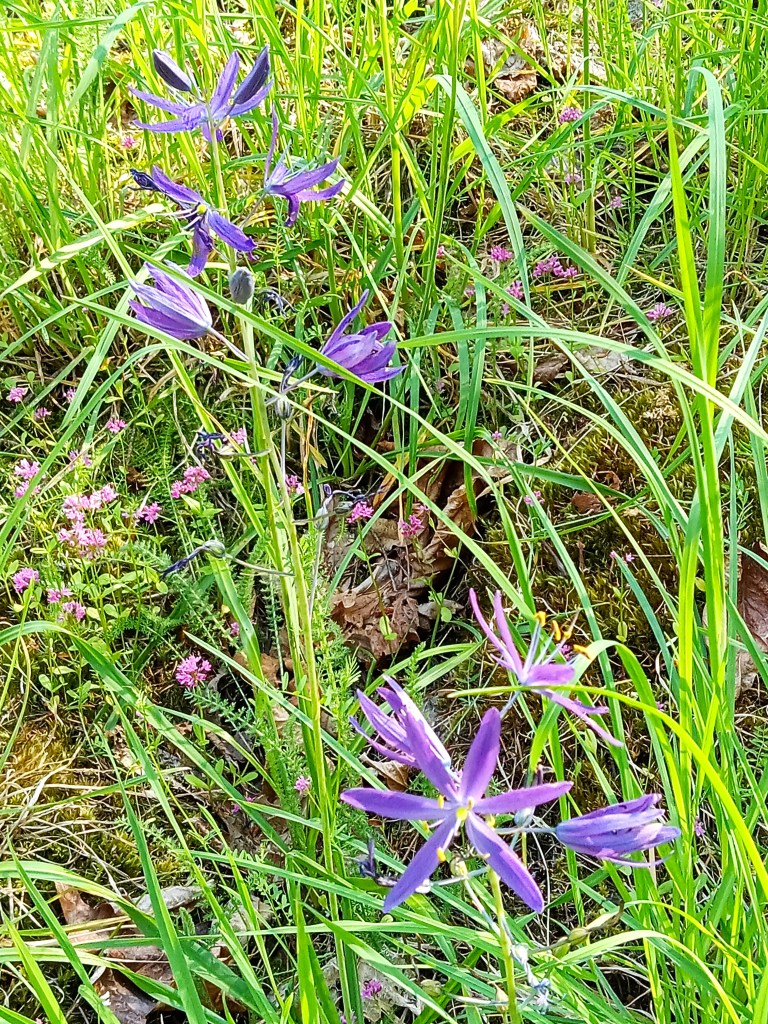
BONUS PHOTOS: It’s wildflower season on the rocky knoll behind Nuthatch Cabin. Blue Camas flowers, above. Below: A white inflorescence of Death Camas — toxic, but pretty — among the purple/pink of Sea Blush.

In island life’s to-and-fro, sail beyond the routine

Seen from my favorite lunch stop: Skippers from the Anacortes Radio Control Sailors club line a dock during a recent regatta.

STRICT ROUTINES ARE PART OF MY ISLAND LIFE. Getting on and off my remote rock can require planning days or weeks ahead, including advance bookings on the mainland, elaborate shopping lists and careful attention to weather forecasts and water-taxi schedules.

Oversleep, miss a water-taxi pickup and I might have to reschedule a long-planned medical appointment. Get mired in Everett traffic on the way home and I could miss the day’s last boat and be looking for a hotel room. And if winter winds are too harsh, the boats might not be running at all.

Yes, routines and attention to detail add a little stress to the pleasures of my island life.

But I’ve built little joys into my routines, too. Since forays to the mainland often put me on the move around noontime, I usually pack a lunch. A turkey wrap slathered with mustard and relish, along with a baggie of sliced vegetables and apple, and maybe one of my homemade oatmeal-craisin-chocolate chip cookies, tends to be my standard. Once I’ve picked up my “mainland car” at Skyline Marina in Anacortes, I’ll make a quick stop for a good coffee-to-go, then find a front-row parking slot at my favorite lunch-munching spot, Seafarers’ Memorial Park on the Anacortes waterfront.

A fishing boat chugs toward the entry to Cap Sante Marina in Anacortes, as seen from Seafarers’ Memorial Park. Mount Baker and the North Cascades loom in the east.

The park includes a monument listing the town’s lost seafarers and fishing crews. Anacortes has a long history as a base for Alaska-bound fishing boats, and its sobering “lost at sea” list includes 127 names, starting with Harry Dunn in 1913. The most recent loss listed: 2020.

On a point overlooking Cap Sante Marina, a poignant bronze statue of a woman holds aloft a lantern as she looks out to sea, her other hand comforting a child who hugs his mother’s windblown dress.

From my parked car I look past the nearby oil refineries — every wonder has its warts — to a view of wooded islets, the snow-frosted Cascades, and a parade of working boats and pleasure craft coming and going from the marina’s narrow entrance.

That, and one of my favorite sights, the seemingly frequent regattas of the Anacortes Radio Control Sailors club, which sails in a protected saltwater lagoon fronting the park.

Model sailboats raced at Anacortes are about 3 feet long with masts reaching 5 feet. Realistic details extend to the bulb keel typical of full-size racing sloops.

The sleek model boats that race here are typically about 3 feet long with 5-foot masts. Competing in laps around buoys as their dockbound “skippers” guide them with handheld radio units that can control rudders and sails, they resemble boats that my daughter, Lillian, and I once rented and sailed on a pond in New York’s Central Park.

Other boredom-breaking parts of my routine might include driving an off-highway route across the Skagit Valley to view whatever crops are in season and flowers in bloom. (Daffodils should start to show color in the month ahead; tulips in April.) This time of year often includes fields full of migratory flocks of Snow Geese and Trumpeter Swans. If I need a special grocery item, I’ll detour to downtown Mount Vernon’s Skagit Valley Food Co-op, among the best hometown natural-foods markets in the Northwest. A summertime stop might be Pleasant Ridge Farm‘s well-stocked self-serve stand, including a Crayola-colorful cut-your-own zinnia patch, or Fir Island’s Snow Goose Produce, where you can get a pot of authentic Skagit Valley tulips or what they advertise as “immodest” ice cream cones (they’re huge). Be patient for your colossal cone, however; closed now, they reopen for the season March 1.

Just a few ways that I break up my travel routine. Even the most hectic days can be spiced with a little joy.

Daffodils brighten the Skagit Valley floor as seen from the Best Road in March 2023.

Of frozen pipes, boiling water, and small island pleasures

Wee Nooke is my 6 foot-by-6 foot writing hut on the rocky knoll behind Nuthatch Cabin.

HOORAY, I’M BACK IN THE NOOKE, with no more water to boil. That’s my good news for the day on Center Island in the San Juans. (More about boiling water in a minute.)

Sitting here eating my sack lunch in Wee Nooke, the tongue-in-cheeky P.G. Wodehouse-inspired name for my writing hut, is good news because I just love working here. Perched on the rocky knoll behind Nuthatch Cabin in a little meadow that dazzles with wildflowers each May, the Nooke is a 36-square-foot cedar hut. First erected as a playhouse for then-preteen daughter Lillian 20 years ago, it came on a couple of pallets as a potting-shed kit from British Columbia.

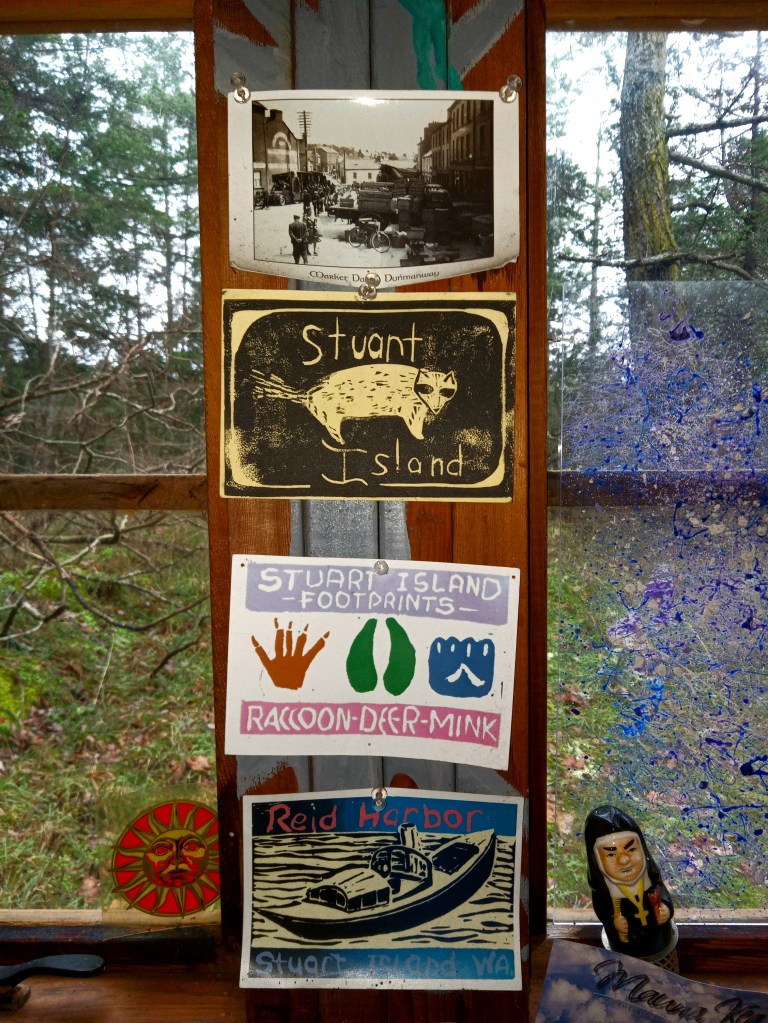
Handmade postcards from Stuart Island, a neighbor in the San Juan archipelago, festoon Wee Nooke’s walls between windows that can open to welcome breezes on warm days.

It did its duty as a daughterly retreat for several years, hosting at least one rather cramped sleepover with one of her middle-school girlfriends before Lillian handed off the keys — or the padlock combination, as the case may be — to her old man.

I installed a small writing desk with lamp, snaked an ethernet cable up the rocks and added an electric oil-filled radiator for January days like this. With a wall of mullioned windows looking out on craggy firs and the occasional grazing deer, it became the perfect place to write, even with the retained pre-teen decor of zebra-striped rug and beaded entry curtain.

Besides countless installments of the “Reef,” the Nooke and I have produced a handful of freelance travel stories, a recreation section of the Mountaineers-published “We are Puget Sound” book, and (with Barbara’s collaboration, in her day) more than one mystery novel.

Mailbox as art: Rescued from Lopez Island Dump, it perches on Wee Nooke’s front railing. The flag is always up.

My custom is to bring a lunch up with me, along with a Thermos of hot water. A tiny table holds a variety of teas and instant coffee. As I write, I usually listen to my favorite music-streaming channel. Jackson Browne, Cat Stevens, Bill Withers and other mellow rockers of the 1970s ring out from the nice Polk Audio computer speakers I got for free at the Lopez Island Dump’s Take It-or-Leave-It warehouse. When the weather doesn’t keep her curled up in the cabin, Galley Cat is a regular visitor as I work. I slide open the door whenever I hear her scratch, and she leaps up on to a bookshelf to be rewarded with cat treats. On a warm day, she’ll be in and out every five minutes. (She shirks duties as a mouser, however. I must set traps on occasion.)

Lillian made this sign for the writing hut.

Yes, I love the Nooke. With the portable radiator pulled under the desk this afternoon, I’m snug as a bug in a rug.

Oh, and that bit about boiling water. It’s just a reminder that this is still January in the winter-wild San Juans. When I returned Sunday from visiting my sweetheart in Thurston County, our island’s community water system was under a “boil water” order until further notice. In the hard freeze while I was gone, our water system froze up again. With the required rerouting to different pipes and another reservoir tank, once water was flowing again the purity couldn’t be trusted.

A jug of emergency water ensured that I could brush my teeth without worry.

But Monday morning our caretaker took a sample to the mainland for testing. By Tuesday we got the “all clear” signal to again drink our tap water without first bringing it to a roiling 212 degrees F.

So, yes, living on a remote island has its challenges, sometimes big. But it always has its wee delights.

Emulating the ant and rockin’ the grasshopper, at solstice time

My project for last week: refinishing the lightboards from my sailboat. Beyond the deck rail blooms the creamy flowers of oceanspray, a shrub native to Northwest woods.

SUMMER ARRIVES this week, the season when islanders like me try to blend the virtues of the ant and the grasshopper.

The Aesop’s Fable, you might recall, tells of the ants who spent their summer busily storing up food for the winter while their grasshopper neighbor spent all summer making music on his fiddle. By season’s end the grasshopper had good memories, and no doubt had polished up some catchy tunes, but faced a hungry winter ahead. When he asked for a handout, the ants told him to bugger off and go dance the winter away.

Therein lies the problem with old Aesop: His righteous protagonists can be mean-spirited bastards. But I digress.

Arriving at a happy medium in the ant-vs.-grasshopper industriousness quotient is my goal on Center Island. I also strive not to be as snotty as the ants.

Saturday, we had an island work party that hit just the right notes. I and 15 or so of my neighbors worked from 9 to noon on projects to preserve and prettify our community assets. I helped to scrape and repaint the railing on our upper dock, while some weed-whacked the boat yard and others did carpentry repairs on the clubhouse.

After three hours, we all gathered on the clubhouse deck for grilled brats and shared some island camaraderie and a pony keg of good IPA from Anacortes Brewery. Ants and grasshoppers. Too bad nobody brought a fiddle.

There’s lots to do around Nuthatch cabin this time of year. I continue to rebuild my deck a few planks at a time, with Lopez Island lumber-yard cedar ferried here on WeLike, 64-board-feet at a time. I try to restain one side of the cabin every summer. There’s lots of firewood to be split. And this summer I’m also doing projects related to my sailboat, Sogni d’Oro, in preparation for its sale.

Sogni d’Oro moored off Puget Sound’s Blake Island, July 2018.

Yes, an era is ending, as daughter Lillian and I have decided it’s time to find someone new to love the dear old Westsail 32, which has been ours since 1989. We have a prospective buyer, one of Lillian’s close friends in Seattle, someone who fits our hopes for a new steward who will give the boat care, energy, love and fresh adventures. I’ve promised a few restoration efforts first, and the sale depends on a satisfactory inspection, but hopes are high.

On Center Island, my summer routine has kicked in. I rise around 7 or 8, with coffee and a breakfast of avocado toast topped with walnuts. Once I’m dressed and more or less cleaned up (one doesn’t really need to shower unless you have visitors, right?) I often go for a bike ride (three brisk one-mile, through-the-woods laps of a route encircling our airfield), then devote a half-hour to a New York Times crossword before getting busy with some project for the day.

Foxgloves are June bloomers on Center Island.

This past week that involved stripping the spoiled old varnish and refinishing the sailboat’s teak lightboards — beautiful craft pieces my father built 30 years ago to hold the boat’s big, vintage zinc-alloy running lights. I cut the wires, detached the boards from the boat’s shrouds and brought them to my island for refinishing. Two days with a heat gun and a sander, then two coats of a heavy-duty waterproofing wood finish. I’ve ordered cutout birchwood lettering from a manufacturer in Idaho to match the Westsail’s sail emblem (a stylized capital W, with 32), which I’ll epoxy to the lightboards as my father did. He made the original cutouts by hand, bless him.

The refinishing project was a lot of work, but satisfying. And doing the work outside on my deck in the June sunshine, with wild foxgloves and oceanspray blooming nearby and twittering birds complementing the Jimmy Buffett tunes on my bluetooth speaker, wasn’t too painful. Galley Cat wandered by every few minutes to meow a hello and roll luxuriantly on the sun-warmed cedar deck.

The healthy 2023 kale crop in the Nuthatch’s rail-mounted planter.

That’s the antsy part of my day. The grasshopper kicks in around 5 when Galley and I indulge in what my daughter calls a “snooze read” (bedding down with a favorite book until one’s eyes close) up in the loft for a half-hour. Then it’s time for me to cook up a good dinner (tilapia tacos, say; maybe a stir-fry with fresh kale from my deck-rail planter) while cranking up more tunes and sipping a glass of good New Zealand sauvignon blanc from my monthly Costco run. The best offerings on Netflix often finish off the evening. (Even small islands nobody’s heard of get the internet these days. In fact, fiber-optic broadband is coming, we’re told. Yikes.)

That’s it. A day in the life of this antsy grasshopper on Center Island in the San Juans. Come 7:57 a.m. (PDT) Wednesday, happy summer solstice to my Northern hemisphere readers. Don’t forget your warm-weather chores. But remember to fiddle now and then, too. Maybe even dance.

The almost-finished product, awaiting new lettering to match the Westsail’s mainsail emblem. The red light goes on the boat’s port side, green on starboard.

Glory be, what a month it’s been

Betsy Davis’s classic double-ender motoryacht Glorybe, built in 1914 and rebuilt after a 2002 fire, looks highly decorative in a May sunset while riding a mooring just off Center Island.

OH MY, OH MY, my May.

Here it’s already Memorial Day weekend, one year since my crewmates and I shoved off for our 10-week voyage up the Inside Passage to Alaska, and I’ve had such a busy month of visiting with other friends that I need to catch up with you, loyal Reefers.

Getting too busy with friends can be a rare thing when you live on a small island nobody’s heard of. Lots of comings and goings this month. For me, that’s a good thing. Winters can get lonely when the winds howl.

Jean and Daniel Farber, May 2023 park hosts at Lime Kiln Point State Park, with an old lime kiln in the background.

Early in the month, I had a pleasant stay with friends (and Inside Passage crewmates) Bill Watson and Barbara Marrett on San Juan Island, paired with a bonus visit with old chums Daniel and Jean Farber. Usually at home in Olympia, they’ve spent the whole month of May living in a travel trailer on San Juan Island where they’ve served as interpretive park hosts (and ruthless wranglers of invasive blackberry vines) at Lime Kiln Point State Park.

Daniel, who retired from a distinguished career with Washington State Parks, once again proved his acumen as a parks pooh-bah by leading me on a walking tour rich in historical narration of Lime Kiln’s old quarries and upland trails. For example, little did I know that Lyman Cutler, the American farmer whose famous shooting of a British pig touched off the Pig War standoff here in 1859, was also a founder of the quarrying business at Lime Kiln Point, which shipped lime to be used in cement for building cities up and down the West Coast. Added trivia from my own research: After Cutler sold his interest, the mining company ultimately dissolved when one partner murdered another — proving, I guess, that it’s dangerous to be a mining baron, or a pig, on San Juan Island.

A curious red fox met us in the woods at Lime Kiln.

If you’re interested in island-living lore, my trips to San Juan Island aren’t quick or easy. I hire the Paraclete Water Taxi to take me from Center Island across Lopez Sound (3 miles, $38) to the Hunter Bay County Dock on Lopez Island, where I keep my faithful old Ford pickup, Ranger Rick (county parking permit, $25 annually for homeowners on neighboring Center and Decatur islands). I drive Ranger Rick 11 miles to park in the public lot (72 hours free) at the state ferry terminal, load my Rubbermaid tote (aka San Juan Samsonite) on my old red handtruck and walk it on to the next ferry bound for Friday Harbor (often waiting longer than expected because ferry runs get canceled due to crew shortages). The good news: the ferry ride is free for interisland walk-ons.

Ten days after my return from that adventure, Galley Cat and I were on the road to Walla Walla to visit my friend Patti Lennartson. Galley Cat usually vocally protests the idea of leaving the cabin overnight, and hides under a bed if she cottons to the fact that I’m packing again. But once she was in the car and set loose from her carrier to be a free-range travel cat (as free as she can be in a Honda Civic), she seemed fine with it. As usual, she often stretched from the passenger seat to put her front paws on the dashboard to watch the world go by. I think she likes high speeds. Crossing Snoqualmie Pass, she seemed fascinated by snowy peaks, as only makes sense for someone who has spent 99.9 percent of her 11 years at or near sea level. (She lived on a boat half her life.)

Latina dancers whirl and twirl at the College Place Block Party, near Walla Walla.

Walla Walla was sunny and hot. But Patti had the A.C. cranked up in the guest room, and Galley and I enjoyed a dose of extra Vitamin D when we got outside. Along with Patti’s daughter Stevie and her partner, Kevin, we drank some good Walla Walla wine, watched a Latin dance troupe at a street fair in College Place, ate good tacos and wood-fired pizza with fresh asparagus, and generally had a fine time.

Dancers balance beer trays on their heads in College Place. That’s talent.

Came back to lovely 65-degree days on my island, where the wildflowers are almost played out. The blue camas (with edible bulb) is almost done, though the appropriately named death camas (whose foliage and bulb are poisonous) is parading white stalks of flowers in a come-hither display. Happily, Galley ignores the siren call. She likes plain old grass.

Just when I was going to get down to work replacing planks on my deck, a delightful respite presented on Wednesday when dear friend Carol Hasse, another of my Inside Passage crewmates, texted to ask if she and shipmates on the beautiful, century-old wooden motoryacht Glorybe, moored that day at Jones Island, might put in at Center Island on Thursday.

Always say yes, friend Daniel and I have pledged, when serendipity knocks. So I got on the phone to island buddy Dan Lewis, who didn’t hesitate when I asked if his mooring buoy might be available. It was a perfect bluebird-sky May afternoon when Hasse, Glorybe skipper Betsy Davis, and fellow crewmate Ace Spragg came for a happy hour and fish-taco dinner on the Nuthatch Cabin’s deck (which will have new cedar planks soon enough).

From left, Betsy Davis, Ace Spragg and Carol Hasse depart my island.

Hasse, as anybody who has set foot on a sailboat in this hemisphere probably knows, recently retired from a renowned sailmaking business in Port Townsend. Betsy, former director of Seattle’s Center for Wooden Boats, these days helms the NorthWest School of Wooden BoatBuilding in Port Hadlock when she isn’t at the wheel of Glorybe. Ace is that school’s education director after serving 11 years as sailing director, among other salty hats she wore, at Port Townsend’s Northwest Maritime Center. All this pedigree talk is simply to say that over beer, wine and a bit of good grub, we had a boatload of good nautical chat to share. I loved Ace’s stories about her idyllic childhood days of building and piloting rafts on the Chesapeake Bay (and constructing a five-story treehouse from which she and other kids dropped eggs — and anything else that seemed interesting — just to watch them splat).

The thing to remember is, friends don’t let friends work too hard. Tomorrow I get busy on the deck. Have a memorable Memorial Day.