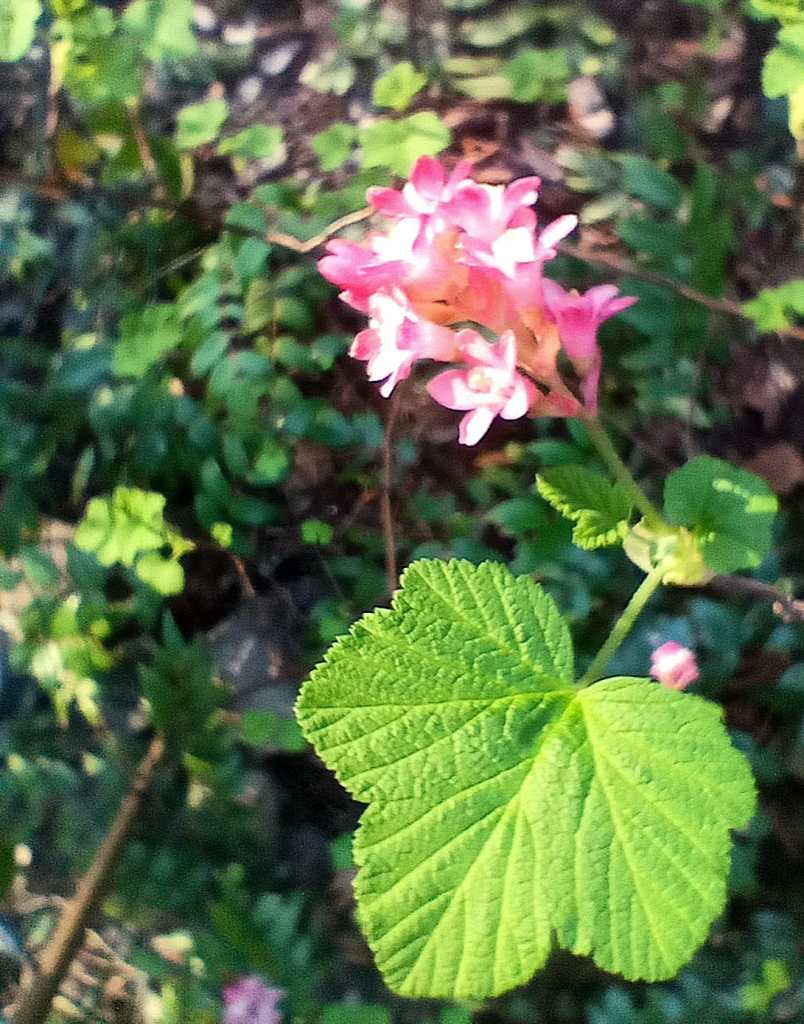
A wild currant blossom presages the arrival of spring on Center Island.
DO YOU FIND JOY TOUGHER TO GRASP THESE DAYS? If so, you’re not alone, and that’s important to acknowledge.
On a rainy day walk through the lush Gazzam Lake Nature Preserve on her home turf of Bainbridge Island last week, my friend Hilary commiserated when I told her I was finding it tougher to write regular posts on “Cantwell’s Reef.”
“I like to write about the joys I’ve found living on my island,” I told her as I squished along a muddy trail flanked by arsenals of sword ferns and tall maples thickly upholstered in chartreuse moss. But with the people in charge taking a wrecking ball to the world all around us, joy can be thin on the ground. Just today my brother sent me an apt meme that declared, “This entire presidency is like being tied to a chair and watching a toddler play with a loaded pistol.”
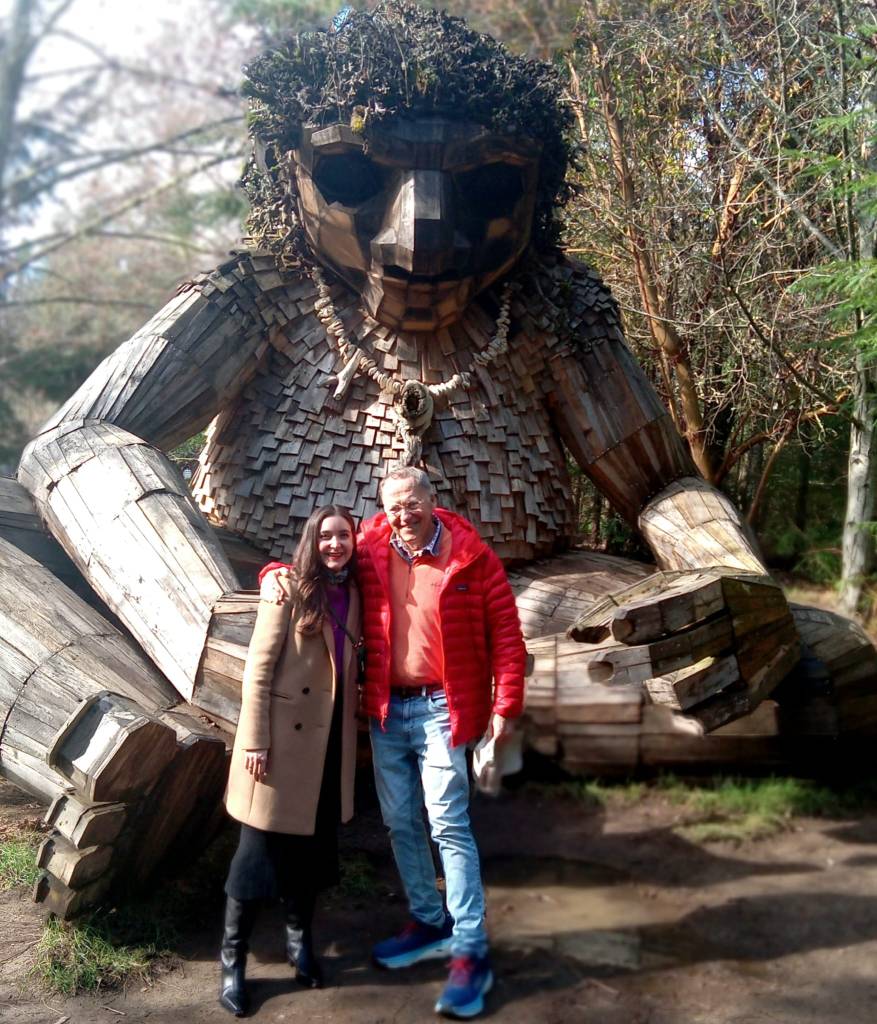
Emily Freidenrich, our new partner at Seattle’s Lake Union Publishing, and my author friend, Neil Johannsen, by sculptor Thomas Dambo’s “Pia the Peacekeeper” troll in a Bainbridge Island park.
Maybe I should share that feeling with all you Reef readers, who are living through the same experience, Hilary suggested. I mulled that and quickly saw the wisdom. Perhaps there’s a “misery loves company” element to it, but it’s more: Friends and loved ones need to support one another through these times of upheaval and uncertainty. Minnesotans bravely modeled how to resist hate and brutality, but there’s a flip side to resisting. We also need to grab joy and celebrate it when we find it.
My joy last week was lunching with Hilary and her husband, Neil, at a cozy Bainbridge pub with Emily, an acquisitions editor at Seattle’s Lake Union Publishing. I had just helped Neil land a book contract for a historical novel on which he had labored for 50 years. This was my first (and likely only) experience as a literary agent. It’s been an interesting bag of new tricks for this old dog to learn. Challenging but, well, joyful in the end.
The joy back home on my little island comes in observing the signs of spring’s pending arrival, such as the watermelon-pink blooms of wild currant outside my cabin’s front door. Or in planting a new quaking aspen tree next to Wee Nooke, my writing hut named after a cottage that Edwin the Boy Scout burned to the ground in a P.G. Wodehouse novel (after he tried to clean the chimney with gunpowder). That book’s, title, coincidentally: “Joy in the Morning.”
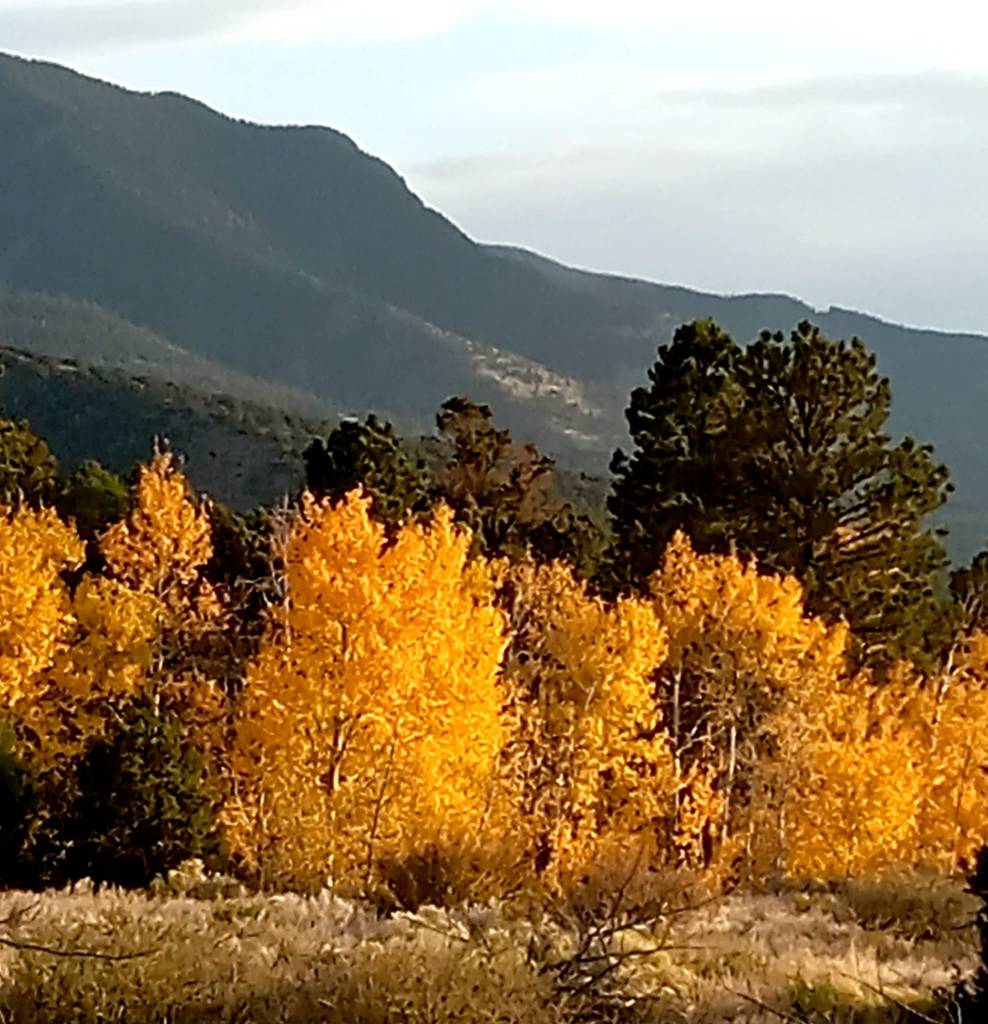
Autumn aspens in Colorado
This might be the first such aspen (Populus tremuloides) on Center Island, but there are many bordering Shallow Bay on Sucia Island, 18 miles north of here, so it’s almost a native species. I figure the climate difference isn’t much. I’m hoping my new tree will offer both the splendid music of wind-ruffled leaves as well as the joyful autumn glow for which its species is famous.
I’ve said it before and the news headlines just keep hammering home the importance: Take joy where you find it. Share it with everyone around you.
I never expected to be quoting Bad Bunny, but it’s pretty darn true: The only thing more powerful than hate is love. Add joy to that and you’ve really got something.
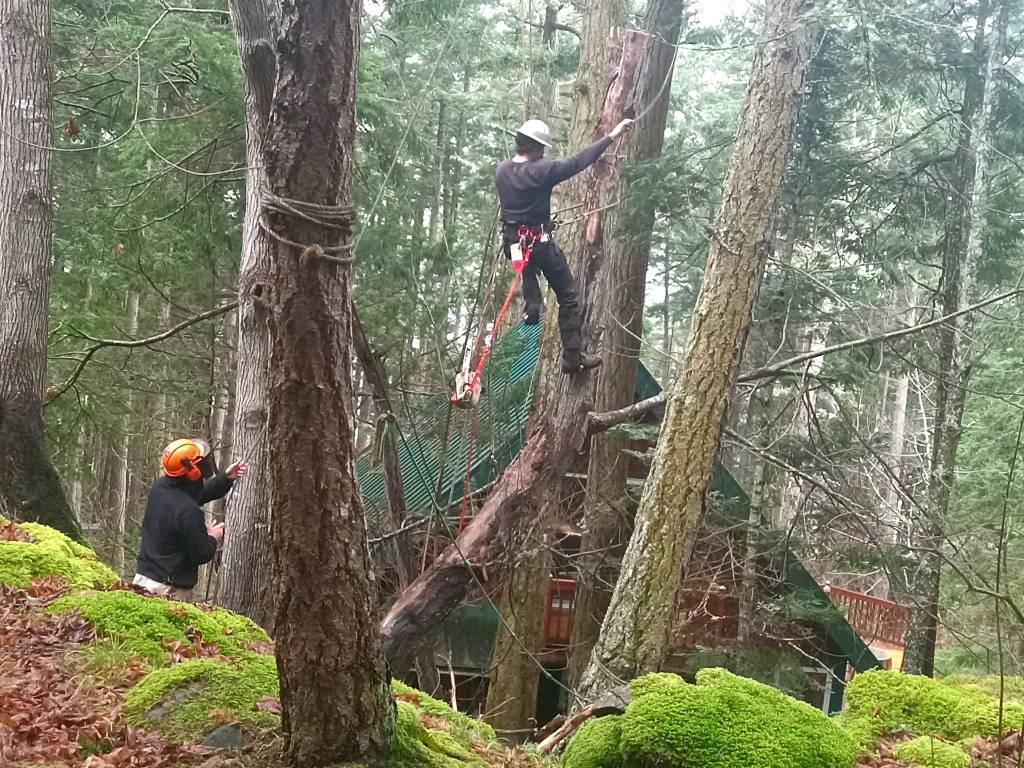
The tree guys at work: John, left, and Austin trim dead wood from a bigleaf maple behind Nuthatch Cabin.
BIG TREES SURROUND MY CABIN, and mostly that’s a delightful blessing.
The best time is a blue-sky summer morning when I can sit on my deck with a mug of steaming coffee, look straight up and watch golden rays sneak into the treetops 100 feet above my head as the sun just crests the rocky knoll behind me.
The trees are a little more worrisome but no less entertaining to watch through my front windows on a blustery winter day as they shake and sway like wild Tahitian dancers.
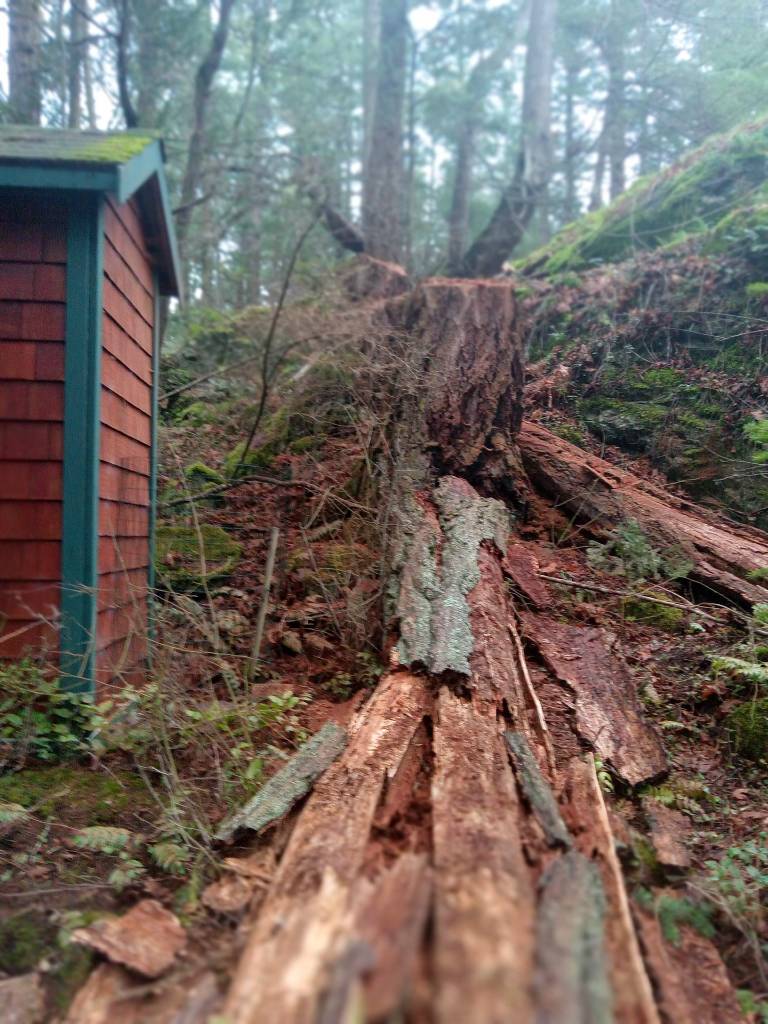
Two tall fir snags turned to shards and wood dust when they fell, just missing my woodshed. The remains will nourish the forest duff.
Rarely does one fall, but it has happened. About 15 years ago, when we still came to Center Island only for monthly getaways from Seattle, a big fir broke off about 15 feet above the ground and fell directly on my cabin, punching a hole in the metal roof. Happily it didn’t break through the wooden ceiling. A roofing crew from Skagit County came out on a barge and replaced half of the roof at a cost of $11,000. Thank you, Farmers Insurance.
But the base of that tree remained as a tall snag, only a few feet from another old dead fir snag about three feet in diameter and 20 feet high with spears of sharp wood topping it. Both were a fall-down hazard that could have taken out my cedar woodshed or my neighbor’s shed, not to mention one of us if we were in the wrong place at the right time.
After years of saying “I need to deal with those snags,” on Tuesday I commissioned two tree cutters to come over from Anacortes and take them down, along with the dead upper limbs of a nearby bigleaf maple.
The tree guys, John and Austin, were experts. John called his partner Austin “a sniper” because of his ability to lay a tree down exactly where he wanted it to fall. Using one of the bigger chainsaws I’ve ever seen, he fell both big snags without damaging either woodshed or even another tree.
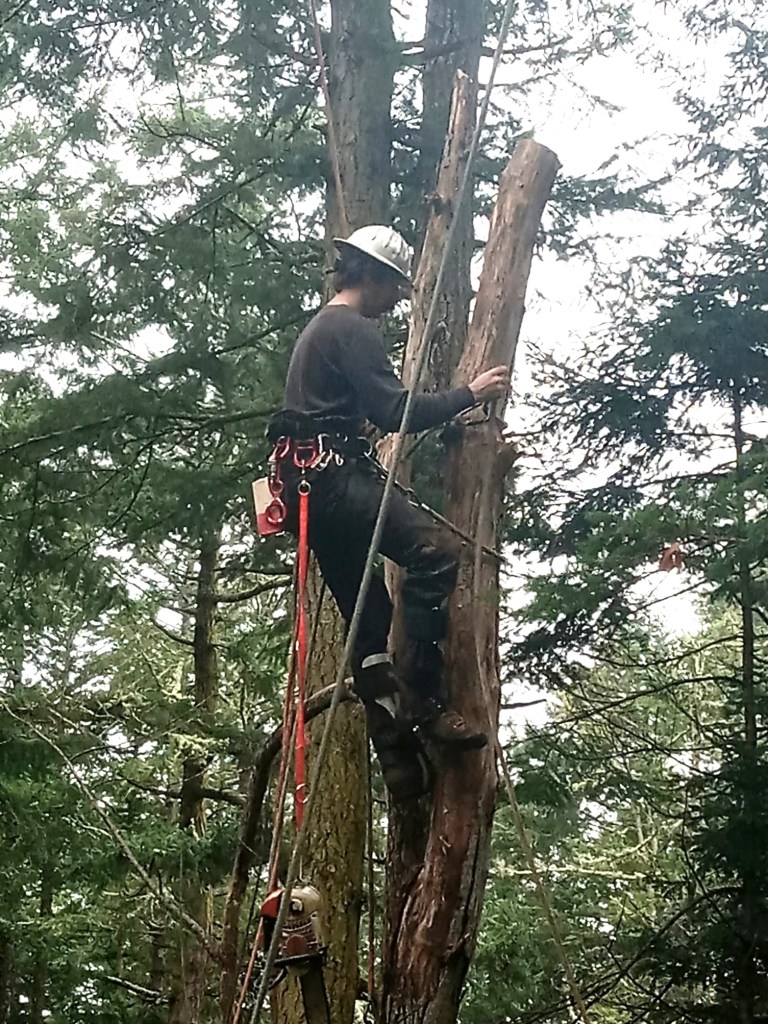
Austin straddles a maple as he cuts pieces of it from above him. His chainsaw dangles on a cord until needed.
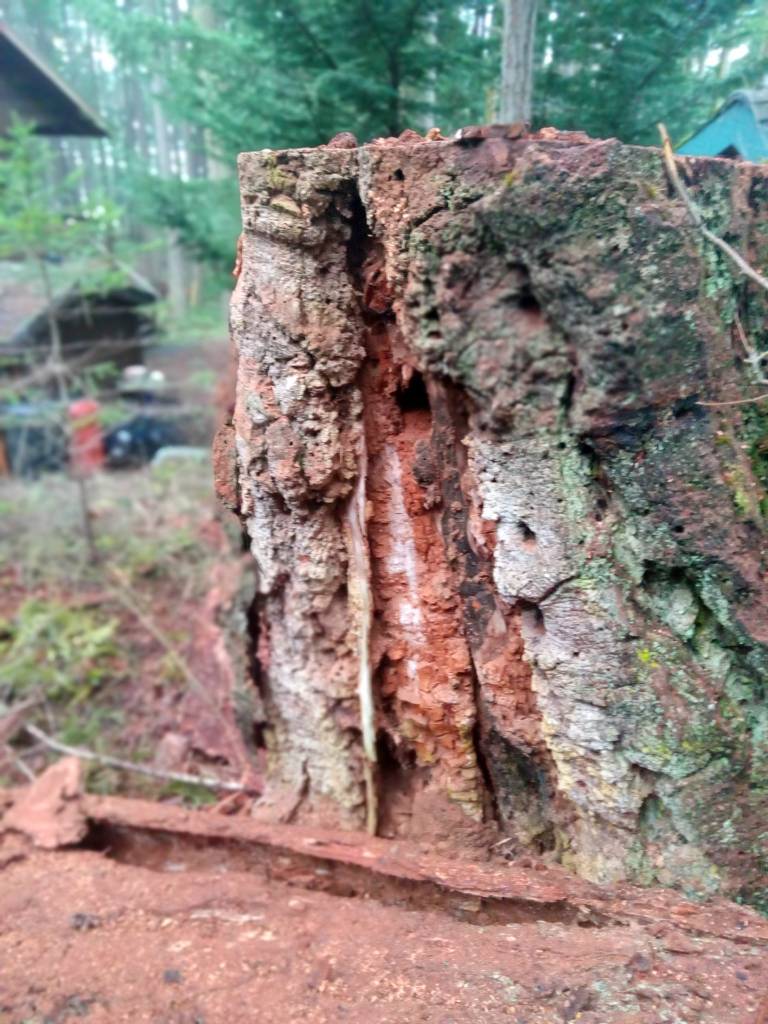
The snags were so rotten inside that both disintegrated into powder and wood shards when they hit the ground. An earlier inspection by another tree man had produced the recommendation: “Don’t breathe on them” for fear they’d fall. No firewood out of this cut! The fallen remains will nourish the forest duff.
What was most fascinating was to watch Austin go to work on the maple, whose dead upper limbs reached above my rooftop. This tree, on a steep slope, presented two challenges: I wanted to save the lower 7 feet, which still had living branches that spread many shading maple leaves in summertime. And there was no clean and safe fall line to drop the tree in place without hitting my back deck, my compost bin, my water tank or the beautiful mossy rocks atop the knoll.
One of the rotten stumps remaining.
Austin’s first surprising move was to climb high into a nearby fir, probably 80 feet off the ground. Using lumberjack spikes mounted to his boots, he zipped upward like a squirrel. Once high enough, with a small chainsaw dangling by a cord from his waist, he rigged a safety line, lowered himself back down and managed to lean out far enough to start cutting the topmost limbs from the maple. Eventually he executed a short Tarzan swing of sorts and positioned himself on the maple’s trunk. He then proceeded to cut pieces of the tree above him, lowered them on a rope to his partner, and methodically made his way downward. Now I know the origin of the term “tree surgeon.” His work was meticulous.
They were done in fewer than 90 minutes. I paid the $1,200 fee they had quoted. For their expertise and dangerous work, they earned it. Nobody got hurt, and Center Island’s woodsheds are out of danger. Another challenge to living in woods on a remote island has been met!
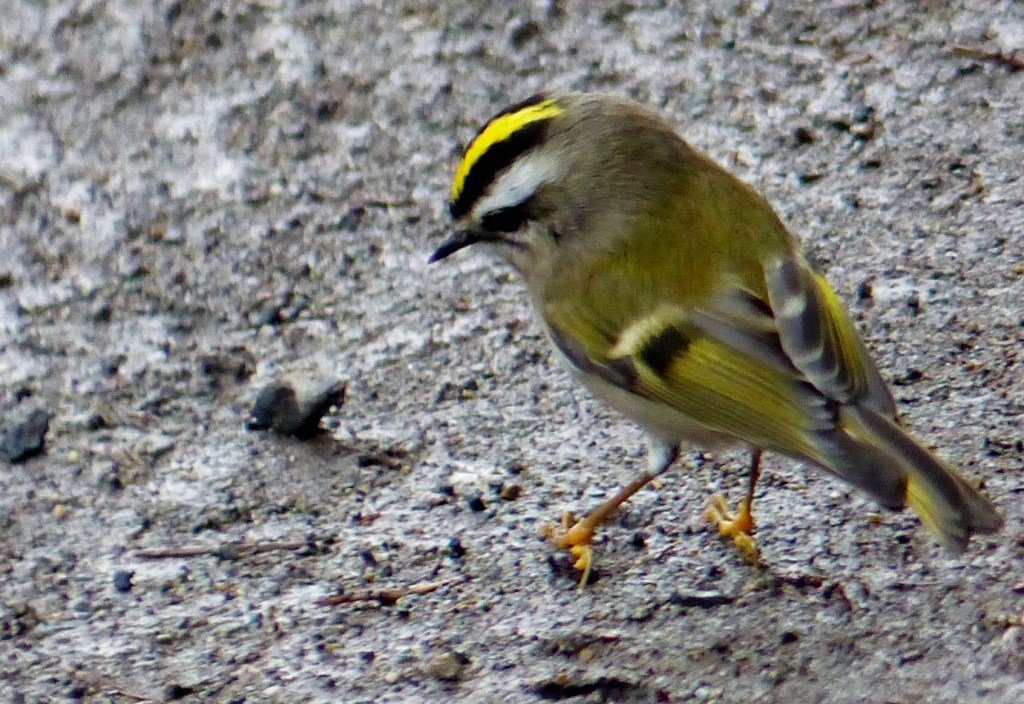
A Golden-Crowned Kinglet pecks for mites among the mud and gravel of a Center Island road.
THE ONLY OTHER LIVING BEINGS I saw today were Galley Cat and four Golden-Crowned Kinglets. Oh, and two squirming earthworms driven by heavy rains to the surface of my dirt road, much to the delight of the resident feline who found them almost as fun to play with as garter snakes.
Those were the only signs of sentient life on my corner of Center Island this January day. After a busy and well-visited holiday season, I was kind of OK with that.
Kinglets, regular winter visitors here, are tiny birds barely bigger than my thumb. Their nearly inaudible call, like the tinkling of a wind chime made of icicles, is an entrancing winter soundtrack when all else on my island is still and quiet.
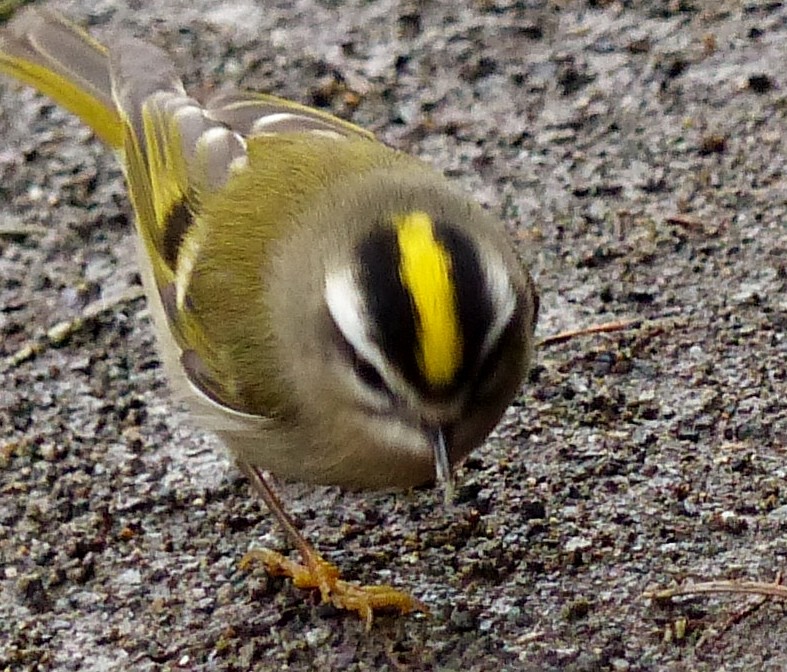
A Kinglet shows off its distinctive head decor.
I spied today’s first Kinglet as I tramped in my duck boots across our mushy, wet airfield to the mail shack late this afternoon. Kinglets are ground feeders, and this one was hopping among the wet grass finding something of culinary interest.
They are pretty little things with grayish-yellow bodies and a distinctive hairdo that is sort of a combination of black and white skunk stripes centered on a bright yellow Mohawk.
I came across a few more as I tramped homeward through the woods to my place. Kinglets are so small — about the weight of two pennies — and their call so elusive that I halted with a start when I suddenly realized several were pecking at the path just in front of me. They must be finding mites of some kind, my Mad Birder neighbor once suggested.
In a Robert Frosty moment I paused stock still in the dark and deep woods as I listened to the birds’ tinkling, what you might imagine from a parade of magical fairies. The Kinglets’ brilliantly striped heads were the only clear marker of their hops among the shadowy forest duff. I was enchanted.
It remains the gloom of winter on this remote little island nobody’s heard of. I live alone with my dopey orange cat, but even on the quietest days I don’t lack for good company.
P.S. Friends, the date on this post can’t go without comment. If you’ve not already ruminated on the fifth anniversary of the most shameful day in our nation’s history, let former Labor Secretary Robert Reich remind you in this salient essay. Thanks for reading.
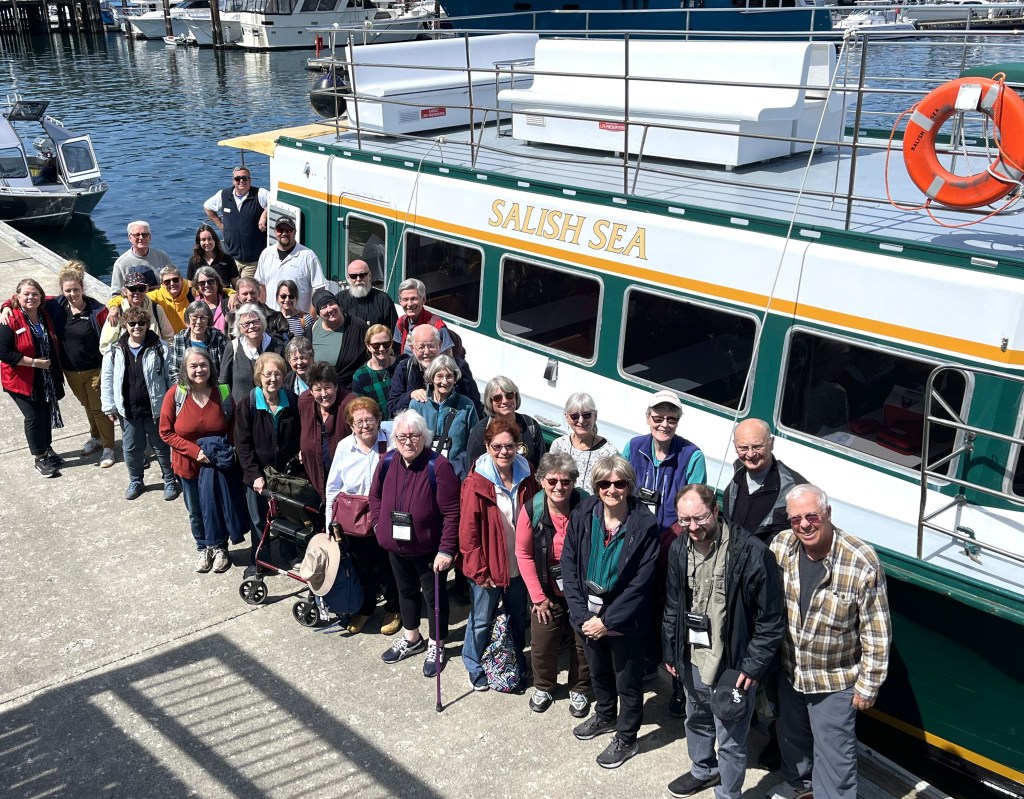
Our Road Scholar contingent by one of our tour boats at dock in Friday Harbor. Your loyal correspondent is the tall drink of water in the back row below and left of the first “S” in Salish Sea. Tour-goers came from as far away as New York and Florida. Kelley Balcomb-Bartok photo.
I’M JUST BACK FROM ROAD SCHOLAR trip Number One, and I think I’ve found my tribe.
This week-long outing was dubbed “The San Juan Islands by Land and Sea: Hidden Anchorages.” It was my first outing as a guide trainee for Road Scholar, the globe-trotting tour leader that is celebrating its 50th year as an education-oriented not-for-profit organization. Locally, it operates in conjunction with the Friday Harbor outpost of Mount Vernon-based Skagit Valley College.
With 30 travelers from across the United States, we skipped across the San Juans by charter boat for three days, plus two days on land exploring our base around Friday Harbor. Our at-sea days included a day trip to remote Sucia, my favorite of the archipelago and home now to my late wife Barbara’s memorial bench. Stops included the historical town of La Conner, where my neighbor the Mad Birder lives when he’s not on my little rock, and where Barbara was once town librarian. We transited three of my favorite scenic-keyhole water passages: Hole in the Wall on Swinomish Channel; the famed swirling waters of Deception Pass; and squeaky-narrow Pole Pass between Orcas and Crane islands. These were places my family and I had navigated again and again over the years on our own sailboat. Virtually everywhere this tour went, I had a story to share with our visitors. With a sizable contingent of retired teachers and librarians, they were eager listeners.
It was gratifying at trip’s end when one of our group kindly proclaimed, “You’re a great storyteller!”
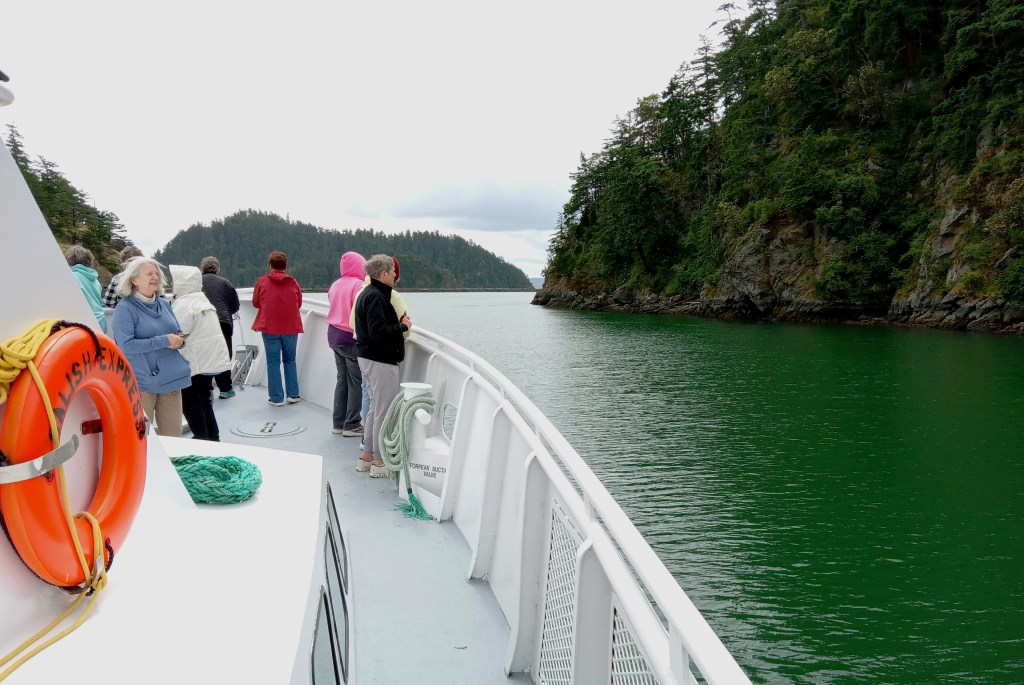
Our tour vessel, Salish Express, transits Hole in the Wall on Swinomish Channel south of La Conner.
Road Scholar specializes in travel for people 50 and older, but the typical age is early 70s. Our group ranged from early 60s up to one participant who was a fit-as-a-fiddle 86. They came from as far away as Florida and New York, along with Midwest contingents from Minnesota, Kansas, Illinois, etc., plus Californians aplenty. Some were on their first Road Scholar trip. One had been on more than 50.
This group traveled under a lucky star. On our first day on the water, between Bellingham and Friday Harbor, we encountered a sizable group of transient killer whales feeding off the northern tip of Cypress Island. For more than a half hour our 100-foot vessel idled as we watched the whales breach, tail slap and generally cavort to the “oohs” and “ahhs” of our visitors, most of whom were first-timers in these islands. In all my years poking around the Salish Sea, this was one of my best orca sightings.
In a trademark red Road Scholar vest, your correspondent takes to the mike aboard a tour vessel. Cathy Holley photo.
The second day we meandered past Whale Rocks at the southern entry to Cattle Pass to get an eyeful of dozens of Steller sea lions, the largest of sea lions. This band included a handful of mammoth males, which can grow to 11 feet long and weigh almost 2,500 pounds. As we paused, one of the incredible hulks scooted to the top of his rocky islet and reared high in what was clearly an “I’m King of the World” pose atop Pride Rock. (Sea lions don’t know better than to mix their Hollywood metaphors.)
At Sucia, we got an eyeful of eagles, as bald eagles circled and swooped a half-mile into the sky above us at Shallow Bay. All in all, this was a wildlife-blessed journey.
Clearly, Road Scholar is a good fit for me. I needed more human interaction than I get on my little rock. This is a good way to fill that need. And I even get paid.
Meanwhile, I’m remembering lost loved ones this Memorial Day and sending warm thoughts to friends and family. I feel I’ve found new friends to help fill the gaps in my life. Best wishes to any of you seeking the same.
The Prince of Whales whale-watching boat zips past my lunchtime viewpoint on Upright Head, Lopez Island.
IT’S BEEN TOUGH keeping up with the blog in these troubled times. We all have plenty of worries as the Trump Regime does its best to bully the world, trash our constitution and cripple the economy. Almost every one of us has seen our life’s savings swirling down the toilet.
But I resolved to help support my community in the face of the onslaught, so I’m here to tell about the good things in my island life.
Tiny calypso orchids are blooming with gusto on Center Island this spring. This flower is about 3 inches high.
Spring weather has finally arrived and we have a bumper crop of calypso orchids, aka fairy slippers. Buttercups are in bloom and ferns are uncurling new fronds like the gentle beckoning of an octopus tentacle. When I tap away at the keyboard in Wee Nooke, the cedar writing hut on the rocky knoll behind my cabin, I might still crank up the heater at first, but by afternoon I’ve opened a window to admit soft and salty breezes.
My big news is that I’ve landed a gig with Road Scholar, the not-for-profit tour operator that offers educational trips catering to travelers 50 and older worldwide. My Friday Harbor friend Barbara Marrett, retired from a career as communications director for the San Juan Islands Visitors Bureau, went to work with Road Scholar a year ago. She convinced me it would be a good fit for me, and kindly recommended me to the local leadership affiliated with Mount Vernon-based Skagit Valley College, which has a branch in Friday Harbor. I will be involved as a paid trainee with three of their week-long tours in my San Juan Islands starting in mid-May. Next year, I will likely be a group leader.
It’s a bright spot on my personal horizon. Living with just a fuzzy feline companion on my remote island, I need more human interaction. And some 20 years of exploring these islands with my family aboard our sailboat, writing about the San Juans as a travel journalist, and making a home on this little island nobody’s heard of seems to uniquely qualify me to help newcomers learn about the San Juans, too.
So far, the Road Scholar leadership has been tremendously accommodating and good to work with. When I told them I had been reserving the summer for overdue cabin projects that got a bit neglected last summer, they responded by assigning me to trips in May, September and October. Perfect! Itineraries will include boat trips to Sucia and other outer islands, a kayak tour and a three-island sampler.
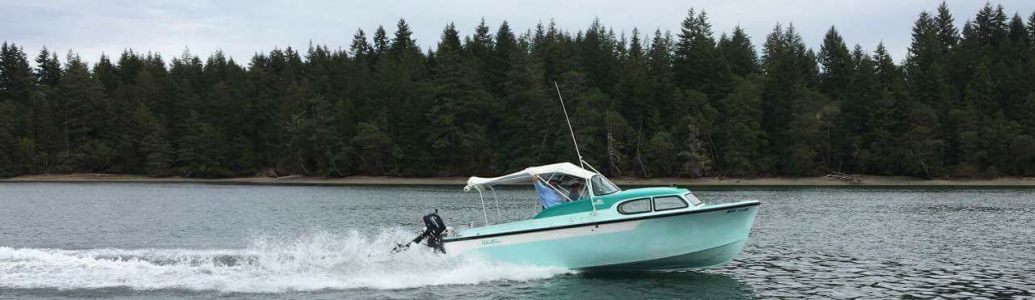
I’ve already attended three training sessions in Friday Harbor, including a first-aid and CPR refresher course, a general leadership orientation, and training in how to safely drive their fleet of 11-passenger vans. That’s kept me busy in recent weeks traveling back and forth to Friday Harbor, a significant endeavor when I don’t yet have my restored 1957 cruiser, WeLike, commissioned for the season. (We’ve not had the weather for it until now.)
Ranger Rick looking spiffy and clean.
So I booked passage on the water taxi from Center Island to Hunter Bay Public Dock on Lopez Island ($76 round-trip), where I keep my good old pickup truck, Ranger Rick. I drove the pickup 25 minutes to the ferry terminal on the north end of Lopez and either parked it there and walked on the state ferry (for no charge to Friday Harbor) or drove aboard ($28 round-trip) when I wanted wheels at the other end. On one trip, I took advantage of the opportunity to drive Ranger Rick to the Friday Harbor car wash where I gave him a much-needed bath. There are no car washes on Lopez. He had gotten positively mossy.
These outings have made me thankful that I don’t often rely on Washington State Ferries, plagued by staffing shortages that commonly cause last-minute cancellations of scheduled runs. When one of my Friday Harbor boats was canceled and the next wasn’t for two hours, I “made lemonade” and took my sack lunch on a pleasant hike to a viewpoint in the San Juan County Land Bank’s Upright Head Preserve, adjacent to the ferry terminal. Couldn’t have been better if I planned it, I thought, as I watched whale-watching boats and big cabin cruisers plow through the water below the mossy bluff where I munched my tuna wrap.
Lumberjack Brian: A newly cleared building lot meant felled trees were available for firewood.
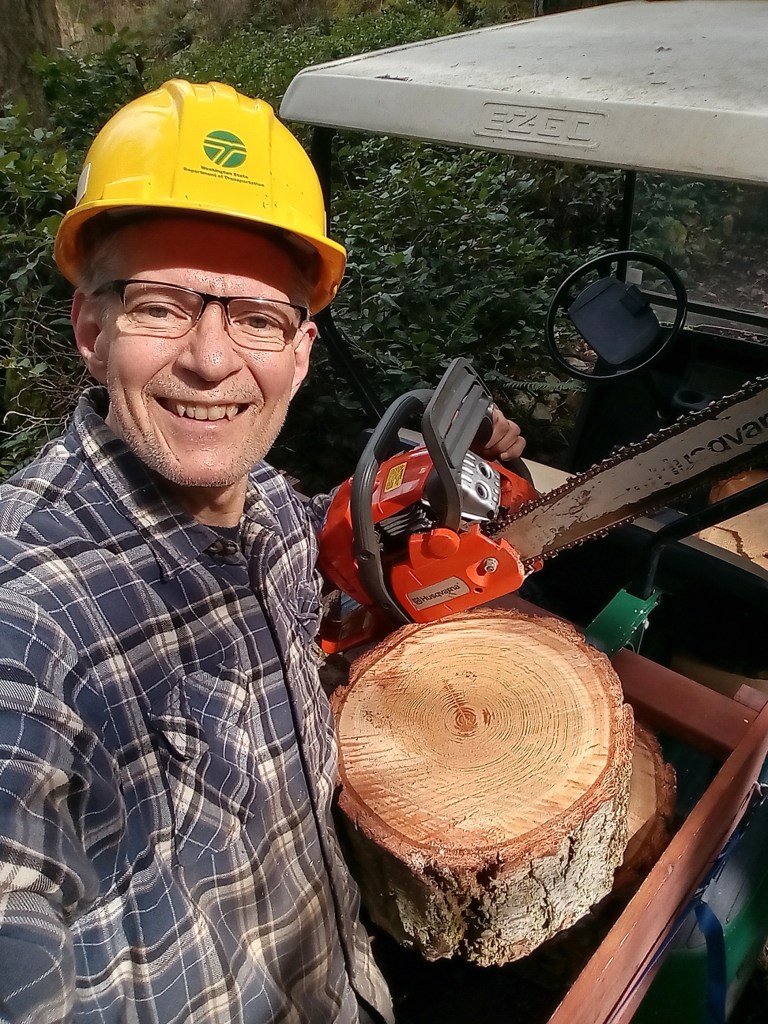
The arrival of spring weather already has me busy with outdoor projects around the cabin. When a nearby lot got cleared for construction of a new cabin the cut trees were available for firewood. Time to fire up my chainsaw and start replenishing my wood stack for next winter. (I had to watch a YouTube to figure out why the saw wouldn’t start after hanging in my shed for the winter, but soon had it roaring and spewing sawdust. When you live on a remote island, you learn to fix stuff yourself.)
My other adventure has been digging on hands and knees with a hand trowel to locate my septic drainfield so I can install capped, upright 4-inch PVC pipes that function as inspection ports, now required by the county if I ever wish to sell my place. One port is installed, one more to go. The joys of home ownership. Nothing that a clothespin to the nose can’t make more pleasant.
Amid all this, daughter Lillian visited to help me celebrate my 69th birthday and neighbors John “The Mad Birder” and Carol showed up with recently dug razor clams they were generously willing to fry up for friends. (Yum.) Lillian showed off her new skills as a patisserie baker by making me the world’s best sugar-free chocolate cupcakes with buttercream frosting. (Ditto yum.)
That’s the April report from Center Island, friends. Find joy where you can. Remember to support your friends, family and other good guys. We all need it now more than ever.
A gray squirrel pauses after raiding the Nuthatch’s bird feeder on a snowy February morning.
LAST NIGHT AS I WATCHED NETFLIX between frequent refueling of my cabin’s woodstove on a frozen February eve, outside the Nuthatch’s dark windows new snow came unbeknownst to me. It arrived secretly and silently, as if on little cat feet.
OK, apologies to Carl Sandburg. But I did get a poetic surprise when I peered out of the sliding door at bedtime and discovered the pristine new blanket of white seamlessly spread like a puffy down comforter across my deck.
FOG
The fog comes on little cat feet.
It sits looking over harbor and city on silent haunches and then moves on.
Carl Sandburg
No flakes were falling then. They had come while I wasn’t looking, anointing my island with a fresh and lovely purity.
This is the peaceful time of a San Juan Islands winter. No raging winds, no worries of losing lights and firing up generators.
This morning I relished the view from my loft. Having trundled back to bed with a gripping Michael Connelly novel, fragrantly fresh-ground coffee, and toast satisfyingly smeared with avocado, I watched through my front wall of windows as sunshine first lit the tall firs’ white-frosted branches.
Ahhhh.
I have a certain license to be lazy, and it’s kind of nice. On a phone consult yesterday, my Seattle hematologist told me it could be six months before my hemoglobin levels return to normal after a bleeding ulcer sapped my energies at Christmas. It means I’m anemic. So I’m giving myself permission to take it kind of easy. To devote myself to eating and sleeping well. Gradually building up my exercise routine.
The morning view from my loft.
I’m dedicated to all that once again after a drastic diversion last week. My dear Aunt Jeanne McLean, my mother’s youngest sibling and the last survivor of that family’s five children, died at age 96. I made the pilgrimage to South Dakota for her funeral.
I debated whether I was strong enough to travel, but my family had always been close to my aunt and her family. As a teen I had invested paper-route money in a Greyhound ticket from Seattle to visit the Dakota relatives on my own. I wanted to go now. I needed to go.
My brother Doug, who would also attend the funeral, made it easy for me. His partner, Lori, whose career tasks included travel arrangements for a globe-trotting employer, suggested I hop a direct flight on Alaska Airlines from Seattle to Denver. Doug would drive from their home in Santa Fe, New Mexico, to meet me and we would have a brotherly 400-mile road trip from Denver to Rapid City in his new Outback, sharing hotel rooms along the way.
Your scribe with cousin Tami McLean Bishop of Rozet, Wyo.
Smiling weather gods gave us a week of sunshine, the funeral service was nicely done, and reconnecting with cousins from across the West was soul-nourishing.
I moved more slowly through airports than is my norm, but I managed fine. And my brother and I saw a whole lot of scenery, from the snow-frosted Colorado Rockies, to the wide, wide wilds of Wyoming, to South Dakota’s beautiful Black Hills.
At 80 mph on U.S. 85, my brother Doug and I traversed hundreds of miles of snow-frosted, wide-open Wyoming.
I returned to the Nuthatch last Saturday just ahead of the snow, and I’m happy to hunker down here again. I’ve returned to what amounts to a Center Island COVID epidemic, affecting at least eight of my neighbors, some 50 percent of our winter population. So I’m being more of a hermit than usual.
That’s OK, Galley Cat is keeping me company. I hope my fellow islanders feel better soon. I plan on staying warm. I plan on staying well. Wishing the same for you.
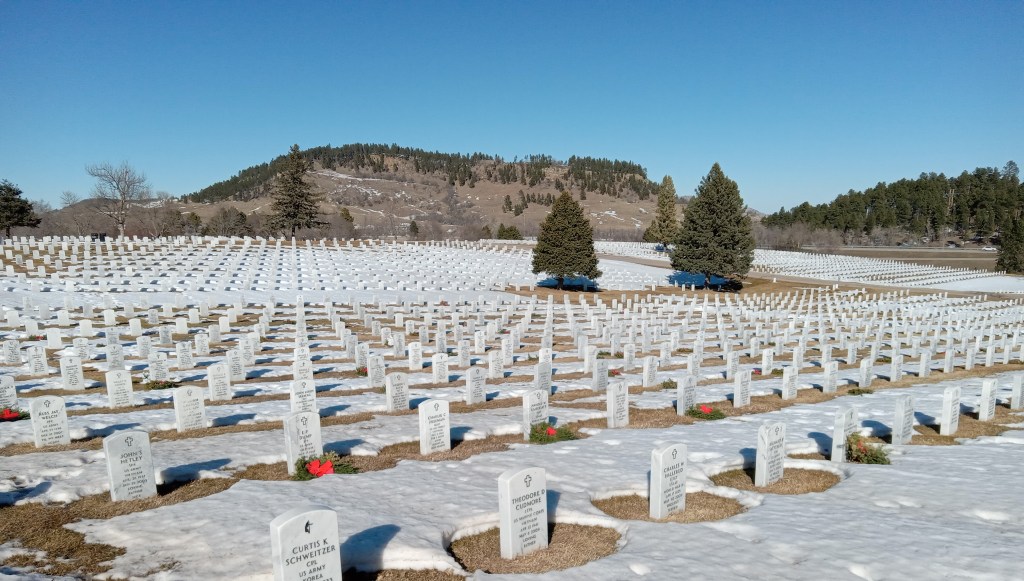
My Aunt Jeanne McLean was buried at Black Hills National Cemetery, S.D., in the same plot occupied since 2006 by her late husband, Calvin McLean, a Korean War vet.
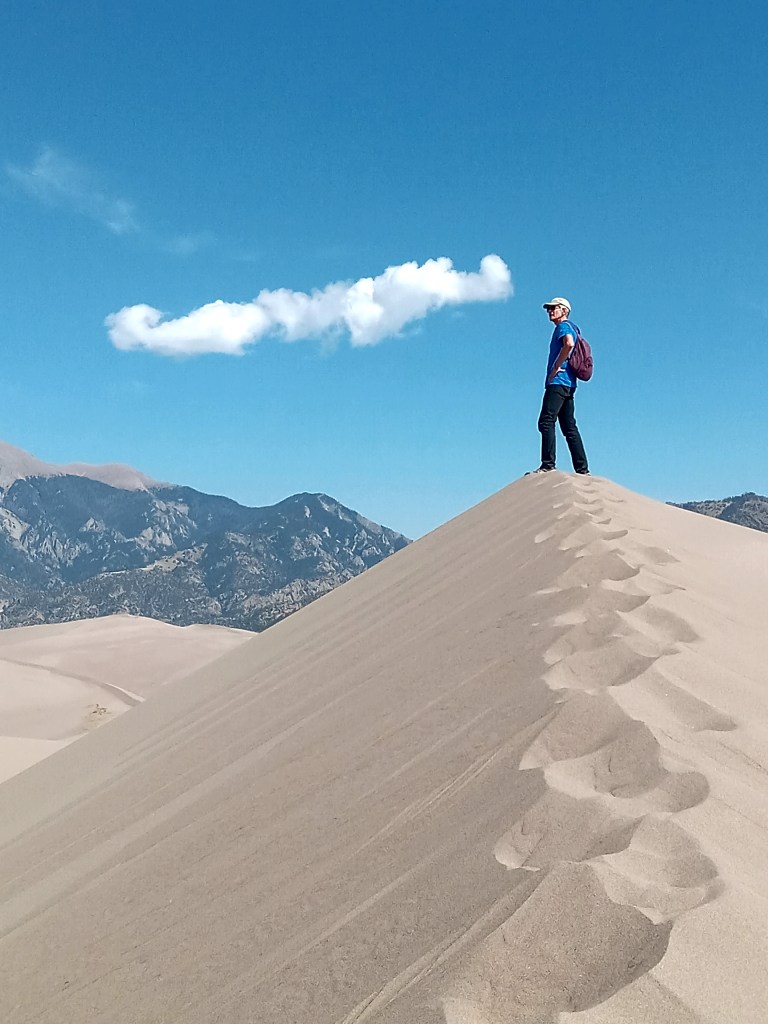
Your loyal correspondent tops out on a 700-foot+ dune in Great Sand Dunes National Park in southern Colorado. North America’s tallest dunes build from windblown grains of sand at the base of the Sangre de Cristo Mountains, seen in the background. Photo by Douglas Cantwell.
ISLAND LIFE CAN BE LONELY AT TIMES, you’ve heard me say. With Center Island’s year-round population hovering around 20, the social life has its limitations.
But, boy, loneliness hasn’t been an issue for me this fall.
So far, my autumn has been a dizzying — and delightful — whirlwind of visits by family and old friends, along with travel to visit family and friends in locales ranging from Orcas Island to Moscow, Idaho, to Santa Fe, New Mexico.
Hilary, Christi and me on Center Island. I love visitors, and I’ve had a few good visits lately.
It began with my Labor Day outing to Sucia Island with daughter Lillian, closely followed by a visit here by Hilary Hilscher and Christi Norman, two longtime friends. I first got to know them through their association with Audubon Washington, for which they drove all over the state together in a sort of “Thelma and Louise Go Birding” partnership about 20 years ago to create the Great Washington State Birding Trail. Laid out in a set of seven detailed and beautifully illustrated maps, the Birding Trail comprises the state’s best bird-watching sites. As outdoors editor for The Seattle Times, I piggybacked on their great work with a regular newsfeature called “Birders’ Top Spots,” spotlighting sites from their maps. (Six of the seven maps, published between 2002 and 2011, are still available to order online here for $4.95 apiece).
Hilary and Christi, who both live with their husbands in the greater Puget Sound area, have been regular readers of “Cantwell’s Reef” and decided they wanted to see my little rock. We ate lots of good food, drank good wine, and enjoyed renewing our friendships.
The same can be said of a visit shortly thereafter by Ken and Kate Brinkley of Portland. I first met Ken on an impromptu shared sailing afternoon out of Orcas Island’s Rosario resort in the 1980s. He became a lifelong friend. Ditto with Kate when she married him.
Ken, Kate and yours truly among Center Island madronas.
Not long after the Brinkleys departed in late September I left my island for a marathon day’s drive across the state to visit a new friend, R.J. (for Robert James). He lives in Moscow, Idaho, just across the state line from Washington State University, where he manages a library. I guess I’m partial to librarians. I met him online, which is a good way to make friends when you live on a small island nobody’s heard of. We’ve become chums.
Sandwiched in there somewhere was a visit with another friend discovered online, Tom, on Orcas Island. My boat, WeLike, got me there. It’s nice to find local buddies, too.
Doing the Idaho road trip in one day each direction was exhausting but also a treat. It had been a while since I’d seen so much of my home state, from the San Juans to Seattle, over the Cascades, to a bit of Coulee Country before navigating the rolling and roiling Palouse. I renewed acquaintance with phenomenal State Route 26, which slices straight as a razor across much of its 114 miles of Eastern Washington as it blazes a path toward Pullman.
Farmers had just completed the wheat harvest. The bright yellow-white stubble glowed in the sunshine as I crossed into Whitman County, where welcome signs boast that it grows more wheat than any other county in America. (In 2015, growers there harvested nearly 30.5 million bushels, according to the National Agricultural Statistics Service.)
Less than a week after my return to Center Island I again caught the Island Express water taxi. I was bound for the Seattle airport, where I hopped an Alaska 737 for Albuquerque, via a layover in Phoenix (where I was glad I didn’t need to step outside into the 108-degree October heat). New Mexico was more clement, with daytime highs in the 70s and low 80s.
My brother Doug met me and drove us the hour to Santa Fe and the lovely adobe home he shares with partner Lori, whom I enjoyed meeting for the first time.
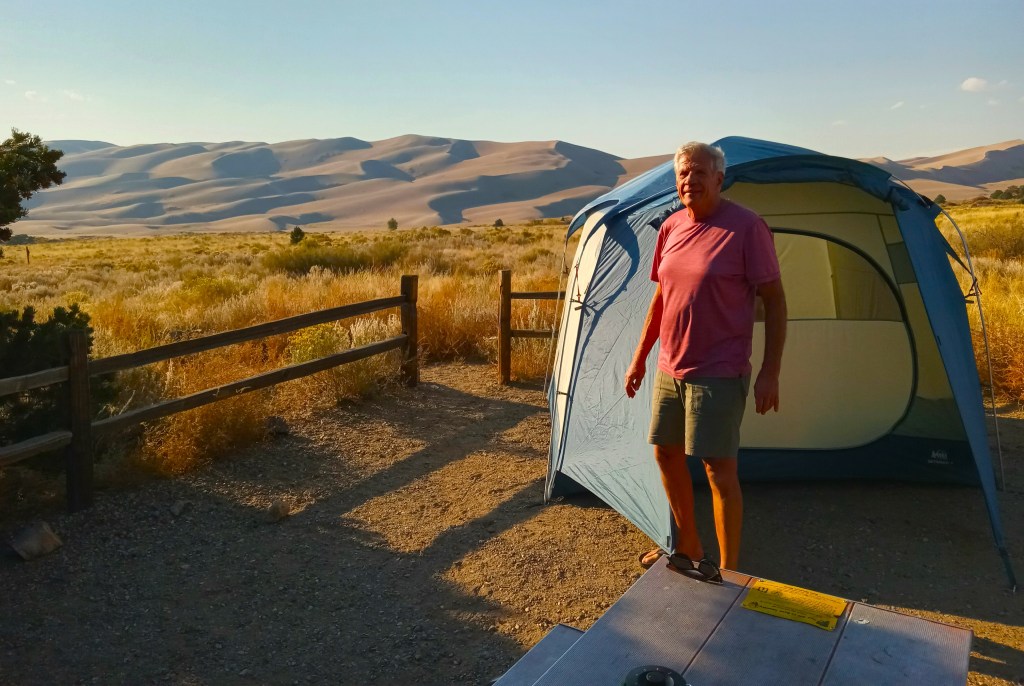
My brother Doug Cantwell at our Great Sand Dunes National Park campsite in Colorado, about three hours from his Santa Fe home.
The next day I acclimated with a pleasant hike with Doug on the outskirts of his town at 1.3 miles of elevation (blowing a raspberry at your Mile-High City claim, Denver). A day later we aimed Doug’s shiny new Outback at southern Colorado for a three-night campout at stunning Great Sand Dunes National Park. I’d never heard of the place, which became a national park at the end of the Clinton administration, but I won’t soon forget it. North America’s highest dunes pile up against the base of the Sangre de Cristo mountains, dominated by 13,297-foot Mount Herard, of which we had a front-row view from our campsite that Doug had hand-picked from a prior stay.
Autumn colors are spectacular among Colorado’s aspens, willows and cottonwoods.
Piñon Flats Campground was named for the scrubby pines that this year were groaning with cones bearing the famed pine nuts that are so good on salads and in sauces. For two geezers whose combined ages approach 140, there was one advantage to having to rise from our cozy sleeping bags in what’s aptly called the “wee hours”: With a combination of dry air, little light pollution, and high elevation, Great Sand Dunes is certified as an International Dark Sky Park. “Wow” and “whoa” dominated our midnight vocabulary as we encountered Orion, the Pleiades, and a bright, night-piercing Jupiter, high in the eastern sky. Doug spotted more than one shooting star.
Though I puffed from the 8,800-foot elevation (I live just above sea level, remember), Doug and I made it to the top of a 700-foot+ dune, often slipping and sliding in the sand that dominant winds bring from afar. During my visit, warm sunshine brought out the startling gold of the area’s aspens and willows. An afternoon thunderstorm swirled towering black clouds around the mountain tops. And, after a half-day drive to the top of 10,856-foot Wolf Creek Pass on the Continental Divide, we experienced a wind-blown snow shower.
This past Saturday, before Doug and Lori dropped me at Albuquerque International Sunport (rivaling in airport-marketing silliness the “Sky Harbor” of Phoenix), we witnessed the final hour of a mass ascension, part of the final 2024 weekend of Albuquerque’s famed Balloon Fiesta. The colorful event draws some 600 hot-air balloons each year.
Frank Boy, a sort of young Frankenstein balloon, came from Brazil for Albuquerque’s 2024 Balloon Fiesta.
I’m back at the Nuthatch today, catching my breath. Over the next two weeks I plan to buckle down and write more get-out-the-vote letters for Vote Forward, which expects to contact 10 million voters before November 5. Ten days ago I mailed 140 letters to Pennsylvania, North Carolina, Georgia and Arizona. Doug will be busy in coming days, too, having committed to 200 letters. There’s still time if you want to join us with your pen.
All the socializing and travel has been great, truly. But sometimes I love my quiet island. A good place to write.













 Cantwell's Reef