A pilgrimage to Barbara’s enchanted isle

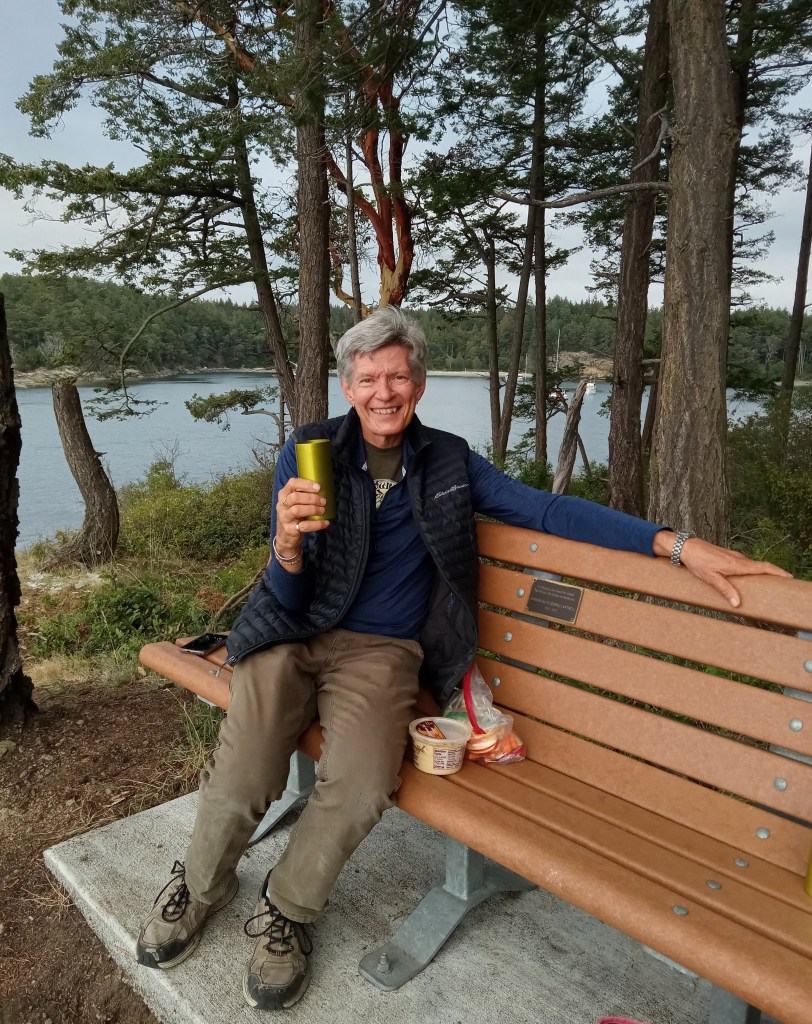
Toasting Barbara from her memorial bench, looking toward Boundary Pass in the Salish Sea and Saturna, left, and Patos islands.

WHAT ELSE CAN I SAY? Barbara sends her love.

That’s the first thought that comes to mind after returning yesterday from my second annual pilgrimage to Sucia Island to visit the park bench memorializing my late wife, who died of breast cancer in 2021. In 2022, state parks workers erected the bench, commanding what might be the most beautiful saltwater view in the San Juans, with the help of a GoFundMe project to which many of you generous readers contributed.

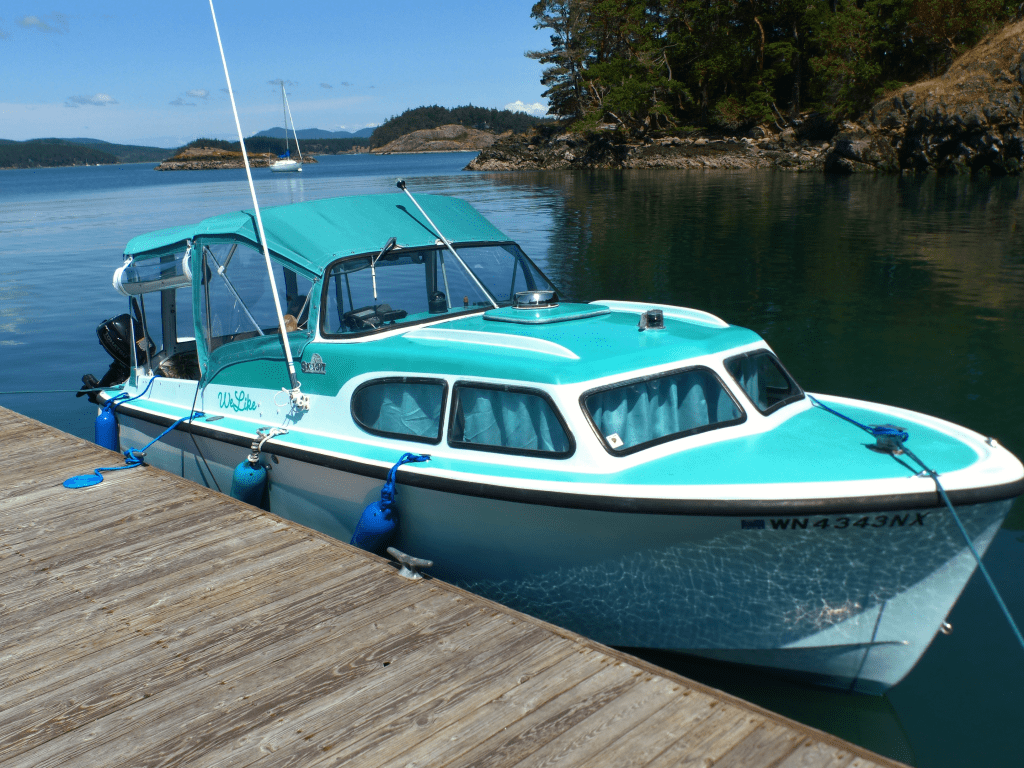
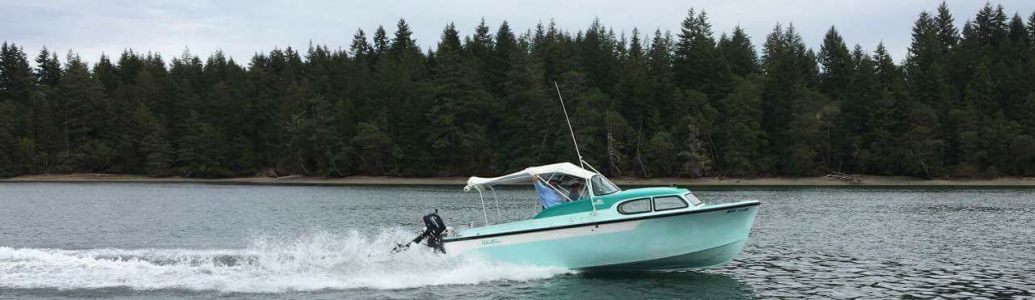
Daughter Lillian accompanied me this time for a cozy overnight in sleeping bags aboard WeLike, my restored 1957 Skagit Express Cruiser, a dazzling study in mid-20th-century turquoise, snugly tied to a dock in Fossil Bay.

My 1957 Skagit Express Cruiser, WeLike.

We arrived on Labor Day afternoon, just as many other boaters were heading home from their holiday weekend. After a bone-jarring ride through tidal turbulence encircling Orcas Island and hazardous wakes from giant motor yachts hell-bent for their home ports, we were thankful to find plentiful dock space at Sucia, our favorite marine state park, the blissful destination of countless voyages over past decades aboard our sweet old sailboat, Sogni d’Oro.

For the easy moorage this visit, we thanked Barbara, whose ashes we scattered on the waters here two years ago. She makes things happen here, we’re sure of it.

Your correspondent at Barbara’s bench, with Shallow Bay in the background.

We immediately packed snacks and a surreptitious bottle of Barbara’s favorite sauvignon blanc, setting out for the mile hike through deeply shaded woods of cedar and autumn-gold maples to her bench at the south peninsula forming soporific Shallow Bay.

Barbara (Burns) Cantwell, 1955-2021

The bench sits high on a bank above some of Sucia’s characteristic shoreline of wildly sculpted sandstone, like something Antoni Gaudi might have fashioned had he won the commission rather than the Northwest winds and tides. From a seat on the bench, a swivel of the head takes in a stunning panorama including Orcas, Waldron, Stuart and Patos islands of the San Juans, and Canada’s Saturna and Pender islands.

After a day of low-scudding clouds that sprinkled raindrops along our way, Barbara now cleared the sky to match the blue of her eyes that had bewitched me from age 16. If the weather had been perfect from the start and seas smooth, we’d never have found room at the dock, Lillian and I professed. “Mum watches out for us,” we agreed.

On the park bench memorializing her mother, daughter Lillian reads aloud from one of Barbara’s favorite mystery authors.

Though the birds had largely spared it as a target, we gave the bench its annual swabbing with cedar-sage spray cleaner, a scrub brush and paper towels. The bronze plaque remained clearly legible: “For Barbara, who loved this island, from Brian, who always sat beside her.”

Perched comfortably, my daughter and I munched on apple slices dipped in peanut butter, sipped a tart and fresh New Zealand wine from colorful metal tumblers off the boat, and took turns reading aloud from one of Barbara’s favorite mystery authors, Elizabeth Peters. “The Last Camel Died at Noon” featured the adventures of Egyptologist Amelia Peabody and her professorial husband, Radcliffe Emerson.

Lillian at the stone gateway to the madrona forest on Sucia Island.

After hiking back on an alternate route through a marvelous madrona forest, we returned in the morning with a vacuum jug of coffee and a small campstove. Cloudy skies cleared to golden sunshine just as we arrived at the magic bench. Over the stove’s flame, we made toast that we smeared with ripe avocado. More Amelia readings. More quiet communing with our beloved wife and mother.

“I miss her,” I told Lillian. “I do, too,” responded our daughter, who turns 33 this month. “She knew how to make things perfect.”

A spare paper towel had to suffice for the Kleenex I forgot to pack.

Much has changed in our lives and continues to change. My ability to fall in love has sputtered back to life, with emotional twists and turns. Lillian and partner Chris are soon to move to Philadelphia, as he takes a new job as a flight attendant. Lillian, the baker, hopes to become Lillian, the book editor. Along the way, they will enjoy free flights all over the world.

But come what may, our love for Barbara will never change. We think of her often. And at least once a year, at least one of us will return to commune with her on her enchanted island.

Seeking a Center Island exit strategy

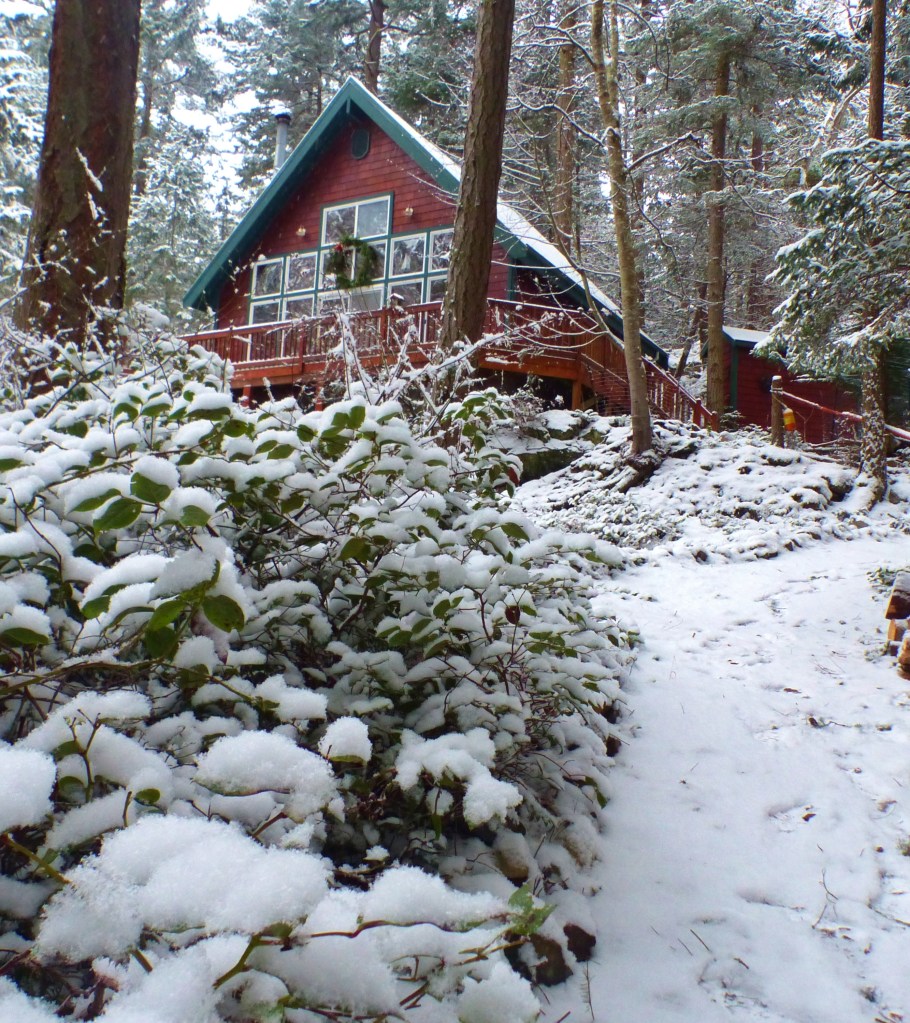
Over the years, winter scenes like this gave me plenty to write about from Nuthatch Cabin. Next winter might be my last here.

THE PENDULUM SWINGS. It’s one of life’s absolutes. Things change, even on Center Island.

I started “Cantwell’s Reef” six years ago with the loosely defined purpose of writing about “ditching the office and making a life on a small island nobody’s heard of.”

The love of my life, Barbara, was my partner in that adventure. The bustling Seattle Times newsroom was the office I had fled. In countless blog posts, I told about learning our way as full-time Center Islanders, situating a cool old boat at the dock and a tough old pickup truck on neighboring Lopez Island. Month after month, my writing marked the turning of seasons, with the arrival of enchanting wildflowers, summer dog days, autumn harvest fairs and winter snows. It’s been a full life.

Now, I turn to my exit strategy.

Cancer took Barbara from me in 2021. The Times newsroom is but a distant memory to me, and in the wake of COVID many staffers work from home. To everything there is a season. Turn, turn, turning pages.

Since Barbara’s death, Galley Cat and I have toughed it out here on our own for three years, but it’s time to look for a new home with more social engagement.

That bell tolled in a way I couldn’t ignore when The Mad Birder and his spouse, my next-door neighbors who have become dear friends and frequent dinner hosts, announced recently that they were putting their cabin up for sale.

The MB just turned 70, and it seems that continuing health challenges and the march of time told him and his dear wife it was time to simplify life and solidify their base in Skagit County, where they have another home.

That seemed like a sign. It is time for me to think about moving on. I will hate to leave this beautiful place, this comfortable cabin, this friendly little island, and my perfect writing hut. But the time is coming.

I won’t move quickly. It will be at least a year before Nuthatch Cabin is ready to put on the market. That deck rebuild needs finishing, for one. An electrical circuit needs repair, the chimney needs replacing, the roof needs a good cleaning, etc. I have no idea where all the travel souvenirs and family mementos will go; I long ago vowed: No more storage units. If I want to flush money away, I own a toilet.

There are challenges, of the type faced by many of my peers in the 65-and-older crowd.

If I sell the house I live in now, which just fits in my retirement budget, will I be able to afford replacement housing anywhere nearby?

I’ve heard the same quandary from friends. Home prices in Western Washington — and pretty much anywhere down the West Coast — are crazy high. And nobody I know wants to move to Arkansas or Oklahoma or pretty much anywhere that’s considered affordable. Most are red states. No thank you.

Because of Barbara’s illness, I retired early, meaning my retirement savings and Social Security income took a hit. The silver lining is that I qualify for housing programs aimed at the low- and middle-income populace.

In choosing a new locale, I have a growing wish list, beyond basic political compatibility. I’m hoping for good parks and trails and maybe a hiking club. A pleasant and walkable downtown with a good coffeehouse or two. I’d like to be near water so I can keep and enjoy my great little boat. I’d like the option of satisfying part-time work as well as volunteer opportunities. Good healthcare. A lively arts scene.

A place where I already have friends would be a big plus.

With the help of friends, I’ve started looking. Daniel and Jean Farber some months ago launched a campaign to get me back to their hometown of Olympia, where I shared a 1970s college-days house with Daniel and fellow students of The Evergreen State College. The latest development: They offered and I accepted a six-week housesitting gig late this fall while they spend quality time with a new grandson in California.

Galley Cat explores the rocky knoll behind the Nuthatch.

The Oly time will help me decide if that’s where I want to live again, with plenty of time to look at the local housing stock and living costs. Galley Cat will accompany me, which is great, though I’m sure she’ll miss roaming the island woods.

No sooner did I announce my Olympia plan than friends on San Juan Island countered with a strategy to keep me in the islands. (It’s nice to be wanted.)

Barbara Marrett and Bill Watson educated me about various affordable-housing projects in and around Friday Harbor. When I visited them recently, Barbara generously drove me around town to inspect every one of those housing developments, including one cluster that consisted of charming old homes that had been lifted from their original sites and barged to Friday Harbor from Victoria, B.C. The San Juan Community Home Trust keeps homes affordable, in part, by selling the house only. Buyers than lease the homesite from the trust at a low monthly rate. There are many such tools to create alternatives to traditional market pricing.

Homes barged from Victoria, B.C., are among affordable housing offered in Friday Harbor.
San Juan Community Home Trust photo

When I had lunch with a new friend on Lopez last week, he told me that Lopez, too, has an affordable-housing project worth a look. While Olympia has its allures, I would love to stay in the San Juans.

So that’s Chapter 1 in the Great Center Island Exit Strategy. More ideas are welcome, shoot me a note. I’ll keep you posted, my friends.

Summer is an island of bliss in a stormy year

Ivory flowers of Oceanspray brighten the June woods on Center Island in the San Juans.

HAPPY SUMMER SOLSTICE on this glorious island day with a perfect 72-degrees Fahrenheit, klieg-lit skies of royal blue and not a single pesky cloud between here and Hurricane Ridge. I hope you’re sharing such dreamy weather.

If the weather gods haven’t convinced you already, the meteorologists will tell you that summer officially began this afternoon at 1:50 p.m. PDT.

Mr. Fix-It. The deck progresses.

The past week on this remote little island nobody’s heard of has been a welcome and peaceful lull between the holiday crowds of Memorial Day and July Fourth, and a welcome diversion from the weird and weirder news of the world. (If you’re a praying person, pray for democracy.) It’s also been a time for me to relax into my summer chores. I’ve planted my deck garden, whacked the weeds on my rocky knoll and replaced more planks in my years-long deck-replacement project. (It’s a bit like painting the Golden Gate Bridge; once done at one end, I’ll start over at the other.)

The wildflowers that gauge the advance of our springtime have mostly come and gone. But June is the season for Oceanspray, the shrub bearing thousands of tiny ivory flowers that in combination give the plant its name, adding a dreamy, creamy sort of surf effect to our sea of evergreens and maples.

George and me at Kapalua Bay, Maui.

For me, the beautiful week on my island is a double dessert in this month’s feast of life. I just returned from a week on Maui with my travel buddy, George, who lives in Seattle. From a comfortable condo in Kihei, we had adventures in snorkeling, beachcombing, trekking ancient lava flows at wild La Perouse Bay, food-truck dining, and luxuriantly lolling around a palm-shaded swimming pool that featured its own cool little waterfall. Even got a tan. It’s good to have a new companion who enjoys travel and adventure as much as I do.

Meanwhile, Galley Cat enjoyed a week’s vacation hosted by Auntie Julie and dog Nigel in their comfortable home in the garden spot known as Brier. Galley and I honor them.

This season makes up a lot for those January days of whistling 50-mph winds and freezing pipes in the San Juans, let me just say. My best wishes to you for good companionship, memorable family fun, idyllic outdoor dining, silly yard games, lazy beach bumming, energetic boat rowing and more this fine summer.

This summer’s deck garden at Nuthatch Cabin.

Sweet roses on a rain-washed island, with thoughts of friends old and new

Despite cool temperatures, wild roses are blooming this Memorial Day in the San Juan Islands.

IT WOULD BE A LOVELY DAY if this were March, I suggested with a smile to fellow islanders as we passed each other on morning walks around our little rock this morning.

But it’s Memorial Day weekend, and I was kitted out in raincoat, Pendleton hat and woolly gloves. It was cold. It was wet. It’s supposed to be late May, for goodness sakes.

The up side: My island, which was already getting crunchy underfoot from a dry spring, is no longer crunchy. We’ve had two much-needed long, soaking rains in the past week. My only worry is that I might have to repeat my usual once-a-year weed whacking, completed last week on the Cantwell little-half-acre.

This Sunday morning rain-washed air as fresh as a tightly furled rosebud lured me outside, and I saw many rosebuds on my walk. Yes, it’s bloom time for the Nootka rose, one of our colorful native plants in the San Juans. The Sea Blush and blue Camas have pretty much come and gone, but for now we have the wild pink roses, and in June we’ll see the creamy, filigree blossoms of Ocean spray.

As I walked, I also met and welcomed our new caretakers, Steve and Nancy, as they circled the island in their red pickup. They are temporary summertime replacements for Rich and Maria, who recently were wooed away by a community association on nearby Blakely Island. Rich, a former state parks ranger, and Maria, a retired school librarian, were wonderful overseers of our island for several years.

Steve and Nancy, who hail from Lake Tahoe, California, these days, have been frequent visitors to friends who have a place on Center Island, so they are well familiar with this little rock. Steve is a retired police chief from the California State University system, and Nancy spent 33 years as an educator in public schools. A teacher and a cop should do OK keeping things in order around here, I expect. But they didn’t seem like disciplinarians, they seemed very friendly.

They will stay through the summer, giving our homeowners association a few more months to find permanent replacements to live in the little blue house next to our clubhouse.

Best wishes for the rest of your Memorial Day weekend, with appreciative thoughts of all the friends and loved ones who’ve come and gone.

When the Web breaks in the islands

Nuthatch Cabin’s old-school, hard-wired communications center: When the wire gets cut, we’re screwed.

OMG, MY INTERNET WAS DOWN FOR A WEEK. Need I say more?

It’s true that many of us spent much of our lifetimes communicating on phones that weren’t any smarter than Bevis or Butthead, and we survived. But that was then.

These days, especially if you live on a remote little rock, home Wi-Fi is what keeps you in touch with the rest of the planet, the World Wide Web that keeps us island spiders fed — with news, with social interaction, with Wordle and the Sunday Crossword, with televised entertainment that streams as easily as the tidal current in Rosario Strait.

Until the Wi-Fi goes dark, as it did about 10 days ago.

As removed from population centers as my Nuthatch Cabin may be, it is served with most of what we call the “mod cons.” Potable water fills the sink when I turn a faucet handle. The toilet flushes. Buried power lines set lights ablaze. Other underground wires bring land-line phone service and, yes, DSL Internet, courtesy of CenturyLink, the Louisiana-based telecom.

Through some convoluted happenstance of old-school technology from the 1990s, never before have my land-line phone and the Internet gone dead at the same time. When it happened this time, I knit my brows.

Already after regular office hours that Thursday, a cell-phone call to CenturyLink led me to a text exchange that I strongly suspect was conducted by an AI entity at the other end. There were too many formulaic responses. Whomever was helping me, I’ll call them “the entity.”

The entity first tried to set a repair appointment a week in the future. It ignored my protests that I depended on my Wi-Fi for keeping linked in so many ways to the outside world. That continued until our text exchange was winding up and I was asked if my problem had been addressed satisfactorily.

“No, the week wait isn’t acceptable,” I texted.

And suddenly the entity found it possible to schedule an appointment for the next day. I explained that I lived on an island with challenging access and offered suggestions for how a repair tech could get here. “I’ll add that to the report,” the entity told me.

All good, it seemed. The problem was that I sat at home all the next day waiting to hear from a repair tech, who was supposed to arrive before 5 p.m. At 4 p.m., CenturyLink texted me that its technician had visited me but was unable to gain needed access to the inside of the premises. Patently false; I hadn’t left home all day. Nobody had showed up.

I got on the phone to a live human being this time. From the accents encountered in several calls, I’m guessing the call center was in India, or maybe Sri Lanka. Bangladesh? Understanding their patois was a challenge. My only comfort was that I could have been trying to wade through a Louisiana drawl thick as gumbo.

Surprise, they now told me, 24 hours after my first report: The problem had been identified as an area outage, affecting more than just my residence. No, they couldn’t say how wide an area was affected. They had no idea when it might be fixed.

That was late Friday, May 10. The call center was closing for the weekend. I would wait, vaguely hoping someone was working on Center Island’s outage. And over the weekend I would watch old DVDs instead of streaming the latest from Netflix. I would walk across my island to check my email at the clubhouse, which is served by Elon Musk’s satellite-based Starlink Internet. (As much as I’ve tried to ‘X’-out Musk from my life, I ruled out switching to Starlink only when I learned that not only would it cost me $25 more per month, but I would have to invest in $600 worth of equipment. And neighbors told me that tall firs on our side of the island make for poor Starlink reception anyway.)

Monday morning I phoned South Asia again. Another new development: My area outage had been repaired, they now claimed. But my phone and Internet are still dead, I protested.

OK, we’ll set up a new repair visit, my customer-service rep said. For the end of the week. “For tomorrow,” I insisted. OK, for tomorrow. Not once did I hear an apology for Friday’s no-show.

Just out of curiosity, I phoned the Washington Utilities and Transportation Commission consumer complaints office, which oversees telecoms. Legally, I could file a complaint two business days after a phone outage, a staffer told me. That meant the end of Monday. But CenturyLink had a poor record of quickly resolving complaints — it could take months — and the commission’s enforcement powers seemed weak.

Tuesday morning I finally heard from the repairman, a gentleman named Armando whose 360 area code indicated he was actually calling from this hemisphere. I told him I’d heard that several of my island neighbors had also lost their CenturyLink service. That was news to him. Mine was the only service request, he said.

He’d secured a plane ride that day to neighboring Decatur Island, which he would have to visit first. Apparently there’s some sort of switchbox on Decatur that controls service to Center Island.

Then he’d need a boat ride to Center Island. That was a problem. My boat was on its trailer, out of the water, and a fluke of the tides was such that water would not be high enough all week to use our launch ramp in daylight hours. I suggested he hire a water taxi. He was unenthusiastic.

I hung up, thought about it for a minute, and phoned a neighbor to ask a favor. His boat was at the dock, and the ride across the bay to Decatur was only 5 minutes. He agreed to help, so I called back to Armando, who said he’d probably be ready for a lift in 20 minutes. He would phone to let me know.

Two hours later, after more than one try, I got through to Armando again. Oh, it appears that all Center Island customers have lost their service, he told me. (Surprise.)

And here’s some irony. It happens that, as a result of the Biden Administration’s American Rescue Plan Act of 2021, San Juan County-based Rock Island Communications won grants to expand fiber-optic broadband service to 1,000 island residents, including us folks on Center and Decatur islands. The digging of trenches and laying of cable had already begun on Decatur Island. And guess why CenturyLink’s old-school DSL service went out?

Yep, while laying lines, the forces of new-and-improved cut the old cable. Oops.

Armando told me he didn’t know where the cable was severed, but that the problem was clearly on Decatur. The good news: He didn’t need a boat ride. But he offered no optimism for a repair.

Bad, bad news, I thought. Why would CenturyLink now want to spend potentially big bucks to fix a broken line serving only a handful of customers on a little island nobody’s heard of? Admittedly, my neighbors and I will all likely abandon their antiquated service as soon as broadband switches on (at $10 less per month, with much faster uploads and downloads).

Commiserating with another Internet-less neighbor at our clubhouse, I learned that CenturyLink had scheduled him for a service call the next day, Wednesday. I wondered if that offered any hope.

I guess it did. Around 1 p.m. Wednesday, my long-silent land-line phone rang with a loud electronic burble. “It lives!” I shouted to Galley Cat as I ran to pick up the call. Leaping frantically from the cozy bed atop her kitty condo, Galley apparently didn’t share my thrill. (She’s always been a Luddite.)

Armando was calling from Decatur Island. The broken cable was repaired. Service was restored. It was unexpected good news.

On reflection, I realize that while Internet is nice to have, I could survive without it. Just as I did for more than half my life.

Meanwhile, I had re-watched a bunch of old “West Wing” episodes on DVD. I love Joe Biden, but God, I wish Jed Bartlet was on the ballot this year.

Cart blanche: Rebuild frees islander of too many treks up the dock

The rebuilt cart on the dock at Center Island: a key link in my island’s transportation network, ready for more seasons of service.

WHEN YOU LIVE ON A REMOTE ISLAND with no shops or garbage pick-up, all your groceries must be transported up a dock and all your trash gets packed the other way. You really come to appreciate a good dock cart.

Anybody who’s had a boat in a marina knows of what I speak: the boxy two-wheeled conveyances with tires the size of a small bicycle’s, usually pushed by a large, U-shaped metal handle. Often capable of carrying two Rubbermaid totes and maybe a Trader Joe frozen-food bag. They do their job handily. No big deal.

But when the cart comes in a large, economy size, carrying two additional totes and maybe a couple of 5-gallon gas cans as well, you fall in love. Such Cadillacs of conveyance halve your required treks up and down the dock ramp, which on a minus tide can almost require ropes and a belaying harness. If you’ve just arrived home from a Costco run, kitted out with a six-month supply of pasta and several half-gallon jars of Adams peanut butter, the unashamed among us dash off the water taxi, pass up the “normal”-size carts and nab the stretch-limo of grocery transport.  

For years, Center Island’s “A” Dock has had such a cart. For years, it has been slowly falling to pieces.

The big cart was home-built long ago of thin plywood. Had the cart ever seen stain or paint, such protectants had long ago thrown in the towel against Northwest winters and retired to Arizona. The plywood’s raw, gray edges had started shredding like store-bought hash browns. On parts of the metal chassis, rust was holding the rust together. Our island’s caretaker kept up a brave campaign of replacing nuts and bolts, evidenced by shiny bits of metal among the oxidized. But as of late the cart’s front panel was falling out, threatening to dump into Read’s Bay one’s warehouse-store flagon of Mrs. Butterworth’s or body bag of Cap’n Crunch.

In places, rust was holding the rust together on the old dock cart.

For ease of reference here, we’ll call the big cart Otto (preferred pronouns: “It” and “Its”). Last fall, with winter looming, on a whim I asked Center Island caretaker Rich if I might tackle an Otto rebuild over the cold, long months ahead. It would be something to do, of benefit to me and all my neighbors. Rich enthusiastically nodded.

Then, you know how things go. I got busy. A bunch of holidays came along. Winter was shorter than usual, I’m certain of it. By April, Caretaker Rich had announced a pending move to another island, where pay was better and duties lighter. (These remote islands-nobody’s-heard-of can be cutthroat when it comes to poaching caretakers.)

Meanwhile, Otto was a wreck. Nuts were rusting to dust. L-braces once holding panels together twirled loosely as screws gave way. I felt bad I hadn’t fulfilled my aspiration and hated for Rich to depart thinking me a slacker. In late April, I queried him if I could take Otto out of service for a couple of weeks and proceed with the makeover. The nod was even quicker.

I wasn’t talking about a refresh. That elderly plywood needed full replacement. I hoped enough of the metal chassis would be reusable once sanded and given new coats of Rust-Oleum.

With gorgeous spring weather arriving, I loaded Otto into an island truck and transplanted it cross-island to the deck outside Nuthatch Cabin. Outfitted in my grubbiest old paint-splattered jeans and T-shirt, like a surgeon’s scrubs after 48 hours of brain surgery, I began the dissection.

With a can of WD-40 at my elbow, I twiddled and twisted, grunted and groaned. I removed a brimming jarful of old nuts, bolts and washers, which I set aside for triage as to possible reuse. Several bolts sheared off with a flick of my socket wrench. A saltwater environment does that.

 The old plywood I set aside for a trip to the Lopez Island dump.

It was a 10-day project, involving three boat trips to the Lopez hardware store/lumberyard. The new plywood was $70. The dump bill, $15. The new nuts and bolts added up quickly, plus about eight cans of spray paint. Otto’s rusty u-shaped handle – already splinted in two places – was a write-off so I hopped on Amazon and ordered a new 1½-inch-diameter aluminum handle made by a manufacturer of industrial hand trucks.

Once Otto’s old metal frame was fully exposed, two corners looked like the work of rust-spewing moths – with more holes than solid surface. I fired up the Sawzall and excised those ends with a few moments of shrieking metal-saw demolition. With sharp edges sanded away, enough solid framing remained to support the cart. The axle and wheels were in good shape.

I painted the new wood in appetizing tones of green – “sage” and “oregano” – and tacked protective rubber edging to the plywood’s perimeter. Metal parts were sanded and sprayed with a rust-transforming undercoat topped by a rust-blocking Hunter-green enamel. To guard against theft, Caretaker Rich suggested I label the cart, which usually means scrawling it with the letters “CIA” (for Center Island Association). I chose to make it friendlier, daubing “Welcome to Center Island” on the end panel. Affixing our island’s name decreases the chance that Otto gets pirated to a neighboring port.

The last step was to install the hefty aluminum handle. Finally, without ceremony, last Friday I deposited the rebuilt cart at the head of A dock, ready for a new lifetime of grocery grunting and trash toting.

All seemed good. Then, Saturday afternoon, when neighbors joined me for a sun-drenched happy hour on the Nuthatch’s deck, I learned that another friend had a hair-raising mishap with the rebuilt cart. As he wheeled three heavy bags of trash down the steep dock ramp during an extreme low tide, the cart’s new handle worked free from its metal anchor loops. The loaded cart careened down the ramp.

Thank god, the ramp was clear. Nobody was hurt. Nothing ended up in the bay.

 Another islander had subsequently reattached the handle to its anchor loops with metal screws, whereas I had relied on pressure from neoprene firmly packed inside the straps. The neoprene gave a solid seal with no wobble, fine for use on level ground but apparently not up to heavy loading on a precipitous ramp. Oops.

I tossed and turned that night, haunted by the fact that my good deed nearly ended in disaster. Finally, I set an alarm for early rising and resolved to inspect the cart first thing Sunday, with tools in hand.

By 7:30 I was in the island workshop adding two more anchor straps to the cart’s handle, satisfied that the unidentified Samaritan’s repair job looked good but convinced that overkill wasn’t bad in this case. While at it, I added half a dozen more bolts and an extra L-brace to reinforce the cart at every edge. Once bitten…

As the rebuilt cart has gotten more use, neighbors have voiced smiling appreciation. It’s the island way. Many pitch in to keep life chugging along on our little rock.

And saving extra trips up the dock with my Costco hauls will keep me smiling, too.

BONUS PHOTOS: It’s wildflower season on the rocky knoll behind Nuthatch Cabin. Blue Camas flowers, above. Below: A white inflorescence of Death Camas — toxic, but pretty — among the purple/pink of Sea Blush.

The morning pause that refreshes

I enjoy coffee and toast with avocado and walnuts on the deck at Nuthatch Cabin, poised to take in an avian aria or two.

DO YOU EVER GET JADED BY BEAUTY YOU SEE EVERY DAY? In the Louvre of your mind, do you walk listlessly past Mona Lisa’s winsome smile? In your inner Florence, do you yawn at David’s washboard stomach? On a pristine spring morning in Seattle, does snowy Rainier not merit an “Oh, look, the Mountain is out!”

I had approached that enervating ennui on my little island of perfection. Daily routines had dulled senses and blinded my eye. But a pleasant phone chat with my brother Doug reminded me of his practice whenever he visits. He starts every day with coffee out on my deck to hear the dawn chorus. His example inspired me this morning.

If you’re not my neighbor the Mad Birder or one of his fellow travelers, you might not know: “Dawn Chorus” is the bird-lover’s label for the cacophonous birdsong that erupts with the sun’s rise in these warming months. It comprises the collective theme songs of scores of early birds determined to get their worms.

A nice thing about my island is we have so many birds that the chorus continues well into mid-morning, meaning I could catch today’s performance even after getting my required eight hours.

With no neighbors at home — the Mad Birder and his lovely wife are off on a madcap fishing trip in Nevada — I wasn’t shy about wrapping up in my bathrobe and slippers as I headed out to the Adirondack chair. In my hands was a breakfast of avocado toast and fresh drip coffee. It was 44 degrees F. outside. I was glad I’d pulled on long johns and that the coffee was blazing hot. Behind me, the sun was just rising over my rocky knoll to light up the treetops around me.

Sure enough, the birdies were belting out songs like Julie Andrews romping an edelweiss-laden Alp.

One virtuoso song, full of joyful trilling and punctuated by rising and falling scales broadcast at perfect pitch, turned my head and prompted a smile from my toast-munched mouth.

I regret that I’m not skilled at identifying many birds by their song, though I am often curious. My eyes scanned the treetops, finally spying a light-colored bird high at the tiptop of a dead fir, 100 feet up where the rising April sun was just warming the chill air.

He was too distant to identify by sight, but I relished the song, imagining the view from high up, and almost feeling the golden glow on my face as I lifted my eyes to the cloudless azure sky. I was the only human hearing his song, but I didn’t own it; the thrill belonged to this island and these woods.

Who was this bird of lilting forest melody? I couldn’t resist. I rose from my deck chair and tiptoed quickly inside, as if the bird would somehow hear me from that dizzying height. I returned with my binoculars. But the singer was gone, like a golden dream barely remembered after waking.

The entertainment wasn’t over, however. Countless songbirds zoomed and swooped in seeming games of tag among the fir limbs and maple catkins. Minutes later the singing bird returned to its perch. My high-powered lenses showed a Purple Finch (my best effort at identification), his rose-tinted head colored scarlet by the klieg-light sun. Besides the birdsong, calm and silence filled my woods but for the faintest background static, almost subliminal, of a passenger jet writing a contrail in the blue heavens. Some 30,000 feet up, its ear-budded transcontinental travelers knew nothing of this morning’s sweet aria from 100 feet above the forest duff.

With the bountifully-lunged singer in sight, I crept back inside for my camera with its 600-millimeter zoom. As I returned to my chair, a nearby nuthatch honked in merriment, taunting that the finch had again taken wing.

I kept watch, struggling for a photo of my elusive Pavarotti of the forest crown. He alighted atop another tree, but was brimming with springtime energy, resting only long enough for me to grab my camera, raise it to my eye, and … focus on an empty branch. Finally, after many tries, I caught a photo.

After many tries, my long-lens camera caught this lustily warbling songbird high atop a fir on a bluebird-sky Center Island morning.

Back atop the dead fir, another finch joined the first. Falling from the perch together they defied gravity, fluttering up, down and sideways like frenetic tiger swallowtails. The start of a hot date? Or two males in a chest-thumping challenge for territory? “Want me to scram? Who’s gonna make me? You and your mother?”

Their struggle against Earth’s pull reminded me of the classic aviator’s poem, “High Flight” (which, Wikipedia tells me, U.S. Air Force Academy students must memorize):

“Oh! I have slipped the surly bonds of Earth

And danced the skies on laughter-silvered wings;

Sunward I’ve climbed, and joined the tumbling mirth

of sun-split clouds — and done a hundred things

You have not dreamed of — wheeled and soared and swung

High in the sunlit silence…”

It was a good start to another day on this small island nobody’s heard of.

Fairy slippers lead parade of island wildflowers

A Calypso Orchid, aka Fairy Slipper, opens like a peacock’s tail among the forest duff behind Nuthatch Cabin.

A MILD WINTER MEANS EARLY WILDFLOWERS in my beautiful San Juan Islands. Easter weekend brought the first blooms on my back-40 of a perennial favorite, Calypso Orchid, also known (because of its tiny size) as Fairy Slipper.

The fairies that visit Center Island seem a careless lot, leaving more and more of their delicate magenta slippers behind every spring.

Visiting friend George and your humble scribe, on James Island

The Oregon grape and buttercups are blooming, too, on my rocky knoll. And when a visiting friend, George Moua, and I hopped aboard WeLike and buzzed over for a sack lunch and hike on delightful James Island on Saturday, I was amazed to see a Giant White Fawn Lily in bloom alongside a trail. Usually these starburst-shaped flowers wait until May to add a splash of delight to our forest understory. Another hiker had seen blooming blue Camas, another surprise at this early date. George, a Seattleite who shares my love of the outdoors, was lucky to encounter such early treats on this, his first visit to the San Juans.

Coming soon: The diatom-sized pink flowers of Sea Blush will roll like an ocean wave across the curvaceous landscape of my knoll, accented by ivory florescence of Death Camas (there’s a fun name), royal blue Camas and more white Fawn Lilies. It’s Center Island’s own grand floral parade. Time to get the lawn chairs ready.

Alone again (naturally)

February sun glitters on Lopez Island’s Fisherman Bay during my Friday escape from The Rock.

I’VE BEEN OUT OF THE DATING POOL for more than 50 years. I guess it shouldn’t be a surprise that I muffed things with my first love affair since I became a widower three years ago.

I won’t bandy the details, other than to say the parting was amicable and now I’m back to spending solo days on my remote rock in the San Juans.

So when February granted us winter-weary islanders a brief break in the rain and cold, I Carpe’d the damn Diem, as my brother and I like to say. I fired up the community tractor and launched WeLike, my restored 1957 Skagit Express Cruiser, for the first time since autumn. Gave Galley Cat a pat, told her I’d return soon, and cruised over to Lopez Island for the day. It had been a while.

It had been a while, with plenty of fir needles and a little bit of moss to hose off of WeLike before she dared show her bow to the public at Hunter Bay Public Dock, the Lopez locale where I keep my old Ford pickup, Ranger Rick.

Lopez gave me a sunny day, surprisingly warm. I ditched my winter coat as soon as I tied up the boat. It was so warm that a gaggle of swimsuit-clad youths was just arriving at the dock with towels. With a smile I gave them “the talk” (about hypothermia). They promised to jump out as quickly as they jumped in.

“We just want the experience,” one girl told me happily. Oh, yeah, I sort of remember being that young.

For me it was a day of running errands, mostly. A stop at NAPA Auto Parts to get a bottle of stuff to treat watery gasoline so I could get my backup outboard running smoothly. (Gas-tank condensation is a hazard of sitting unused through a long winter.)

A whimsical sign crafted from castoffs welcomes patrons to the Lopez Dump.

Second was a much-needed stop at the Lopez Dump — really just a transfer station — to jettison two big totes of recyclables at the island’s remarkably thorough and well-managed recycling center. The recycling combined with home-composting my produce waste meant my actual trash (the dump management labels it “Absolute Garbage”) was limited to one small Rubbermaid tote. The bill: $5.

Next came some fun: a stop at the Lopez Island Library. When my late wife, Barbara, and I moved to Center Island in 2018, we shelled out the $50 non-resident fee to become borrowers from the excellent little library that occupies an old schoolhouse on the edge of Lopez Village.

I knew which aisle I wanted, and quickly found a book to occupy me through perhaps the rest of winter: “A Column of Fire,” Welsh author Ken Follett’s 900+-page sequel to his masterwork “The Pillars of the Earth,” which chronicled construction of a British cathedral in medieval times.

Coffee and a good book on the deck at Isabel’s.

More fun at my next stop: Isabel’s Espresso, to redeem the full punchcard I’ve been carrying in my wallet for months. I talked sailboats (and the idea of February swimming) with the jovial, dreadlocked barista while he brewed my free 16-ounce half-caff latte. I sat outside on the sunny deck, sipped my coffee from a massive ceramic cup and cracked the first pages of the Ken Follett. Ahhh. Does life get better?

But eventually necessity called. Among other motivations to make the trip: My fridge was out of fresh produce.

Rarely have I gone through a checkout counter with more fruit and vegetables than that visit to Lopez Village Market. Honeycrisp apples were on sale, as were white mushrooms and tomatoes-on-the-vine. Got a giant handful of organic kale and some overpriced broccoli crowns. There was no price posted for the celery. I learned why when I saw it ring up at almost $5, which is highway robbery for a vegetable whose fiber is really its only nutritional value. However, I like it as a vehicle for peanut butter.

Dog walkers navigate the isthmus between Fisherman Bay and San Juan Channel, at Otis Perkins Park.

Taking care of things that needed taking care of, I stopped near the supermarket’s gas island for the annual addition of air to Ranger Rick’s tires. It was going on 3 in the afternoon before I finally pulled in to the gravel lot at Otis Perkins Park, edging broad San Juan Channel, to eat my sack lunch. When I looked up from my book, my view was of a big white-and-green state ferry chugging past Shaw Island.

A Friday Harbor-bound ferry rounds Shaw Island, as seen from Otis Perkins Park.

The sun had dropped behind the crest of the island as I returned to my boat around 4. With the sun went the warmth. Shivering, I pulled my coat back on as I loaded aboard my groceries and empty trash bins.

Happily, even after the winter’s hiatus, my big Evinrude ran perfectly as WeLike sprinted like a greyhound back to Center Island.

Alone again, this winter. But spring is on its way. And Galley and I have lots of plans.

The view from the helm as WeLike threads the channel approaching Center Island.

In island life’s to-and-fro, sail beyond the routine

Seen from my favorite lunch stop: Skippers from the Anacortes Radio Control Sailors club line a dock during a recent regatta.

STRICT ROUTINES ARE PART OF MY ISLAND LIFE. Getting on and off my remote rock can require planning days or weeks ahead, including advance bookings on the mainland, elaborate shopping lists and careful attention to weather forecasts and water-taxi schedules.

Oversleep, miss a water-taxi pickup and I might have to reschedule a long-planned medical appointment. Get mired in Everett traffic on the way home and I could miss the day’s last boat and be looking for a hotel room. And if winter winds are too harsh, the boats might not be running at all.

Yes, routines and attention to detail add a little stress to the pleasures of my island life.

But I’ve built little joys into my routines, too. Since forays to the mainland often put me on the move around noontime, I usually pack a lunch. A turkey wrap slathered with mustard and relish, along with a baggie of sliced vegetables and apple, and maybe one of my homemade oatmeal-craisin-chocolate chip cookies, tends to be my standard. Once I’ve picked up my “mainland car” at Skyline Marina in Anacortes, I’ll make a quick stop for a good coffee-to-go, then find a front-row parking slot at my favorite lunch-munching spot, Seafarers’ Memorial Park on the Anacortes waterfront.

A fishing boat chugs toward the entry to Cap Sante Marina in Anacortes, as seen from Seafarers’ Memorial Park. Mount Baker and the North Cascades loom in the east.

The park includes a monument listing the town’s lost seafarers and fishing crews. Anacortes has a long history as a base for Alaska-bound fishing boats, and its sobering “lost at sea” list includes 127 names, starting with Harry Dunn in 1913. The most recent loss listed: 2020.

On a point overlooking Cap Sante Marina, a poignant bronze statue of a woman holds aloft a lantern as she looks out to sea, her other hand comforting a child who hugs his mother’s windblown dress.

From my parked car I look past the nearby oil refineries — every wonder has its warts — to a view of wooded islets, the snow-frosted Cascades, and a parade of working boats and pleasure craft coming and going from the marina’s narrow entrance.

That, and one of my favorite sights, the seemingly frequent regattas of the Anacortes Radio Control Sailors club, which sails in a protected saltwater lagoon fronting the park.

Model sailboats raced at Anacortes are about 3 feet long with masts reaching 5 feet. Realistic details extend to the bulb keel typical of full-size racing sloops.

The sleek model boats that race here are typically about 3 feet long with 5-foot masts. Competing in laps around buoys as their dockbound “skippers” guide them with handheld radio units that can control rudders and sails, they resemble boats that my daughter, Lillian, and I once rented and sailed on a pond in New York’s Central Park.

Other boredom-breaking parts of my routine might include driving an off-highway route across the Skagit Valley to view whatever crops are in season and flowers in bloom. (Daffodils should start to show color in the month ahead; tulips in April.) This time of year often includes fields full of migratory flocks of Snow Geese and Trumpeter Swans. If I need a special grocery item, I’ll detour to downtown Mount Vernon’s Skagit Valley Food Co-op, among the best hometown natural-foods markets in the Northwest. A summertime stop might be Pleasant Ridge Farm‘s well-stocked self-serve stand, including a Crayola-colorful cut-your-own zinnia patch, or Fir Island’s Snow Goose Produce, where you can get a pot of authentic Skagit Valley tulips or what they advertise as “immodest” ice cream cones (they’re huge). Be patient for your colossal cone, however; closed now, they reopen for the season March 1.

Just a few ways that I break up my travel routine. Even the most hectic days can be spiced with a little joy.

Daffodils brighten the Skagit Valley floor as seen from the Best Road in March 2023.