I REMEMBER APRIL 22, 1970. I was 14 years old, in Eighth Grade, and the first-ever Earth Day was a big deal to me.
I was attending a brand-new public school in Bellevue, Washington, that had opened its doors the previous fall. It was a modern new building, a school that celebrated modern ways to teach and learn. My teachers encouraged participation in this new concept of environmental responsibility. There was a feeling of optimism and hope.
My Earth flag flies from the cabin’s deck rail as a Nuthatch grabs a seed from the feeder.
I took it to heart by joining up with Bellevue’s first-ever organized — very loosely — recycling effort, led by a local high-school student. We crusaded under the ill-advised name of C.R.U.D., the Committee for the Recycling of Unwanted Disposables. Eastside Disposal placed free dumpsters in my school’s parking lot and promised to cart away and recycle the glass bottles we collected. My job was to sweep up any broken glass, and remove items such as the dead fish that some thoughtful citizen left for us. (The very smelly fish was, apparently, unwanted, and here was a place to dispose of it.) C.R.U.D. was a tiny start; a microcosm of a movement.
As I awakened this morning, I checked my email and read historian Heather Cox Richardson’s “Letters From an American” post about Earth Day, and how “Silent Spring” author Rachel Carson planted the seed. The post also chronicles then-President Richard Nixon’s significant role in passing environmental legislation, including establishment of the U.S. Environmental Protection Agency in 1970. I was shaken to be reminded that such landmark changes in our political landscape came under the aegis of a president that many of my generation so detested. Compared to present-day Republicans, the man was a saint (which is an excoriation of today’s GOP much more than an exoneration of Tricky Dick).
Today, I’ve hung out my Earth flag, and my to-do list includes organizing a bin of recycling to take to the mainland when I leave tomorrow for a visit to Seattle. Symbolic little things. Admittedly, recycling hasn’t saved the planet. Maybe it has helped focus our thinking. While I love my island retreat, on days like this I wish I lived where I could join a crowd of people intent on taking action for the greater good.
With the emergency klaxons sounding about climate change, it seems Earth Day 2023 is once again about hope. Reminding us all of prior progress, and embracing the possibility that new generations will commit to more effective and lasting measures — political and otherwise — means this day is still relevant.
Do you have any Earth Day memories? What does Earth Day 2023 mean to you?
Blooming daffodils paint the valley floor east of Best Road in the Skagit Valley. The golden blooms are peaking this week.
FROM LONELY CATERPILLAR TO SOCIAL BUTTERFLY, that’s me this month.
With just me and the cat and not a lot of neighbors around, I’m sharply aware of the necessity of scheduling off-island time in the off-season. Dear Barbara was happy to be a hermit. I’m more of a social animal. On a small island nobody’s heard of, it’s a challenge.
Due to a variety of circumstances, some recent plans got postponed (Galley Cat had a bad cold, then my daughter had a bad cold, etc.) Now, several social occasions and road trips have become stacked on top of one another. Not complaining, but I’m flapping as fast as I can.
Dave and Jill Kern on the dock at Joemma Beach State Park, on South Puget Sound’s Key Peninsula.
It started with me and Galley road tripping through daffodil fields of the Skagit Valley last Thursday on our way to the Kitsap Peninsula. We spent three days there at the end of last week with Dave and Jill Kern, old friends from my days at The Columbian newspaper in Vancouver, Wash. From their home near Port Orchard, my hosts and I had a fun road trip exploring the nearby Key Peninsula, a remote backwater that is home to communities such as Home (yes, that’s the town name), a tiny burg on a shallow bay of South Puget Sound.
Today, Home is a quiet assemblage of pleasant waterfront domiciles, but it was founded in 1895 as a utopian community for free-thinkers, anarchists, nudists and adherents of free love. The community’s founders chose the remote location, hidden from the rest of the world, for a reason. But after a self-proclaimed anarchist assassinated President William McKinley in 1901, the Home anarchists drew the ire of self-styled patriots in nearby Tacoma who almost descended on the community with pitchforks and torches. (Home was spared only because a steamboat operator refused to transport the vigilantes). As years went by, fractures grew within the community, with Home residents staking out various moral grounds, leading to factions being labeled “Nudes and Prudes.” (Read the Wikipedia entry, it’s a hoot.)
Dave and Jill had no idea of the colorful history just down the road from them. I had fun sharing the story that I had learned from an earlier sailing adventure in the area.
Galley and I returned to the Nuthatch on Saturday evening, and I was up and about early the next morning to hop aboard WeLike for a trip to Lopez Island. I was invited to brunch with friends Lynn Thompson and David Foutch at their holiday home overlooking Outer Bay on the southern tip of Lopez. Besides gorging with my friends on tasty pastries and muffins from Holly B’s Bakery and Barn Owl Bakery, along with fruit salad, flagons of good coffee, and Lynn’s tasty quiche with goat cheese, I got to meet new friends Ande and Scott Finley, Lopezians who are active with Transition Lopez Island, a coalition of locals working toward a regenerative, resilient future. The conversation was lively. They told me about vacationing in their electric car. I told them about my Center Island neighbor who is building an electric-powered, carbon-fiber hydrofoil catamaran.
Lopez friends and Eddy the Springer Spaniel pause at Lopez Island’s Iceberg Point monument commemorating the Treaty of 1908, which finalized the boundary between the United States and Canada.
On a hike around nearby Iceberg Point we saw wood ducks, harbor seals and the season’s first wildflowers.
This coming Saturday Galley and I hit the road again for three nights in Vancouver/Portland to visit more friends and have a reunion with my brother Tom, whose 10-week cabin-sitting experience for me last summer helped convince him to return from Arizona to the Northwest. I’m having breakfast with him in his new Portland digs on Sunday. Dinner with friends that night. A day of walks and exploring with another friend on Monday.
Whew. This butterfly’s wings are getting a workout. After a quiet winter in my island cocoon, it’s a good thing.
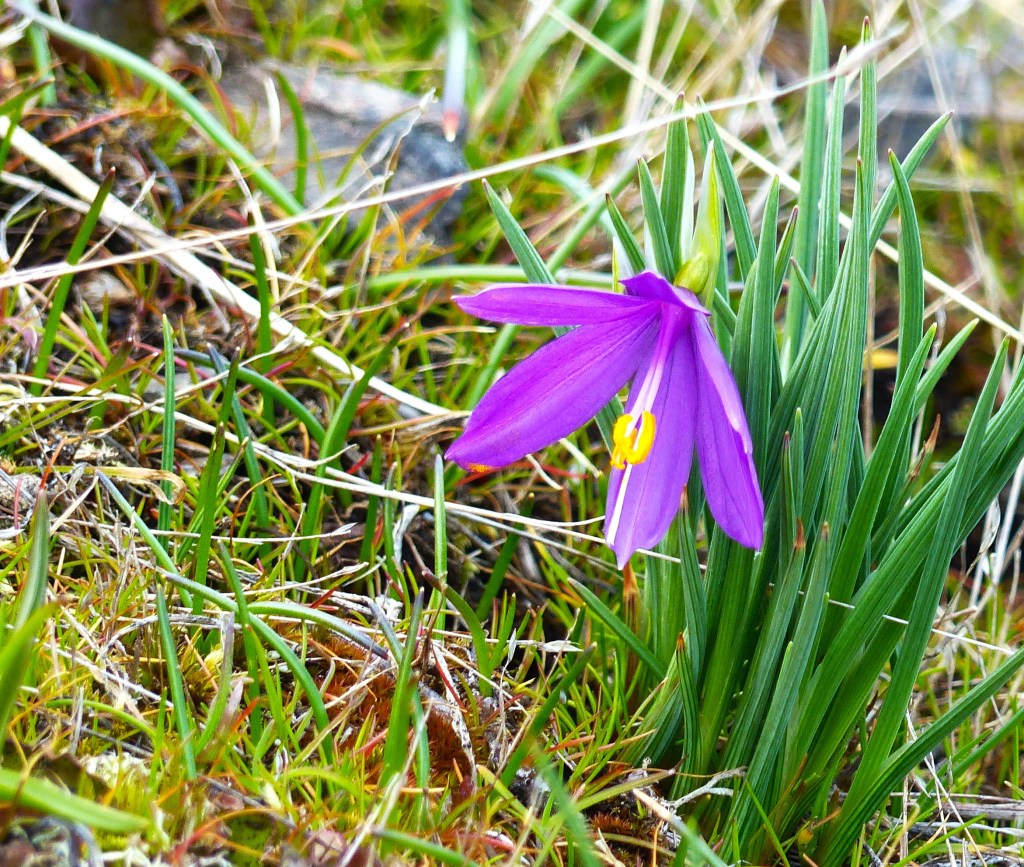
A satin flower, Olysynium douglasii, was among the first blooming wildflowers on Iceberg Point on Sunday.
Sailboats sit at moorings on Fisherman’s Bay, just off Lopez Village, as seen from my lunch spot.
THE OFFICIAL, FARMER’S ALMANAC-SANCTIONED spring equinox might not be until 2:24 p.m. PDT Monday. But spring arrived today in the San Juan Islands.
Hallelujah.
The sky was clear, the seas were calm, the thermometer pushed 60 degrees, and Center Island’s docks were nearly full. All over my island people were outside hammering, hoeing, washing down and tidying up — doing all the celebratory puttering that comes with the end of a long winter.
I celebrated a few days early by relaunching my 1957 runabout, WeLike, on Thursday. It had sat forlornly on a trailer since November. Doing my part as a spring-inspired islander, I checked over the boat’s electrical system, added fresh fuel, drained the water strainer, ran the bilge pump and gave the boat a good scrub.
Then I buzzed over to Lopez Island yesterday for a blissful day of normal stuff you do when it’s not winter.
At Isabel’s Espresso, I sat outside on the deck and read a book while I sipped a good coffee. I stopped in at the supermarket for fresh produce. I took a sack lunch and strolled out to a favorite bench at Fisherman Bay Spit, where rogue daffodils were starting to bloom in the pasture of a long-deserted farmstead. I ducked into the public library and checked out a real book. What a delight! One gets overly reliant on Kindle when you live on a remote island.
Galley Cat, too, is reveling in the warmer days, gamboling up and down the rocky knoll. Returning inside today after an hour out inspecting the grounds, she smelled all sun-washed and fresh, like linen sheets that had dried on a clothesline.
It’s supposed to rain on Monday, the Weather Service says. But for a few days, we got a jump on the season of renewal, in all its glory. Hallelujah.
A Dark-eyed Junco like this explored my chimney and woodstove this morning.
ALL’S WELL THAT ENDS WELL, Will S. wrote, and as I breathed a sigh of relief this morning I decided he was right.
But this is definitely the year I replace my chimney.
Being Daylight Savings Sunday, I was lolling in bed reading John Grisham and finishing my coffee and avocado toast at what some might call a late-ish hour of the morning. But I had that “spring ahead,” lose-an-hour-of-sleep excuse for lolling.
That’s when I heard the skittering.
For a moment I tried to convince myself it was a Nuthatch — the bird for which my cabin is named — outside messing about in my metal roof’s gutter, as they often do. Getting a sip of water, perhaps; the drainage isn’t all that great.
But then I heard it again: a sound like fingernails lightly brushing metal, and it wasn’t coming from outside. I recognized that sound.
Damn.
I had another bird down my chimney.
Loyal Reefers might recall a couple Novembers ago when this happened before. That time, I got paranoid about what was in my chimney, imagining anything from a hapless bird to a squirrel or raccoon (or, as several merciless readers suggested, a skunk).
At that time, try as I might I couldn’t figure out how to open up the chimney and release the creature, which had fallen into the lowest reaches of the woodstove’s metal flue, the eight feet or so that connect the stove with the cabin ceiling. The chimney has a conical cap up top and I expect it was screened when it was new, but the screen has probably disintegrated with rust and heat over the years. Rising high above my rooftop, it’s not easily inspected.
Unable to catch-and-release that first time round, I went with Undesirable Choice No. 2: Refrain from building a fire and let nature, uh, take its course. It was several days before the skittering stopped.
Eventually I discovered a way to remove the fire bricks at the top of the woodstove and was able to remove the poor dead sparrow.
As I lolled in the loft this morning, I resigned myself to another unpleasant days-long “death watch.”
But then I realized: Now I know how to open up the stove from inside. I could try to get the bird out. If I could free it from the chimney, maybe I could capture it in a large trash bag and set it free outside, hopeful that it wouldn’t be caked with soot and creosote. I had to try.
Meanwhile, Galley Cat, who usually snoozes the morning away on her heated cat bed downstairs, had come up to the loft to see me. Vocal and wide-eyed, she was clearly trying to tell me something.
Descending the stairs and crossing the living room, I saw what she was trying to communicate: “Pops!” (she calls me “Pops”)… “Pops, there’s a birdie in the woodstove, you can see it in there!”
Sure enough, this bird was no longer caught in the chimney, it had squeezed its way down past the firebricks and made it into the stove’s main chamber. There it was, clearly visible, fluttering behind the glass: a very unhappy Dark-eyed Junco. For goodness’ sake.
OK, Rescue One, suit up and respond to an avian distress call at 1366 Chinook Way.
Adrenaline flowing, I grabbed a trash bag from the pantry. Plopped the feline in the bathroom, behind a closed door. (She was certain she could help. I demurred.) I hoped to bag the victim as I cracked open the stove door, but in case it got past me I opened wide the glass slider and a side door.
Happily, the Junco wasn’t caked with creosote. It remained perfectly mobile, which it proved the moment the door was cracked. Despite my best efforts with the trash bag, I had a Junco flying around my living room.
Unfortunately, it didn’t find the open doors. It bumped against one of the big front windows, then flew through the kitchen and thumped against a window by the sink, where it decided to stay and flutter about.
Now, I have to say this for that bird. Whether or not it knew I was trying to help, it did me one huge favor. Anybody who has heard the sad tale of the duck that got into our sailboat’s V-berth, which ended with a very long afternoon at the laundromat getting our bedding de-ducked, will know these things can end badly. I’ll just say it bluntly: No matter how frightened it may have been, the Junco did not shit inside my house. Thank you. Were the roles reversed and a giant songbird was chasing me with a trash bag the size of Mount Constitution, I can’t promise I’d have been so reserved.
Anyway, I sidled over to the kitchen with my trash bag opened wide. The bird tried to take cover in a potted plant sitting behind the sink, but I swooped and scooped.
As first, I didn’t think I’d caught it. Songbirds don’t weigh much, and under the feathers there’s not a lot of bulk. I very lightly gripped the bag closed while I searched around the plant and among the dishbrushes. My home invader wasn’t there. So I carefully peeked into the plastic bag cradled in my fist and saw a pair of fragile bird feet sticking out. It wasn’t struggling, perhaps just resigned to its fate.
Keeping my grip loose, I quickly strode out onto the deck, put the bag down and opened it wide. The Junco flew away, and I don’t think it stopped until it hit Lopez Island.
All’s well that ends well. But, sheesh, it’s time to get a chimney with a screen.
When I flee the seemingly endless winter on Center Island and seek a place with more live humans, I guess you might call me an “off-my-rocker.” Kind of goes along with living in a cabin called the Nuthatch.
Anyway — forging prosaically on — when I need to get away and have just a day, I like to go to Bellingham.
This week I decided a necessary grocery-shopping trip would be a good opportunity for a northward pilgrimage to the City of Subdued Excitement, as Bellinghamsters like to call their town.
OK, I mean, right there — not only does the place have a great self-deprecatory, tongue-in-cheek slogan, but residents go by a name that conjures a vision of a town full of anthropomorphized rodents driving around in little cars. I appreciate a community with a sense of humor.
They also have almost as many craft breweries and brew pubs as Bend, Ore., which everyone knows adds significantly to the quality of life.
When my family returned from a 1990s sailing trip to Mexico after two years of being off the grid careerwise, Barbara and I realized we could start afresh wherever we chose. We hoped to make a go of it in Bellingham, a congenial college town on a beautiful bay, a half-day’s sail from the San Juans and practically in the shadow of Mount Baker and its razzle-dazzle ski area.
Unfortunately, it didn’t work out. Newspapering was my life, and I did get hired and worked for one day at the local daily, the Bellingham Herald. But I was young, a bit cantankerous, and just returning from the freedom of the wild seas. That first day on the job, after I’d expressed enough disagreements with the corporate policies of the Herald’s parent company, Gannett, one of America’s worst newspaper chains, the newspaper’s H.R. director and I mutually agreed that it just wasn’t a match made in heaven. So my family sailed south into Puget Sound and I ended up at The Seattle Times. A happy ending, as it turned out.
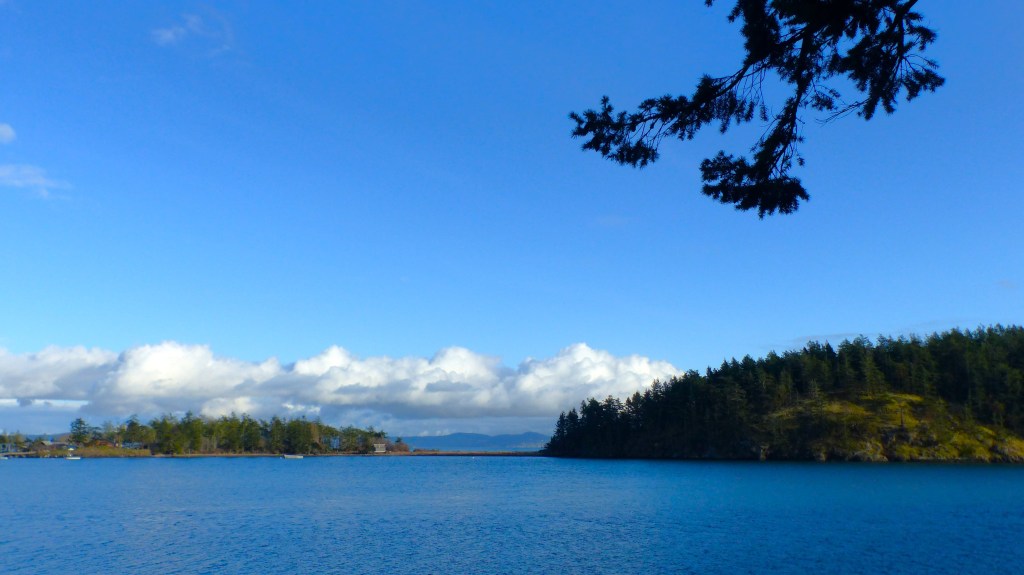
From a viewpoint along Chuckanut Drive, the road to Bellingham offers panoramas of islands and saltwater in a varied palette of blues.
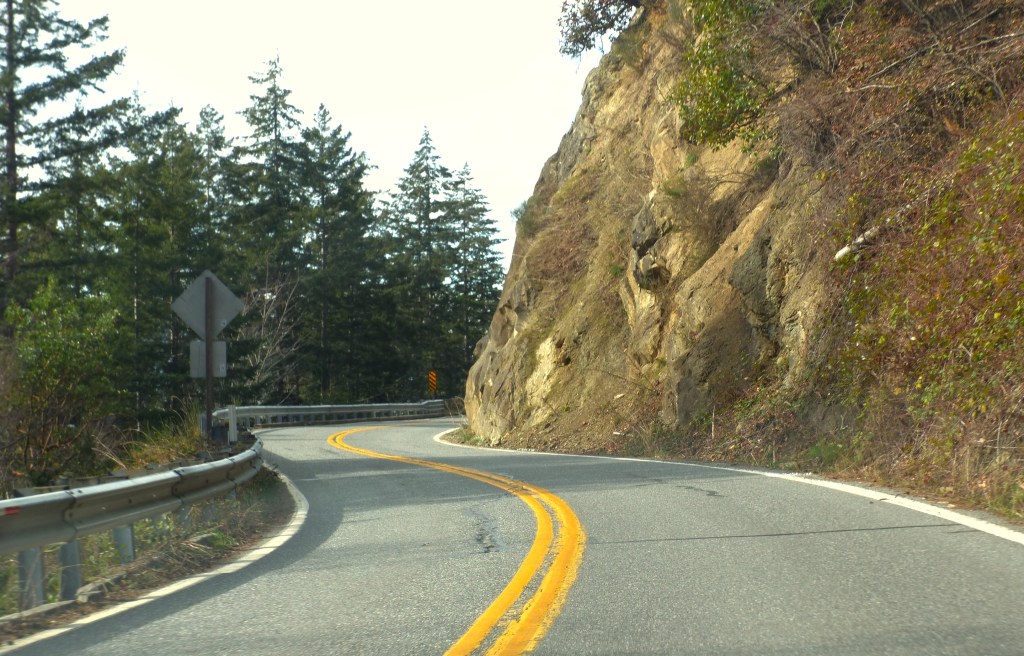
Chuckanut Drive curves
But I’ve always enjoyed visiting Bellingham, about which I wrote numerous travel stories for the Times. These days I like going even if only for a quick trip to the sole Trader Joe’s in Northwest Washington. From the water-taxi dock in Anacortes, it’s an easy hour’s drive.
I got a pleasant sunny day for this trip, and I found time to get off Interstate 5 and chug northward on scenic and serpentine Chuckanut Drive, the original northbound road that skirts the base of the Chuckanut Mountains, a foothill spur that geologists say is the only place the Cascade range meets the sea. It adds only about 15 minutes to the trip, but it’s a superb quarter hour. Starting from the Samish Flats, where I saw a fluttering flurry of snow geese, my red Civic snaked along boulder-strewn cliffs, passed chattering waterfalls and skirted moody panoramas of islands and saltwater.
An overwater boardwalk is part of the waterfront trail crossing Bellingham’s Boulevard Park.
Reaching town, I navigated the old-town Fairhaven district and pulled off at Boulevard Park. A narrow strip of land between the bay and the main north-south railroad tracks, the park offers shoreside benches, picnic tables, a kids’ playground and a waterfront path and overwater boardwalk that stretches miles into downtown. It’s my chosen stop when I pack a lunch. On breezy days, I’ve watched kiteboarders fly high out in the bay. The park even has a good, locally run coffee shop. Very civilized.
After lunch, my day was devoted to grocery shopping. But if you’re there with more time, Bellingham has a bunch of fine museums, dedicated to history, art, and even electricity (the eyepopping Spark Museum); a distinctively spired performing arts center (the 96-year-old Mount Baker Theatre); a variety of pleasant walking trails (such as a waterfront amble on Lake Whatcom), and the aforementioned breweries.
The excitement, though tastefully subdued, is earned.
Cottony clouds crowd the Cascades on a recent sunny but cold day. Looking east from Center Island across Decatur Island to Rosario Strait.
DECEMBER TOOK A JAB AT IT, but February has again tussled its way to the title as the San Juan Islands’ winter month with the most unpredictable and weirdest weather.
We’ve had hail (pelting down like a million icy little meteorites on my deck, more than once). We’ve had frigid Fraser Valley gales (combined with big tidal swings that make crossing Rosario Strait to Anacortes a rocking, sloshing, life-challenging adventure, more than once). We’ve had blowing snow, we’ve had frosty nights. And, yes, we’ve also had pristine sunny days, such as today, most of which have never warmed above freezing. And, oh my, the starry nights.
Galley has donned a cunning Argyle sweater against the February cold.
“I’m done with the cold,” the Mad Birder grumped on a recent visit. He moved here from California, which by rights might make him bitter about our February freezes, but today Los Angeles has blizzard warnings, so go figure.
Extreme cold tends to keep us otherwise hardy islanders indoors by blazing fires much of the time. By now, with the month of March parading our direction as if to a John Philip Sousa composition, our feet are decidedly itchy.
I have done a few things other than binge-watch all four seasons of “New Amsterdam” in recent weeks. On a day when the earth wasn’t frozen I finally dug a hole in which to plant the five-foot Charlie Brown fir tree that had been living in a root-bound pot on my deck for many months. Daughter Lillian brought the tree up a couple years ago. It was Nuthatch cabin’s Christmas tree in 2021. When much smaller, it had served as her Christmas tree on the sailboat in 2020, after being dug up on Auntie Sarah’s Camano Island property. So it’s a well-traveled little tree, finally properly planted and surrounded by deer fencing next to the porch of Wee Nooke, my Center Island writing hut.
Wee Nooke’s newly planted tree.
Wee Nooke needed a new tree. We originally erected the 36-square-foot cedar shed in the shade of a sizable shore pine that leaned artfully over its roof until the pine blew down a few winters ago. Had the tree fallen about 10 inches to the left my Nooke would have been transformed from man cave to matchsticks. If the Charlie Brown tree ever gets big and old enough to blow down, I am confident I won’t be around to be squished. Always look on the bright side of life, I say.
I bottled a gallon of beer this week, brewed on the Nuthatch’s stovetop a couple weeks ago with the help of Lillian and partner Chris when they were up for a quick visit. The beer fermented in a jug next to a miniature electric radiator beneath an upturned plastic storage tote behind my bed. I got to drift off to sleep to the comforting “boop-boop” of the jug’s venting gases that told me the yeast was happily working its magic.
Made with a popular strain of pungent, citrus-scented hops called Cashmere, this brew is dubbed Cashmere Blonde. Lillian educated me that cashmere wool comes from Cashmere goats, so I found an image of a wildly-horned, blonde Cashmere goat to go on the bottle label. The ale will be properly bottle-aged in time for me to quaff with Lil and Chris on their next visit, possibly while we brew another batch, in mid-March.
Meanwhile, if robins are harbingers of spring (a highly dubious assumption, I see them here in December) (but I digress)… If robins are harbingers of spring, we should be headed for warmer days. Yesterday I saw about a hundred of the red-breasted harbingers pecking for worms on the grassy field that is Center Island International. So I guess “seeing red” isn’t always a bad thing.
Until spring has sprung, Galley Cat and I send warm thoughts your way.
WINTER IS QUIET, winter can be lonely, but winter can also be a time of unique beauty on my island.
Here’s a sampling of photos captured during my walks around Center Island in recent weeks, starting with our pre-Christmas snowfall and concluding with recent cool days mixed with sun and showers.
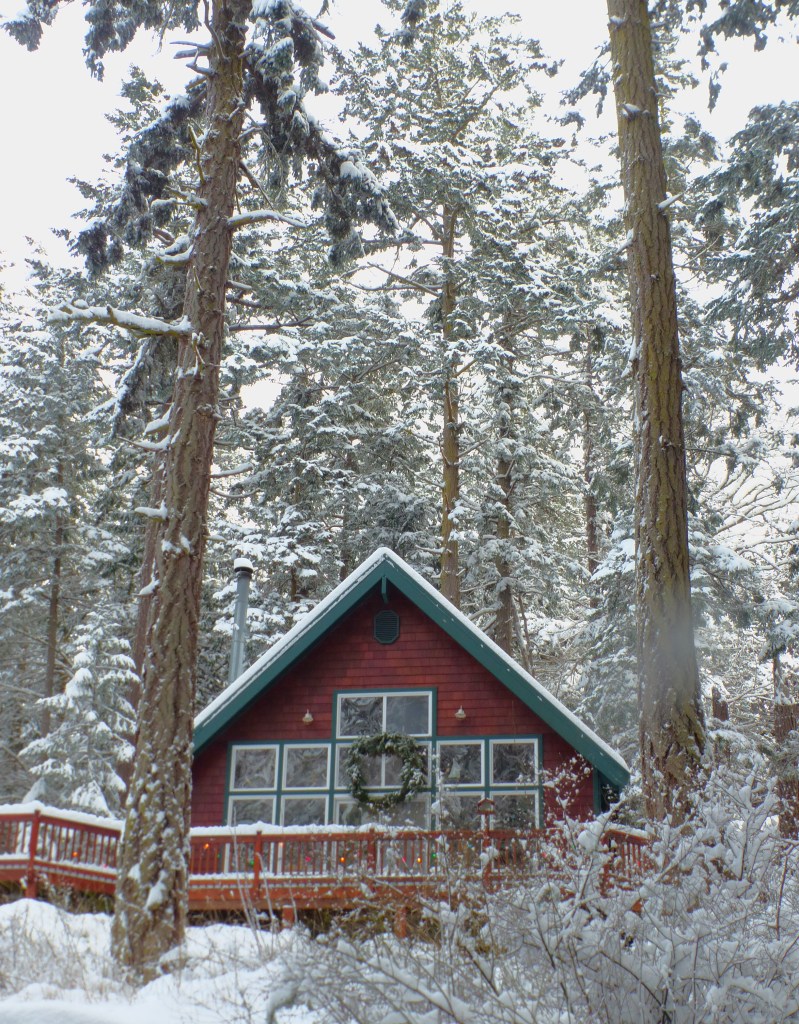
It was starting to look a lot like Christmas at The Nuthatch after heavy snow fell just around the solstice.
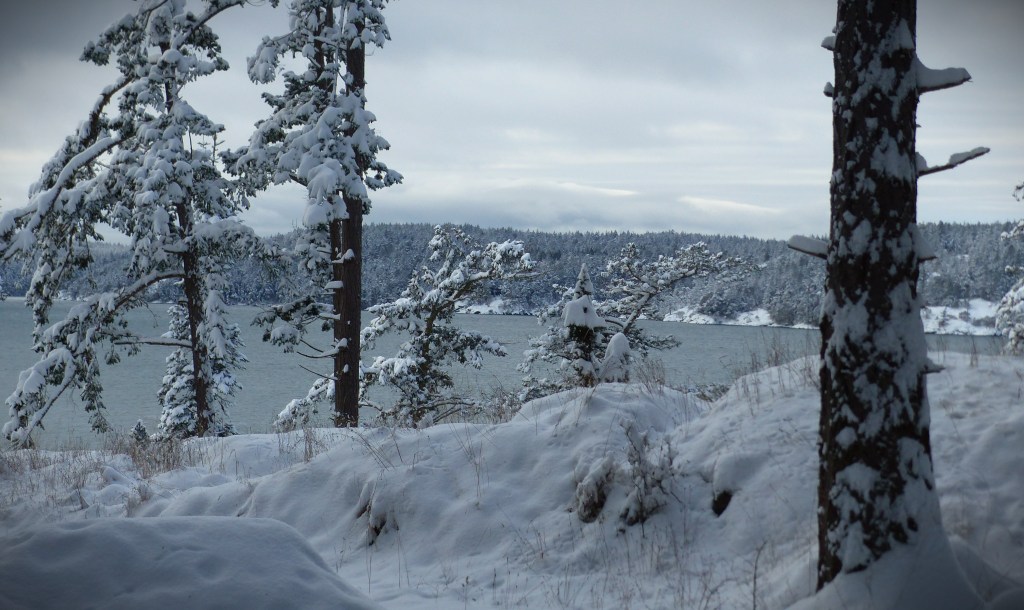
Lopez Sound was just as cold as it looked. Taken from the southwest quadrant of Center Island, looking toward Lopez Island.
A neighbor’s chairs make for a cozy place to sit — in July. Looking toward the southern tip of Decatur Island.
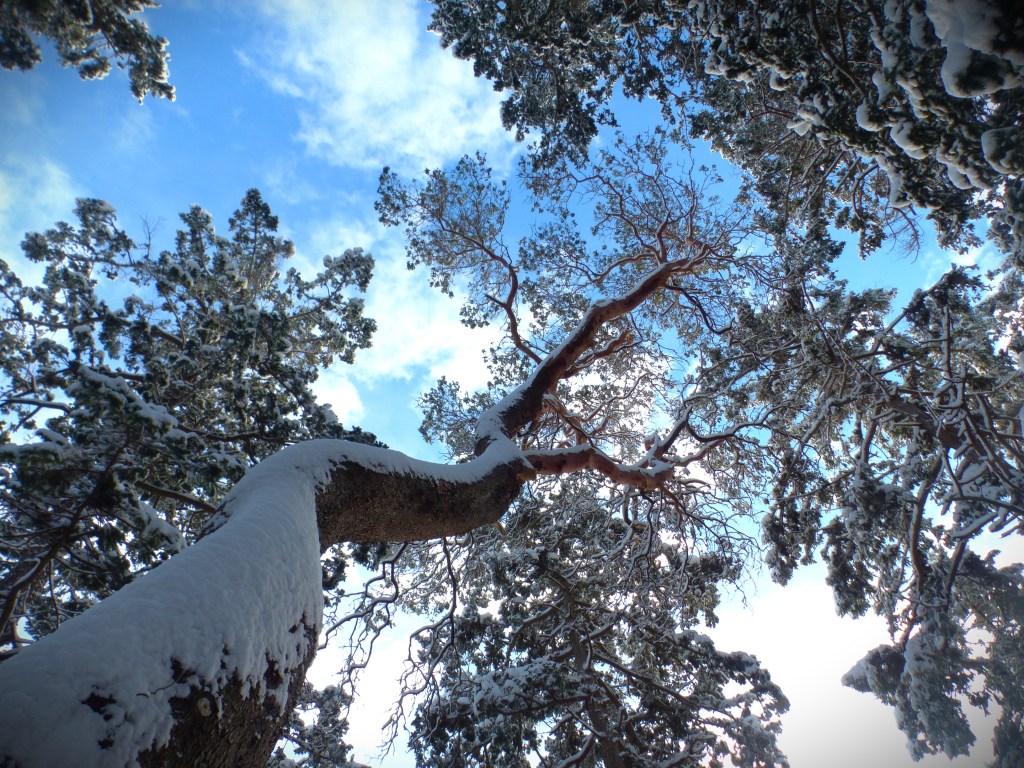
Looking up the snow-laden trunk of one of the island’s largest madrona trees.
This week, with the snow only a memory, watery winter sunshine lit the back path up the moss-cushioned rocky knoll where my writing hut is situated, behind the cabin.
A pair of Bufflehead ducks (female, left, and male, right) didn’t see eye to eye during a paddle this week on Reads Bay, a short distance off our Center Island dock. They are likely wintering in the San Juans from a summer breeding ground in Alaska or Western Canada.
This was the view from the Nuthatch cabin’s front window the morning of December 20. The railing was snow-free only because ravenous birds mobbing the feeder had knocked it clear.
This has been a terrible, horrible, no good, very bad December in the San Juan Islands.
A week ago Monday night, it snowed and snowed, then snowed some more. Enough to snowshoe on. Skis would have been great. Tromping around the island, as my boots sank deep, I got twice the normal exercise.
Then it froze and froze, then froze harder. The snow never melted. My firewood pile sank quickly.
Daughter Lillian, who lives in Seattle, and I had long ago planned Christmas at a little camping-cabin at Camano Island State Park, a pretty spot halfway between us, reachable by a bridge from the mainland. The trip required only an hour of driving for each of us.
Our Christmas cabin on Camano Island.
Happily — even Alexander would have been optimistic — the National Weather Service assured us that a warming trend would arrive two days before Christmas. Presumably, rain would wash away the snow and ease any travel worries. Our plans were golden. I’d catch a water taxi on the late morning of Christmas Eve and Lil and I would meet up in time for the 4 p.m. check-in time, ready to whirl our way around the little cabin, trimming it with lights, baubles and bows.
Though snowy and cold, the week was going well. I’d hosted a pleasant happy hour for neighbors on the solstice. Then, Thursday at 1:09 p.m., my water-taxi service texted to tell me that they expected to cancel every trip on Christmas Eve. The forecast called for winds exceeding 50 mph, rendering the voyage unsafe. Even Santa might get blown off course.
Rebook your trip for Friday, the Paraclete Charters folks urged.
Panic ensued. Staging a portable Christmas with many of the favorite family decorations and dishes — the Santa-and-reindeer light string, the Christmas Spode, etc. — entailed hours of careful packing. I’d been counting on a full day of prep on Friday.
I would also now need a place to stay Friday night on the mainland.
Shamelessly, I phoned my next-door neighbor, the Mad Birder, and “invited myself ” to crash with my sleeping bag on his sofa at the La Conner home he shares with his wife, Carol. They had boated over to Center Island the previous week, to stay through Christmas at their cabin.
The Mad Birder, generous by nature, put up little resistance. He also agreed to look in on Galley Cat, who would be home alone for a couple nights. (Someone else had nabbed the one Camano cabin that allowed pets.) By late afternoon, it seemed that I (with help from the M.B.) had risen to the challenges the islands were throwing at me this Yuletide. I would get the Paraclete’s final Friday sailing, by which time the snow would have mostly melted away. So the plan went.
Then, at 4:45 p.m. Thursday, just as I was thinking about dinner prep, the lights went out.
My meal that night was a peanut butter and jelly sandwich.
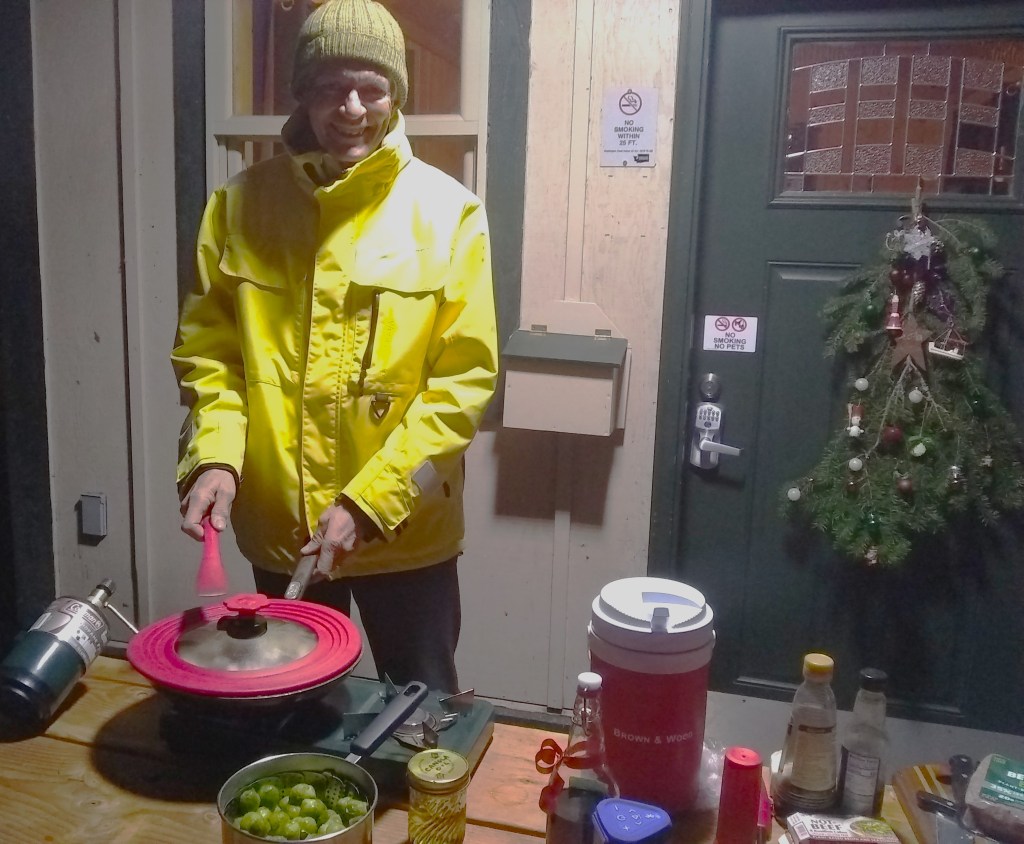
Your correspondent with Christmas dinner in the works: stovetop Shepherd’s Pie, with Brussels sprouts, spiced with fresh air.
Usually these outages are localized and fairly quickly resolved. But a call to our power cooperative informed me that the outage was countywide, caused by a system failure on the mainland. Uh-oh. That meant fixing it was up to Puget Sound Energy and Bonneville Power Administration, rather than our quick-responding, owner-operated Orcas Power & Light Cooperative (OPALCO). Our islands don’t always top the priority list for Puget Sound Energy, owned primarily by Canadian investors.
A recorded message said the power might be out at least four hours. Outside temperatures were in the low 20s. It would be a very cold night. After I’d risen every hour on the hour to stoke a fire in the woodstove, my lights came back on 13 hours later, at 6 a.m. Friday. I could cook again, but I was bleary eyed at the start of a very long day.
Friday didn’t warm up nearly as much as forecast. By the time I needed to head for the dock with my food, gifts, decorations, camping gear and warm clothing, eight inches of snow remained on the ground. The gravel roads were still coated in compact snow and ice. No traction for my golf cart or a community pickup truck, so I loaded baggage into my pushcart and trudged slowly across the island, 3/4 of a mile through freezing rain and light snow. Two trips, the last one in the dark. I really didn’t want to cancel Christmas with my daughter.
Happily, roads in Anacortes and the Skagit Valley had almost completely thawed. I made it to La Conner with barely a hitch. The only place I got stuck was trying to pull into my friends’ driveway, still a solid mass of snow. Luckily, I’d brought a shovel.
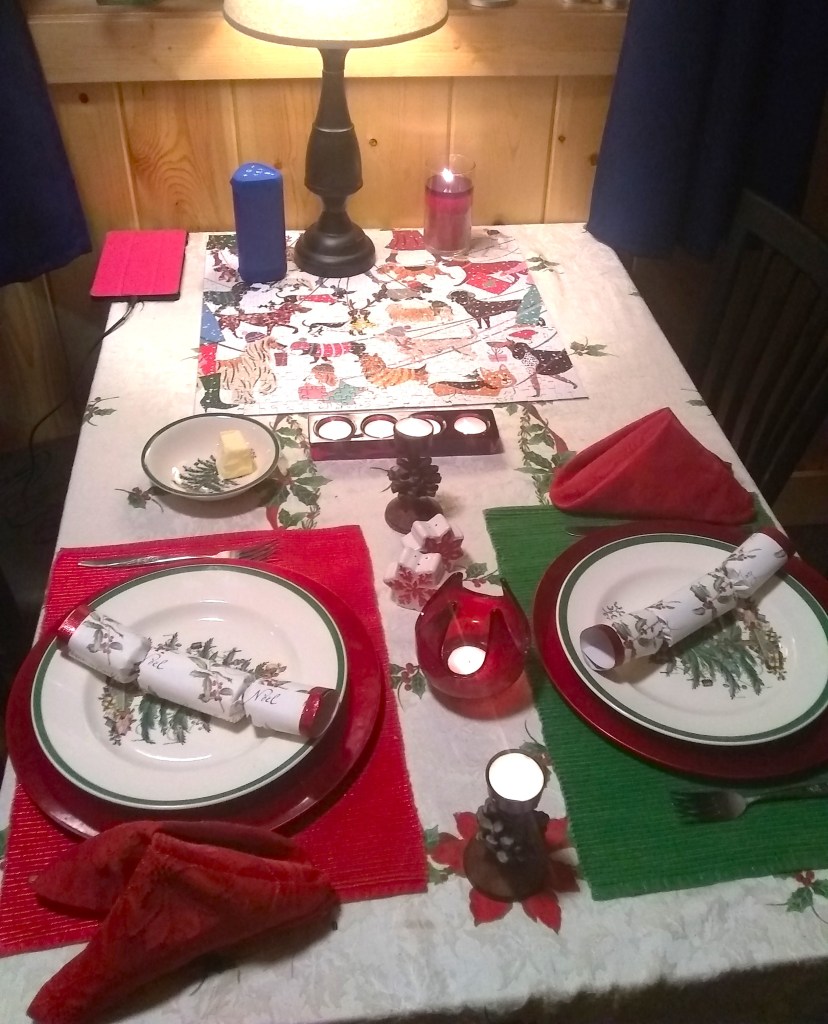
Our Christmas dinner table at the Camano cabin included prize-packed crackers, a fixture inspired by my late wife Barbara’s Australian upbringing.
At 8 p.m., I sat down to the sack dinner I’d brought. In a phone call to let the Mad Birder know I’d made it, he insisted I raid his liquor cupboard for a tot of Glenfiddich. This time, it was I who put up little resistance. If there’s a heaven, that man is going there.
The next day, Christmas Eve, Lillian and I made our rendezvous at the Camano cabin. It was basic, but cozy, with lights, heat, a fridge, a microwave oven and comfy beds. I set up my propane camp stove on a picnic table under the covered porch. Bathrooms and hot showers were 100 feet away.
We made the place festive, gathering fallen fir boughs for a window-sill vase and a swag on the door. Lights went up in a window and over the door. If there had been a hall, we’d have decked it. Heirloom treasures made for a holiday dinner table fancier than that place had ever seen, I’ll wager. I was glad to have trundled the Cantwell holiday trappings through the snow.
Meanwhile, I discovered that the San Juans had lost power again that morning. My kind neighbors were again sitting in the dark. Happily, power came back on just in time for their Christmas Eve dinner.
Christmas Day, my daughter and I breakfasted on almond-flour blueberry pancakes. We hiked through rain-washed woods to wander the beautiful cobbled beach, returning to the Christmas cabin to lunch on Stilton and Cotswold Double Gloucester cheeses on crackers while piecing together a new jigsaw puzzle. We played new board games before and after a savory dinner of camp-stove shepherd’s pie, which Lillian totally aced.
Your correspondent, left, and daughter in their Christmas crowns.
My dessert, Bûche de Noël, baked at home just before the power failed, was, um, a mixed success. The sponge was basically a failure — chewy and tough rather than airy and light. But if you smothered mocha-flavored whipped cream on cardboard, it would still be heavenly.
So, after all, in the end, the terrible December got better. The horrible weather didn’t defeat us. Christmas turned out more good than no good. And even my very bad dessert was tasty.
Is there a moral to the story? I guess it’s this: Let’s nurture resilience and hope. Let’s meet the challenges. Let’s trundle through the storms, no matter what 2023 throws our way. Happy new year, friends. And remember to bring your shovel.
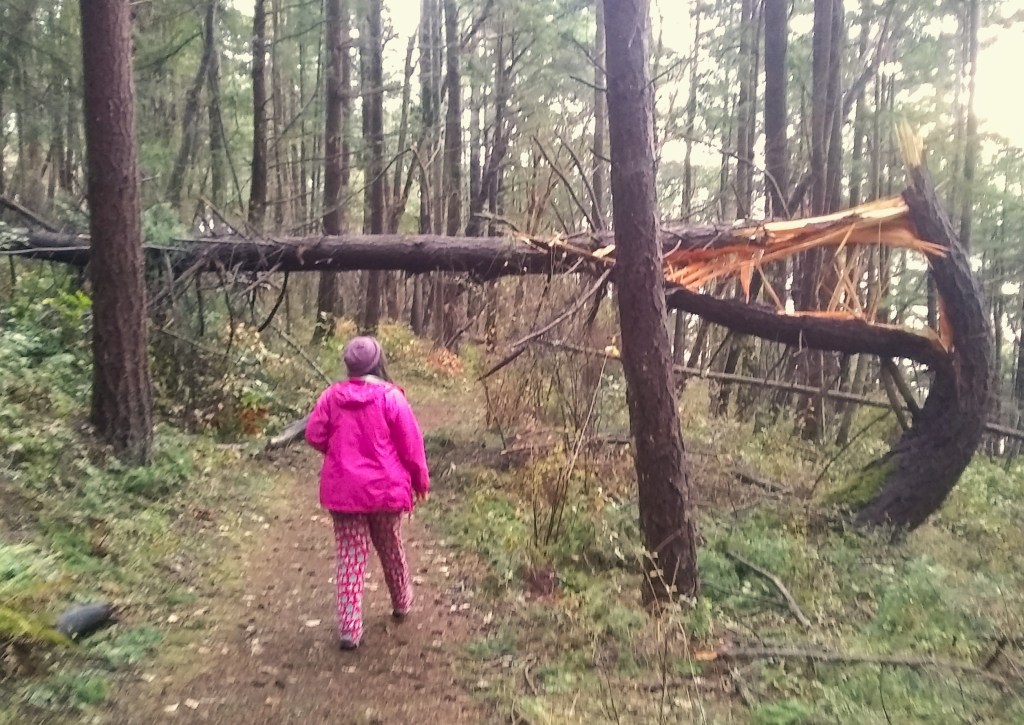
Winter winds had wreaked havoc in the woods at Camano Island. The fang-like splinters inspired Lillian to dub this the dragon tree.
Chris Noel and Lillian Cantwell on the edge of San Juan Channel at Lopez Island’s Shark Reef Sanctuary.
IT’S HUNKERING-DOWN SEASON in the islands.
But before the snow flies, Galley Cat and I enjoyed a Thanksgiving that evoked the true meaning of the day, with an enjoyable visit from daughter Lillian and her new partner, Chris. Lil is vegetarian and he eats vegan, so turkey wasn’t on our menu. Instead we fired up the charcoal barbecue — never a bad turn of events at the Nuthatch, in the view of this chief cook and bottle washer — to grill Beyond Meat burgers. For a Thanksgiving spin, we added sage to the plant-based “meat” (meet? mheet? mieht?) and a dollop of cranberry sauce on the buns. Sweet-potato fries and oven-crisped green beans were our sides. For dessert: Lillian’s homemade pumpkin pie. (The woman has the gift of pie crust, a skill that will serve her well in life.)
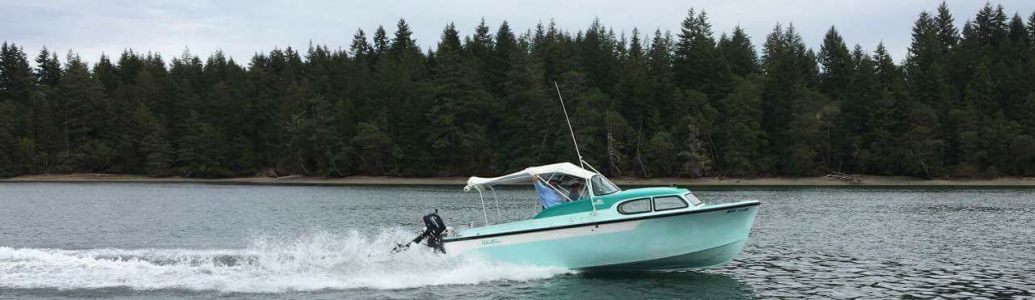
We played games by the fire. We watched favorite movies. The day after our fanciful feast we hopped aboard WeLike, the eldest but most colorful watercraft of the Cantwell fleet (turquoise was popular in 1957), and buzzed over to Lopez Island for a hike through woods to one of my favorite San Juan destinations, Shark Reef Sanctuary. As we looked out from a mossy cliff, whitecaps churned the wide Strait of Juan de Fuca, harbor seals and cormorants lounged on offshore rocks, and wind-riding bald eagles pirouetted above our heads.
Lil and Chris returned to Seattle on Saturday morning, and I soon set about preparing for winter. The weather forecast for this week frequently mentions the “S” word (snow), along with robust winds, pelting rain and nighttime temperatures below freezing.
I hoisted a brown triangular rain tarp between trees to help ease winter’s assault on the Nuthatch’s Electronic Personnel Transport, aka Mr. Toad, my 26-year-old golf cart. (A toad-size carport is still on the to-do list for coming summers.) I climbed aboard Center Island’s big orange Kubota tractor and pulled WeLike on to its trailer for winter storage, safe from battering waves. After spraying the boat’s canvas top with waterproofing gunk (to use the technical term), I snapped on the window covers and refreshed the boat cabin’s dehumidifiers with new calcium-chloride pellets.
So, let’s see. The woodshed is stacked high. The pantry is stocked. Extra cat food is on order. Tomorrow I will test-run the gas-powered generator and be sure the emergency candles are someplace I can find them in the dark, should it come to that.
Winter’s coming. On a small island nobody’s heard of, you gotta know when to hunker down.
Viewed from the Paraclete water taxi’s transom on a pleasant first day of November, a ship on Rosario Strait churns southward toward the Strait of Juan de Fuca.
SUDDENLY IT’S SERIOUSLY NOVEMBER, and I’m back in my writing hut on the rocky knoll. The oil-filled radiator is cranked up high, warming my shivering knees. When did all this happen?
For the family Halloween party, daughter Lillian was a Gorgonzola (a, um, cheesy take on Medusa) and your correspondent was a giant wedge of cheese. M.S. Burton photo.
After autumn’s sunny and dry debut until October’s final days, the Pacific Northwet is reasserting itself. About time. We have sorely needed the rain. In a matter of days, the 3-inch quilt of moss blanketing my knoll has returned from its anemic pallor to a vibrant lime green.
Still, we’ve had a happy mix of weather days. For a weekend getaway to the Long Beach Peninsula with old friends, we enjoyed a blueberry sky (on what’s sometimes regarded as the Cranberry Coast, because they grow them there). Back with Seattle in-laws two days later for the annual Halloween party, I sheltered from an onslaught of fire-hose rain.
Yet, November’s first day brought another blue-heavens afternoon. Galley Cat and I relaxed into a smooth ride on placid seas as the Paraclete water taxi transported us home to Center Island.
Now I sit with a high-intensity lamp gleaming on my keyboard to counter the mid-afternoon gloom. Rain pelts Wee Nooke’s cedar-shake roof. Outside the mullioned window, serviceberry leaves that have taken 40-degree nights like a tonic are suddenly a brilliant yellow, defying the gunmetal sky. On my desktop speakers, Bob Dylan drones his delightfully nasal “Like a Rolling Stone.” Outside, rapidly building winds set tall firs shimmying as the drumming raindrops transform from a rattly snare to a booming timpani.
It might be time to beat a retreat to the sturdier cabin and stoke a blaze in the woodstove. This is why I split all that firewood in September.
Stay dry if you can, fellow webfoots. Stay warm, however you may.
















 Cantwell's Reef