Days of splendor arrive like an avalanche

Avalanche lilies on Center Island? That was my first guess. But, really?

THESE ARE MAGIC DAYS in the San Juan Islands.

As I sit in Wee Nooke, my cedar writing hut atop the rocky knoll, the door and windows are open wide. Buttercups at my doorstep match the sunshine streaming in. No heater today, for the first time since autumn. No hot tea to sip. I’m guzzling cool lemon-water and hyperventilating on the sweet scent of wildflowers. Our wintry days are finally done.
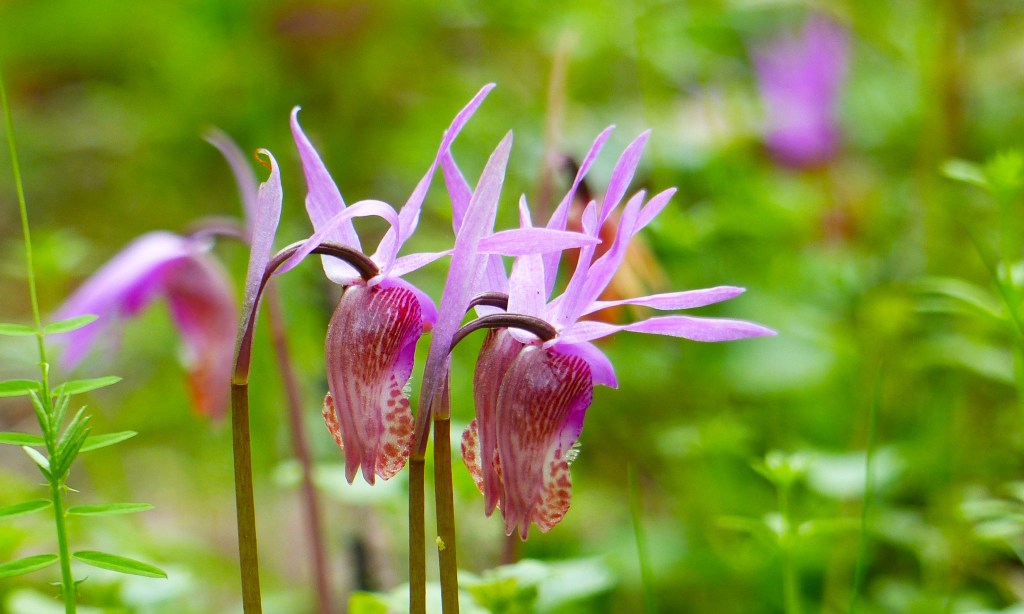
We’ve had a bumper crop of fairy slippers.

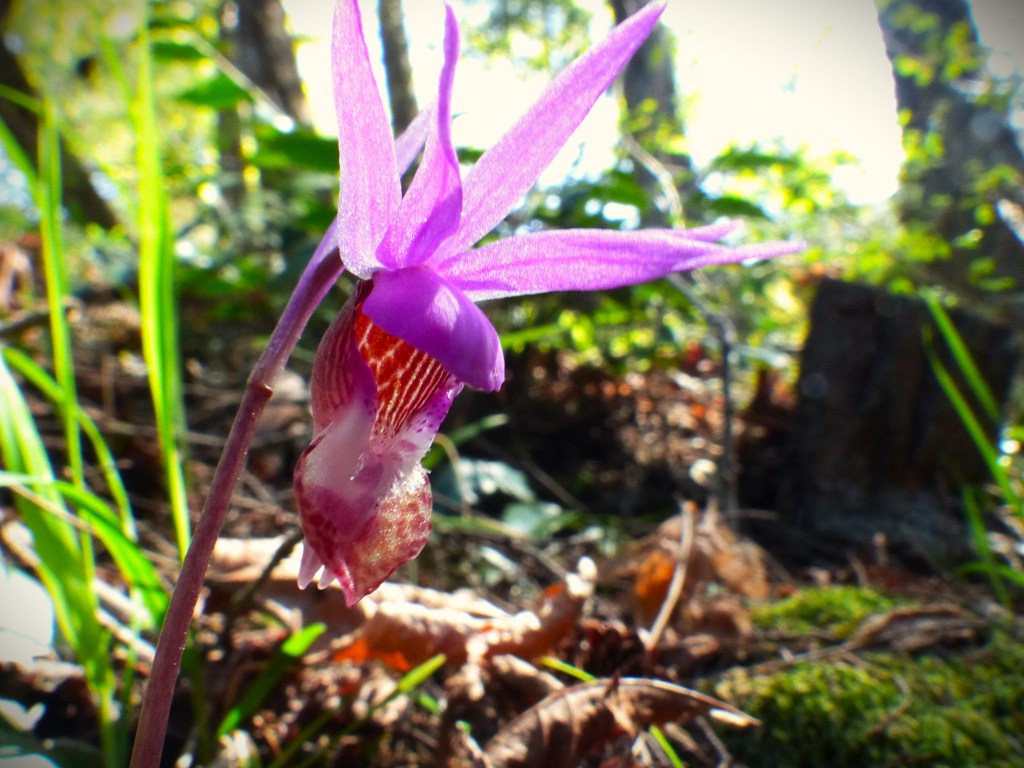
Besides those cheerful, buttery blooms, we’re enjoying a bumper crop of fairy slippers, aka calypso orchids. Sea blush, each of its flowers barely the size of a grain of beach sand, is starting to carpet the knoll with pink. And I was briefly flummoxed to come across what looked for all the world like avalanche lilies, those spidery blossoms of snow white on a tall stalk much more often seen on Mount Rainier than a few feet above sea level. Never encountered this flower on my island before, but this week half a dozen are bobbing in the gentle April breezes on the knoll. A little research proved that climate change hasn’t, in fact, brought interlopers off the mountain; these were great white fawn lilies, Erythronium oregonum, a common flower in the San Juans, though new to my corner. The leaves are spotted like a fawn, thus the name. (For a quick bit of education before making a wildflower safari to the islands, check out this useful guide, Wildflowers of San Juan Island National Historical Park, which pretty much applies to the entire archipelago.)

Pileated Woodpecker.
Courtesy Jack Bulmer/Pixabay

Birds are causing a flap in my world, too. The past few days I’ve been regularly hearing a distinctive call from what I believe to be a rare (for us) Pileated Woodpecker, that sartorially splendid redhead of the forest. These guys, which can be the size of a small chicken, often set the woods echoing with a burble akin to the jungle birds of old Tarzan movies. Nesting, maybe? But it might also be a Northern Flicker, whose call is similar and which is more common here. A big flicker clung and swung on my suet feeder this morning, perched as precariously as Kong atop the Empire State. Compare the two plus-size birds and their calls here and here on Cornell University’s handy “All About Birds” website.

Other avian excitement: Saw the season’s first American Goldfinch at my feeder 10 days ago, decked out in fabulous lemony plumage all fresh for mating season (there might even have been a paisley cravat there). Haven’t caught one on camera yet. But this morning, as I sat in my living room working a crossword, I looked up in time to see a large Bald Eagle swoop down through my trees, carving a wide circle directly in front of my window before perching on a tree limb by the side of the road. Wow!

I grabbed the camera, stepped outside, and called for Galley Cat. Give me credit here: I put the cat’s well-being above my hope for a photo. I’ve heard about eagles flying away with felines.

Lurking among the foliage, my eagle visitor hung around for 10 minutes, during which I kept Galley Cat inside.

Galley, for once, responded immediately from somewhere in back of the cabin. “Whadda ya want, Pops, whadda ya want?” she trilled, weaving in and out of my ankles while I click, click, clicked the camera shutter in the direction of our national bird, seemingly oblivious of the 10-pound ginger tabby who was doing her best to trip me. As soon as I got my photo, I shooed her inside.

That’s my report from the San Juan Islands on this exceedingly clement day in late April. I hope you’re relishing similar days. Wherever the seasonal wonders find you.

‘Trawler 101’ and keeping busy with a birthday

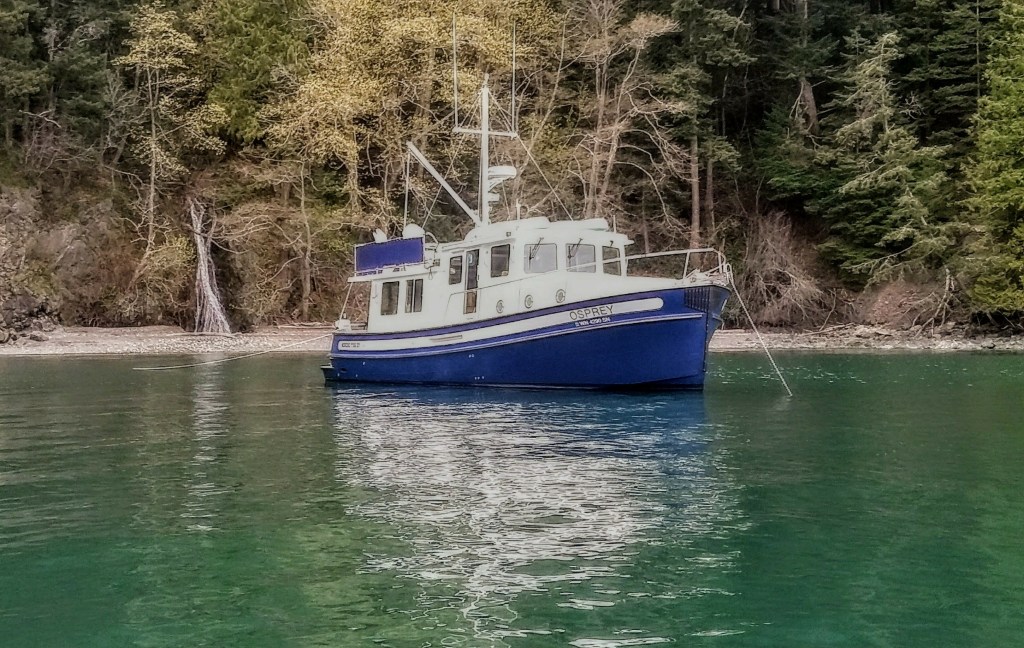
Osprey, the Nordic Tug that friends and I will take to Alaska in late May, sits at anchor by a spring waterfall edging pretty Inati Bay, Lummi Island. A productive weekend aboard helped us get to know the boat.

This post is available on audio. Listen to my Cantwell’s Reef podcast.

EVEN ON A REMOTE LITTLE ISLAND, with no job to go to and no stores to shop at, weeks can get busy. Which is why I’m only just now writing about the training cruise my fellow voyagers and I took 10 days ago aboard Osprey, the charter vessel we will point toward Alaska six weeks from now.

The four of us who will be on the first leg of the cruise are all seasoned sailors, which is one reason we needed a shakedown outing. The bulk of our many sea miles has been aboard sailboats, some of it long ago. So it was a smart idea to spend a weekend with a training skipper to help us learn the ropes (and the anchor, the engine, the modern navigation instruments…) of our 37-foot Nordic Tug trawler.

It was just an overnight out of the boat’s Bellingham base. We had hoped to get out to Sucia Island in the San Juans, but like the conscientious sailors we are, we took a close look at the weather forecast. Or I should say that Carol Hasse, our shipmate from Port Townsend, looked at the weather forecast, using SailFlow, a weather app she checks multiple times a day, a habit formed while sailing Lorraine, her no-frills 25-foot Nordic Folkboat sloop, built in Denmark in 1959.

(I should say that “Hasse,” as her friends often call her, is something of a legend in the Northwest boating community, having operated her own highly respected sail loft for many years. Aboard Osprey, her encyclopedic knowledge of everything nautical has already earned her the nickname “Sea Goddess.”)

Monitoring SailFlow, Hasse reported that a spring storm with gale-force winds would be visiting our corner of the Salish Sea about the time we headed home Sunday. So rather than fight the weather for so many miles on our homeward leg we stayed closer to the home dock, crossing Bellingham Bay to put in for the night at pretty little Inati Bay on the eastern shore of Lummi Island. For practice, we anchored with a tie to a log on shore, keeping our stern facing a waterfall that chattered onto the narrow beach. We had the quiet cove to ourselves for the night. Nice.

Training skipper Tim Hoving gave us a thorough grounding (in a good way, not the hitting-a-rock way) in becoming Ospreyites. Before leaving the marina, we took a detailed tour of the engine room. Then we each took the helm to back-and-fill the boat for a 180-degree turn in close quarters, and took turns docking, both at the helm and working the mooring lines. Once anchored at Inati, we staged a man-overboard rescue, using the trawler’s topside boom and tackle to hoist the “victim” back on to the boat. (We weren’t so heartless as to make the victim dive in to that frigid water; Osprey’s dinghy was our rescue platform.)

After Barbara Marrett’s delicious dinner of shrimp pasta, our day on the water ended perfectly with a DVD viewing in the boat’s salon of — what else? — “Captain Ron.”

The Sunday morning return to dock involved, as predicted, plenty of rocking and rolling. With Bill Watson at the helm through the worst of it, the boat proved itself reliable and stout. One hiccup: The china cupboard in the galley popped open more than once on a bumpy swell, sending coffee cups shattering on the counter. Tim added “stronger cupboard latch” to a short list of fixes needed before the boat heads north Memorial Day weekend.

Magnified with a close-up lens, a tiny Calypso orchid, or Fairy Slipper, blooms on the hillside behind Nuthatch Cabin.

My past week was pleasantly filled with a visit from daughter Lillian, who arrived on my birthday and prepared a tasty dinner attended by my favorite next-door neighbors, The Mad Birder and his wife, Carol. The menu included toothsome jack-fruit tacos laced with pickled peppers and oven-toasted broccoli bits followed by a sugar-free birthday cake, tangily tasty with orange zest and topped by chocolate frosting. Keto ice cream gilded that lily.

Another highlight of last week: The tiny magenta Calpyso orchids, wildflowers affectionately known as Fairy Slippers, bloomed on my rocky knoll. Buttercups and pink Sea Blush are coming on quickly.

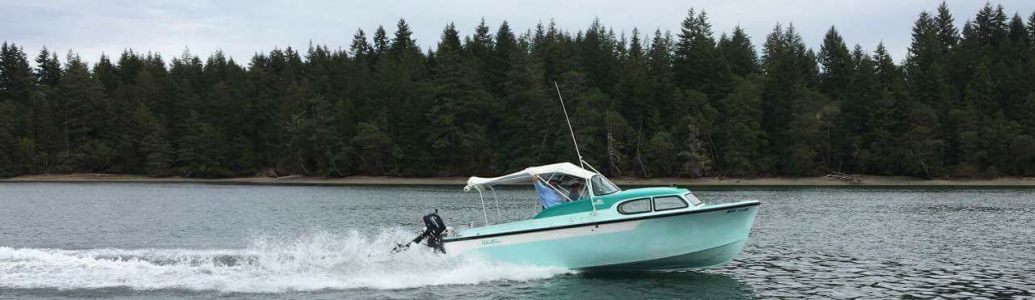
This week, my brother Doug visits from Santa Fe. Plans are to barbecue salmon one night and grill vegan burgers another. Maybe take WeLike for a spin on Lopez Sound. The fun rarely stops when you live on a small island nobody’s heard of.

The power of a San Juan spring

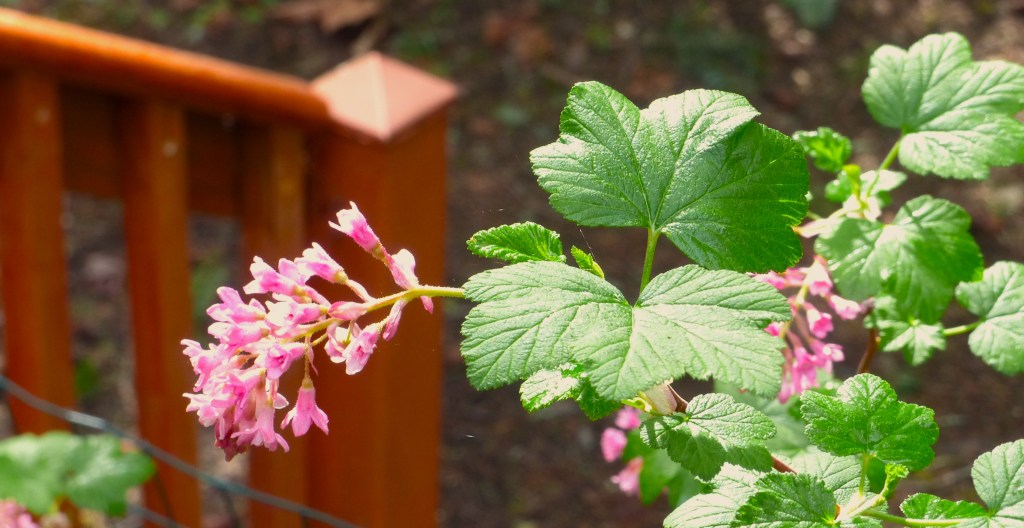
Wild-currant blossoms welcome visitors to the Nuthatch.

MY WILD CURRANT is madly blooming this spring. It’s a good tiding.

From the time Nuthatch cabin became ours in 2003, one thing I loved was the red-flowering wild-currant shrub that grew out of the rocky face just below our front deck. Its many clusters of dainty, trumpet-shaped blooms bobbed enchantingly above the deck rail and added a welcome early-spring splash of color to our view of woods and water.

Hummingbirds loved the flowers, and I mounted a bird feeder on the rail there so eager nuthatches, finches, juncos and towhees could use the currant’s branches as a perch while waiting their turn for a sunflower seed. It was akin to the queuing area at airport security. Always busy. And when fruit emerged later in the season, something of an avian snack bar.

I liked the wild currant so much that I planted another inside a deer fence next to the cabin’s front steps about 10 years ago. I gave the new planting plenty of water to get through dry summers. It grew large, with many branches and attractive foliage. But it didn’t flower much. Maybe just one little cluster of blooms each spring.

Meanwhile, after many seasons of enjoying the cliff-dwelling currant’s spring color, watering it in summer, seeing it get big and eventually rigging a supporting sling so it wouldn’t pull out of the rock, I waited in vain for new buds to emerge one February a few years ago. Barbara and I kept watching and hoping for a revival that sadly never came.

Its cliff-hanging location was a blessing and, probably, a curse. That hungry deer couldn’t reach it was likely the only reason it survived as long as it did. Yet the challenge of drilling roots into rock and finding necessary water probably doomed it.

Narcissus flowers add to the spring color outside the cabin.

Its gnarled old branches cobbled with lichen and bearded with moss, the dead shrub almost fell to my axe. But I stopped before the first swing. Why take it down? The birds continued to use it as a staging platform. It still served a purpose, and even without flowers or foliage it was pleasing to the eye.

Inside that deer fence, I planted another red currant next to the first. Tiny by comparison, it nonetheless produced a modest display of flowers the past two springs. Perhaps it finally shamed its big brother, which this spring has produced a robust display.

The new plants’ blossoms are more pink than red, whereas the cliff dweller wowed the eye with blooms of deep red to magenta. But this year’s dozens of flowering clusters have renewed my faith in the power of springtime in the San Juans.

To all my Northern Hemisphere friends, savor this season of renewal, whatever touches your heart.

NEW: This post available in audio. Listen to my Cantwell’s Reef podcast.