A seal of approval at Barbara’s bench

“Our” seal watched fearlessly as Lillian and I ventured near on the rocks below Barbara’s memorial bench.

BARBARA JUST MIGHT BE A SELKIE NOW, it seems.

If you’re not an avid fan of the delightful 1994 John Sayles movie, “The Secret of Roan Inish” (in which a selkie is part of the secret), you might need this Wikipedia definition: “Selkies are mythological creatures that can shapeshift between seal and human forms by removing or putting on their seal skin. They feature prominently in the oral traditions and mythology of various cultures, especially those of Celtic and Norse origin.” “Roan Inish” is a real island on the Ulster coast of Ireland.

Daughter Lillian and I just returned from our annual overnight pilgrimage to remote Sucia Island, a marine state park that’s home to the park bench memorializing Barbara, my wife and Lil’s mother, who died of breast cancer in 2021. Three years ago, we cast her ashes in waters near this island.

Barbara aboard WeLike shortly after we retired to Center Island.

The bench, a GoFundMe project funded by generous donations by many of you Reef readers, sits in one of the most beautiful spots in the San Juan Islands, with a stunning waterfront panorama that takes in Orcas, Waldron and Patos islands in the San Juans, along with Boundary Pass (the Canadian border) and a handful of Canada’s Gulf Islands. Eagles soar, kayakers skim the waves, sailboats ride the breeze on wide, wild waters, and seals bob in the sea.

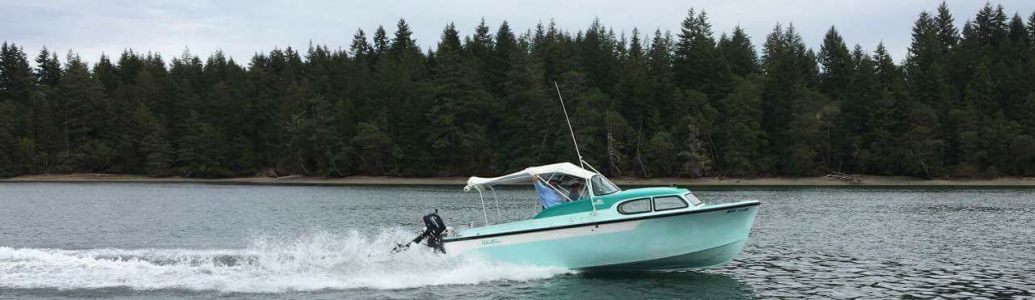
As always, getting there was an ambitious 90-minute saltwater voyage aboard WeLike, my restored 1957 Skagit Express Cruiser, the 20-footer built in nearby La Conner, Skagit County. WeLike’s cuddy cabin includes a cozy V-berth just big enough for a father and daughter in a couple of sleeping bags.

After departing Center Island in a warm summer-morning rain, Lillian and I docked at Sucia’s Fossil Bay on a pleasant, partly sunny afternoon scattered with puffball clouds. We immediately gathered a sack lunch and set out on a mile-long hike through tall cedars and swordfern grottos to the southerly point at the entrance to Shallow Bay.

There we found the bench in excellent shape. We always bring a scrub brush, spray cleaner and paper towels for an annual cleaning, but the cedar-colored planks of durable recycled plastic needed only a quick wipe. The bronze plaque — which I personally affixed three years ago with wood screws and plenty of epoxy — remained, unmarred: “For Barbara, who loved this island, from Brian, who always sat beside her.”

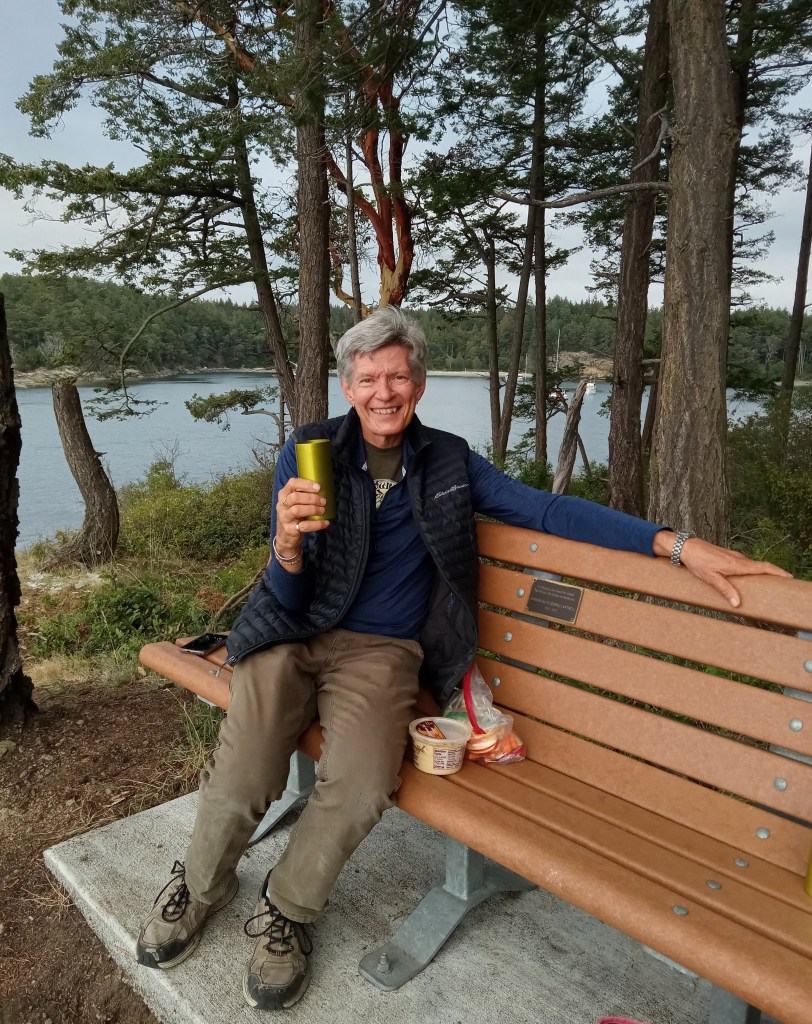
Lillian offers a toast to her mother as we lunch at the memorial bench on Sucia Island. Boats ride moorings on Shallow Bay behind her.

As we munched our lunch, Lillian and I saw a harbor seal bobbing in the water and looking up at us from just beneath our shoreline perch. The emerald-green water was so clear here we could see the seal’s entire body beneath the surface. Remarkably, the seal stayed there, riding the incoming swell, as we finished our lunch and began to read aloud from one of Barbara’s favorite authors. We continued where we left off in last year’s novel, “The Last Camel Died at Noon,” an Amelia Peabody mystery by Elizabeth Peters.
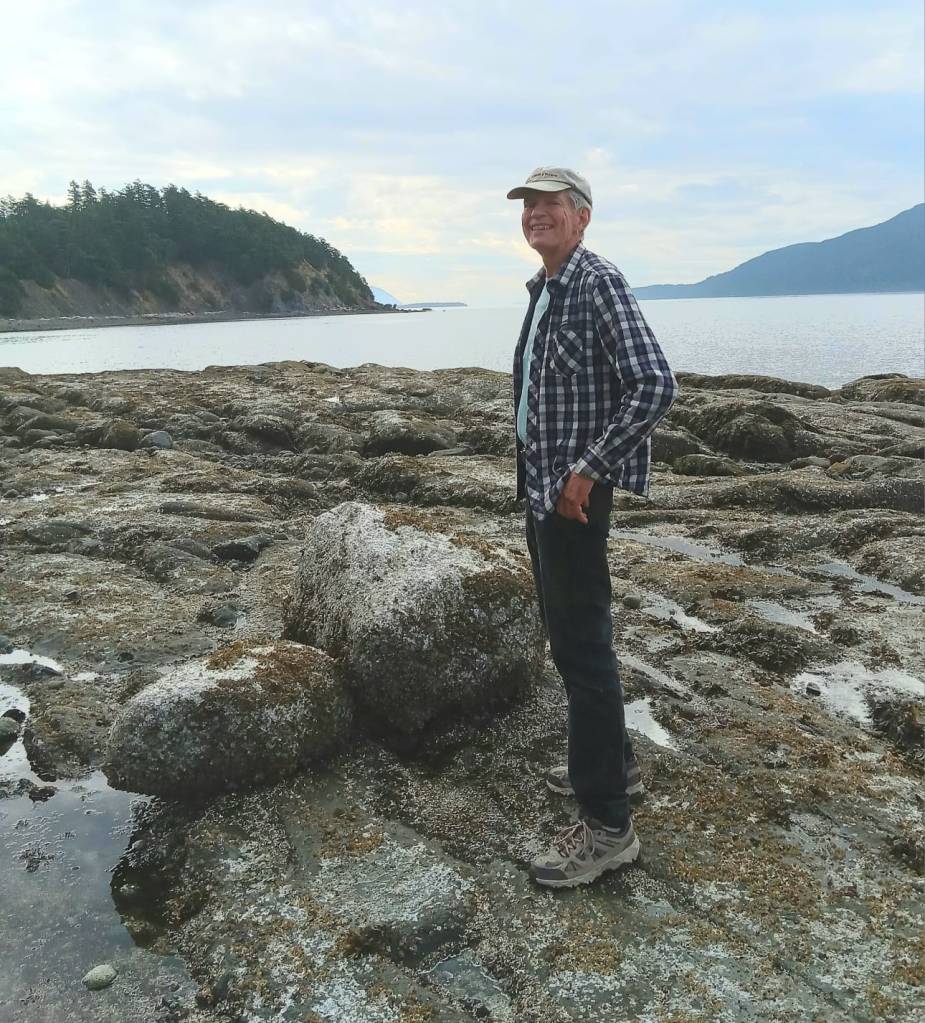
Your faithful scribe among Sucia tidepools.

As Amelia, husband Emerson and son Ramses traveled down the Nile on a mysterious quest, we watched the seal clamber out of the water and on to a rock so near that we easily looked each other in the eye. Kayakers paddled near, motorboats buzzed by, and our friend the seal stayed put. When Lillian and I walked down to a small rocky point beneath the bench’s promontory, the seal followed us with her eyes but never fled back into the water.

Barbara?

Back at the dock, we chatted with other boaters. One friendly fellow on a C Dory heard our story and asked, “Oh, are you talking about Barbara’s bench? I was there yesterday! Wait, what’s your name?” “I’m Brian,” I told him. Another dock neighbor made plans to visit Barbara’s bench the next morning.

It’s sweet to know that other visitors are enjoying that resting spot with the million-dollar view. It was what dear Barbara wanted.

I hope they saw the seal.

Glassy waters reflect a pleasant morning at Sucia Island’s Fossil Bay. My family and I brought our sailboat to Sucia every summer for decades. Three years ago we cast Barbara’s ashes on nearby waters.

Good company helps fill gap in remote island life

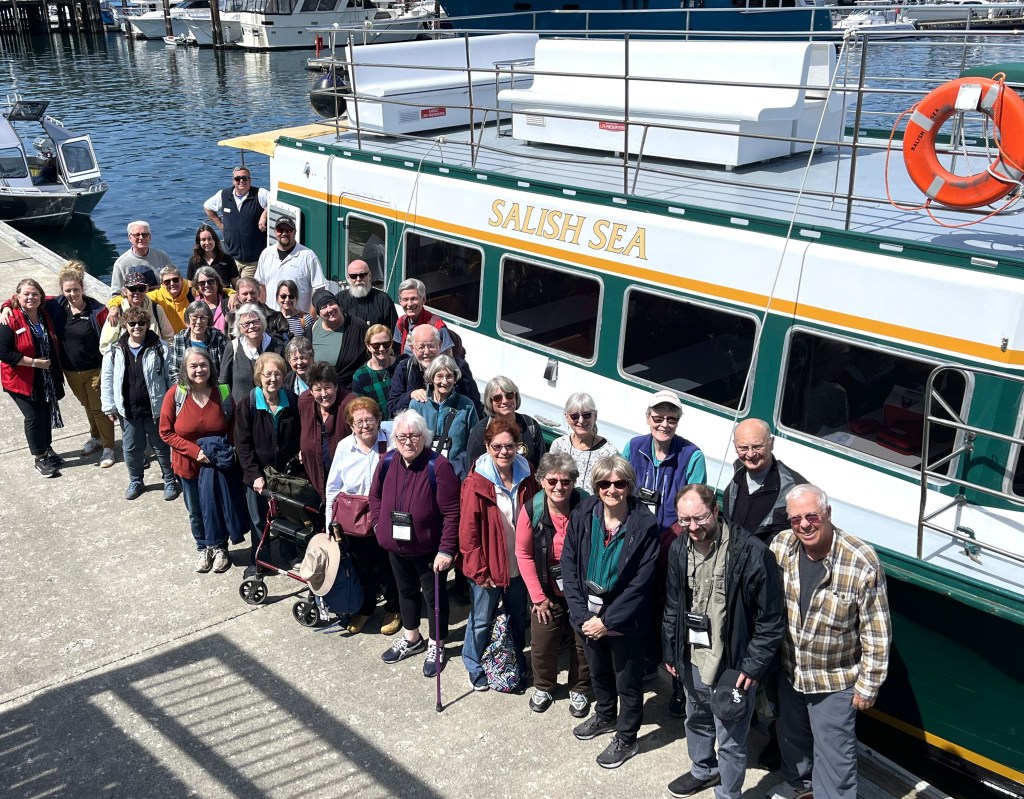
Our Road Scholar contingent by one of our tour boats at dock in Friday Harbor. Your loyal correspondent is the tall drink of water in the back row below and left of the first “S” in Salish Sea. Tour-goers came from as far away as New York and Florida. Kelley Balcomb-Bartok photo.

I’M JUST BACK FROM ROAD SCHOLAR trip Number One, and I think I’ve found my tribe.

This week-long outing was dubbed “The San Juan Islands by Land and Sea: Hidden Anchorages.” It was my first outing as a guide trainee for Road Scholar, the globe-trotting tour leader that is celebrating its 50th year as an education-oriented not-for-profit organization. Locally, it operates in conjunction with the Friday Harbor outpost of Mount Vernon-based Skagit Valley College.

With 30 travelers from across the United States, we skipped across the San Juans by charter boat for three days, plus two days on land exploring our base around Friday Harbor. Our at-sea days included a day trip to remote Sucia, my favorite of the archipelago and home now to my late wife Barbara’s memorial bench. Stops included the historical town of La Conner, where my neighbor the Mad Birder lives when he’s not on my little rock, and where Barbara was once town librarian. We transited three of my favorite scenic-keyhole water passages: Hole in the Wall on Swinomish Channel; the famed swirling waters of Deception Pass; and squeaky-narrow Pole Pass between Orcas and Crane islands. These were places my family and I had navigated again and again over the years on our own sailboat. Virtually everywhere this tour went, I had a story to share with our visitors. With a sizable contingent of retired teachers and librarians, they were eager listeners.

It was gratifying at trip’s end when one of our group kindly proclaimed, “You’re a great storyteller!”

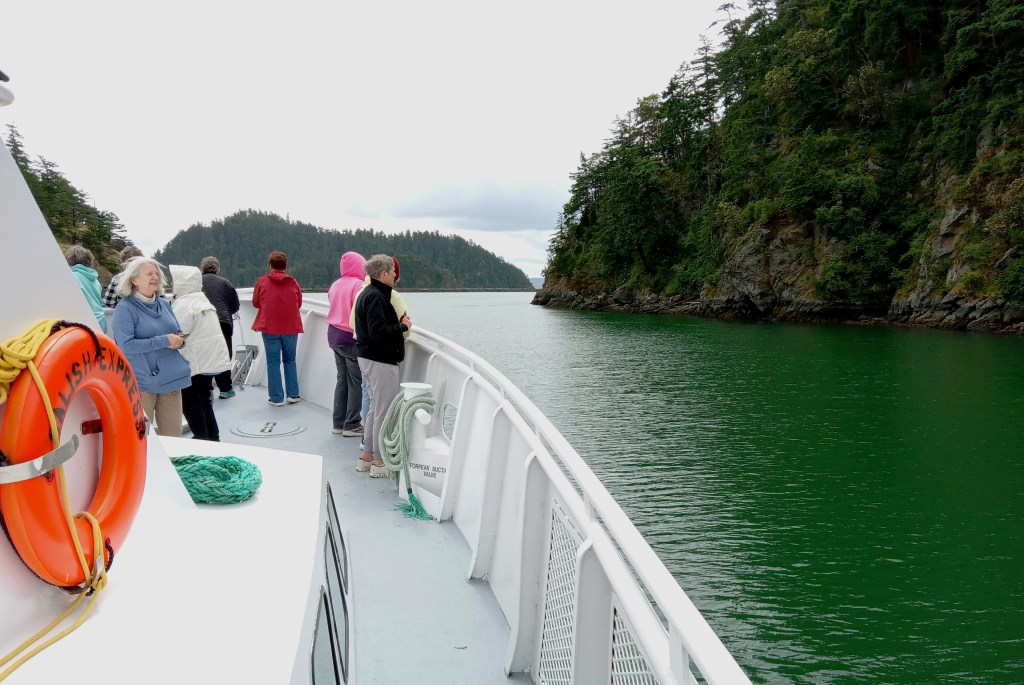
Our tour vessel, Salish Express, transits Hole in the Wall on Swinomish Channel south of La Conner.

Road Scholar specializes in travel for people 50 and older, but the typical age is early 70s. Our group ranged from early 60s up to one participant who was a fit-as-a-fiddle 86. They came from as far away as Florida and New York, along with Midwest contingents from Minnesota, Kansas, Illinois, etc., plus Californians aplenty. Some were on their first Road Scholar trip. One had been on more than 50.

This group traveled under a lucky star. On our first day on the water, between Bellingham and Friday Harbor, we encountered a sizable group of transient killer whales feeding off the northern tip of Cypress Island. For more than a half hour our 100-foot vessel idled as we watched the whales breach, tail slap and generally cavort to the “oohs” and “ahhs” of our visitors, most of whom were first-timers in these islands. In all my years poking around the Salish Sea, this was one of my best orca sightings.

In a trademark red Road Scholar vest, your correspondent takes to the mike aboard a tour vessel. Cathy Holley photo.

The second day we meandered past Whale Rocks at the southern entry to Cattle Pass to get an eyeful of dozens of Steller sea lions, the largest of sea lions. This band included a handful of mammoth males, which can grow to 11 feet long and weigh almost 2,500 pounds. As we paused, one of the incredible hulks scooted to the top of his rocky islet and reared high in what was clearly an “I’m King of the World” pose atop Pride Rock. (Sea lions don’t know better than to mix their Hollywood metaphors.)

At Sucia, we got an eyeful of eagles, as bald eagles circled and swooped a half-mile into the sky above us at Shallow Bay. All in all, this was a wildlife-blessed journey.

Clearly, Road Scholar is a good fit for me. I needed more human interaction than I get on my little rock. This is a good way to fill that need. And I even get paid.

Meanwhile, I’m remembering lost loved ones this Memorial Day and sending warm thoughts to friends and family. I feel I’ve found new friends to help fill the gaps in my life. Best wishes to any of you seeking the same.

A pilgrimage to Barbara’s enchanted isle

Toasting Barbara from her memorial bench, looking toward Boundary Pass in the Salish Sea and Saturna, left, and Patos islands.

WHAT ELSE CAN I SAY? Barbara sends her love.

That’s the first thought that comes to mind after returning yesterday from my second annual pilgrimage to Sucia Island to visit the park bench memorializing my late wife, who died of breast cancer in 2021. In 2022, state parks workers erected the bench, commanding what might be the most beautiful saltwater view in the San Juans, with the help of a GoFundMe project to which many of you generous readers contributed.

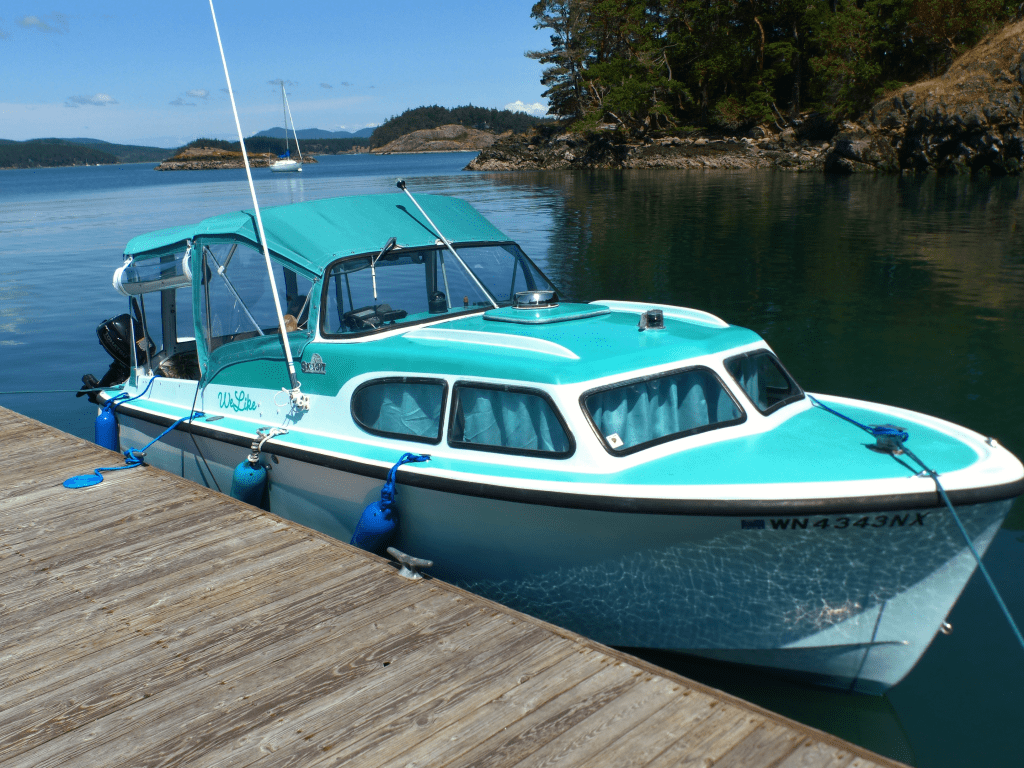
Daughter Lillian accompanied me this time for a cozy overnight in sleeping bags aboard WeLike, my restored 1957 Skagit Express Cruiser, a dazzling study in mid-20th-century turquoise, snugly tied to a dock in Fossil Bay.

My 1957 Skagit Express Cruiser, WeLike.

We arrived on Labor Day afternoon, just as many other boaters were heading home from their holiday weekend. After a bone-jarring ride through tidal turbulence encircling Orcas Island and hazardous wakes from giant motor yachts hell-bent for their home ports, we were thankful to find plentiful dock space at Sucia, our favorite marine state park, the blissful destination of countless voyages over past decades aboard our sweet old sailboat, Sogni d’Oro.

For the easy moorage this visit, we thanked Barbara, whose ashes we scattered on the waters here two years ago. She makes things happen here, we’re sure of it.

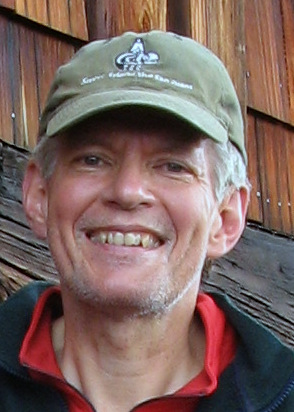
Your correspondent at Barbara’s bench, with Shallow Bay in the background.

We immediately packed snacks and a surreptitious bottle of Barbara’s favorite sauvignon blanc, setting out for the mile hike through deeply shaded woods of cedar and autumn-gold maples to her bench at the south peninsula forming soporific Shallow Bay.

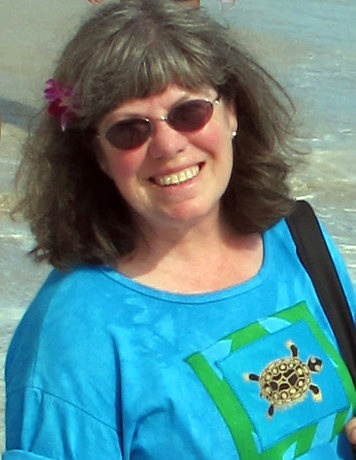
Barbara (Burns) Cantwell, 1955-2021

The bench sits high on a bank above some of Sucia’s characteristic shoreline of wildly sculpted sandstone, like something Antoni Gaudi might have fashioned had he won the commission rather than the Northwest winds and tides. From a seat on the bench, a swivel of the head takes in a stunning panorama including Orcas, Waldron, Stuart and Patos islands of the San Juans, and Canada’s Saturna and Pender islands.

After a day of low-scudding clouds that sprinkled raindrops along our way, Barbara now cleared the sky to match the blue of her eyes that had bewitched me from age 16. If the weather had been perfect from the start and seas smooth, we’d never have found room at the dock, Lillian and I professed. “Mum watches out for us,” we agreed.

On the park bench memorializing her mother, daughter Lillian reads aloud from one of Barbara’s favorite mystery authors.

Though the birds had largely spared it as a target, we gave the bench its annual swabbing with cedar-sage spray cleaner, a scrub brush and paper towels. The bronze plaque remained clearly legible: “For Barbara, who loved this island, from Brian, who always sat beside her.”

Perched comfortably, my daughter and I munched on apple slices dipped in peanut butter, sipped a tart and fresh New Zealand wine from colorful metal tumblers off the boat, and took turns reading aloud from one of Barbara’s favorite mystery authors, Elizabeth Peters. “The Last Camel Died at Noon” featured the adventures of Egyptologist Amelia Peabody and her professorial husband, Radcliffe Emerson.

Lillian at the stone gateway to the madrona forest on Sucia Island.

After hiking back on an alternate route through a marvelous madrona forest, we returned in the morning with a vacuum jug of coffee and a small campstove. Cloudy skies cleared to golden sunshine just as we arrived at the magic bench. Over the stove’s flame, we made toast that we smeared with ripe avocado. More Amelia readings. More quiet communing with our beloved wife and mother.

“I miss her,” I told Lillian. “I do, too,” responded our daughter, who turns 33 this month. “She knew how to make things perfect.”

A spare paper towel had to suffice for the Kleenex I forgot to pack.

Much has changed in our lives and continues to change. My ability to fall in love has sputtered back to life, with emotional twists and turns. Lillian and partner Chris are soon to move to Philadelphia, as he takes a new job as a flight attendant. Lillian, the baker, hopes to become Lillian, the book editor. Along the way, they will enjoy free flights all over the world.

But come what may, our love for Barbara will never change. We think of her often. And at least once a year, at least one of us will return to commune with her on her enchanted island.

A memorable blue-moon August

Mount Rainier turns colors in the sunset beyond the Indianola pier on the Kitsap Peninsula early this month.

SUMMER ON MY ISLAND is as much about going away as staying. It’s the season when invitations beckon me to friends’ sun-drenched decks, and calm waters call me to crank up WeLike’s big Evinrude and go exploring.

I started the month with a delightful few days with friends at Indianola and Belfair. My buddy Steve Miletich, with whom I started and ended my journalism career (at the Sammamish High School newspaper, Totem Talk, and in the Seattle Times newsroom), invited me to his family’s compound at Indianola on the Kitsap Peninsula. In a classic beach house from the 1920s I spent a few sun-baked days with a happy passel of extended family of Steve and his wife, Emily Langlie. (Emily was a newbie TV reporter in Yakima in the 1980s when I was starting there as a daily newspaper reporter; she went on to a stint with KOMO in Seattle, and now works in the U.S. Attorney’s Office.)

We all ate too much good food and watched the henna-tinted super moon rise over Puget Sound. One day, Steve, his brother, Dave, and I drove south to Belfair for a reunion with another Totem Talk alumnus, Mark Morris, who retired five years ago as photo director for the Sacramento newspaper. Mark’s family maintains a beach home, designed by famed Seattle architect Victor Steinbrueck, on the shore of Hood Canal. It was all several days of happy reconnection.

The bronze plaque on Barbara’s bench.

More bittersweet but still soul-nourishing was my solo outing aboard WeLike to Sucia Island in the San Juans a week ago. When my family and friends scattered my late wife’s ashes in those waters and dedicated a memorial bench on Sucia in Barbara’s honor a year ago this week, I vowed to revisit it annually. This was my first pilgrimage.

I took a sack lunch and ate it perched on the waterfront, bluff-top bench, which commands one of the island’s finest views, looking northwestward toward Waldron Island and into Canada. As kayakers paddled the sparkling waters, I chatted with Barbara. I told her about our daughter and her new bakery job, and how we’ve both been doing. The bench is on a lightly used trail, so nobody was there to wonder about my sanity. I took some spray cleaner, a brush, and paper towels and gave the bench a good cleaning, though it had weathered the year in very good shape. I was able to tie up to a state-parks buoy in Shallow Bay and slept in WeLike’s cozy cuddy cabin. Within sight of the bench, my chats with Barbara lasted into the evening.

My view as I lounged on Barbara’s Sucia Island bench. In the left distance is Patos Island, at the northern edge of the San Juans.

I returned to my island for just three days before heading out again Saturday morning on WeLike for Friday Harbor. An old Seattle Times friend, Greg Gilbert, was stopping over in Friday Harbor in his classic 1926 motor yacht, Winifred. In a class known as a Lake Union Dreamboat, the name well fits Winifred, which Greg maintains in cherry condition, with gleaming varnish and gilded name.

Winifred was built in 1926 at Lake Union Drydock in Seattle. She is named for the wife of Adolph Schmidt of Olympia Brewery, who once owned the boat.

This was a very special occasion: At age 77, Greg had retired as a Seattle Times photographer last Tuesday, after working for the newspaper since he was 21.

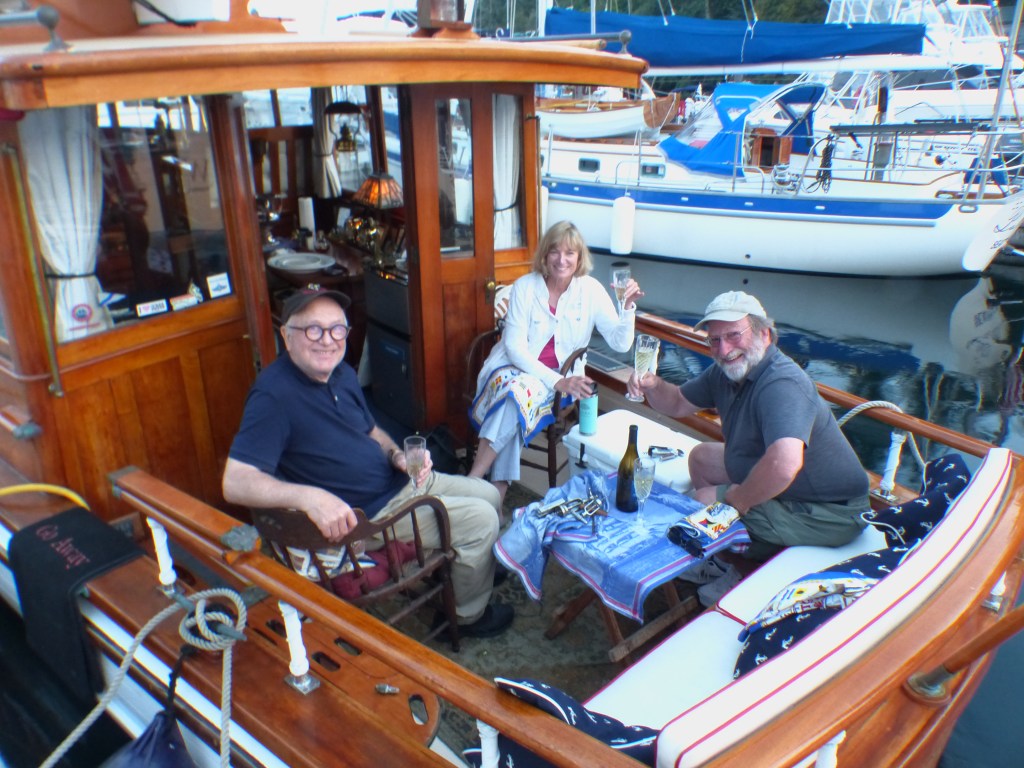
He generously let me invite my Friday Harbor friends (and fellow Inside Passage voyagers) Barbara Marrett and Bill Watson to dinner aboard Winifred, and we all got along like gangbusters. I procured two-pounds of fresh salmon from the fish shop on the Friday Harbor dock and we had a scrumptious dinner on Winifred’s open fantail as the almost-full moon dawdled across the sky. Barbara M. and Bill brought superbly fresh vegetables from their garden. Greg’s contribution, besides the perfect venue: three chilled bottles of Champagne. It was a memorable evening, even if the memory gets a little fuzzy toward the end.

Raising glasses of bubbly from Winifred’s fantail, from left: Greg Gilbert, Barbara Marrett and Bill Watson.

Before departing on Sunday, I accompanied Barbara and Greg to a San Juan Island ceremony commemorating the recent death of Tokitae, the last Southern Resident orca in captivity (at Miami’s Seaquarium), and marking the installation of a Lummi tribe’s carving depicting the orca known as Tahlequah, who carried her dead calf more than 1,000 miles around the Salish Sea and generated worldwide headlines in 2018.

Freddie Lane photographs the whale carving installed at Jackson Beach Park on San Juan Island. He is road manager for the Lummi Nation’s House of Tears Carvers, which created the work.

Now I’m back in the writing hut on my rocky knoll, where we’re having the first wet week of summer. The sound of raindrops plunking on my cedar-shake roof is punctuated now and again with kettle-drum rumbles of thunder.

On Wednesday evening, if there’s a clearing in the clouds, look for the Blue Moon, the second full moon — and second close-to-earth supermoon — of this month. Every which way I look at it, my August has been full, and at times super. I hope the same for you.

Back on the rock: Paella with pals, and a bittersweet memorial

A bubbling vat of paella on a neighbor’s deck was the lure last week to a Center Island block party, easing my transition back to landlubberly existence.

BACK TO THE REEF, and the rock also known as Center Island.

I needed a writing hiatus for a few weeks after returning from the Alaska adventure. It’s been a period of readjustment to the landlubberly life, and to daily existence shared primarily with Galley Cat, with whom I’ve enjoyed a joyful reunion with many shared runs up and down our rocky knoll.

It took a week or so until I was waking in the morning without the inclination to jump out of my bunk, get coffee water heating on the Force 10 stove and climb down in the hold to complete the morning engine checks so we could weigh anchor.

My past three weeks of land-based confinement has hardly been solitary, though. After a couple of days reuniting with my brother Tom, who was my cabin watcher/cat sitter for 10 weeks, I was invited to lunch on Lopez Island with old friend and Seattle Times colleague Lynn Thompson and her family.

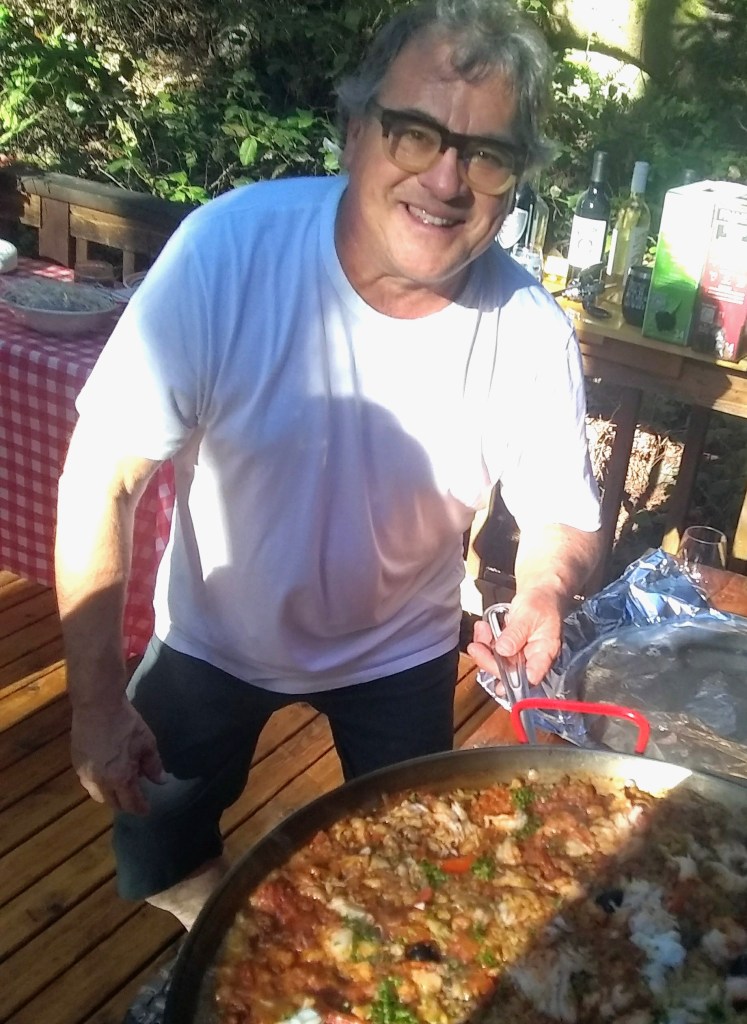
Shortly afterward, The Mad Birder and his wife, Carol, invited me next door with three other neighbors to share a bounty of Dungeness crab, freshly hauled from Lopez Sound. That led to another party two days later after neighbor Steve, a restaurant chef from Nevada, took the crab shells back to his holiday cabin to create a stock from which he whipped up a splendid vat of paella, colorfully aswim with fresh San Juan Channel shrimp, Read’s Bay crab and Center Island Farm vegetables. I was among the dozen or so neighbors who got to partake of that locavore lovefest on a sunset-view deck thanks to Steve and his wife, Dawn, the organizing force behind their family-owned eatery.

Neighbor Steve, the paella king of Center Island.

As cabin-owners come and go on our rock, you never know who will be your next neighbor. Right now, we’re enjoying an amiable mix of compatible friends along our dead-end spur of Chinook Way, the grandiose name of the gravel cow-path winding through our thickets of salal and Nootka rose. Three of us are sailboat owners (four, when you count the neighboring farm). Among others is a family with three energetic boys, ages 5, 7 and 9, who added an element of fun to the block party. The kids’ mom told me they are fans of a YouTube channel called “Outdoor Boys,” and the youngest had recently learned of the edibility of seaweed. So as we prepared to sit down to paella on Steve and Dawn’s deck, this adventurous 5-year-old, expertly wielding a pair of chopsticks, doggedly ate his way through a bowl of some sort of kelp. I like that spirit.

Over good food and drink, we all pondered our island existence. Because our cabins face west overlooking Lopez Sound, with the frequent reward of a sinking sun setting the saltwater sparkling brighter than a Tiffany’s display case, we decided our neighborhood’s new nickname should be “Sunset Strip.” There was serious talk of carving a sign.

A couple days later longtime friends Ken and Kate from Portland joined me for three nights at the Nuthatch, giving me a chance to barbecue, one of the things that makes life worth living (in case you didn’t know). Hickory-smoked vegan burgers with Lebanese spice one night. The next: thick-cut pork chops with a crust of fresh island rosemary, minced garlic and romano cheese, grilled with apple-wood smoke.

All that camaraderie and good food was lovely. But stress and emotion wasn’t absent from my return to the island. On my calendar, these days led up to last Sunday, August 21, when we committed my dear Barbara’s cremated remains to the Salish Sea. It wasn’t an easy day to plan for.

Sucia Island, a 90-minute boat ride to the north, was the location. For some 20 years, my family and I would spend a couple weeks of every August poking around the San Juans in our cozy old Westsail 32 sailboat, Sogni d’Oro. On those sojourns, Sucia Island State Park, near the Canadian border, became perhaps our favorite place in the world. In our wills, Barbara and I both requested that our remains be cast on waters around Sucia.

For a day trip with a dozen family members and friends, I chartered the Paraclete, the water taxi that I routinely use for passage to and from Anacortes. It was a day of good karma; just before arriving at Sucia, we encountered a pod of orca. For my sister-in-law Jane, who spent much of her childhood around the San Juans, this was the first time she finally saw an orca in the wild.

The picnic crowd near Barbara’s bench on Sucia Island. From here you can see far into Canada.

The Sucia visit included a one-mile hike to a new memorial bench honoring Barbara. The bench installation took more than a year to bring to fruition. The effort’s success can largely be credited to the persistent persuasive powers of my friend Daniel Farber, a retired official with Washington State Parks, along with dozens of friends and family who donated to a GoFundMe campaign. The bench’s bronze plaque reads: “For Barbara, who loved this island, from Brian, who always sat beside her.” I’m sorry it doesn’t acknowledge the many others who played a role in the bench’s creation. Barbara and I chose the wording some time ago, paraphrasing a line from a favorite old movie, to be adapted for whomever went first.

The bronze plaque on Barbara’s bench.

Barbara loved to picnic, so we all brought sack lunches and sat on the bench or on the rocky hillside sloping down to the water. Barbara’s sister Julie made a couple loaves worth of sandwiches; ham-and-pickle and chicken salad, according to family tradition. Her brother Mark brought a toothsome potato salad. For the first time in my life, I made deviled eggs, another family favorite.

After lunch, we reboarded the boat and motored a short ways offshore while snacking on chocolate-coated cream puffs, one of Barbara’s favorite desserts, baked by daughter Lillian. We toasted the memory of a dear wife, mother and sister as we scattered her ashes into the sea along with armloads of summer flowers, many provided by our friend Monique from Center Island Farm.

Daughter Lillian tries out the park bench honoring her mum.

It was a bittersweet but wonderful day. A regrettable follow-up: At least three people who made the trip came down with COVID within days. Sigh. Their symptoms are mild, thanks to vaccinations. I’m feeling fine, so far. One way or another, it seems likely that we’ll all catch this stupid bug eventually.

The Mad Birder summed up the day.

“Regardless of the consequences, Sunday was beautiful, and … the bench is soooooo perfect.”

Lillian and I have resolved to revisit that bench every summer. Barbara will be sitting beside us in spirit, I’m certain.

Help build a bench, and keep Barbara happy

Sucia Island in the San Juans, as seen from atop Mount Constitution, is where we’ll place a park bench in memory of Barbara Cantwell.

IT’S A LITTLE MODERN for me, orchestrating an Internet crowdfunding campaign from my cozy wicker chair here in Nuthatch Cabin, but for Barbara, I can do it.

Today I launched my first GoFundMe fundraiser, to raise money for a park bench to be dedicated to my dear wife’s memory. The bench will be on Sucia Island, our favorite place in the San Juans.

Barbara, our daughter Lillian, and I have visited Sucia countless times over many years of island explorations aboard our sailboat, Sogni d’Oro. The entire island with its dramatic wind-sculpted shorelines is a marine state park, situated at the archipelago’s wild northeastern corner where the deep waters of Boundary Pass do a Mixmaster blend with the roiling currents of Georgia Strait. Sucia’s numerous deep coves and sheltered bays provide peaceful moorages for boaters seeking a haven from the elements — and from the worries of the outside world.

Barbara looks out at the saltwater views of the San Juans in 2018.

Barbara loved the place so much she asked that part of her cremated remains be cast on the waters there. She also asked that a new bench be built in her name, so that more hikers on the island’s scenic trails could pause along the way and enjoy the view as much as we did.

Building a quality bench that will stand the tests of salt air, weather and wind isn’t cheap, nor is transporting it to a remote island and installing it along a rocky trail far from any roads. The project could cost as much as $2,000. When friends and loved ones expressed an interest in helping to make it happen, a GoFundMe effort seemed to make sense. And here I am with the hat out. (Don’t worry, I’m not going to tell you I need gas to get home.)

If you’re interested in giving, whether it be $5 or $50, you’ll find more details on the fundraising site accessed by the button below. I thank you. Lillian thanks you. And the Nuthatch Ghost (as we tend to wistfully call her these days) might thank you, too. (She’ll knock three times.)

EPILOGUE: As of Friday, July 9, we exceeded our GoFundMe goal through a touching display of generosity from people I love, people I’m happy to know, and a few I don’t know. Any additional donations will be channeled to Washington State Parks in Barbara’s name. Thank you.