Run for the border cures November’s island fever

The crowded modern skyline of Vancouver, British Columbia, looms over False Creek on the edge of downtown.

TO FULLY APPRECIATE LIVING ON AN ISLAND, sometimes you just have to get the heck off the rock.

Especially when November rains are turning your world as soggy as an overdunked Oreo and the ferry’s distant foghorn keeps blowing well into the murky afternoon.

Our Vancouver digs. Tom Willard photo.

For a change of scene and a welcome escape from dastardly American politics, my Orcas Island friend Tom and I fled to Canada on Thursday.

Our timing wasn’t perfect. Metro Vancouver was officially under a Heavy Rain Warning. As we navigated Whatcom County on the way north, streaming rivers of rainwater functionally obliterated any view through the Civic’s side windows. The frantic “high” setting on my wipers got its once-a-decade full aerobic workout.

At the Canadian customs station, a bemused border agent looking out on the unwelcoming weather quizzed us, “Why are you coming now?”

Well. Maybe he doesn’t know about island fever. Or that my buddy Tom, originally from Minnesota and an old goalie himself, was starved to see a hockey game. The Canucks were on the road, but we had Friday-night tickets to see the champion women’s team of the University of British Columbia Thunderbirds face off against the pony-tailed team from Edmonton’s MacEwan University, the Griffins (terrors of the prairie).

A flower in lights, part of Vancouver’s annual Lumière Festival, which brightens November.
Tom Willard photo.

Downtown on Richards Street, we checked into the delightful little four-story Kingston Hotel, owned and operated by the same family for more than 100 years.

Vancouver is a city of splendid ethnic diversity, a characteristic Canada seems to happily embrace. The city’s downtown, packed with high-rise apartments, is also crowded with clubs, theaters, independent coffeehouses and thriving little restaurants representing every continent. We set out on foot at dusk to a little hole-in-the-wall Lebanese cafe we found online, Manoush’eh, on Davie Street, about a 12-minute walk from our hotel. With a gas-fired oven up front, it was cozy and the food was delicious. (I had a hot-from-that-oven flatbread wrap with labneh, fresh tomatoes and olives; Tom had sbanekh, a folded lemony flatbread filled with spinach, onion and sumac. Yum.)

For a cool Thursday night, downtown streets were surprisingly packed with people. After dinner we strolled along Davie Street, where serendipity brought us to an outdoor show of art installations based on colorful lighted shapes and images. It was one of seven locations around the city for an annual November festival called Lumière. A happy crowd wandered among artworks that cheered up the chilly night. On our walk home, we happened upon another Lumière installation on Robson Street.

Engine 374 linked Canada’s Atlantic to the Pacific in 1887.

The next day, rain-free, we happily walked the city, starting with a tasty breakfast on a heated patio on the shores of pretty False Creek. Ambling back to our hotel, we stumbled on the Roundhouse Community Arts & Recreation Centre, home to the impeccably restored Engine 374, a musclebound steam locomotive that pulled Canada’s first transcontinental passenger train into the city in 1887. Entry to the iron horse’s pavilion is free of charge, and kids of all ages (us included) were free to climb into the engineer’s cab, work the controls and imagine guiding the steaming behemoth across the continent.
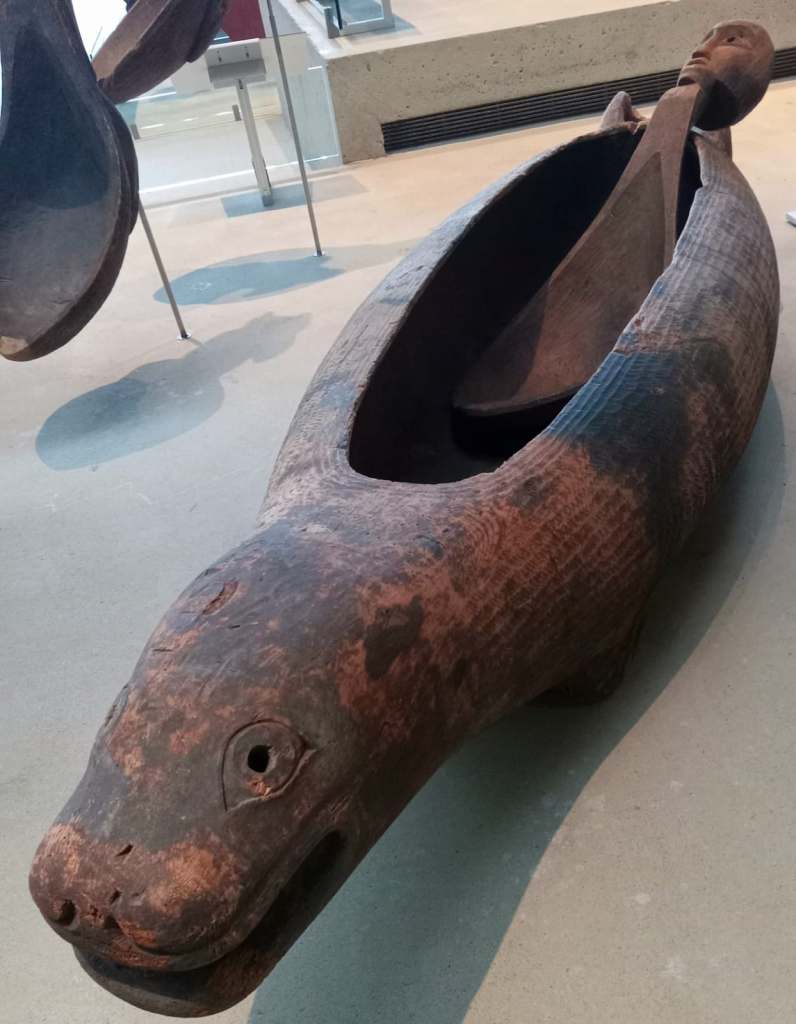
A carved, hollowed-out harbor seal was used as a serving tureen at a First Nations potlatch.

Afternoon took us to the University of British Columbia’s famed Museum of Anthropology, home to a fabulous collection of First Nations art and artifacts, including the Great Hall’s stunning collection of large poles, house posts and carved figures, primarily from the mid-19th century. Among my favorites was a large, hollowed-out wooden harbor seal that first struck us as an innovative canoe with a large paddle. No, a docent informed us: This was an enormous serving tureen for a potlatch celebration. These folks took feasting seriously.

Our dinner was at an Irish pub, the Wolf & Hound in the Kitsilano district, before we headed back to the university for hockey. The powerhouse Thunderbird women pummeled the Griffins, 5-1. Tom tutored me in the wiles of the game as we ranged from one seating zone to another — behind the goalie, next to the home-team box, etc. The live pep band tootling on trumpets happily reminded me of my middle-school days.

The women of U.B.C.’s Thunderbirds rally to celebrate their Friday victory on the ice.

Saturday took us back to the San Juans, where Tom and I each live on forested islands with our respective ginger cats. Vancouver was an invigorating change. And going away always makes coming home all the sweeter.

Good company helps fill gap in remote island life

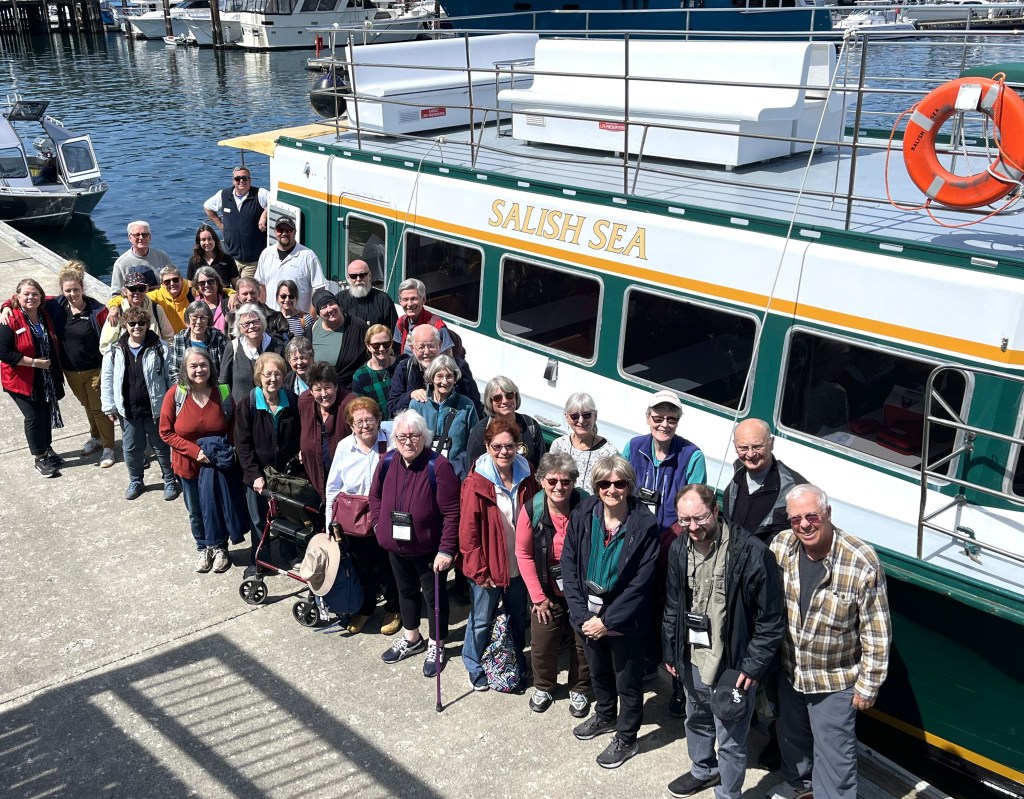
Our Road Scholar contingent by one of our tour boats at dock in Friday Harbor. Your loyal correspondent is the tall drink of water in the back row below and left of the first “S” in Salish Sea. Tour-goers came from as far away as New York and Florida. Kelley Balcomb-Bartok photo.

I’M JUST BACK FROM ROAD SCHOLAR trip Number One, and I think I’ve found my tribe.

This week-long outing was dubbed “The San Juan Islands by Land and Sea: Hidden Anchorages.” It was my first outing as a guide trainee for Road Scholar, the globe-trotting tour leader that is celebrating its 50th year as an education-oriented not-for-profit organization. Locally, it operates in conjunction with the Friday Harbor outpost of Mount Vernon-based Skagit Valley College.

With 30 travelers from across the United States, we skipped across the San Juans by charter boat for three days, plus two days on land exploring our base around Friday Harbor. Our at-sea days included a day trip to remote Sucia, my favorite of the archipelago and home now to my late wife Barbara’s memorial bench. Stops included the historical town of La Conner, where my neighbor the Mad Birder lives when he’s not on my little rock, and where Barbara was once town librarian. We transited three of my favorite scenic-keyhole water passages: Hole in the Wall on Swinomish Channel; the famed swirling waters of Deception Pass; and squeaky-narrow Pole Pass between Orcas and Crane islands. These were places my family and I had navigated again and again over the years on our own sailboat. Virtually everywhere this tour went, I had a story to share with our visitors. With a sizable contingent of retired teachers and librarians, they were eager listeners.

It was gratifying at trip’s end when one of our group kindly proclaimed, “You’re a great storyteller!”

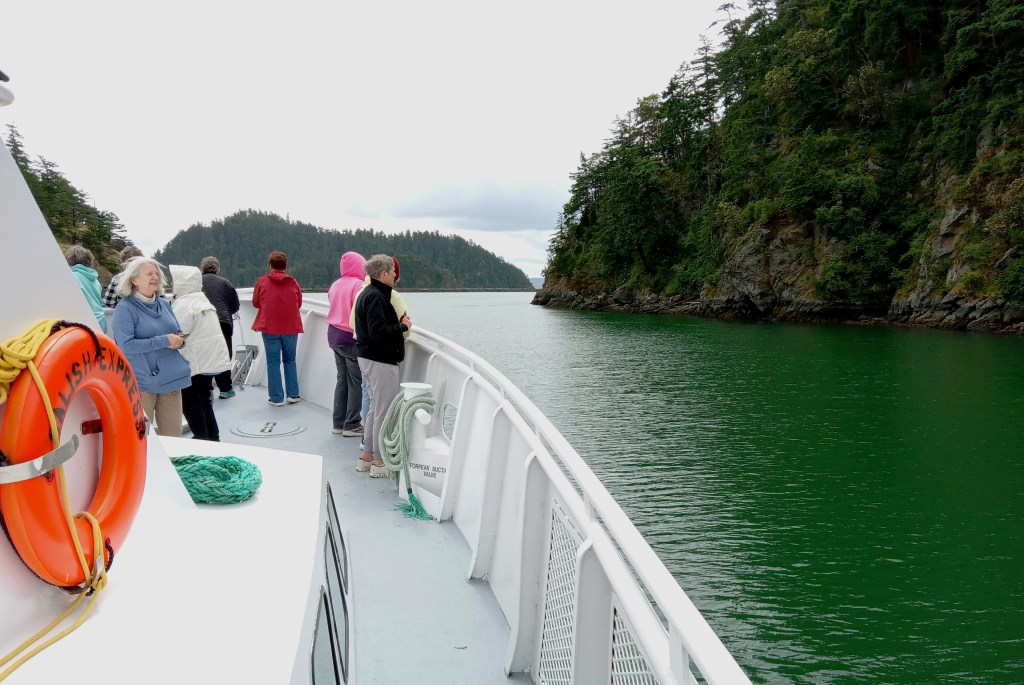
Our tour vessel, Salish Express, transits Hole in the Wall on Swinomish Channel south of La Conner.

Road Scholar specializes in travel for people 50 and older, but the typical age is early 70s. Our group ranged from early 60s up to one participant who was a fit-as-a-fiddle 86. They came from as far away as Florida and New York, along with Midwest contingents from Minnesota, Kansas, Illinois, etc., plus Californians aplenty. Some were on their first Road Scholar trip. One had been on more than 50.

This group traveled under a lucky star. On our first day on the water, between Bellingham and Friday Harbor, we encountered a sizable group of transient killer whales feeding off the northern tip of Cypress Island. For more than a half hour our 100-foot vessel idled as we watched the whales breach, tail slap and generally cavort to the “oohs” and “ahhs” of our visitors, most of whom were first-timers in these islands. In all my years poking around the Salish Sea, this was one of my best orca sightings.

In a trademark red Road Scholar vest, your correspondent takes to the mike aboard a tour vessel. Cathy Holley photo.

The second day we meandered past Whale Rocks at the southern entry to Cattle Pass to get an eyeful of dozens of Steller sea lions, the largest of sea lions. This band included a handful of mammoth males, which can grow to 11 feet long and weigh almost 2,500 pounds. As we paused, one of the incredible hulks scooted to the top of his rocky islet and reared high in what was clearly an “I’m King of the World” pose atop Pride Rock. (Sea lions don’t know better than to mix their Hollywood metaphors.)

At Sucia, we got an eyeful of eagles, as bald eagles circled and swooped a half-mile into the sky above us at Shallow Bay. All in all, this was a wildlife-blessed journey.

Clearly, Road Scholar is a good fit for me. I needed more human interaction than I get on my little rock. This is a good way to fill that need. And I even get paid.

Meanwhile, I’m remembering lost loved ones this Memorial Day and sending warm thoughts to friends and family. I feel I’ve found new friends to help fill the gaps in my life. Best wishes to any of you seeking the same.

Sharing smiles where I find them

The Prince of Whales whale-watching boat zips past my lunchtime viewpoint on Upright Head, Lopez Island.

IT’S BEEN TOUGH keeping up with the blog in these troubled times. We all have plenty of worries as the Trump Regime does its best to bully the world, trash our constitution and cripple the economy. Almost every one of us has seen our life’s savings swirling down the toilet.

But I resolved to help support my community in the face of the onslaught, so I’m here to tell about the good things in my island life.

Tiny calypso orchids are blooming with gusto on Center Island this spring. This flower is about 3 inches high.

Spring weather has finally arrived and we have a bumper crop of calypso orchids, aka fairy slippers. Buttercups are in bloom and ferns are uncurling new fronds like the gentle beckoning of an octopus tentacle. When I tap away at the keyboard in Wee Nooke, the cedar writing hut on the rocky knoll behind my cabin, I might still crank up the heater at first, but by afternoon I’ve opened a window to admit soft and salty breezes.

My big news is that I’ve landed a gig with Road Scholar, the not-for-profit tour operator that offers educational trips catering to travelers 50 and older worldwide. My Friday Harbor friend Barbara Marrett, retired from a career as communications director for the San Juan Islands Visitors Bureau, went to work with Road Scholar a year ago. She convinced me it would be a good fit for me, and kindly recommended me to the local leadership affiliated with Mount Vernon-based Skagit Valley College, which has a branch in Friday Harbor. I will be involved as a paid trainee with three of their week-long tours in my San Juan Islands starting in mid-May. Next year, I will likely be a group leader.

It’s a bright spot on my personal horizon. Living with just a fuzzy feline companion on my remote island, I need more human interaction. And some 20 years of exploring these islands with my family aboard our sailboat, writing about the San Juans as a travel journalist, and making a home on this little island nobody’s heard of seems to uniquely qualify me to help newcomers learn about the San Juans, too.

So far, the Road Scholar leadership has been tremendously accommodating and good to work with. When I told them I had been reserving the summer for overdue cabin projects that got a bit neglected last summer, they responded by assigning me to trips in May, September and October. Perfect! Itineraries will include boat trips to Sucia and other outer islands, a kayak tour and a three-island sampler.

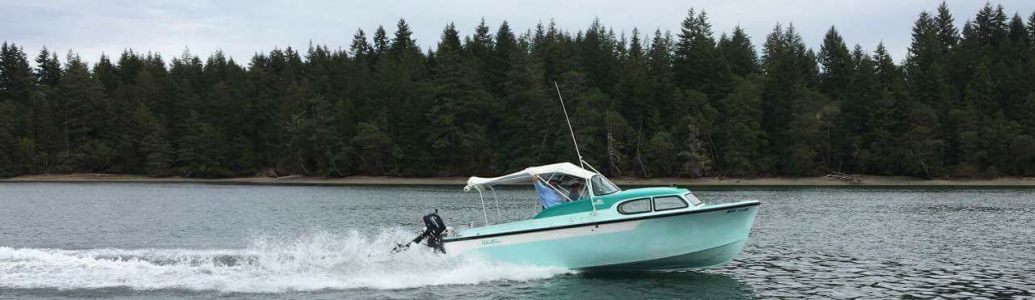
I’ve already attended three training sessions in Friday Harbor, including a first-aid and CPR refresher course, a general leadership orientation, and training in how to safely drive their fleet of 11-passenger vans. That’s kept me busy in recent weeks traveling back and forth to Friday Harbor, a significant endeavor when I don’t yet have my restored 1957 cruiser, WeLike, commissioned for the season. (We’ve not had the weather for it until now.)

Ranger Rick looking spiffy and clean.

So I booked passage on the water taxi from Center Island to Hunter Bay Public Dock on Lopez Island ($76 round-trip), where I keep my good old pickup truck, Ranger Rick. I drove the pickup 25 minutes to the ferry terminal on the north end of Lopez and either parked it there and walked on the state ferry (for no charge to Friday Harbor) or drove aboard ($28 round-trip) when I wanted wheels at the other end. On one trip, I took advantage of the opportunity to drive Ranger Rick to the Friday Harbor car wash where I gave him a much-needed bath. There are no car washes on Lopez. He had gotten positively mossy.

These outings have made me thankful that I don’t often rely on Washington State Ferries, plagued by staffing shortages that commonly cause last-minute cancellations of scheduled runs. When one of my Friday Harbor boats was canceled and the next wasn’t for two hours, I “made lemonade” and took my sack lunch on a pleasant hike to a viewpoint in the San Juan County Land Bank’s Upright Head Preserve, adjacent to the ferry terminal. Couldn’t have been better if I planned it, I thought, as I watched whale-watching boats and big cabin cruisers plow through the water below the mossy bluff where I munched my tuna wrap.

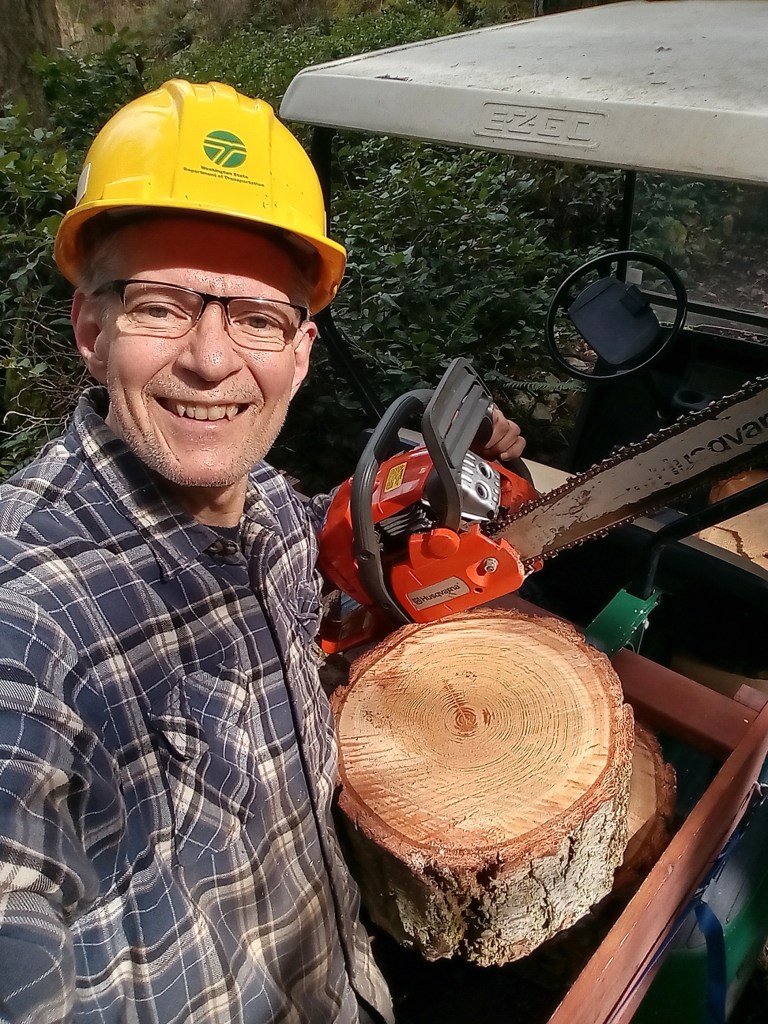
Lumberjack Brian: A newly cleared building lot meant felled trees were available for firewood.

The arrival of spring weather already has me busy with outdoor projects around the cabin. When a nearby lot got cleared for construction of a new cabin the cut trees were available for firewood. Time to fire up my chainsaw and start replenishing my wood stack for next winter. (I had to watch a YouTube to figure out why the saw wouldn’t start after hanging in my shed for the winter, but soon had it roaring and spewing sawdust. When you live on a remote island, you learn to fix stuff yourself.)

My other adventure has been digging on hands and knees with a hand trowel to locate my septic drainfield so I can install capped, upright 4-inch PVC pipes that function as inspection ports, now required by the county if I ever wish to sell my place. One port is installed, one more to go. The joys of home ownership. Nothing that a clothespin to the nose can’t make more pleasant.

Amid all this, daughter Lillian visited to help me celebrate my 69th birthday and neighbors John “The Mad Birder” and Carol showed up with recently dug razor clams they were generously willing to fry up for friends. (Yum.) Lillian showed off her new skills as a patisserie baker by making me the world’s best sugar-free chocolate cupcakes with buttercream frosting. (Ditto yum.)

That’s the April report from Center Island, friends. Find joy where you can. Remember to support your friends, family and other good guys. We all need it now more than ever.

Relieved to be home on my rock after Brian’s Dreadful December

AT LEAST IT DIDN’T HAPPEN on my remote little island nobody’s heard of. No helicopter evacs were involved, thank God.

That’s the best thing I can say about my recent up-close-and-personal encounter with America’s emergency health-care system.

Your faithful scribe and cat, happy to be back at the Nuthatch.

Loyal readers, if you were wondering about my long absence from the Reef, it was because I was busy living Brian’s Dreadful December.

When last we shared screen time, I was in the midst of a six-week housesitting stint in the lovely bayview home of friends Daniel and Jean in Olympia. In fact, after the presidential election I had resolved to make Olympia my next home.

That housesitting assignment was to conclude December 15. My plan was to return to my island for a week before hotfooting it back down the highway to spend Christmas with Portland friends Ken and Kate. Their daughter had orchestrated a plan for Christmas Eve dinner at Portland’s posh Ritz-Carlton hotel, followed by a couple of nights for family and friends at her Oregon Coast holiday home.

For me, all those holiday plans began to unravel on Friday the 13th (just like a bad movie).

After three days of serious digestive dysfunction in Olympia, I was on the phone at 7 in the morning to an old college friend — Kathy Pruitt, to whom I’m forever indebted — begging a ride to the nearest Emergency Room.

I had managed to pick up a nasty intestinal bug that over the course of the week had dehydrated me such that my blood pressure registered just 60/30 when they cuffed me in the St. Peter Hospital E.R. Never had I seen so many medical professionals swoop around me so quickly with armloads of I.V. bags, tubes and needles.

I was in the hospital four days before I.V. hydration, a liquid diet and a course of serious antibiotics set me right.

The lost time canceled my December return to Center Island. After a couple days of convalescence with my now-returned Olympia hosts, I packed up Galley Cat and drove straight to my Portland friends’ floating home on the Portland shore of the Columbia River.

On a back channel of the Columbia in Portland, my friends’ floating home is moored behind their sailboat, outlined in lights.

We had a nice few days. Toured a collection of Paul McCartney’s photos at Portland’s art museum. Shopped a holiday bazaar. Had a lovely little solstice party.

Then my digestion went south again. At 7 in the morning on Christmas Eve, I asked my hosts to drive me to another E.R.

I didn’t know it at the time, but the bug I’d suffered had a common side-effect: ulcers of the bowel. Admitted to a hospital in Vancouver, Washington, I got transfusions of five units of blood, then underwent emergency surgery on Christmas Day to stop the bleeding from a duodenal ulcer. Four hours on the table with only a local anesthetic while a surgeon probed my arteries. Ack.

Five more days in a hospital. My holidays were a culinary blur of green Jell-O and steaming yellow broth rumored to have once met a chicken. A far (and gastronomically anguished) cry from the Ritz.

Throughout the ordeal, my chums in Olympia and Portland showed me what true friendship means. The day after Christmas, daughter Lillian flew out from her new home of Philadelphia. Three weeks of her unsparing help and support was a godsend as I convalesced, first at my friends’ homes down south and finally at the Seattle-area home of my ever-generous sister-in-law Julie. I struggled to overcome stamina-robbing anemia and low blood-counts. In a quick trip to Center Island last weekend Lillian helped me transport my belongings and a carload of groceries homeward before I had to return to Seattle for final medical exams.

Tuesday night I drove Lillian to catch a Philly-bound plane. Wednesday, already halfway into January, I finally returned on my own to Nuthatch Cabin for some long-anticipated nesting and recovery time with Galley Cat.

With temperatures stuck in the 40s here, last summer’s fuchsias are still blooming on my deck. Blazes in the wood stove cheer the cabin nightly. Awakening mornings in my loft, I look out to watch each day unveil itself, whether wrapped in mist or warmed by the sun’s first lemony fingers caressing the treetops.

I’m getting back into my fitness routine, including a daily half-hour on the stationary bike. So far, so good. (Thursday I included two naps in my day’s itinerary. So I’m not overdoing.)

I’m working to boost my hemoglobin count, including another in a lineup of steak dinners tonight. Red meat isn’t my dietary norm but it helps bolster my blood, along with iron supplements.

For now, Galley Cat and I are both just glad to be home on our island. She’s back hunting the mice that live under the woodshed. I’ve returned to pleasant afternoons tapping the keyboard in my writing hut. Day by day, I’m encountering the rock’s few winter neighbors and chatting them up after my long absence. Sunny skies and coppery sunsets are a healing balm.

For now, I want to pull up the drawbridge and never leave. I hope your January offers comforts as dear.

Capital times in Olympia

Mount Rainier dominates the horizon above downtown Olympia, as seen from the West Bay Drive home I’m housesitting.

SO WHAT’S HAPPENING IN OLY TOWN? It’s December already, my six weeks of housesitting time is winding down, and somehow I got distracted by the news of November.

Here I sit looking out from West Bay Drive to the snowy majesty of Mount Rainier looming over downtown on a blue-sky afternoon. Other than trying to ignore the news in recent weeks, I’ve had some nice visits with friends and family and gotten to know this town again.

Some of my visitors probably won’t believe Olympia can be sunny and that Rainier looms large here. We’ve had our share of socked-in days of featureless low clouds, especially on days when I’ve had visitors. My buddy R.J., whom I call the Unitarian Librarian, was here from Moscow, Idaho, for three gloomy days in late November. He’ll never believe the sun shines on the state capital. Same for yesterday when longtime friends Dave and Jill from Port Orchard came for lunch and a genial hike around the Billy Frank Jr. Nisqually National Wildlife Refuge. Despite the glum day, we enjoyed sighting two Bald Eagles in the top of a tall fir. Among troops of migrating waterbirds on the tideflats, a flock of maybe a hundred Dunlins performed their signature aerial acrobatics in which the flock navigated amazing hair-trigger zigzags above the Nisqually tide flats, seeming to disappear in thin air and then astonishingly reappearing on a different tack. Worth the trip!

But today I’m on my own, and the day is blue and beautiful. I won’t complain.

With R.J., I revisited McLane Creek to see the spawning salmon. It was a new and mesmerizing experience for my friend, who grew up on a farm near Spokane. Because he’d not explored Olympia before, I took him to the Capitol building, thinking we’d poke our nose inside briefly. But at the entry we met a tour guide named Terry. “Are you here for the 1 o’clock tour?” he asked. We shook our heads. “Would you like a tour? It’s exactly 1 o’clock and nobody else is here.”

A Tiffany-created chandelier hangs inside the Capitol dome.

So purely through serendipity, we got a delightful private tour of the Capitol. I had spent a lot of time in that building during a reporting internship in college days, but on this visit I learned much more about it. For example, I never knew that there are 42 steps leading to the entrance, celebrating the fact that Washington was the 42nd state admitted to the Union. I never knew that the giant chandelier hanging inside the dome was crafted by Tiffany (as were light fixtures throughout the building), or that the Capitol campus was designed by the Olmsted Brothers, famed landscapers whose father was one of the lead designers of New York’s Central Park.

I especially enjoyed stepping into the foyer of the governor’s office, where huge portraits of past governors looked down on visitors. Caught up in a moment of wonder, I recounted to tour-guide Terry my “six degrees of separation” links to a handful of those governors. “Arthur Langlie’s granddaughter is a friend of mine. And my daughter just finished working at Rosellini’s Bakery in Seattle, run by a descendant of Albert Rosellini. Dan Evans was president of my college and I got to know him a bit in my tenure as editor of the college newspaper. And I had dealings with Dixy Lee Ray when I interned here.” It was a reminder that I am definitely a Washingtonian.

The day after R.J. returned to Idaho, my daughter Lillian and our friend Lux arrived to help me celebrate Thanksgiving. We enjoyed several days of exploring the town, where Lux had grown up and Lillian had gone to college. Both enjoyed seeing Olympia looking like it’s on an upswing, they said. Some boarded up storefronts remain, but new shops and eateries are moving in along with more residents as new downtown apartment buildings have gone up.

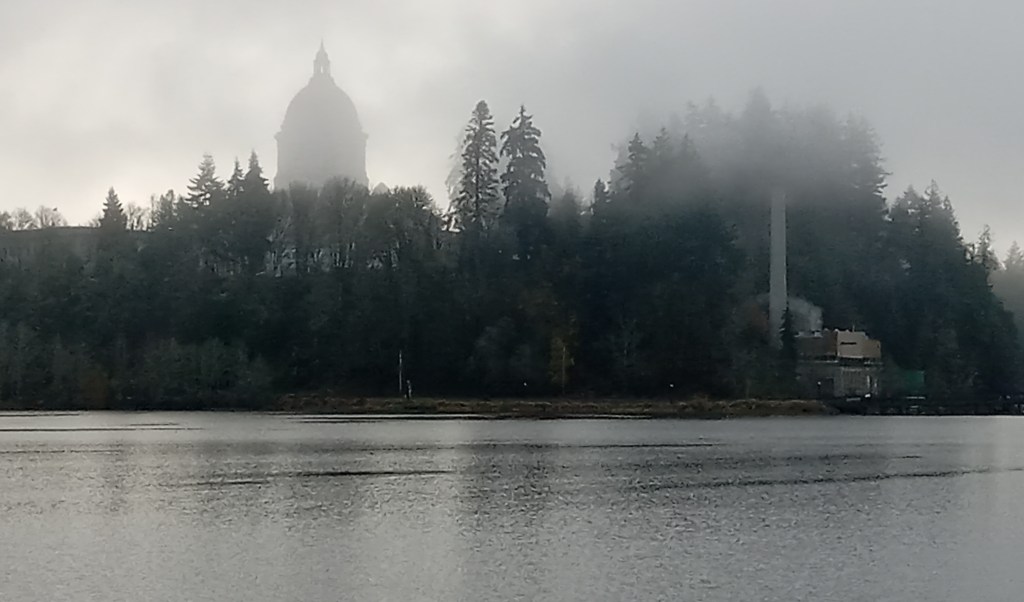
The mist-shrouded Capitol dome rises above Capitol Lake in Olympia.

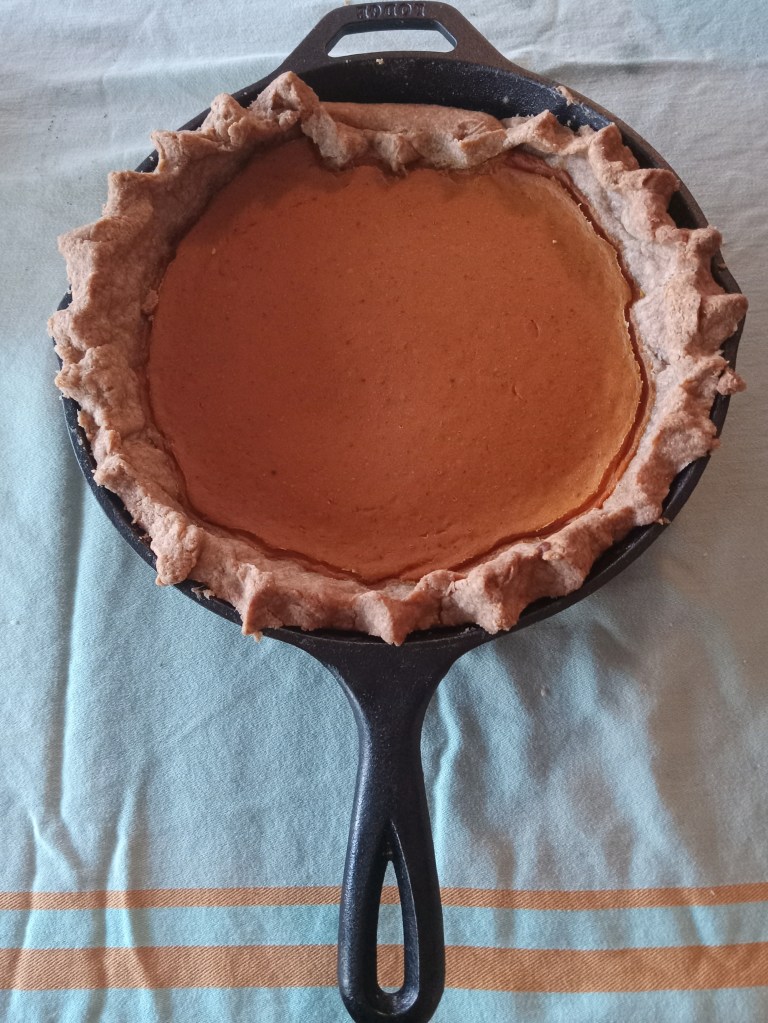
After a misty morning walk around Capitol Lake, we joined in a fun all-day collaboration cooking our Thanksgiving feast. Meat-eschewers Lil and Lux’s main dish was a Trader Joe creation, a Vegan Breaded Turkey-less Roast with Gravy, while I roasted my first-ever Rock Cornish Game Hen. Side dishes included roasted Brussels sprouts and golden beets, sage-crazy stuffing with walnuts and celery, mashed potatoes, mashed rutabaga, and Lillian’s specialty, luscious mushroom gravy. Her rich and delicious pumpkin pie with plant-based whipped cream concluded our evening’s repast.

Lillian’s pumpkin pie, delicious despite a slight crust malfunction.

For years, my daughter and I reserved a special day to go Christmas shopping together at Seattle’s Pike Place Market. But with her imminent departure for a new home in Philadelphia (prompted by a new job for her partner), we decided Friday was perfect to go shopping in downtown Olympia. We enjoyed hours nosing about a delightful local bookstore, the Traditions shop specializing in fair-trade artisanal imports, plus several lively boutiques and specialty stores. We ambled back up the hill to West Bay Drive laden with holiday packages and good secrets.

That afternoon, the three of us jumped in the car and headed out Highway 101 to Kennedy Creek, another well-known salmon-spawning stream. We got to chat with two knowledgeable docents there who told us this year brought a larger than usual run of 40,000 chum salmon to Kennedy Creek. The only downside, one of the experts told us: In their effort to find good nesting areas among the pebbly creek bottom, later-arriving fish tend to destroy the egg nests built by earlier arrivals. A bittersweet ending for all the effort these fish expend in returning from the ocean to the freshwater stream of their birth.

I’ve 12 days left here before friends Daniel and Jean return from visiting with their new grandson in California. I have one more special dinner on the calendar, with an old college housemate. I’ll put a bit more energy into looking at housing, and maybe I’ll take in a Christmas show before I go.

Then it’s back to Center Island for me and Galley Cat for a week before I join Portland friends for my first Christmas without family around me. But that’s really a misstatement; my Portland friends Ken and Kate are really family to me, as are so many others I’ve mentioned. Happy holidays to you all.

The social butterfly of autumn

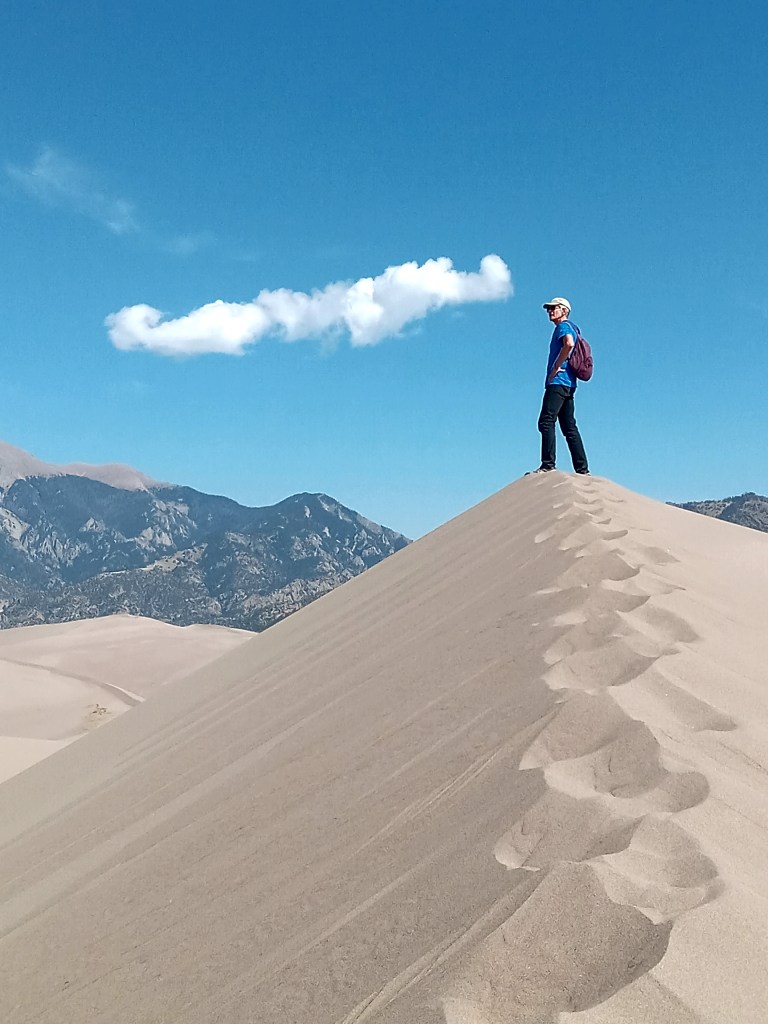
Your loyal correspondent tops out on a 700-foot+ dune in Great Sand Dunes National Park in southern Colorado. North America’s tallest dunes build from windblown grains of sand at the base of the Sangre de Cristo Mountains, seen in the background. Photo by Douglas Cantwell.

ISLAND LIFE CAN BE LONELY AT TIMES, you’ve heard me say. With Center Island’s year-round population hovering around 20, the social life has its limitations.

But, boy, loneliness hasn’t been an issue for me this fall.

So far, my autumn has been a dizzying — and delightful — whirlwind of visits by family and old friends, along with travel to visit family and friends in locales ranging from Orcas Island to Moscow, Idaho, to Santa Fe, New Mexico.

Hilary, Christi and me on Center Island. I love visitors, and I’ve had a few good visits lately.

It began with my Labor Day outing to Sucia Island with daughter Lillian, closely followed by a visit here by Hilary Hilscher and Christi Norman, two longtime friends. I first got to know them through their association with Audubon Washington, for which they drove all over the state together in a sort of “Thelma and Louise Go Birding” partnership about 20 years ago to create the Great Washington State Birding Trail. Laid out in a set of seven detailed and beautifully illustrated maps, the Birding Trail comprises the state’s best bird-watching sites. As outdoors editor for The Seattle Times, I piggybacked on their great work with a regular newsfeature called “Birders’ Top Spots,” spotlighting sites from their maps. (Six of the seven maps, published between 2002 and 2011, are still available to order online here for $4.95 apiece).

Hilary and Christi, who both live with their husbands in the greater Puget Sound area, have been regular readers of “Cantwell’s Reef” and decided they wanted to see my little rock. We ate lots of good food, drank good wine, and enjoyed renewing our friendships.

The same can be said of a visit shortly thereafter by Ken and Kate Brinkley of Portland. I first met Ken on an impromptu shared sailing afternoon out of Orcas Island’s Rosario resort in the 1980s. He became a lifelong friend. Ditto with Kate when she married him.

Ken, Kate and yours truly among Center Island madronas.

Not long after the Brinkleys departed in late September I left my island for a marathon day’s drive across the state to visit a new friend, R.J. (for Robert James). He lives in Moscow, Idaho, just across the state line from Washington State University, where he manages a library. I guess I’m partial to librarians. I met him online, which is a good way to make friends when you live on a small island nobody’s heard of. We’ve become chums.

Sandwiched in there somewhere was a visit with another friend discovered online, Tom, on Orcas Island. My boat, WeLike, got me there. It’s nice to find local buddies, too.

Doing the Idaho road trip in one day each direction was exhausting but also a treat. It had been a while since I’d seen so much of my home state, from the San Juans to Seattle, over the Cascades, to a bit of Coulee Country before navigating the rolling and roiling Palouse. I renewed acquaintance with phenomenal State Route 26, which slices straight as a razor across much of its 114 miles of Eastern Washington as it blazes a path toward Pullman.

Farmers had just completed the wheat harvest. The bright yellow-white stubble glowed in the sunshine as I crossed into Whitman County, where welcome signs boast that it grows more wheat than any other county in America. (In 2015, growers there harvested nearly 30.5 million bushels, according to the National Agricultural Statistics Service.)

Less than a week after my return to Center Island I again caught the Island Express water taxi. I was bound for the Seattle airport, where I hopped an Alaska 737 for Albuquerque, via a layover in Phoenix (where I was glad I didn’t need to step outside into the 108-degree October heat). New Mexico was more clement, with daytime highs in the 70s and low 80s.

My brother Doug met me and drove us the hour to Santa Fe and the lovely adobe home he shares with partner Lori, whom I enjoyed meeting for the first time.

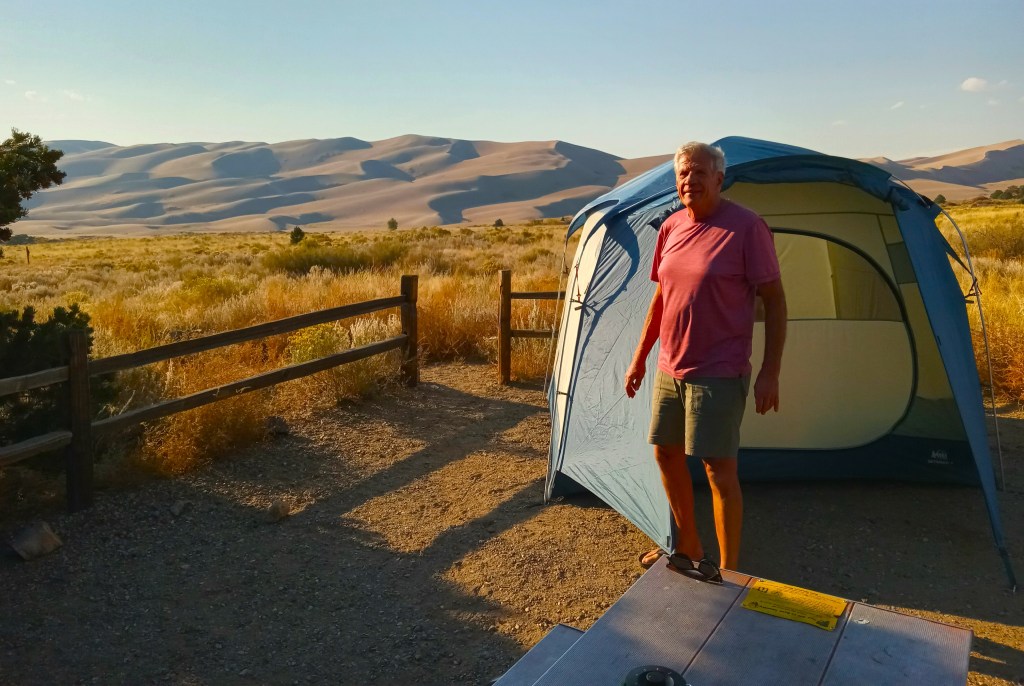
My brother Doug Cantwell at our Great Sand Dunes National Park campsite in Colorado, about three hours from his Santa Fe home.

The next day I acclimated with a pleasant hike with Doug on the outskirts of his town at 1.3 miles of elevation (blowing a raspberry at your Mile-High City claim, Denver). A day later we aimed Doug’s shiny new Outback at southern Colorado for a three-night campout at stunning Great Sand Dunes National Park. I’d never heard of the place, which became a national park at the end of the Clinton administration, but I won’t soon forget it. North America’s highest dunes pile up against the base of the Sangre de Cristo mountains, dominated by 13,297-foot Mount Herard, of which we had a front-row view from our campsite that Doug had hand-picked from a prior stay.

Autumn colors are spectacular among Colorado’s aspens, willows and cottonwoods.

Piñon Flats Campground was named for the scrubby pines that this year were groaning with cones bearing the famed pine nuts that are so good on salads and in sauces. For two geezers whose combined ages approach 140, there was one advantage to having to rise from our cozy sleeping bags in what’s aptly called the “wee hours”: With a combination of dry air, little light pollution, and high elevation, Great Sand Dunes is certified as an International Dark Sky Park. “Wow” and “whoa” dominated our midnight vocabulary as we encountered Orion, the Pleiades, and a bright, night-piercing Jupiter, high in the eastern sky. Doug spotted more than one shooting star.

Though I puffed from the 8,800-foot elevation (I live just above sea level, remember), Doug and I made it to the top of a 700-foot+ dune, often slipping and sliding in the sand that dominant winds bring from afar. During my visit, warm sunshine brought out the startling gold of the area’s aspens and willows. An afternoon thunderstorm swirled towering black clouds around the mountain tops. And, after a half-day drive to the top of 10,856-foot Wolf Creek Pass on the Continental Divide, we experienced a wind-blown snow shower.

This past Saturday, before Doug and Lori dropped me at Albuquerque International Sunport (rivaling in airport-marketing silliness the “Sky Harbor” of Phoenix), we witnessed the final hour of a mass ascension, part of the final 2024 weekend of Albuquerque’s famed Balloon Fiesta. The colorful event draws some 600 hot-air balloons each year.

Frank Boy, a sort of young Frankenstein balloon, came from Brazil for Albuquerque’s 2024 Balloon Fiesta.

I’m back at the Nuthatch today, catching my breath. Over the next two weeks I plan to buckle down and write more get-out-the-vote letters for Vote Forward, which expects to contact 10 million voters before November 5. Ten days ago I mailed 140 letters to Pennsylvania, North Carolina, Georgia and Arizona. Doug will be busy in coming days, too, having committed to 200 letters. There’s still time if you want to join us with your pen.

All the socializing and travel has been great, truly. But sometimes I love my quiet island. A good place to write.