

OH MY, OH MY, my May.
Here it’s already Memorial Day weekend, one year since my crewmates and I shoved off for our 10-week voyage up the Inside Passage to Alaska, and I’ve had such a busy month of visiting with other friends that I need to catch up with you, loyal Reefers.
Getting too busy with friends can be a rare thing when you live on a small island nobody’s heard of. Lots of comings and goings this month. For me, that’s a good thing. Winters can get lonely when the winds howl.
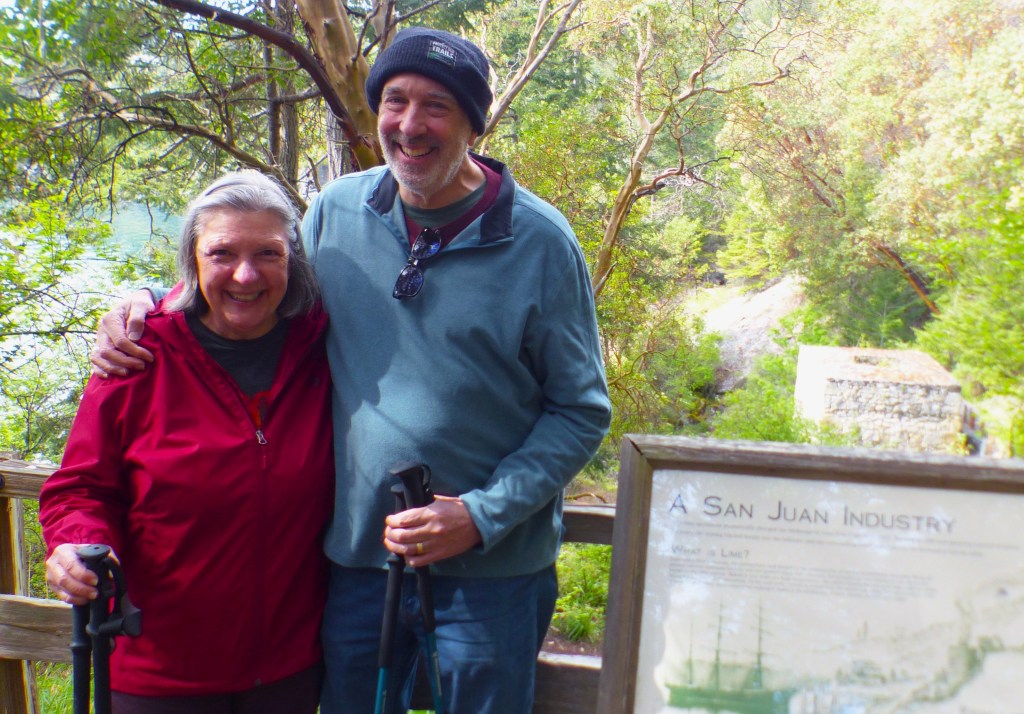
Early in the month, I had a pleasant stay with friends (and Inside Passage crewmates) Bill Watson and Barbara Marrett on San Juan Island, paired with a bonus visit with old chums Daniel and Jean Farber. Usually at home in Olympia, they’ve spent the whole month of May living in a travel trailer on San Juan Island where they’ve served as interpretive park hosts (and ruthless wranglers of invasive blackberry vines) at Lime Kiln Point State Park.
Daniel, who retired from a distinguished career with Washington State Parks, once again proved his acumen as a parks pooh-bah by leading me on a walking tour rich in historical narration of Lime Kiln’s old quarries and upland trails. For example, little did I know that Lyman Cutler, the American farmer whose famous shooting of a British pig touched off the Pig War standoff here in 1859, was also a founder of the quarrying business at Lime Kiln Point, which shipped lime to be used in cement for building cities up and down the West Coast. Added trivia from my own research: After Cutler sold his interest, the mining company ultimately dissolved when one partner murdered another — proving, I guess, that it’s dangerous to be a mining baron, or a pig, on San Juan Island.

If you’re interested in island-living lore, my trips to San Juan Island aren’t quick or easy. I hire the Paraclete Water Taxi to take me from Center Island across Lopez Sound (3 miles, $38) to the Hunter Bay County Dock on Lopez Island, where I keep my faithful old Ford pickup, Ranger Rick (county parking permit, $25 annually for homeowners on neighboring Center and Decatur islands). I drive Ranger Rick 11 miles to park in the public lot (72 hours free) at the state ferry terminal, load my Rubbermaid tote (aka San Juan Samsonite) on my old red handtruck and walk it on to the next ferry bound for Friday Harbor (often waiting longer than expected because ferry runs get canceled due to crew shortages). The good news: the ferry ride is free for interisland walk-ons.
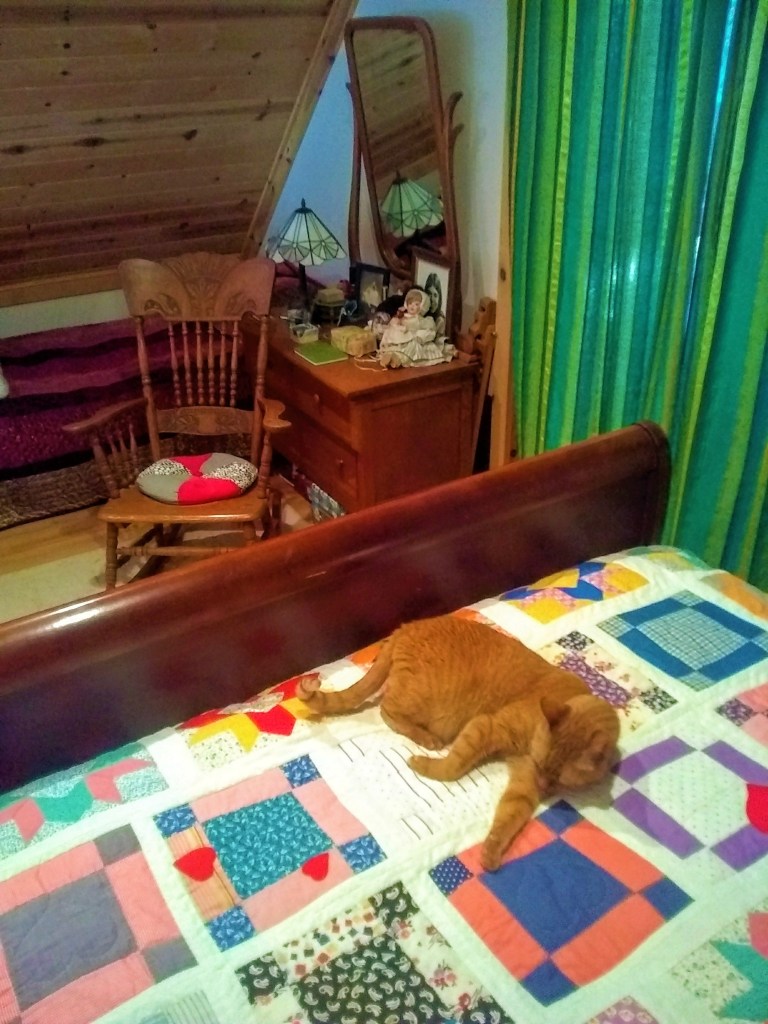
Ten days after my return from that adventure, Galley Cat and I were on the road to Walla Walla to visit my friend Patti Lennartson. Galley Cat usually vocally protests the idea of leaving the cabin overnight, and hides under a bed if she cottons to the fact that I’m packing again. But once she was in the car and set loose from her carrier to be a free-range travel cat (as free as she can be in a Honda Civic), she seemed fine with it. As usual, she often stretched from the passenger seat to put her front paws on the dashboard to watch the world go by. I think she likes high speeds. Crossing Snoqualmie Pass, she seemed fascinated by snowy peaks, as only makes sense for someone who has spent 99.9 percent of her 11 years at or near sea level. (She lived on a boat half her life.)

Walla Walla was sunny and hot. But Patti had the A.C. cranked up in the guest room, and Galley and I enjoyed a dose of extra Vitamin D when we got outside. Along with Patti’s daughter Stevie and her partner, Kevin, we drank some good Walla Walla wine, watched a Latin dance troupe at a street fair in College Place, ate good tacos and wood-fired pizza with fresh asparagus, and generally had a fine time.
Came back to lovely 65-degree days on my island, where the wildflowers are almost played out. The blue camas (with edible bulb) is almost done, though the appropriately named death camas (whose foliage and bulb are poisonous) is parading white stalks of flowers in a come-hither display. Happily, Galley ignores the siren call. She likes plain old grass.
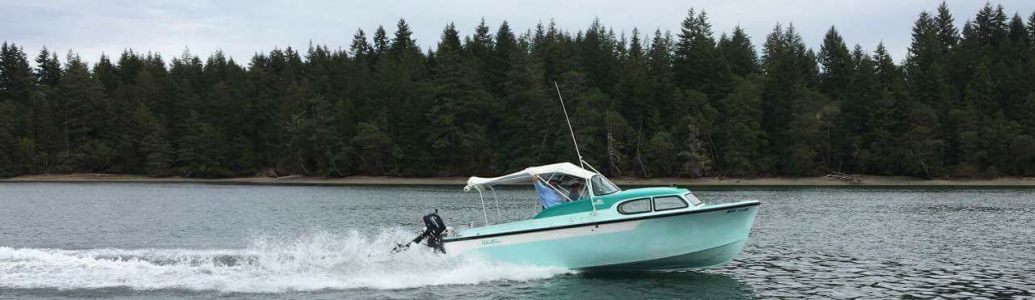
Just when I was going to get down to work replacing planks on my deck, a delightful respite presented on Wednesday when dear friend Carol Hasse, another of my Inside Passage crewmates, texted to ask if she and shipmates on the beautiful, century-old wooden motoryacht Glorybe, moored that day at Jones Island, might put in at Center Island on Thursday.
Always say yes, friend Daniel and I have pledged, when serendipity knocks. So I got on the phone to island buddy Dan Lewis, who didn’t hesitate when I asked if his mooring buoy might be available. It was a perfect bluebird-sky May afternoon when Hasse, Glorybe skipper Betsy Davis, and fellow crewmate Ace Spragg came for a happy hour and fish-taco dinner on the Nuthatch Cabin’s deck (which will have new cedar planks soon enough).

Hasse, as anybody who has set foot on a sailboat in this hemisphere probably knows, recently retired from a renowned sailmaking business in Port Townsend. Betsy, former director of Seattle’s Center for Wooden Boats, these days helms the NorthWest School of Wooden BoatBuilding in Port Hadlock when she isn’t at the wheel of Glorybe. Ace is that school’s education director after serving 11 years as sailing director, among other salty hats she wore, at Port Townsend’s Northwest Maritime Center. All this pedigree talk is simply to say that over beer, wine and a bit of good grub, we had a boatload of good nautical chat to share. I loved Ace’s stories about her idyllic childhood days of building and piloting rafts on the Chesapeake Bay (and constructing a five-story treehouse from which she and other kids dropped eggs — and anything else that seemed interesting — just to watch them splat).
The thing to remember is, friends don’t let friends work too hard. Tomorrow I get busy on the deck. Have a memorable Memorial Day.


 Cantwell's Reef