
Introducing Wee Nooke, where I plan to write some real barn-burners


P1220413.JPG
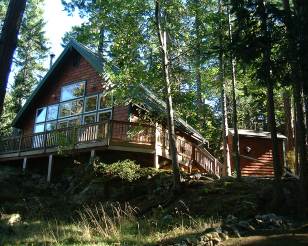
My cedar-sided writing studio, or writing hut, as befits its size, sits atop a rocky knoll behind our Center Island cabin.

IMG_7955OK, LOYAL READERS (BOTH OF YOU), don’t say that this scribe isn’t heedful of his public. I’ve had a request for a closer look at the writing studio (or writing hut, more accurately) from which I fire off these juicy missives. So here you go.

This humble structure originated as a playhouse (or escape hatch) for daughter Lillian, who was 12 when we bought our island cabin in 2003. With a 6-foot-square interior, it came as a kit, designed to be a cedar garden shed, and it fits nicely in the grassy space atop our rocky knoll behind the cabin we’ve come to call The Nuthatch.

Thanks to my dear wife’s Australian upbringing, the hut was first called the Wendy House, after the British term for playhouse, taken from “Peter Pan.” (You can take the Aussies out of the empire, but you can’t take the…)

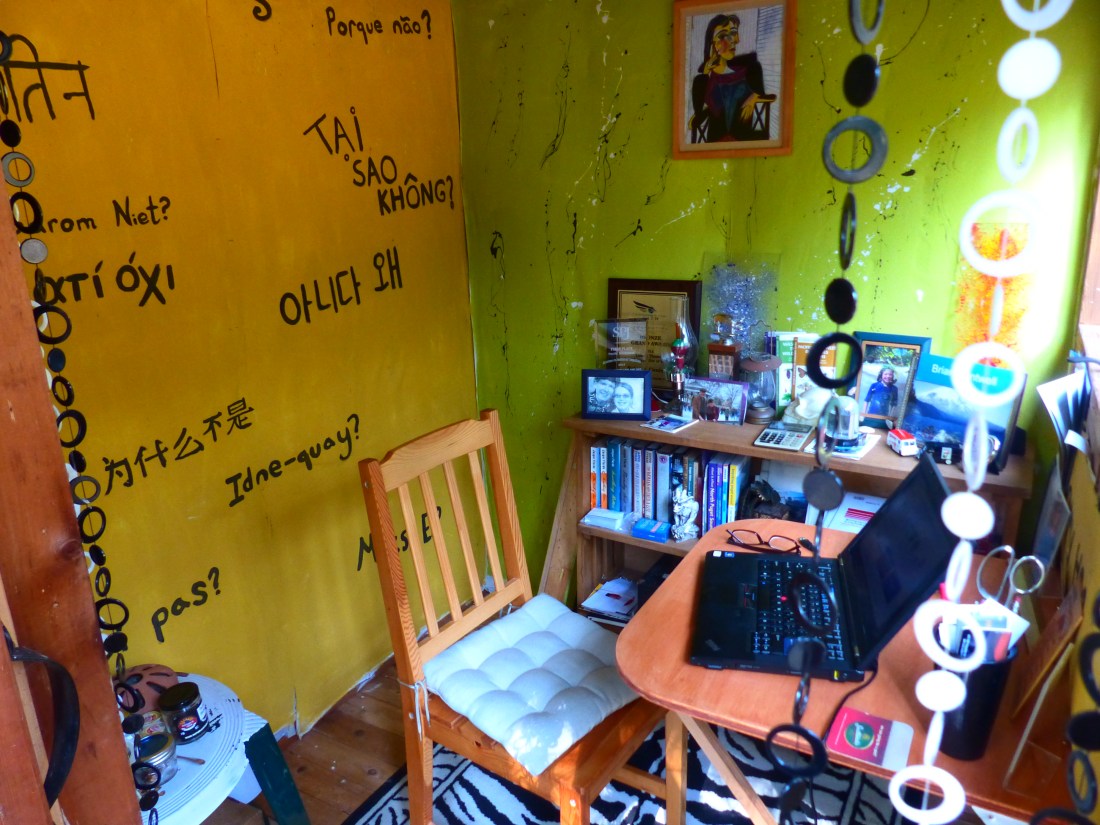
Lillian was given free reign to decorate the interior as she wished. In her blooming teenager-hood, the world was one of infinite possibilities, apparently. So at the top of one interior wall she painted the question, “Why not?” She then went to the University of Washington library, where her mother worked, and interviewed foreign-language librarians to find out how to write “Why not?” in other languages. To this day, the question is painted inside in 18 different languages, ranging from Vietnamese (“tai sao khong?”) to Dutch (“waarom niet?”) to what I finally recognized the other day to be Pig Latin (“Y-whay ot-nay?”).
P1220415.JPG
“Why not?” is a question repeated in 18 different languages on the inside walls of my writing hut, thanks to my daughter, the previous tenant.

I’ve kept most of her decor, including the zebra-striped rug, though I did take down the many circa-2003 Johnny Depp posters (Disney’s “Pirates of the Caribbean” film had just come out), which were encrusted with dead spiders after these many years. One poster even concealed a tiny hibernating bat that had found its way inside.

I also renamed the writing hut. It’s new name, announced by a wooden placard that Lil made for me as a Father’s Day gift last month, is “Wee Nooke.”

P1220414.JPG
The sign made by my daughter, framed in twigs over the door. The name came from a P.G. Wodehouse story.

The moniker is taken from a P.G. Wodehouse story in which bon vivant Bertie Wooster rents a country cottage of that name. Unfortunately, a pesky Boy Scout named Edwin, committed to doing daily acts of kindness, attempts to clean the cottage’s chimney using  gunpowder and paraffin, burning Wee Nooke to the ground.

So, it’s a literary name. What better to inspire a writer? I might even put in a woodstove for winter — with a chimney, of course. If so, I promise I’ll keep an eye peeled for wayward Boy Scouts. cropped-1-anchor.jpg

Island time feels good on another island (but let’s never leave home again)

IMG_7955WE GOT OFF OUR ROCK and sampled an island in the south seas this week. Well, an island south of us. In Puget Sound.

It was good to be back on the strong and steady old Westsail 32, Sogni d’Oro, for a two-night outing with our daughter, Lillian, who now makes it her home. For once we weren’t heading in the direction the wind didn’t want to help with, so we even hoisted the sails and cherished the silent sounds of the Sound (with the engine off). Mind you, it was a sunny morning in July and there wasn’t much wind, so it took well over an hour before we got up close and on a first-name basis with Bainbridge Island, the first land west of the sailboat’s moorage at Seattle’s Shilshole Bay.

But we were in no hurry. Our planned landfall was no more than 11 miles away at Blake Island, the popular marine state park just south of Bainbridge.

We were taking a gamble on getting a mooring buoy at Blake, where depths can make anchoring dicey, during one of the hottest and sunniest weeks of the summer so far. It’s a mighty magnet for Seattle boaters looking to cool off and ditch the sizzling city.

For those of us who’ve lived on a boat at Shilshole and almost always headed north to the San Juans and beyond when we left the dock, one treat to heading south was the full-on Seattle skyline view we got as soon as we rounded Magnolia Bluff.

P1220133.JPG
A tug and a ferry cross paths on Puget Sound, with the Seattle skyline as a backdrop, on our way to Blake Island.

That panorama from the water is really the only time you get the full visual impact of downtown’s alarming upward growth. Happily, pretty Smith Tower, which was THE skyscraper when Barbara and I were little, still stands off to the side and hasn’t been swallowed up by the tangle of urban architecture just to its north. Smith Tower and the Space Needle still bookend the urban core.

Another treat was our timing. We had guessed that Tuesday would be a good day to go in hope of snagging a buoy. (Our backup plan, if there was no comfortable place to moor at Blake, was to chug around the corner through Rich Passage and drop the hook in Poulsbo’s Liberty Bay.)

As soon as we were out on the wide-open Sound, however, we noticed a happy and rare occurrence. We were out there pretty much alone. No streams of big powerboats to dodge. Not a freighter or cruise ship in sight. Only a rare tug or two and the usual scheduled Washington State Ferries. That boded well for these new retirees: Everyone else was at work, ha, ha.

And sure enough, when we finally rounded the point to peek at the west side of Blake, we spied at least six open buoys just off the pretty sandy beach. Blue sky above. Gentle, cooling breezes, a view of ferries scuttling in and out of Southworth and Bremerton, and a wooded island with miles of trails to explore.

P1220233.JPG
Native wild blackberries grow abundantly along trails on Blake Island.

The next morning, Lil and I tried out a new inflatable kayak and went on an early-morning paddle along the shore, watching raccoons digging for clams on the beach. “Isn’t it nice to see them eating natural foods rather than dumpster diving, for a change?” we agreed.

We went for a hike, we played board games in the cockpit, we grilled our dinner and sipped rum coolers as the sun set behind the Olympics.

P1220302.JPG
Sogni d’Oro, our old Westsail 32, at right, sits on a buoy off Blake Island as the sun sets behind the Olympic Mountains.

Thursday, we fired up the engine and motored back to Shilshole on calm waters in two easy hours. It was nice to be on the old boat again.

But you know what? After the long homeward slog up the freeway, Barbara and I are really glad to be back on our island. It’s another beautiful day in paradise. “Let’s never leave again,” she said.

Hmmm, for today anyway, that idea feels kind of good. 1-anchor

All creatures great and (very) small

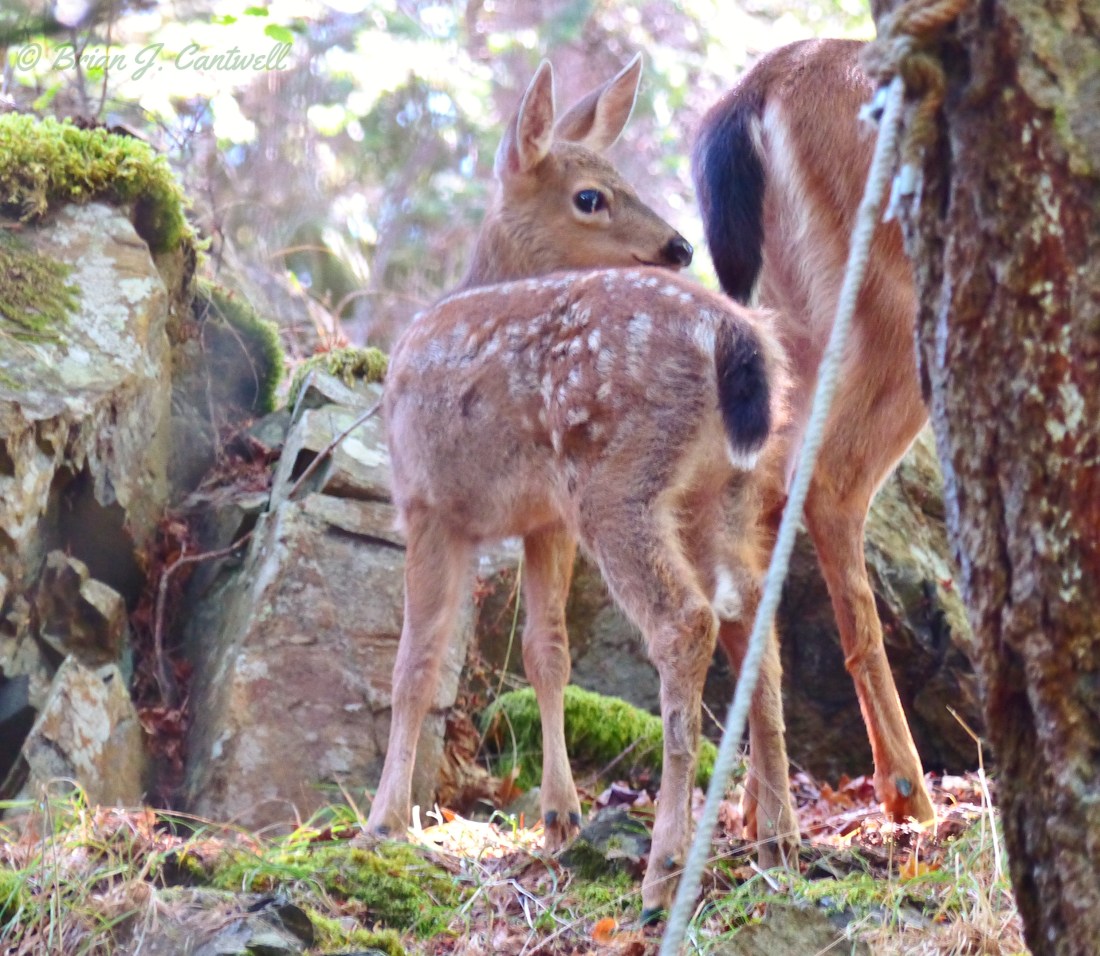
Spotted fawn, Center Island(1).jpgA fawn pauses with its mother atop the rocky knoll behind The Nuthatch cabin. The rope tied to a tree trunk serves as a handhold for humans scaling the steep bank.
IMG_7955IT’S THE SEASON OF FECUNDITY on Center Island.

Suddenly the bird feeders are besieged by whole families of fledgling goldfinches, just days out of the nest. They are small, socially awkward and they fly like children thrown by centrifugal force from a merry-go-round horse. They’ll soon learn how to work their wings, I’m sure, and perfect their landings. When four of them descended on the bamboo fountain on our deck, one teetered on the edge of the bowl and fell in the water. It’s a hoot to watch them. And they are cleaning out the feeders like a fleet of winged Hoovers.

This morning we also saw the first spotted fawn of our year, accompanying its mother as she slurped up the less-desirable birdseed that the goldfinches had strewn from the feeder outside our kitchen window. When I cracked opened a door to take their photo, the fawn showed itself much more surefooted than a goldfinch chick. It pranced effortlessly behind its mother up the side of our rocky knoll.

Life on a small island has its pleasures. 1-anchor

Shot through with lights of stars and dawns,

And shadowed sweet by ferns and fawns,

— Thus heaven and earth together vie

Their shining depths to sanctify.

— excerpt from “My Springs,” by Sidney Lanier

Those ‘10 nations in 5 days’ tours ain’t got nothin’ on me

P1200631.JPG
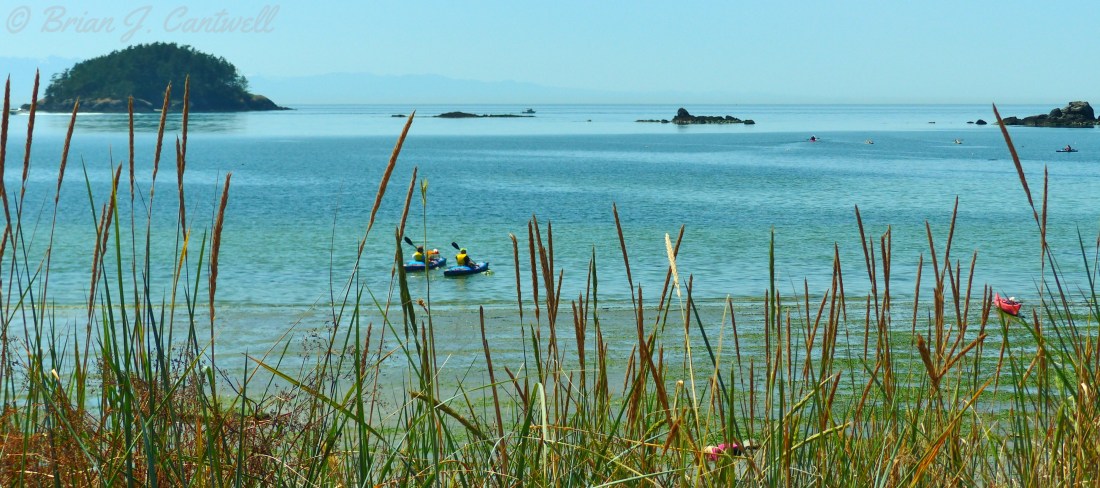
One of my photos from Deception Pass State Park: Kayakers launch on Bowman Bay.

IMG_7955I’M BACK ON THE ROCK after a whirlwind, no-time-to-smell-any-darn-roses field trip to top-tier recreation sites around Puget Sound and the Salish Sea. I put more than 500 miles on the Civic. Whew.

Retirement can be hard work, especially if you’re not very good at committing to doing nothing, I’m finding.

The good news is I’ve landed a plum project with Seattle-based Mountaineers Books. One of their imprints, Braided River, is working in cooperation with the Washington Environmental Council on a new book about Puget Sound, aimed at furthering discussion of the need to clean up the Sound (as Washingtonians said we were going to do about 50 years ago). I will be a contributing author on the project, with my section spotlighting about 30 top recreation spots around the Sound and the Salish Sea.

I’ve been to most of the places on the list we’ve come up with, some of them multiple times. But there were a few I’d never quite gotten around to, and others that I needed to revisit to take some fresh photos.

So I packed our car-camping gear and caught the water taxi on Monday morning. My first night was camping at Deception Pass State Park, where I explored some trails I’d never trod and got lots of new photos. (High point: Sunset light on North Beach and the arching bridges. Low point: Being kept awake until midnight — along with everyone else in the campground — by the thundering jets from nearby Whidbey Island Naval Air Station. With new much-noisier aircraft and more and more day-and-night training sorties, the previously innocuous “sound of freedom” is sadly spoiling a gem of a park.)

P1210036.JPG
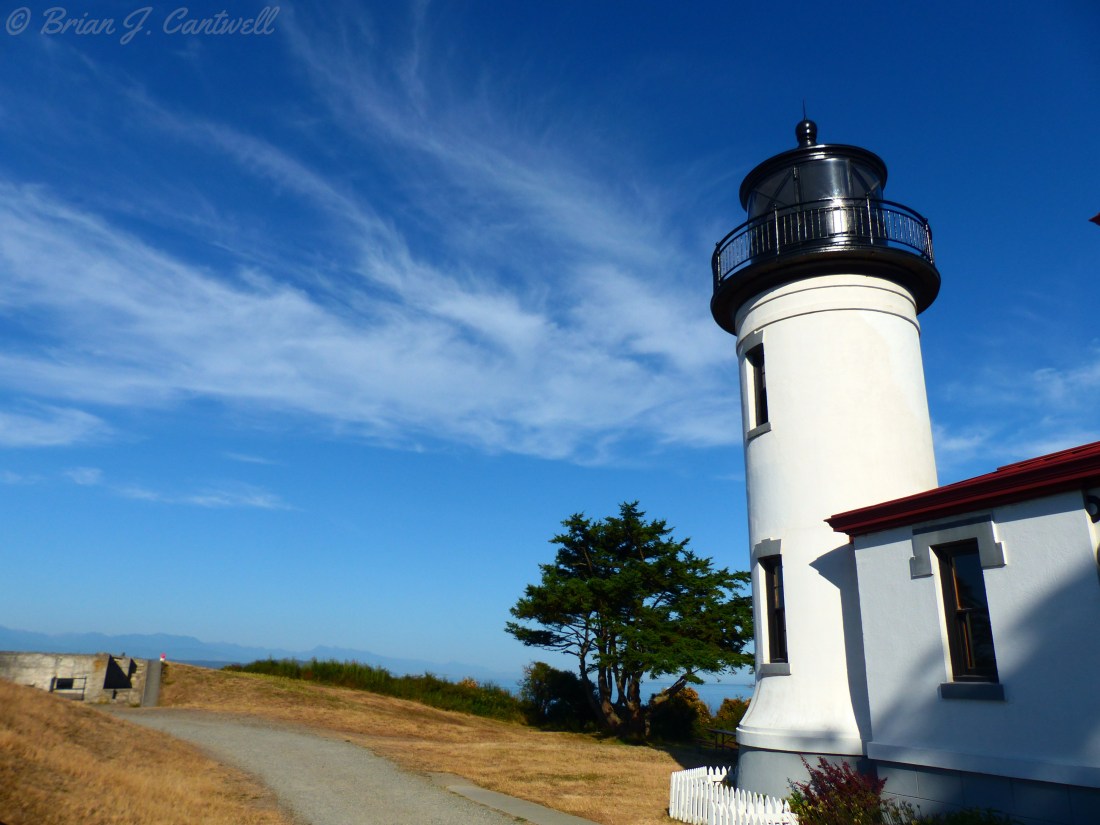
Admiralty Head Lighthouse at Fort Casey.

The next day I started the real marathon. My Whidbey Island stops for quick exploration and photography included Ebey’s Landing National Historical Reserve and Fort Casey State Park, before catching a 9:30 a.m. ferry from what’s now called the Coupeville dock (formerly known as Keystone) to Port Townsend.

From there, I was on the clock to catch a noontime minus tide at Clallam County’s Salt Creek Recreation Area, 16 miles west of Port Angeles. I’d never been to Salt Creek, but I’d heard of it (and edited stories about it) and its phenomenal tidepooling. Marine biologists and students from across the nation come there to study marine life.

P1210186.JPG
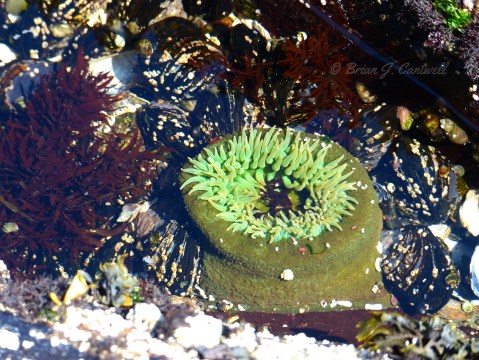
A sea anemone among mussels and barnacles on the rocks at Salt Creek Recreation Area in Clallam County.

Not only was the place a Disneyland of intertidal-zone wonders, I found a bunch of water-view campsites definitely worth a return trip.

From there, I drove back east a few miles to find the newly developing beach where the now-undammed Elwha River meets the Strait of Juan de Fuca. I’d visited the spot a couple years ago, and I was wowed now at how much more beach has been created as the newly free-flowing river continues to flush sediment to its mouth.

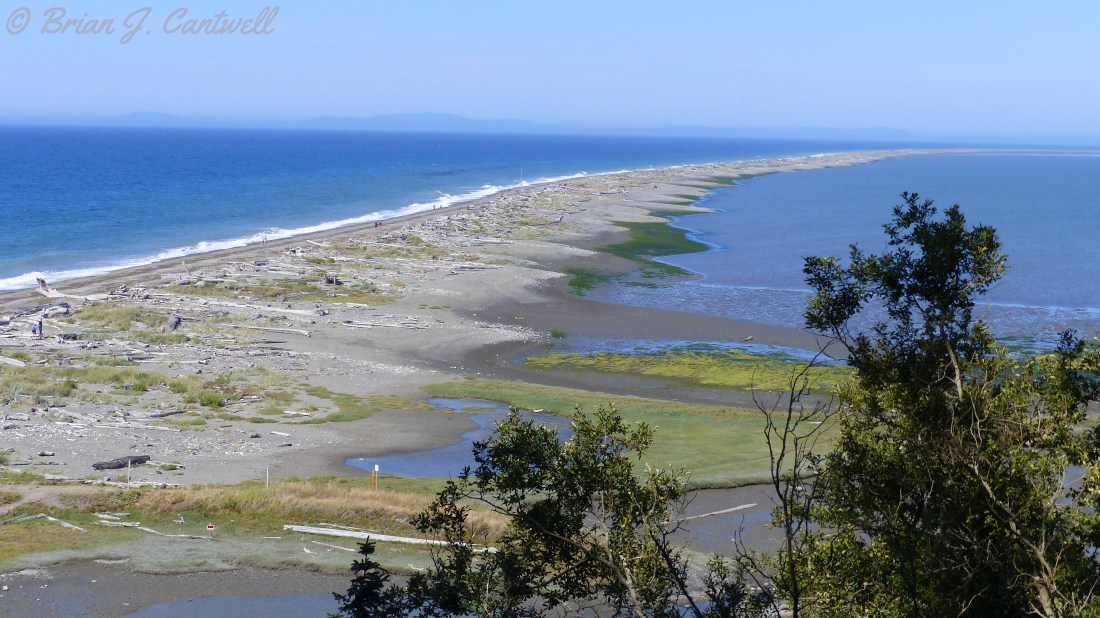
Then I burned up the road back to Sequim for a stop at Dungeness National Wildlife Refuge and a half-mile hike down a woodsy trail to get good photos of 5-mile-long Dungeness Spit.

P1210360.JPG
Dungeness Spit reaches out into the Strait of Juan de Fuca like a long arm cozying up to a lover.

Then it was on to my second night camping destination, Dosewallips State Park, on Hood Canal (the resident elk herd wasn’t at home, more’s the pity).

Next day: Dosewallips to Poulsbo (for snaps of Liberty Bay’s waterfront and Sluy’s Bakery pastries), to Suquamish (and Chief Seattle’s 19th-century Agate Pass homesite, and his nearby gravesite), to Bremerton (whose waterfront is home to one of the more innovative fountain parks, with an apt Naval-vessel theme), to Belfair’s Theler Wetlands Nature Trails, to Gig Harbor’s lively waterfront, and finally across the Narrows Bridge to Tacoma’s Point Defiance Park, a classic (and classy) urban park that, in my Seattlecentricity,  I had shockingly never visited. I could easily have spent a full weekend exploring Point Defiance alone.

P1210959(1).JPG
Mount Rainier and downtown Olympia, as seen from the Farbers’ deck.

I ended that day with a stay with my friends Daniel and Jean Farber in their delightful home overlooking Olympia’s Budd Inlet (and a pretty nice view of Mount Rainier). It was great to have a real bed, delicious home-cooked food (Moroccan recipes!) and a long hot shower. (Thanks, you two.)

Next morning I hiked to the end of the verrrry long boardwalk at Billy Frank Jr. Nisqually National Wildlife Refuge. It was the first time I got a little damp, from a heavy drizzle, after several days of warm sunshine, but it meant a quieter outing with more birds. A fellow walker said she saw a weasel by the barns. Sorry I missed it; I’d have liked to compare it to our Center Island mink.

Then it was a long and tedious drive back up I-5 to Anacortes and the boat ride home. For more details, you’ll just have to read the book, which will likely publish in time for Christmas 2019. 1-anchor

You never know whooo you’ll run in to on Center Island

IMG_7955ON OUR LITTLE ROCK IN THE SAN JUANS, we have deer (who nibble my ferns), raccoons (who leave intriguing footprints when it snows), mice (who now live in fear of our cats), herons (who wade in close on minus-tide days like this), otters (who poop prodigiously on our docks) and mink ( including one that occasionally drinks from the bamboo fountain on our front deck, just like it’s slurping from an office water fountain). Yes, mink are native to the San Juans. No, we are not planning on making anybody into coats or stoles.

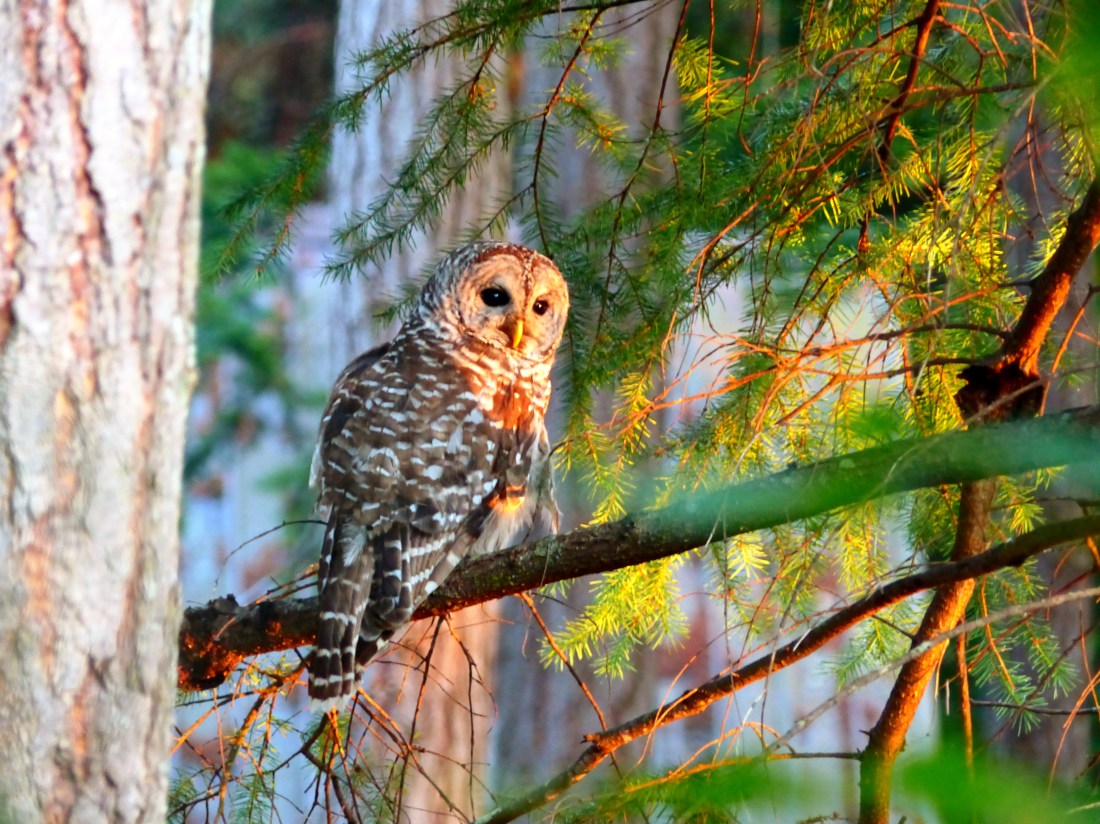
A couple evenings ago as we stepped outside The Nuthatch we encountered another local — though actually, when I read up on him, I learned that his family migrated here from the East Coast. This guy was sitting on the post of our front steps, then made a quick hop to a nearby tree. He didn’t seem to mind just hanging out while we watched him as he watched the sunset. cropped-1-anchor.jpg

P1190892.JPG
A barred owl perches on a Douglas fir branch as the sun sets over nearby Lopez Sound. Barred owls — whose distinctive hooting call is described as “Who cooks for you?” — are native to eastern North America. They’re considered invasive in the Pacific Northwest. But, hey, so are Californians. Brian J. Cantwell photo.

How does our garden grow? With high hopes and lots of encouragement

IMG_2559.JPG
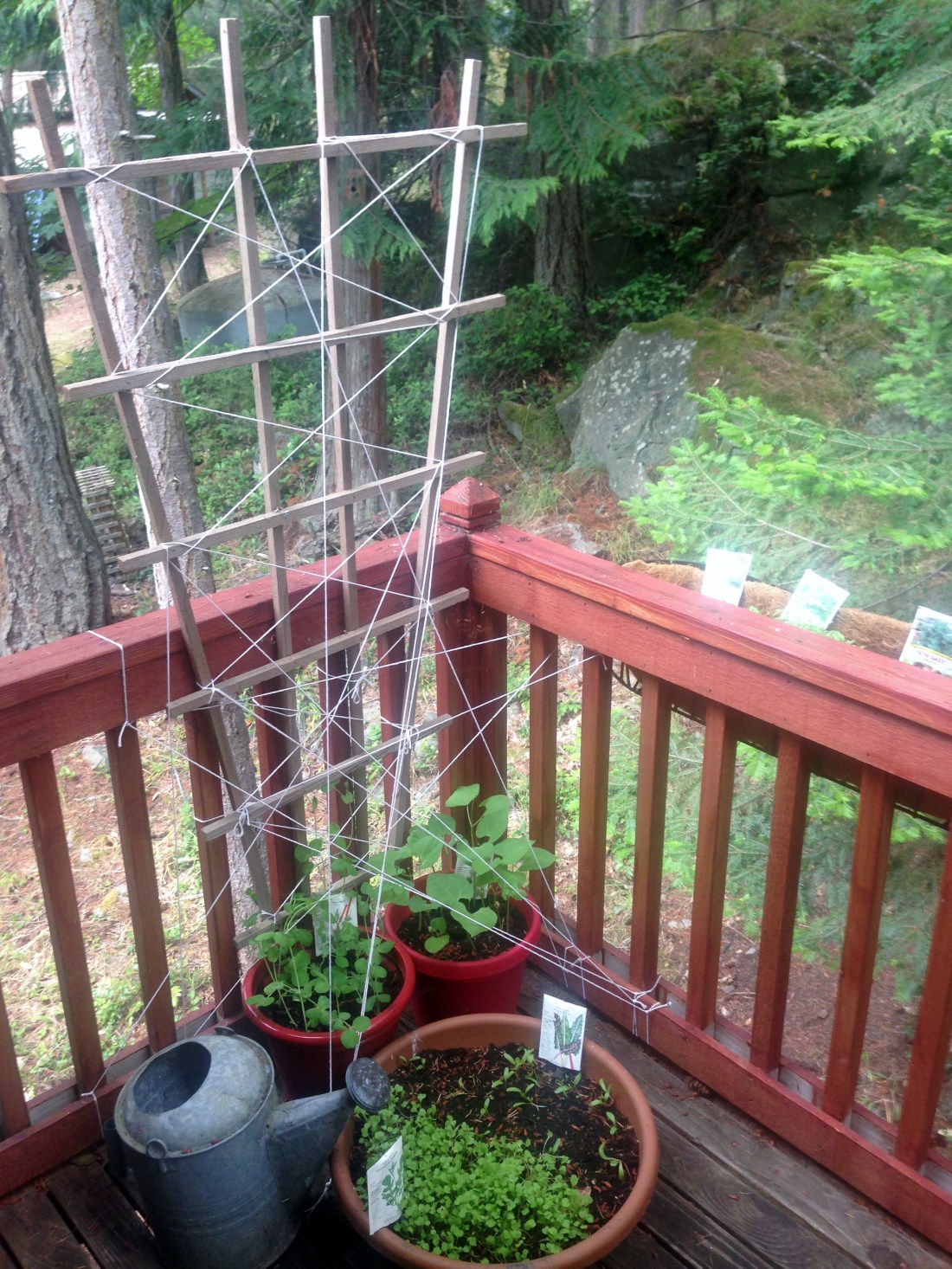
Our deck garden with a cat’s cradle of string beckoning climbing tendrils of peas and pole beans.

IMG_7955LONG BEFORE I WORKED AT THE SEATTLE TIMES, my first daily-newspaper job was at the Yakima Herald-Republic (before it was owned by The Seattle Times, as it is now.) For Barbara and me, it was our first time living east of the Cascade Mountains. We Seattle kids, who liked green woods and water views, always thought the world ended at North Bend.

But sagebrush-rimmed Yakima had its way of wooing us. I used to go to work on a nice day and leave the windows down on the parked car; there was no chance it would rain. Do that in Seattle and you’ll get soggy seats.

And behind our little bungalow on South Sixth Avenue we had the best vegetable garden we’ve ever had before or since. It was two years after Mount St. Helens had sent billows of ash eastward, bringing Yakima a day of darkness. When we lived there, we’d dig down only an inch in our garden to find a band of chalky grit, and that stuff was a great soil amendment. Add long days of sunshine, plus irrigation water from the Naches River, and we had ripe tomatoes, eggplant, peppers and more.

Now, after most of 25 years living on a boat, we’re on land again, and we’d love to have another bountiful garden. On our rock in the San Juans? Good luck!

Center Island
The Nuthatch cabin sits atop a rocky knoll. Nice view, bad soil.

I use the word “rock” advisedly. Our cabin perches atop a stone outcropping, which gives it a great view, and I love the characteristic San Juans topography. There’s soil around us, but dig down less than a foot and you’ll hit rock. I managed to plant a few trees in one spot, but next to them you can marvel at the BOULDER I dug up in the process. You could almost sit down and eat your lunch on it. The soil isn’t the best, either. We’ve tried growing a few things other than Douglas firs, which like it here, but most of our efforts have gone to the brush pile after a few years of steadfastly refusing to prosper.

That’s not to mention the deer, which mercilessly nibble just about everything that isn’t fenced.

But that isn’t stopping us from trying this summer, with imported soil in big pots on the cabin’s deck. On the upstairs deck off our loft, the most protected spot, we’re bravely experimenting with snow peas and pole beans, growing from large pots next to a trellis that I’ve lashed to the railing. Since both put out many eager tendrils and love to climb, I’ve supplemented the trellis with a sort of cat’s cradle of white zigzagging string. (Barbara thinks I got carried away.) So far, so good, though it’s the east side of the cabin, with lots of big trees around, and sunshine is sparse. We’ll see.

IMG_2580.JPG
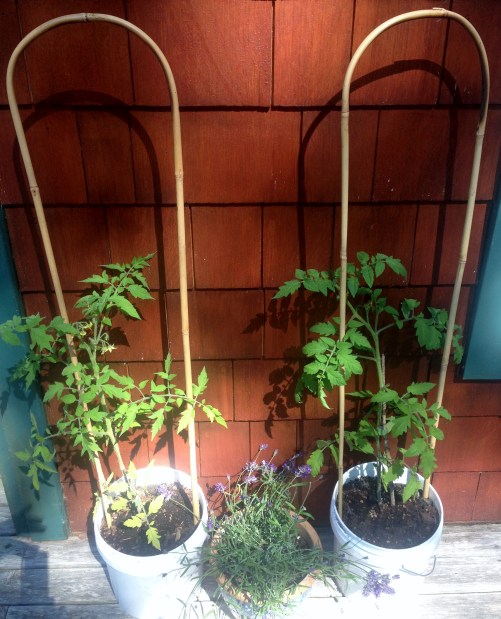
The tomatoes are movable, so we can shift them to sunny spots on the Nuthatch cabin’s deck. What’s retirement for, if not for pandering to your plants?

The next experiment is with tomatoes. Having grown up in Western Washington, the land of green tomato pickles (who actually likes those?), I’m dubious that we’ll get any to ripen. We don’t have a good spot that’s sunny all day (see previous mention of big trees), and because we’re surrounded by water it’s a rare day that we get as warm as 75 degrees, even at summer’s height. (Sounds like a good recipe for more of those damn pickles, if you ask me!) But a generous neighbor with a greenhouse offered us a couple of plants that were already tall and flowering. So we’ve planted them in buckets, with the idea that we can move them around to sunny spots as the sun moves across the sky.

Beyond that, we have a large planter divided between rocket (the Australian name for arugula, which gets kudos for zooming upward) and Swiss chard (limping along like a Swiss goatherd with bunions), plus a rail-mounted planter with cilantro (viva for its vigor), dill (doing well, maybe it can flavor those tomato pickles) and tiny little sprouts of oregano and basil (still about flea-size after a month of hopeful coaxing).

Oh, well, we’re retired. We have time to pander to our plants. Maybe we’ll pack their pots into the pickup and take them on a vacation to Yakima. cropped-1-anchor.jpg

There is no gardening without humility. Nature is constantly sending even its oldest scholars to the bottom of the class for some egregious blunder.

— Alfred Austin

Keeping fit on a small island (oh deer, oh deer)

IMG_2565.JPG
My island bike, with tires suited to gravel roads, at the base of our rocky knoll behind The Nuthatch.

IMG_7955FOR YEARS I RODE MY BIKE to work at The Seattle Times about nine months out of the year (during the less-rainy-and-dark season); a 14-mile round-trip that kept me from becoming too much of a fatty, though my personal physician (Dr. Bendova, we’ll call him) still wanted me to lose more weight. When I couldn’t ride, I worked out mornings at a Ballard gym.

Now I have no gym and I live on a 176-acre island. Riding 14 miles a day would involve many circuits of our rock, and I’m just not up for getting that dizzy. Besides which there’s a place appropriately called Cardiac Hill where the perimeter road suddenly decides to make like Everest’s South Col.

But I’m making an effort to take a morning ride every day or two, and I’ve worked out a circuit that roughly circles the island’s 1,600-foot grass airfield, with some pleasant detours into the woods and some up-and-down bits that add some fun as well as a workout. When I do my average 3 circuits, it’s about 2 miles of rapid riding, just enough to work up a sweat.

And while it is the same scenery repeated each lap, I’ve added a factor to add interest: I count deer.

Our island has a small population of black-tailed deer, just enough to ensure that nobody can grow a vegetable garden without putting up a deer fence. The deer also make sure to keep the swordferns, one of my favorite Northwest native plants, closely cropped (it’s like swordfish to them, I think).

Each day I come back from my ride and record on my Sierra Club calendar how many laps I rode and how many deer I saw along the way.

This, however, brings up a question of scientific protocol. Because I can’t tell the deer apart (maybe in a few more months I’ll distinguish Comet from Donder, but for now give me a break) I count every deer I see. And since I’m riding in circles, I freely admit that I might be — no, probably am — seeing the same deer more than once.

deer.jpg
Hello, deer: One of our island friends outside our kitchen window.

So while my daily deer record to date is “3 laps, 45 deer” on June 14, I’m sure the Gallup people would make noises about a sampling error. I may have been counting the same seven deer six times (once in each direction). Such are the perils of census taking. You never know if you’re getting the right number of blue-collar workers of Hungarian descent, or if the same family just keeps moving across town.

The good news is that despite my reduction in bike miles, I’m also not sitting idly at a computer five days a week. Because we live on the far side of the island from the boat dock, where I’ve been spending a lot of time tinkering on the WeLike, I’ve been walking a good bit. Even getting the mail is more than a half-mile trek. I’ve lost more than 5 pounds since we moved here in May. So ha, I say, Dr. Bendova.

My next goal is to do more cycling around Lopez Island, where I keep a bike stashed inside the canopy of our pickup truck parked at the public dock.

Then, instead of counting deer, maybe I’ll count how many drivers give me “the wave.” On Lopez, “the wave” usually involves just lifting a finger off the steering wheel as you pass someone. In summer, when the island can be mobbed by dayglo-spandex-clad two-wheelers from afar, who sometimes ride three abreast and cause significant delays on a Lopezian’s morning drive to Holly B’s Bakery, a cyclist must heed whether it’s the index finger that is lifted, making it “the wave,” or the middle finger that is lifted, which just makes it “the finger.”

Oh, dear. 1-anchor

Pssst! The government is sending me money (and the story of my clip job)

IMG_7955SHHH. DON’T TELL ANYONE, but I’ve finagled this deal where I don’t have to go to work anymore, and the government sends me cash.

I feel a bit like one of those North Dakota farmers getting paid to not plant soybeans.

Yes, my first Social Security payment showed up in our credit-union account today.  It’s kind of like magic. You don’t even have to watch the mailbox anymore.

Of course, I’m only 62, so “the check” is not as much as if I’d waited a few more years to my “official retirement age” of 66 and 4 months. And it would be even more if I had waited until I was 70 as they try to say you should. (Ha! Good luck convincing Baby Boomers that’s a good idea.) I’ve heard from many others in the Younger Geezer Set, of which I’m now a proud member, who say it’s worth retiring as early as you can because nobody wants to be that guy who retires at 72 and three days later blows a gasket, or slips all his discs, or steps in front of a bus. It happens.

IMG_2513
Feeling a bit sheepish, your humble correspondent gets shorn.

Another exciting step into the future: My dear wife cut my hair today. It’s sort of a double whammy iconic event, signifying that (A) we don’t live anywhere near a barber shop anymore, and (B) we’re on a budget, also known as the dreaded Fixed Income. (That Social Security payment was close to equaling the net pay I got from The Seattle Times twice a month. Only this will come only once a month. Hmm. Good thing we both have pensions as well.)

The haircut was accomplished outside on our deck so the hair wouldn’t get all over the floor like it does at Supercuts. Barbara had prepared by getting a book on how to cut hair, and she got some really sharp professional-style hair-cutting scissors. It was a big step up from a few decades ago when I tried cutting my own hair using a device advertised on TV that was essentially a razor blade inserted inside a comb. It didn’t so much cut your hair as pull it out by the roots. It was akin to trying to shave using one of those serrated metal cutting strips off a box of aluminum foil. (Come to think of it, my older sister gave me a “shave” — just like Dad! — using one of those serrated strips when I was about 5. You can still see the scar on my face if you peer hard enough.)

But Barbara does good work. And this way she gets to decide how long my hair should be. (She always thought I got it cut too short.) So far, I am resisting all suggestions of a man bun1-anchor

Trash talk

IMG_7955WHOOSH, ANOTHER WEEK HAS PASSED, and we’re settling comfortably into the mode of not knowing what day it is, and not really caring much.

It’s a sunny Sunday in paradise, the olive-sided flycatchers are incessantly calling for their “Quick Three Beers,” and I’ve retreated to the top of our rocky knoll to what was formerly daughter Lillian’s “Wendy House” (aka playhouse, a la the British allusion to “Peter Pan”). It has now become my writing studio — though I think “writing hut” is more like it. It came as a kit, designed as a cedar-sided potting shed, about 6 feet square plus a front porch. It’s a cozy place to write.

My topic for today is garbage.

How much garbage a society generates tells you a lot about that society, whether you’re looking at things from under an archaeologist’s pith helmet or wearing the backward baseball cap of a modern-day solid-waste wrangler (i.e., garbage man). How they dispose of that garbage — burn it? bury it? dump it in the sea and hope it washes up on someone else’s beach? — tells you a lot about a society as well.

Trash disposal is a challenge on our island. We could set our trash can — if we had one — out by the curb — if we had one — and it would sit there a long time. In fact, the trash would sit there until we finally decided to actually get rid of it, because ain’t nobody coming to haul it away in a big truck. Like all the best wilderness camping destinations, Center Island is strictly a “pack it in, pack it out” kind of place.

Our options are limited. When Barbara took the Paraclete water taxi to the mainland last week for her monthly checkup in Seattle, she took along two big totes of recycling and one of trash. I kind of left it up to her as to where she got rid of things. (Not along a roadside, I’ll say that much, but you won’t get any more details out of me, copper.)

Starting next week, we will take trash on our boat to Lopez Island, where there is a holistically managed, volunteer-run community transfer station and recycling center. The recycling disposal is free (if sorted and clean) and trash disposal costs $8 per 32-gallon can. (I’m thinking I might volunteer there myself, though I’ll be torn between the pith helmet and the backward cap.)

For residents of this island with no stores, one of our biggest boons when it comes to shopping is Amazon. For residents of this island with no waste disposal, one of our biggest curses is Amazon — and all the packaging, plastic bubble stuff and crumpled paper that comes with every order.

IMG_2484
Your correspondent with the boat brush, the giant box and the 50 feet of brown paper from Amazon.

Every shipment adds to our disposal problem, but the most outrageous example came last week when I got a boat brush from Amazon — a brush with a four-foot handle for scrubbing the WeLike’s decks. The day it was to arrive I stepped into our mail shack — and there was hardly room to move. The folks at the Amazon warehouse just didn’t have a long skinny box that day, so they popped the brush into a box that could have held a baby elephant, then stuffed this giant box with wadded paper in a vain attempt at keeping the brush from rattling around. We had to bring our handtruck to cart it home — not because it was heavy, just because it was unwieldy.

As I pulled out fold after fold of brown butcher paper, which had come from a roll more than 20 inches wide, I couldn’t resist grabbing a tape measure to see just how much paper they had used. It measured 50 feet long!

So far, that box and all that paper are crammed into our wood shed, where there is room only because I haven’t yet started chopping wood for next winter’s fires. Sooner or later I’m going to have to break down the box and cut it into smaller pieces and figure out a fate for it.

Meanwhile, write us nice letters (but send us no packages). Or come visit, friends. Bring trash bags when you come. 1-anchor